

If you know Krishnadasa Kaviraja Goswami mainly as an honoured name, the next step is not to collect more praise about him. It is to discover what kind of reader, practitioner, and transmitter his memory asks you to become.
A commemoration of his disappearance gives you a natural occasion to do that. In Vaishnava devotional usage, disappearance is not treated merely as the date on which a historical personality ceased to be physically present. It is a day for examining whether the acharya’s service remains active in the lives of those who inherit it.
What Krishnadasa Kaviraja Goswami preserved

Krishnadasa Kaviraja Goswami’s enduring service is most clearly encountered in the Caitanya-caritamrta. His defining work preserves the life and teachings of Sri Caitanya Mahaprabhu while bringing biography, theology, devotional memory, and guidance for conduct into one coherent spiritual vision.
That combination matters. A biography can tell you what happened without telling you how to live. A philosophical treatise can define truth without showing what devotion looks like in a human relationship. A collection of devotional episodes can move the heart without giving the mind a stable framework. Krishnadasa Kaviraja holds these dimensions together.
His legacy therefore cannot be reduced to preserving information about the past. He preserved a way of seeing: spiritual truth is received through lineage, tested through scripture and reasoning, embodied through service, and protected by humility. Knowledge and character are not competing qualifications. Each guards the other.
This is also why acintya-bheda-abheda, the Gaudiya understanding of inconceivable simultaneous oneness and difference, should not be treated as an isolated slogan. It trains the reader to resist crude either-or thinking. Unity need not erase distinction, and distinction need not imply absolute separation. When you encounter this teaching, pause over the relationships it illuminates: the Divine and the living being, the teacher and the disciple, received tradition and personal realization.
Read for formation, not devotional consumption

You can read a revered work repeatedly and still keep it at a safe distance. Familiar stories, memorable sayings, and elevated language can become objects of consumption. You feel inspired for a while, but nothing in your speech, attention, or service changes.
A better reading practice is to stay with one coherent passage and ask four questions in order:
- What truth is being affirmed? State it plainly, without immediately turning it into a metaphor about your own life.
- Whose authority carries the teaching? Notice whether the passage rests on scripture, guru, realized devotees, reasoned explanation, or a combination of them.
- What disposition does it commend or correct? Look for humility, attentiveness, service, patience, surrender, pride, rivalry, carelessness, or some other quality expressed through conduct.
- What should change before you read further? Choose one concrete correction: verify a quotation before sharing it, listen without planning your reply, complete an unnoticed service, or stop presenting an inference as settled doctrine.
The order is important. If you jump directly to personal application, you can make the passage say whatever suits your present concern. First understand the claim on its own terms. Then ask how it judges your habits.
Do not measure a reading session by pages completed. Measure it by whether you can identify the teaching, explain why it matters, and name the conduct it requires. A short passage understood and practised is more faithful to this literary legacy than a large quantity read for completion alone.
His humility teaches us how to handle authority
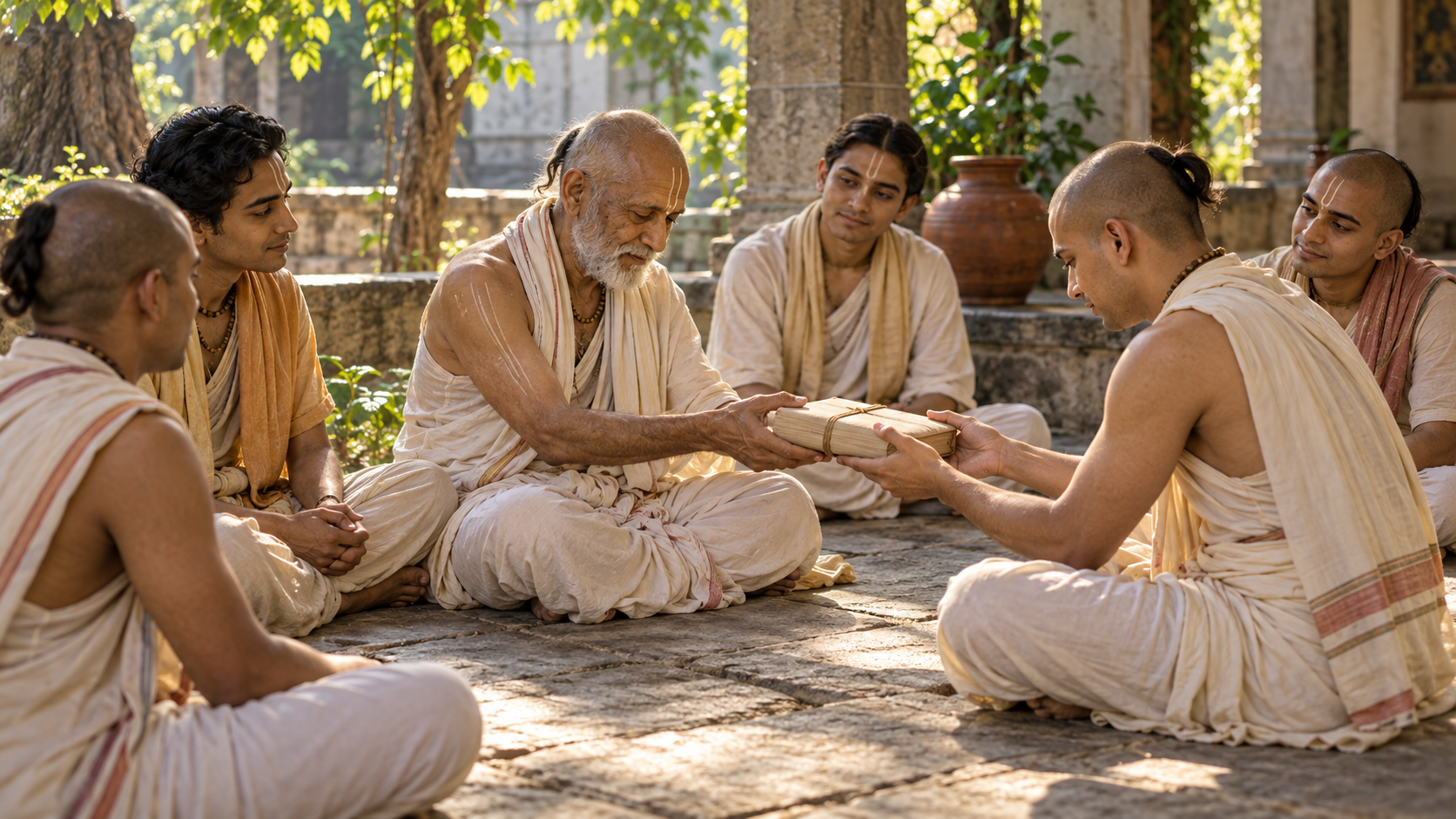
Krishnadasa Kaviraja’s authorial humility is among the clearest lessons carried by his work. It should not be mistaken for theatrical self-denigration or a denial of responsibility. His humility locates authority correctly. The writer serves what has been received; he does not make himself the centre of the truth he transmits.
That distinction is especially useful now. A person can repeat traditional vocabulary while quietly turning every discussion toward personal status. Another can speak modestly yet handle quotations carelessly. Neither habit protects a living tradition. Humility has to become visible as accuracy, gratitude, restraint, and willingness to be corrected.
When you teach, write, speak at a gathering, or share a devotional claim online, keep four layers distinct:
- Quotation: the actual words should be checked before quotation marks are used.
- Paraphrase: the meaning is restated in your words and should be identified as such.
- Traditional explanation: the interpretation belongs to a lineage or teacher and should not be presented as your discovery.
- Personal application: your conclusion may be useful, but it should not be given the same status as the text itself.
This simple separation prevents two common failures. The first is museum-like preservation: teachings are displayed respectfully but never allowed to challenge present conduct. The second is uncontrolled improvisation: inherited teachings become raw material for whatever the speaker already wanted to say.
Faithful transmission stands between those failures. It preserves meaning carefully while allowing that meaning to produce fresh action. Before passing on a teaching, identify the exact claim, retain an important technical term when translation would flatten it, include the context needed to prevent distortion, and say openly where interpretation begins.
Key takeaways
- Krishnadasa Kaviraja Goswami’s legacy joins spiritual biography, theological clarity, devotional character, and practical guidance.
- Read a passage first for its own claim, then for the conduct it asks you to change.
- Humility in transmission means accuracy, acknowledged dependence, restraint, and openness to correction.
- Keep quotation, paraphrase, traditional explanation, and personal application visibly distinct.
- A disappearance observance becomes meaningful when remembrance produces a specific act of study, service, or repair.
Turn a disappearance observance into living service

You do not need an elaborate programme to honour Krishnadasa Kaviraja Goswami. You need an observance ordered toward attention and change. Use the following sequence privately, with your family, or in a community gathering:
- Begin with remembrance. Offer pranama and state why you are approaching his legacy: not merely to admire an acharya, but to become more responsible toward what he preserved.
- Read or hear one complete unit. Choose a coherent passage or teaching rather than a collection of disconnected quotations. Context is part of meaning.
- Name its centre. Write one sentence identifying the theological or devotional truth at stake. If you cannot state it simply, return to the passage before trying to teach it.
- Notice the demanded quality. Ask what kind of person can receive and embody this teaching. The answer may expose impatience, vanity, inattentiveness, sectarian competitiveness, or casual treatment of sacred words.
- Choose one act of service or repair. Correct something you have misquoted, finish a neglected responsibility, seek clarification from a qualified teacher, reconcile with another practitioner, or establish a regular practice of careful reading.
- Transmit only what you have understood. When you share the teaching, separate its words from your explanation and your explanation from your personal application.
Do not let the observance end when the gathering ends. Open a reliable edition of the Caitanya-caritamrta, mark one passage that requires more than admiration, and keep it before you until it alters one visible habit. That is how inherited wisdom remains a living presence rather than a ceremonial memory.
References

Leave a Reply
You must be logged in to post a comment.