
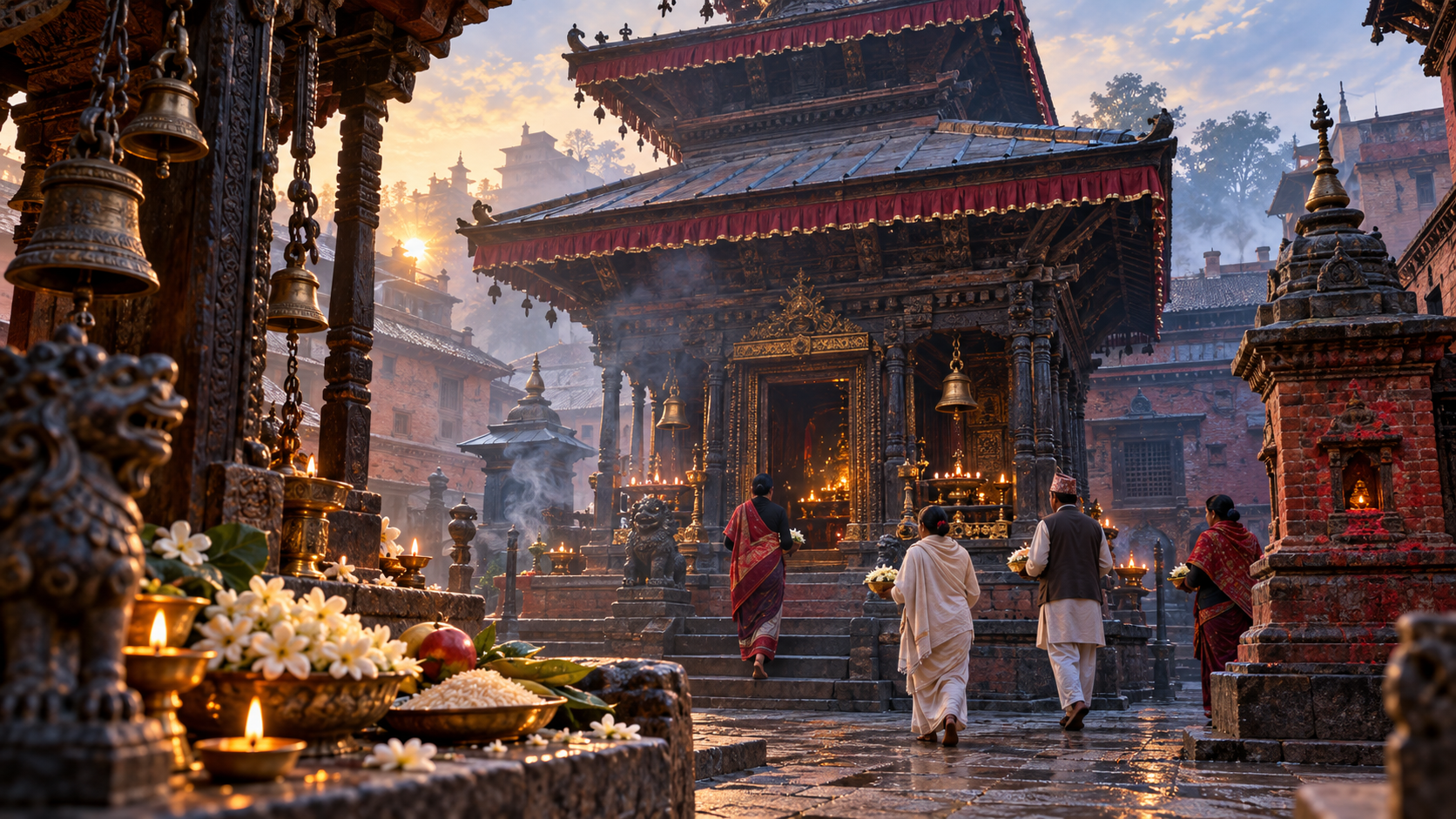
If you have heard of Kathmandu’s White Kali and are wondering how Kali can be both white and fierce, begin with the name Naradevi. This is not a contradiction to solve. It is a local form of the Mother to encounter on its own terms.
Three names will orient you: Naradevi, Sweta Kali, and Nyata Ajima. Keep them together and the tradition becomes clearer. Separate them, and it is easy to reduce a living Kathmandu deity to a colour, a generic image of Kali, or an unfamiliar temple name.
Three names identify one sacred presence
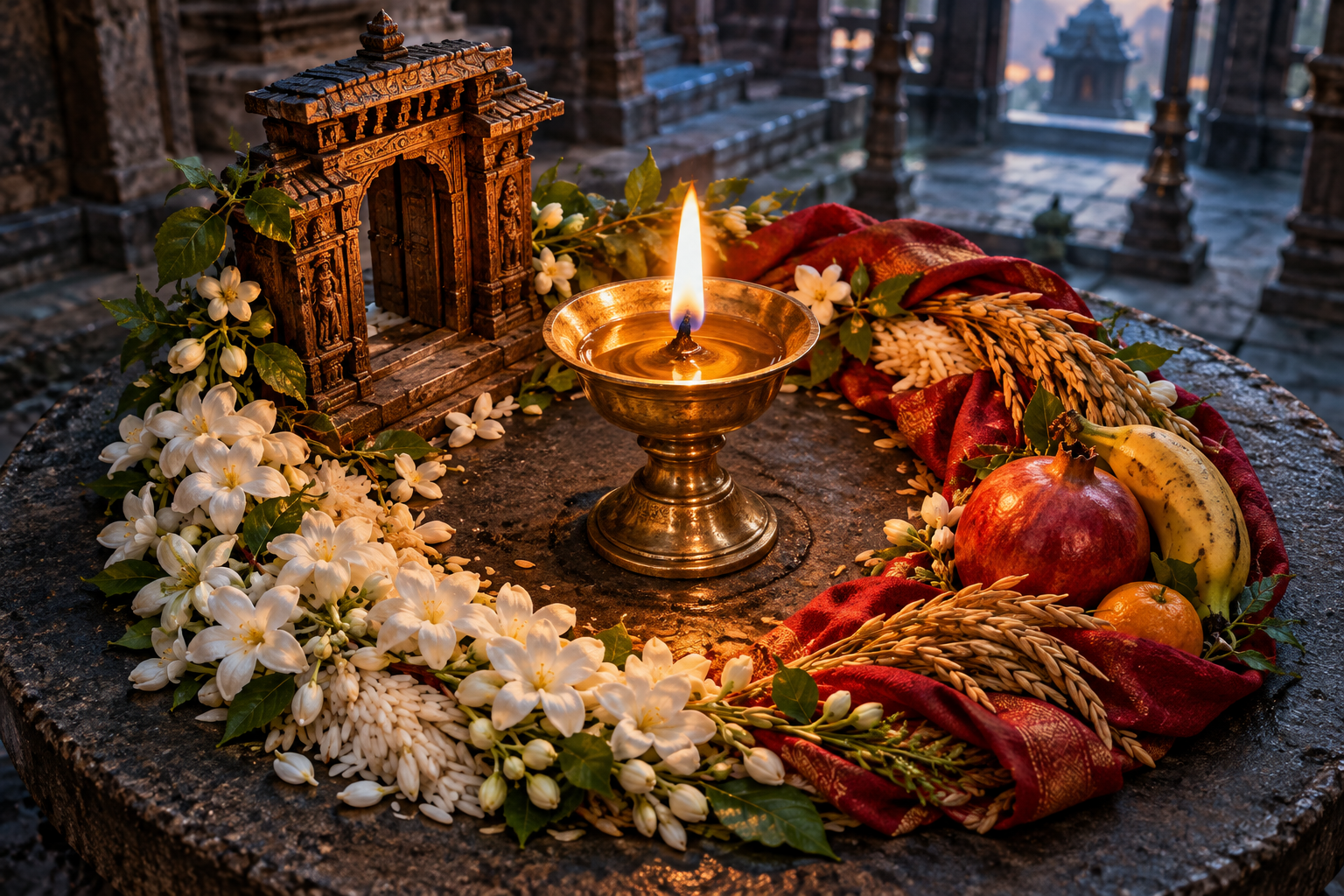
Naradevi points you toward the temple and the locality associated with it. Sweta Kali identifies the deity as White Kali. Nyata Ajima is the local name by which the same Mother is known. Each name supplies a different kind of information, so none should be discarded in favour of the one that sounds most familiar.
- Naradevi is the most practical name when identifying the shrine or asking where it is.
- Sweta Kali places the deity within the broader Hindu language of Kali while preserving her distinctive white identity.
- Nyata Ajima keeps the local Kathmandu identity in view. It reminds you that the deity belongs to a particular community of worship, not merely to an abstract category assembled from books or images.
This naming pattern gives you a useful rule for approaching regional Hindu traditions: start with the local name, then use the pan-Hindu comparison. Reversing that order often causes the local deity to disappear behind a more famous form.
If you encounter a spelling or pronunciation you do not recognise, do not manufacture an etymology from similar-sounding Sanskrit words. Retain the name as you received it and ask a temple attendant or knowledgeable local worshipper how it is pronounced and understood. That small discipline prevents a surprising amount of misinformation.
Why White Kali is still a fierce Mother
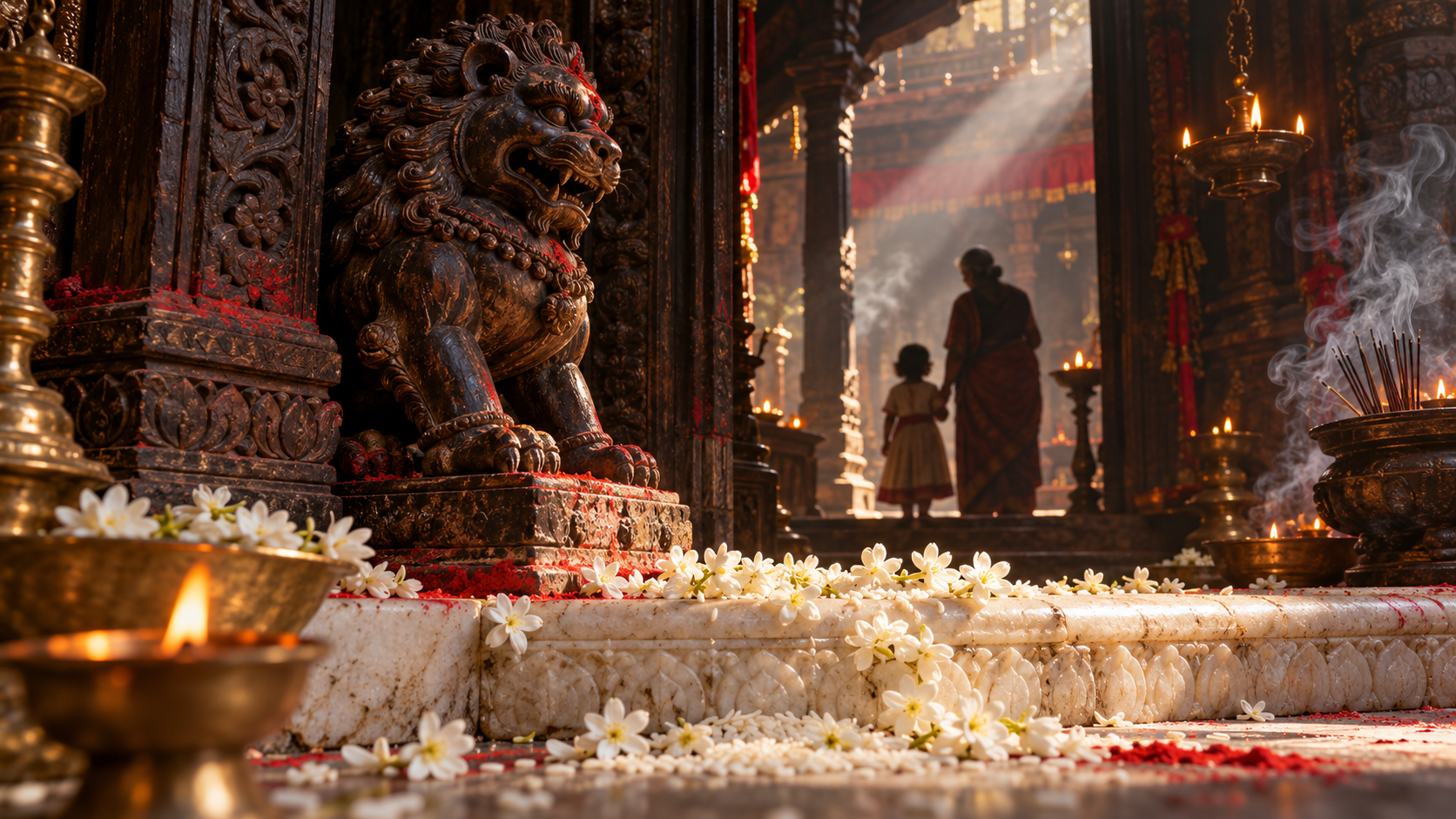
The most common interpretive mistake is to treat white and fierce as opposites. In the Naradevi tradition, they are not. Sweta Kali is remembered as a fierce Mother associated with the granting of life. Her whiteness does not cancel her power, and her fierceness does not make her hostile to devotees.
Fierce divine forms are better understood through relationship than appearance. A mother who protects life may need the force to confront whatever threatens it. The terrifying and the compassionate can therefore belong to the same sacred personality. Fierceness describes the Mother’s capacity to defend, restrain, and overcome; it need not mean cruelty.
The word Sweta means white, but a colour-name should not be treated as a complete theological explanation. Nor should you assume that White Kali is simply a familiar Kali image with its colour reversed. The useful question is not, “Why is she different from the Kali I already know?” It is, “What does this form reveal about the Mother’s work here?” Naradevi answers through a pairing: formidable protection and life-giving grace.
This distinction matters beyond one temple. Hindu sacred forms are connected without being interchangeable. Shared names allow recognition across regions; local names, iconography, and worship preserve the form through which a community actually knows the divine. You can acknowledge the wider Kali tradition without flattening Nyata Ajima into a generic version of it.
The temple’s scale can mislead an unprepared visitor
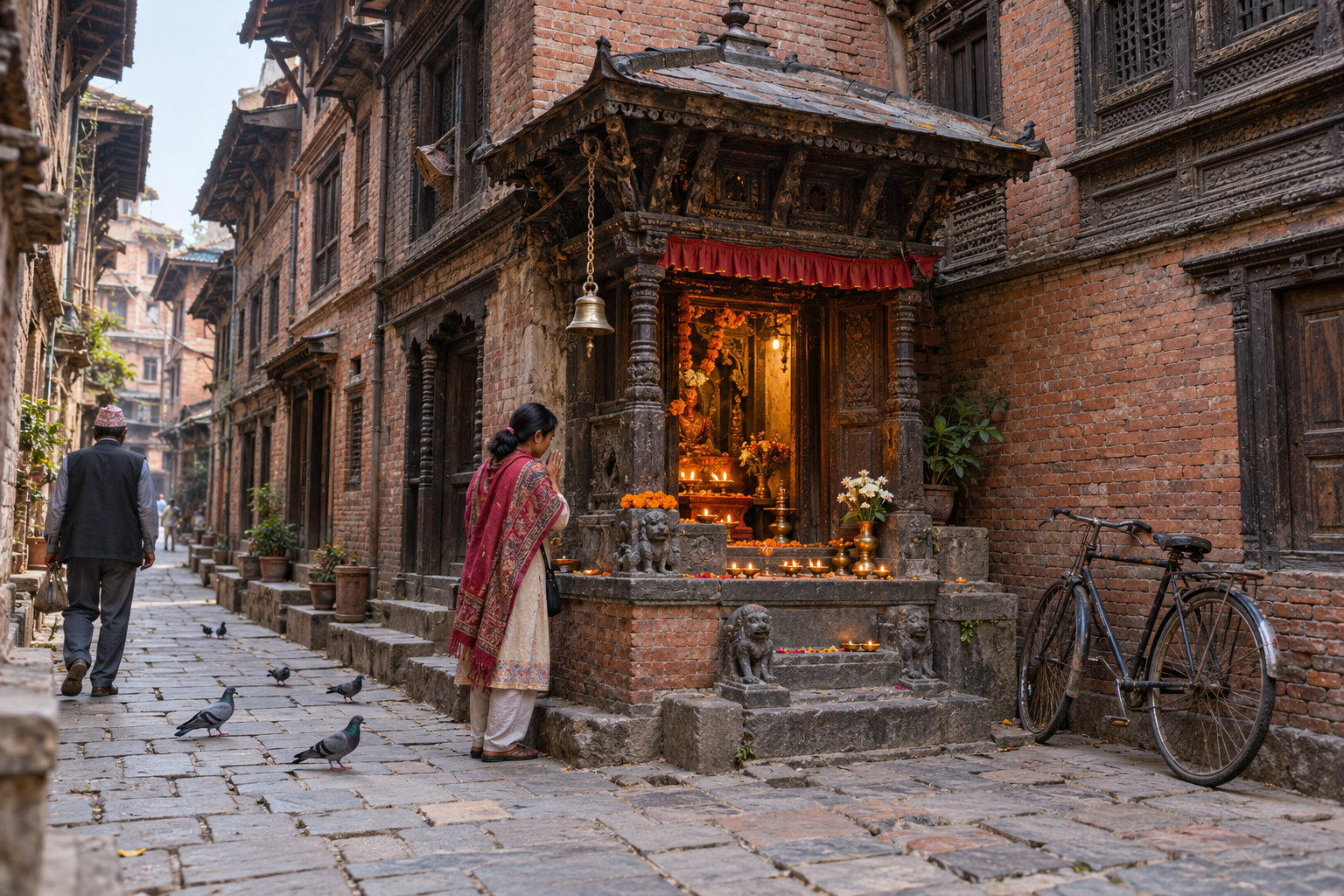
Naradevi Temple stands in the dense urban fabric between Chhetrapati and Basantapur. Its three-tiered pagoda is modest in physical scale, even though the deity carries much greater spiritual weight as a guardian of Kathmandu’s heart.
Do not look for monumentality as proof of importance. A compact shrine embedded in a busy neighbourhood may be more closely joined to daily religious life than a large complex set apart from the street. At Naradevi, the surrounding lanes are not irrelevant scenery. They are part of the setting in which worship, movement, commerce, sound, and ordinary life meet.
This changes how you should look for the temple. If you expect a vast forecourt or an isolated landmark, you may pass the place while searching for something grander. Use Chhetrapati and Basantapur as your broad bearings, keep both Naradevi and Nyata Ajima available when asking directions, and pay attention to the smaller religious architecture of the lane.
Once you arrive, pause before trying to catalogue everything. Notice the pagoda structure, the threshold, the flow of worshippers, and the relationship between the shrine and the street. These observations tell you something important: Naradevi’s guardianship is imagined at the centre of lived Kathmandu, not at a safe distance from it.
A respectful way to approach Naradevi
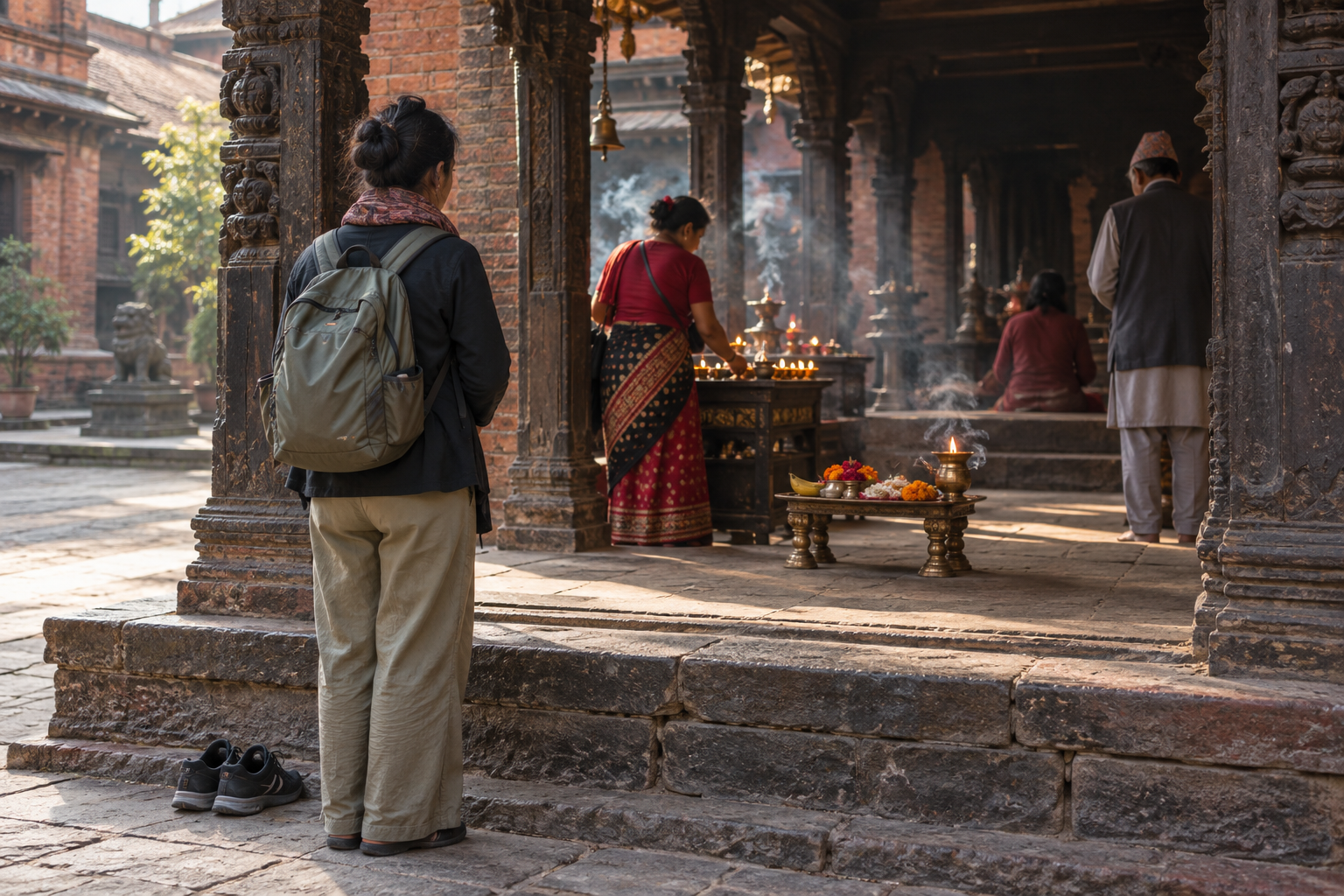
You do not need to arrive with an elaborate ritual prepared. You do need to recognise that this is a functioning sacred place rather than an exhibit. Local practice always takes priority over a visitor’s assumptions about how a Kali temple ought to operate.
- Carry the relevant names. Ask for Naradevi Temple, and retain Sweta Kali and Nyata Ajima when discussing the deity. This shows more care than referring only to “the White Kali place.”
- Pause at the edge. Before entering or approaching the principal sacred area, observe where footwear is left, how people move, and whether any space appears restricted.
- Follow visible local practice. Do not copy a gesture whose meaning you do not understand, but do take cues about where to stand, when to wait, and how to avoid interrupting worship.
- Ask before photographing. Permission to photograph a building does not automatically include the deity, ritual activity, priests, or worshippers. If the expectation is unclear, keep the camera away.
- Do not improvise an offering. If you wish to make one, ask what is appropriate at that shrine. A practice remembered from another Kali temple may not belong here.
- Keep your prayer simple. You can offer a respectful namaskar and address the deity as Mother. Sincerity does not require pretending to know a local rite.
- Leave room for worshippers. Narrow urban temples demand spatial awareness. Do not occupy a threshold, block a line, or turn a devotional moment into a prolonged photo opportunity.
If you want to learn more, ask a narrow question rather than requesting a complete explanation on the spot. “Why is the Mother called Sweta Kali here?” or “Is Nyata Ajima the name people commonly use?” gives a knowledgeable person something precise to answer. It also leaves room for local explanations that may not fit the categories you brought with you.
Key takeaways
- Naradevi, Sweta Kali, and Nyata Ajima are three names you should hold together when identifying the shrine and its deity.
- White does not mean that this Kali is passive or stripped of fierceness; the tradition joins protective force with the granting of life.
- The temple is a modest three-tiered pagoda between Chhetrapati and Basantapur, so spiritual importance should not be judged by architectural scale.
- Begin interpretation with the local identity and then make broader Hindu comparisons, not the other way around.
- When visiting, observe before acting, ask before photographing or offering, and allow the shrine’s living practice to set the terms.
When you next encounter Naradevi, resist the urge to solve White Kali as an odd variation. Carry the three names, look closely at the temple’s place within the city, and let Nyata Ajima be encountered first as Kathmandu knows her: a fierce, life-giving Mother guarding its heart.
References

Leave a Reply
You must be logged in to post a comment.