

You open the calendar to plan Vishnu’s awakening observance and find several nearby names: Uthwana Ekadashi, Ksheerabdi or Uthwana Dwadashi, Tulasi Habba, Kartika Pournami and Vaikuntha Chaturdashi. The dates look as though they compete. They do not need to.
The practical task is to identify the observance followed by your family, temple or sampradaya, confirm its local tithi, and give that day a clear devotional purpose. This guide will help you do that without turning a living regional tradition into an artificial one-size-fits-all ritual.
Why Vishnu’s awakening appears on more than one day

Kartika observance is better understood as a sacred sequence than as a single isolated date. Maha Vishnu’s awakening from cosmic repose provides the unifying meaning, while different communities mark that meaning through related vows and acts of worship on nearby tithis.
In Karnataka, Tulasi Habba is associated with Ksheerabdi Dwadashi during Kartika. The same observance may be kept elsewhere on Uthwana Ekadashi or Kartika Pournami. Uthwana Dwadashi itself is remembered as the occasion of Maha Vishnu’s awakening. This variation is not a reason to declare one household correct and another mistaken. It is a reason to ask which calendar tradition your household actually follows.
Vaikuntha Chaturdashi belongs to the same Kartika setting but has a distinct place in the sequence. It falls on Shukla Paksha Chaturdashi of Kartika, and its upvaas is generally observed on the preceding day. Do not silently move the fast to Chaturdashi merely because the festival bears that name.
Three distinctions prevent most calendar confusion:
- The divine event: Vishnu’s awakening supplies the spiritual centre.
- The regional celebration: Tulasi Habba or Tulasi Puja expresses that centre through a local Kartika tradition.
- The vrata date: Vaikuntha Chaturdashi Upvaas is kept before the Chaturdashi festival rather than automatically on the festival day.
If two calendars differ, first check whether one is listing a fast and the other a festival. Then check whether one follows Ekadashi, Dwadashi or Pournami for Tulasi Puja. A difference in labels may reflect a difference in observance, not an error.
Put the 2026 dates into a workable order
For 2026, the available dates form a short sequence. Use them as planning anchors, but confirm the operative tithi for your location through the panchanga used by your family or temple.
| Civil date in 2026 | Observance | What you should decide |
|---|---|---|
| November 21 | Tulasi Habba on Ksheerabdi Dwadashi | Whether this is your household’s principal Tulasi Puja and Vishnu-awakening observance |
| November 22, Sunday | Vaikuntha Chaturdashi Upvaas | Whether you are undertaking the preceding-day vrata and what form of fasting is customary and safe for you |
| Nearby Kartika tithis | Tulasi Puja may instead be associated locally with Uthwana Ekadashi or Kartika Pournami | Which regional or sampradaya calendar governs your worship |
Tulasi Habba falls on November 21 in 2026, while the Vaikuntha Chaturdashi Upvaas is dated November 22. Those facts are compatible: they refer to distinct but adjacent observances.
Do not plan from the civil date alone. A Hindu festival is governed by tithi, and the applicable timing can depend on location and the rule used for selecting the observance day. The sound approach is simple: use the 2026 dates to reserve your time, then use one trusted local panchanga to settle the worship period. Mixing the date from one calendar with the time from another can create confusion that neither calendar intended.
Build a coherent home observance without inventing a new ritual
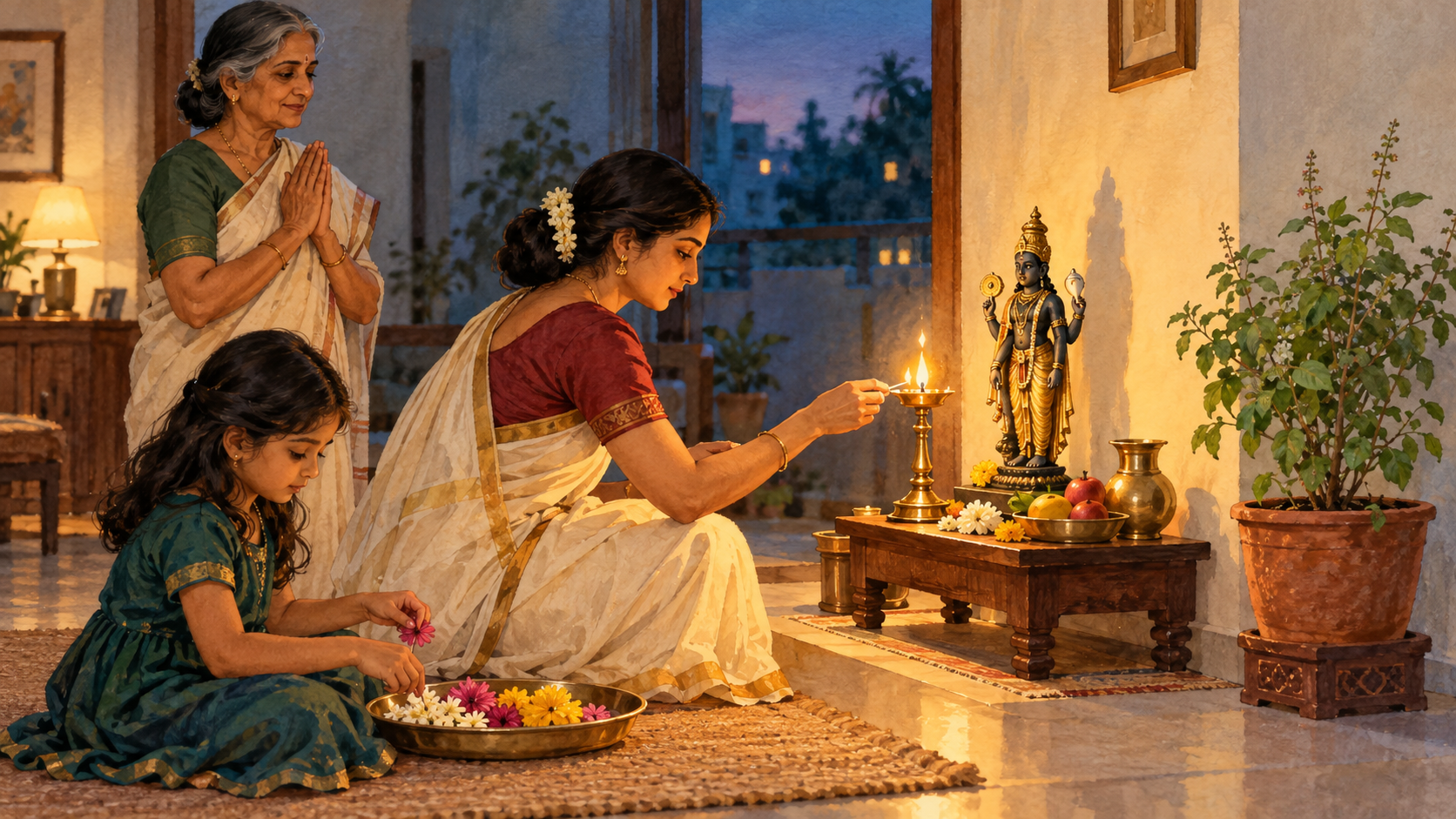
You do not need to combine every Kartika custom into one elaborate programme. A smaller observance rooted in your inherited practice is more coherent than a large collection of unrelated instructions gathered from several calendars.
- Identify the tradition you are responsible for keeping. Ask whether your family observes Tulasi Puja on Ekadashi, Dwadashi or Pournami, and whether it keeps the Vaikuntha Chaturdashi fast. Record the answer instead of reopening the question every year.
- Choose one calendar authority. Use the panchanga followed by your family, temple or sampradaya for the final tithi and worship period. If you are away from home, make sure it is calculated for your present location.
- Prepare the place of worship beforehand. Clean the Tulasi area and Vishnu shrine, and arrange only the offerings ordinarily used in your household. If a lamp is part of your practice, place it where it can be attended safely.
- State a clear sankalpa. Name the observance you are keeping rather than vaguely treating the entire cluster as one festival. Your intention might centre on Tulasi Puja for Uthwana Dwadashi or on the upvaas preceding Vaikuntha Chaturdashi.
- Keep worship recognisable. Offer the prayer, nama-japa, stotra or aarti already known in your tradition. If you have not received a specialised procedure, a sincere and simple Vishnu remembrance is preferable to presenting an improvised sequence as scriptural obligation.
- Decide the fast before the day begins. Establish what your tradition means by upvaas and what you can safely undertake. A vrata is not a competition in deprivation. If restricting food or water could affect your health or prescribed treatment, seek appropriate medical advice and ask a trusted religious guide about a suitable devotional alternative.
This order protects two things at once: continuity and attention. Continuity keeps you connected to a real community of practice. Attention prevents the observance from becoming a hurried performance assembled at the last moment.
Let the image of awakening reach beyond the calendar

Vishnu’s awakening is not merely a label attached to Dwadashi. For a devotee, it presents a question: what in your own dharmic life has remained dormant while you continued to call it important?
Choose one answer that can be acted upon. Resume a daily prayer you have neglected. Complete a duty you have repeatedly postponed. Restore care for the Tulasi plant or shrine already entrusted to you. Reopen a text you intended to study. These are applications of the awakening theme, not substitutes for the traditional puja and not mandatory Kartika rites.
Keep the commitment proportionate. A daily act you can sustain carries more meaning than an ambitious vow abandoned after the festival. If you select nama-japa, fix a realistic time and place. If you select study, decide which text is already available and when you will read it. If you select seva, name the person, temple or community responsibility involved. Specificity turns devotional sentiment into dharmic conduct.
Tulasi offers the same lesson in visible form. Worship is directed through a living presence that must also be tended after the appointed day. The morning after the celebration therefore matters. Clear the worship area respectfully, attend to the plant, and continue the one discipline you chose. The festival has done its work when remembrance becomes steadier rather than merely busier.
Key takeaways
- Vishnu’s awakening is marked through a cluster of related Kartika observances, not necessarily one universal civil date.
- Tulasi Habba is associated with Ksheerabdi Dwadashi in Karnataka, while some communities keep Tulasi Puja on Uthwana Ekadashi or Kartika Pournami.
- In 2026, Tulasi Habba is dated November 21 and Vaikuntha Chaturdashi Upvaas is dated November 22.
- The Vaikuntha Chaturdashi fast is ordinarily kept on the day before the festival, so distinguish the vrata date from the named festival.
- Follow one local panchanga and the custom of your family, temple or sampradaya rather than combining incompatible timings.
- Give the observance a durable result by reviving one neglected prayer, duty, study practice or act of seva.
Begin by making one call or sending one message to the elder, priest or temple whose calendar you follow. Confirm whether your 2026 observance centres on Ekadashi, Dwadashi, the preceding-day upvaas or Pournami. Once that is settled, prepare simply and let Vishnu’s awakening call one part of your own dharmic life back into motion.
References
- Hindu Pad — Vaikunth Chaturdasi Upvaas 2026
- Hindu Pad — Tulasi Habba | Tulasi Puja on Uthwana Dwadashi in Karnataka

Leave a Reply
You must be logged in to post a comment.