
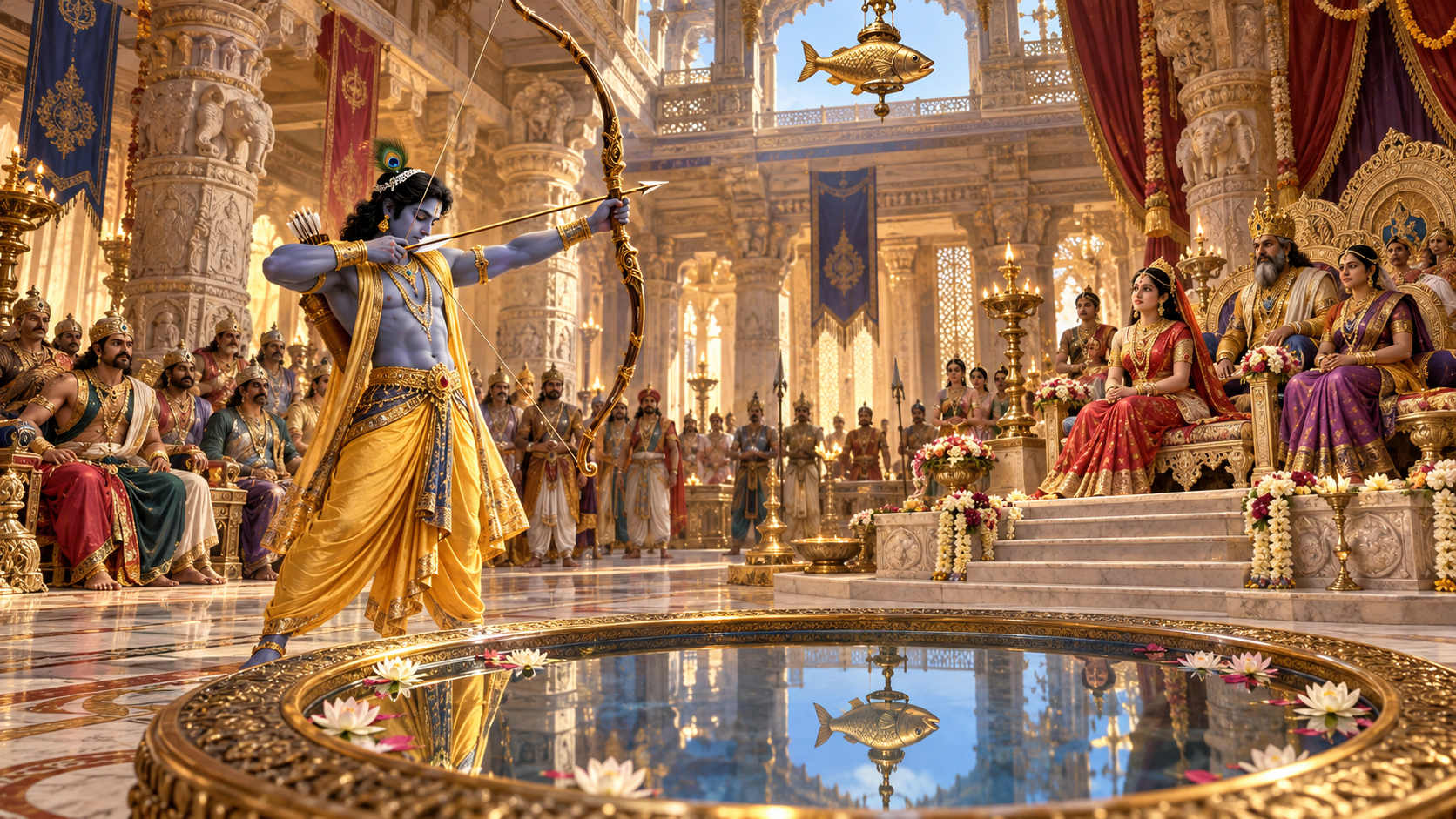
If the name Lakshmana makes you think of Rama’s brother, pause there. The Lakshmana in this story is a princess of Madra and one of Krishna’s eight chief queens. Her swayamvara is remembered for an exacting test in which Krishna had to direct his attention toward a fish through its reflection.
The episode becomes much easier to understand when you keep three questions separate: Who is this Lakshmana? What did Krishna actually have to do? What spiritual meaning may we draw from the reflection without pretending that our interpretation is part of the narrated event?
First, identify the right Lakshmana
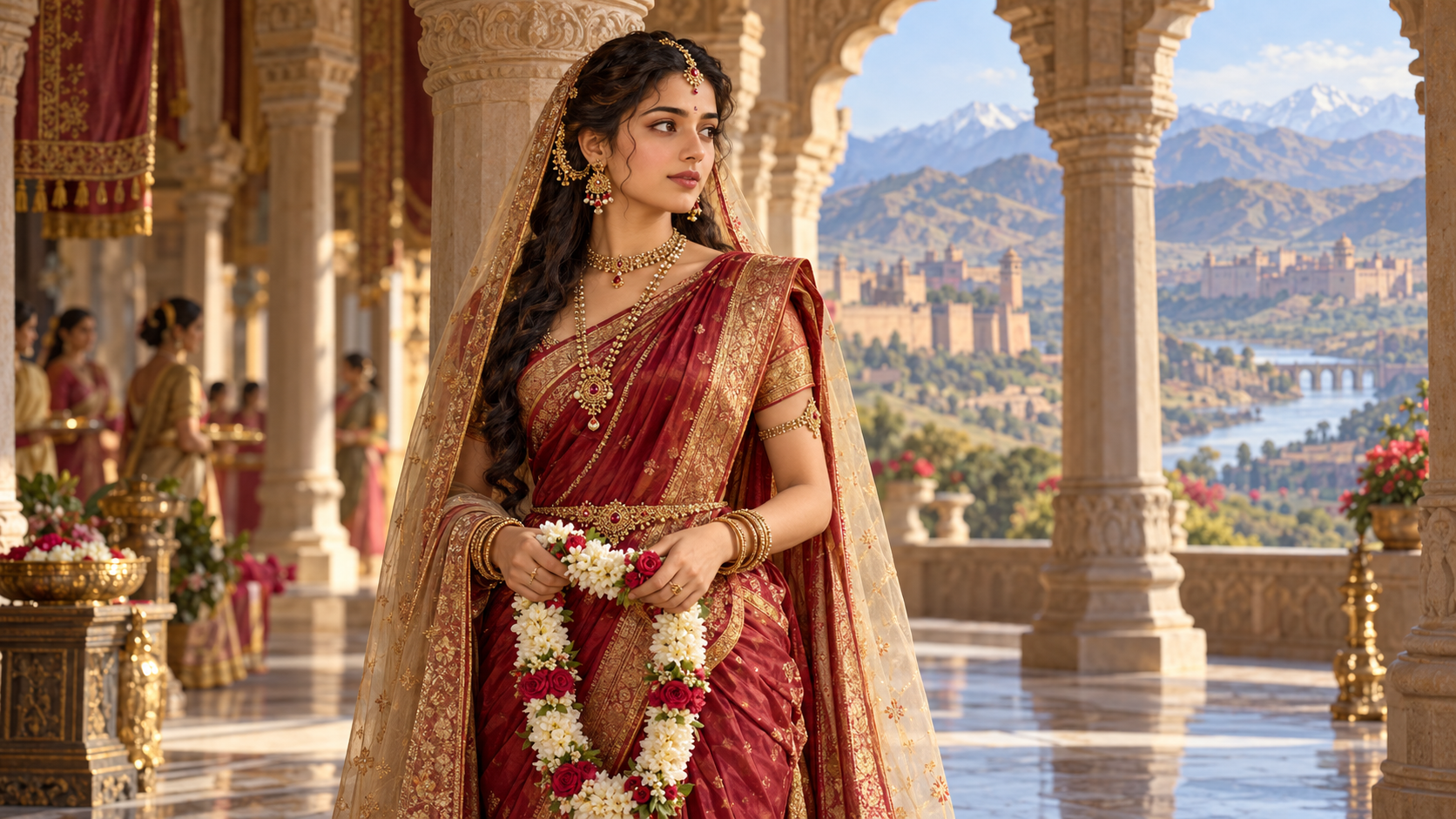
This Lakshmana belongs to Krishna’s marriage narratives. She is one of the Ashtabharya, the eight chief queens of Krishna. She is not Lakshmana, the devoted younger brother who accompanies Rama in the Ramayana.
The confusion is partly created by English transliteration. The masculine name may be rendered as Lakshmana, while the princess’s feminine name is more precisely rendered as Lakshmana with a long final vowel, or Lakshmanaa when the diacritic is unavailable. Many English retellings print both forms simply as “Lakshmana.” Context therefore matters more than the spelling you happen to see.
Use two identifiers when explaining the story: call her the princess of Madra and one of Krishna’s chief queens. Those details immediately place her in the correct narrative world.
There is also a small but important difference in how her father is identified. His name is King Brihatsena in the Padma Purana tradition, while the Bhagavata Purana refers to him simply as the ruler of Madra. If you are recounting the shared core of the story, “the king of Madra” is sufficient. If you use the name Brihatsena, identify the textual tradition rather than implying that every account supplies the same detail.
What happened at Lakshmana’s swayamvara
A swayamvara was a formal setting in which a royal marriage could be decided through publicly declared conditions. The term evokes a bride’s choice, but it should not be reduced to the modern image of a woman informally choosing anyone present. In this episode, Lakshmana’s father announces a demanding trial whose successful completion determines the marriage.
- The ruler of Madra arranges a swayamvara for his daughter Lakshmana.
- A fish serves as the target in an unusually difficult test.
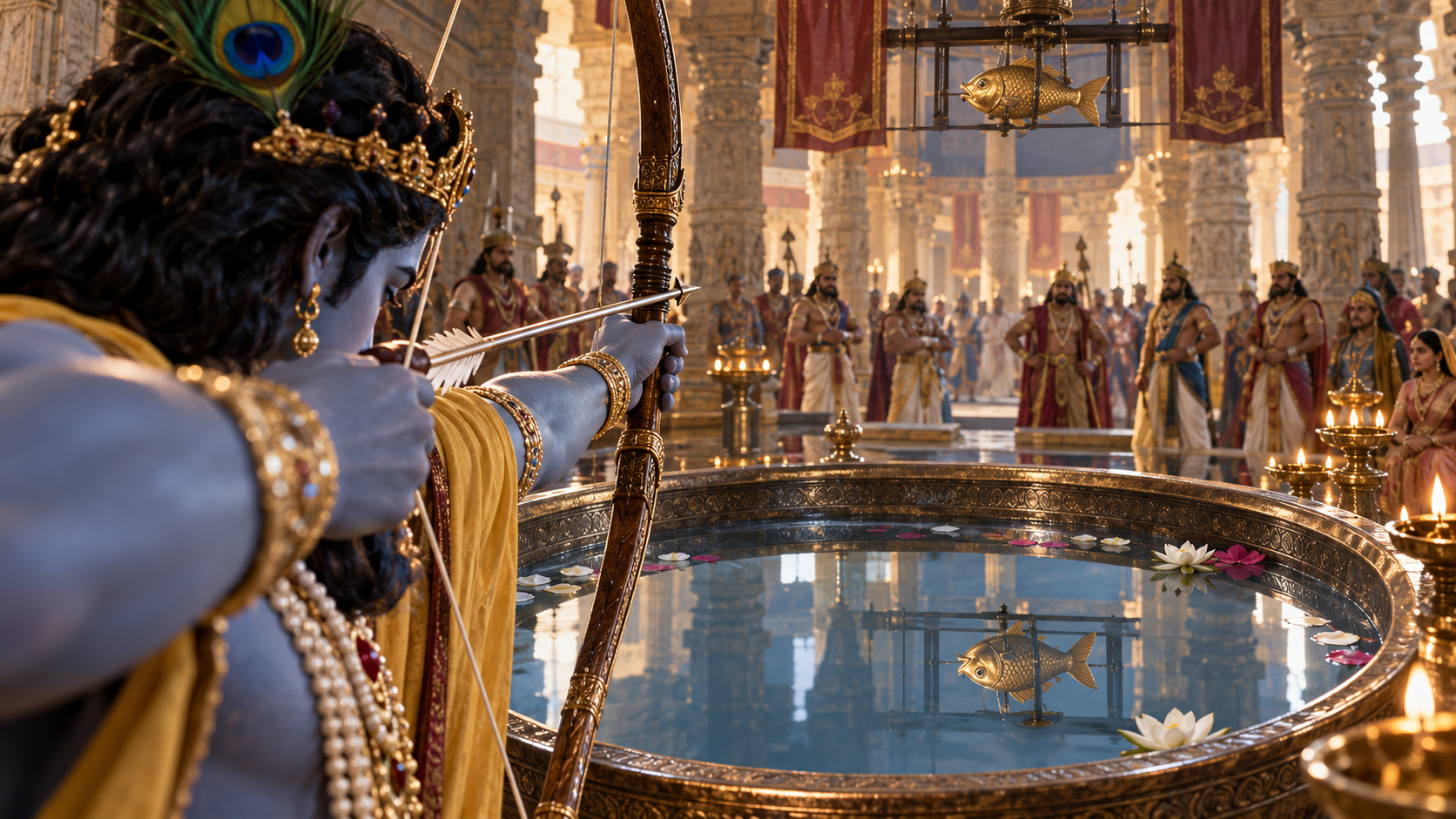
- The competitor must rely on the fish’s reflection rather than ordinary direct sight.
- Krishna masters the test and wins Lakshmana’s hand in marriage.
The reflection is not decorative scenery. It is the condition that gives the contest its distinctive character. Hitting a plainly visible target would demonstrate strength and ordinary accuracy. Acting through a reflected image also tests whether the archer can control attention, interpret an indirect visual cue and execute the movement without being confused by the separation between appearance and object.
Keep the account this precise when teaching it. Details remembered from another famous fish-target swayamvara should not automatically be inserted here. Unless you are working from a particular text, do not add an elaborate mechanism, a list of unsuccessful competitors or an exact description of the target’s motion. The essential sequence is already complete: royal swayamvara, fish target, reflected view, Krishna’s success and marriage to Lakshmana.
Why the reflection matters

At the narrative level, the reflection makes the physical challenge harder. At the contemplative level, it offers a useful image of disciplined perception. Those two levels should be distinguished. The first belongs to the event being narrated; the second is a spiritual reading we bring to it.
- Attention must remain fixed on the real objective. The archer receives information through an image but must act upon the actual target.
- Power without composure is insufficient. Greater force does not correct a mistake produced by disordered perception.
- Indirect knowledge need not be false knowledge. A reflection is not the fish, yet it can guide correct action when it is read accurately.
- Discernment connects perception to action. Success depends on understanding the relationship between what is seen and what must be done.
This makes the episode especially useful when thinking about viveka, or discernment. Much of life reaches you indirectly: through another person’s words, an outward sign, a memory, a report or the consequences of an earlier decision. The lesson is not that every appearance is deceptive. It is that appearances must be interpreted in relation to the truth they indicate.
You can turn that insight into a simple practice. When a decision feels confusing, name the target first: What outcome is actually dharmic and necessary? Then name the reflection: What evidence or outward sign are you using to judge the situation? Finally, ask whether you understand the relationship between the two. This does not turn Krishna’s marriage story into a modern decision-making manual. It lets the image discipline your attention without claiming more for it than the narrative supports.
How to keep Lakshmana present in her own story
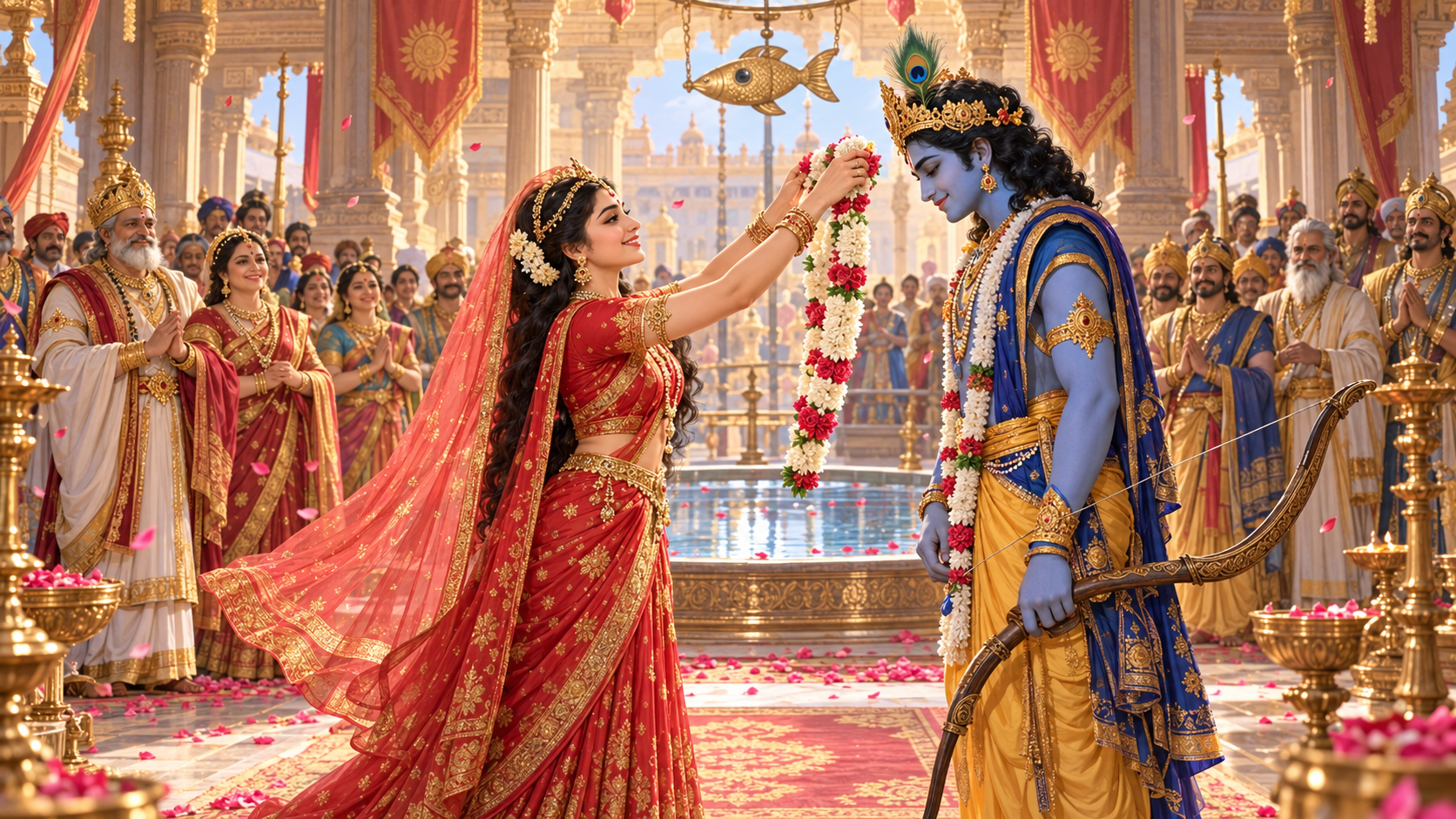
A retelling can become so absorbed in Krishna’s feat that Lakshmana almost vanishes. That is a mistake. The feat matters because it occurs within her swayamvara and leads to her marriage. Without Lakshmana, the archery trial becomes a detached display of skill rather than part of a relationship and a royal marriage tradition.
At the same time, a swayamvara should neither be romanticised as identical to unrestricted modern courtship nor dismissed as if the bride were merely a prize. This episode combines several elements: a daughter whose marriage is at issue, a father who establishes the public contest, a standard that tests prospective grooms and Krishna’s successful completion of that standard. Reading all of those elements together is more faithful than forcing the event into a single modern category.
If you are telling the story to children, a study group or a temple audience, use this five-part discipline:
- Introduce Lakshmana before describing the contest.
- Clarify that she is Krishna’s queen, not Rama’s brother.
- Locate her in Madra and mention the textual variation concerning her father’s name only if it is relevant.
- Describe the reflection as a literal condition of the test before offering symbolism.
- Label any moral or philosophical application as an interpretation, not as words explicitly spoken by Krishna or Lakshmana.
That approach protects both bhakti and accuracy. Devotion does not require embellishment. A carefully told account can honour Krishna’s mastery, Lakshmana’s place among his chief queens and the distinct shape of their marriage narrative without borrowing colour from a different episode.
Key takeaways
- Lakshmana is a princess of Madra and one of Krishna’s eight chief queens, not the Lakshmana of the Ramayana.
- Her father is named Brihatsena in the Padma Purana tradition; the Bhagavata Purana identifies him only as Madra’s ruler.
- Krishna wins the swayamvara through a difficult fish-target test governed by a reflection.
- The reflection literally increases the difficulty and can contemplatively represent disciplined perception and discernment.
- A responsible retelling separates narrated facts, textual variations and later spiritual interpretation.
The next time you encounter this swayamvara, listen for three anchors: Lakshmana of Madra, the fish seen through reflection and Krishna’s successful mastery of the test. Hold those firmly, and you can explore the episode’s spiritual depth without confusing it with another story or presenting interpretation as scripture.
References

Leave a Reply
You must be logged in to post a comment.