

If you have seen the claim that 300 people in Goa face a police case over anti-Hindutva slogans, resist the two fastest reactions: treating an entire crowd as guilty, or treating the slogan as too trivial to examine. Neither response helps you judge what happened.
The defensible approach is to separate the reported event, the legal process and your political judgement. That lets you oppose hostility towards Hindutva without turning an allegation into a verdict or unnamed people into targets.
Start with the narrow fact pattern
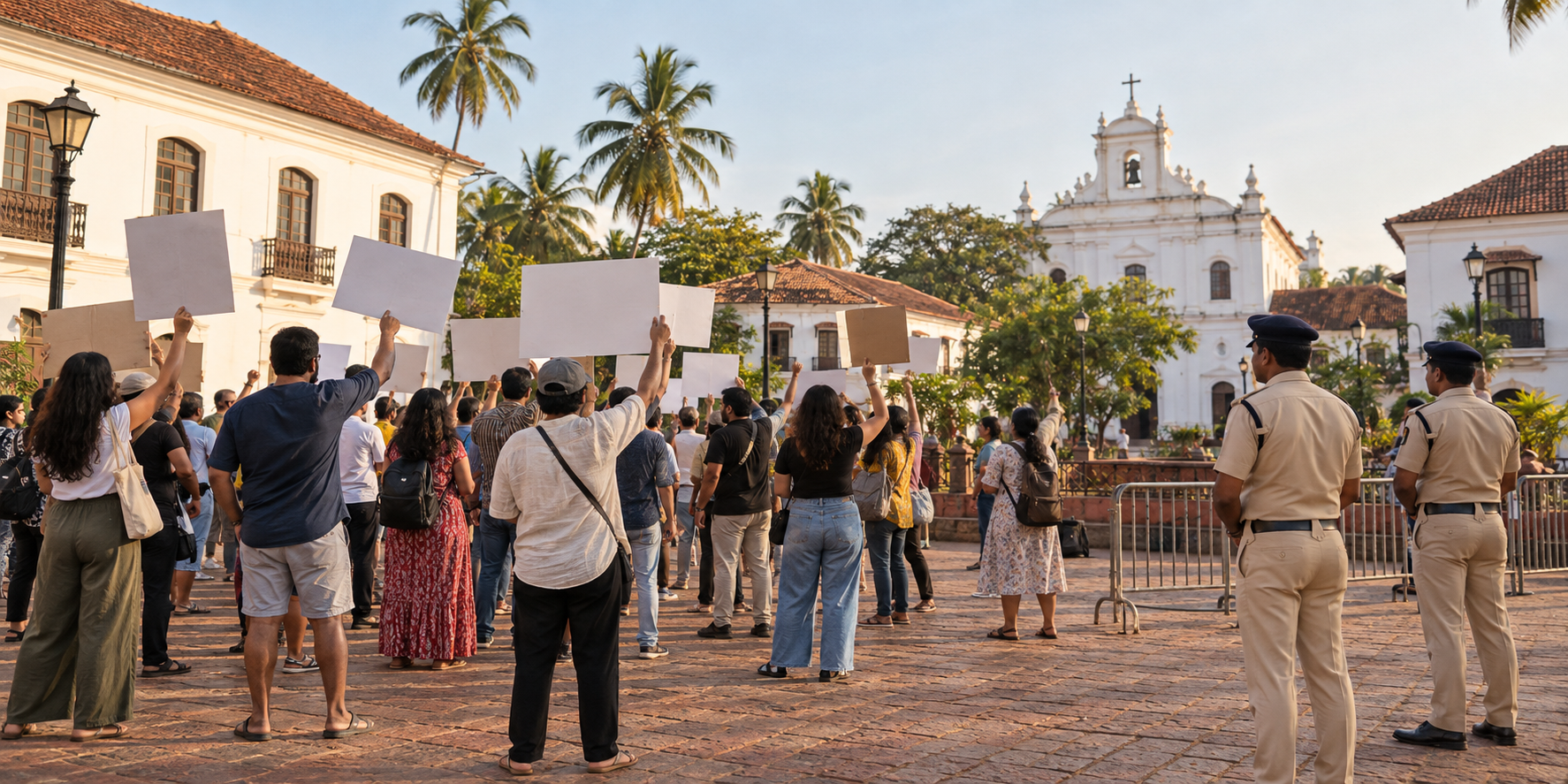
On 18 October 2026, Goa Police were reported to have registered an FIR against 300 unidentified people after “Murdabad, Murdabad, Hindutva Murdabad” was raised during a CJP protest. Those are the facts that can presently be stated with specificity.
They do not establish the identities of the participants, the statutory provisions invoked, the complete complaint, the evidence collected, or whether conduct beyond slogan-raising was alleged. It is also not yet clear whether the number 300 came from an official count, an estimate, or the complaint itself.
The word “unidentified” is crucial. An FIR referring to 300 unidentified people is not proof that 300 identified individuals committed an offence. Do not attach names, faces, organisations or motives that the available facts do not support.
When you share the development, preserve its limits: Goa Police, an FIR, 300 unidentified people, a CJP protest and an anti-Hindutva slogan. Remove any additional detail that you cannot trace to a police record or other direct evidence.
An FIR begins a process; it does not decide guilt

An FIR records an allegation for police investigation. It is not a judicial finding, a conviction or proof that every person present participated in the alleged act. Later police and court records may confirm the initial account, narrow it, identify particular people, reveal additional allegations, or close the matter without prosecution.
Your language should track that procedural reality. Call the people “unidentified persons named in the FIR” or “unidentified protesters” unless an official record supplies a more precise status. Do not call someone arrested, charged or convicted unless that specific development has occurred and can be verified.
If you receive a police notice or learn that you have been identified in the case, preserve the notice and any original recordings or messages. Do not delete, edit or manufacture material. Speak to a criminal lawyer licensed to practise in India, preferably one familiar with proceedings in Goa, before giving a detailed statement. Social-media commentary is not a substitute for advice based on the actual FIR and your circumstances.
Separate ideological hostility from unlawful conduct

In South Asian political usage, “murdabad” ordinarily functions as “down with.” The reported words are combative and hostile, but their stated target is Hindutva. They do not, on their face, name a particular Hindu, temple or act of worship. That textual distinction matters, even if many Hindus understand Hindutva as inseparable from their civilisational security and public self-respect.
The wording alone does not settle the moral or legal question. Context can change the meaning of a protest: a slogan delivered in a general political demonstration is not the same event as words directed at worshippers while blocking a temple, accompanying a threat, or inciting imminent violence. None of those additional circumstances should be assumed here without evidence.
Use five questions to test any stronger claim:
- What were the complete words immediately before and after the reported slogan?
- Was the stated target an ideology, an organisation, a religious community, named individuals or people at a particular place?
- Did the gathering involve a specific threat, obstruction, assault, property damage or attempt to provoke violence?
- Which acts does the FIR allege, and which statutory provisions does it invoke?
- Has any person been identified, questioned, arrested, formally charged or convicted?
Until those questions are answered, two absolute claims go beyond the known facts. It is too broad to declare that every denunciation of Hindutva is criminal persecution of Hindus. It is equally careless to insist that political slogans can never form part of intimidation or targeted hostility. Judge the words, setting and conduct separately.
A disciplined pro-Hindu response

You do not need to minimise the slogan to respond responsibly. A strong response is accurate enough to survive scrutiny and restrained enough not to reproduce the conduct it condemns.
- Preserve the original claim. Save the URL, publication date and exact wording. Distinguish what is reported from what you infer.
- Seek the primary record. Look for the FIR number, police station, filing date, invoked provisions, complaint narrative and description of the accused. A screenshot of a headline is not a substitute for the FIR.
- Check any circulating video in full. Find the earliest available upload, watch what precedes and follows the slogan, and look for cuts, missing audio or an unverified location. A short clip may establish that words were spoken without establishing who spoke them or what else occurred.
- Protect unidentified people from misidentification. Do not crowdsource names, match faces, contact employers or publish personal details. A mistaken identification can expose an innocent person to harassment and expose you to legal consequences.
- Criticise precisely. Describe the reported slogan as anti-Hindutva and explain why you consider it hostile. Do not relabel it as proven violence, an attack on a temple or a threat against all Hindus unless evidence establishes that additional fact.
- Reject collective guilt and dehumanisation. Dharma is not strengthened by treating opponents as vermin or by assigning guilt through association. Condemn unlawful conduct, if proved, while retaining the distinction between a person and an allegation.
- Update visibly. If police or court records change the factual position, correct the headline, body text and social post rather than leaving an outdated allegation in circulation.
If evidence shows threats, violence or targeted intimidation, demand a lawful investigation and equal protection without exaggeration. If the case concerns political expression alone, answer the expression openly and test any restriction against the law. The same evidence-based standard protects Hindus when vague ideological labels are used against Hindu organisations, speakers or devotees.
Key takeaways
- The reported development is an FIR against 300 unidentified people following anti-Hindutva slogans at a CJP protest in Goa.
- An FIR records allegations for investigation; it does not establish individual identity or guilt.
- The words reportedly target Hindutva, while their wider meaning depends on the full setting and any accompanying conduct.
- Do not add arrests, threats, violence, statutory provisions or named participants unless an official record supports those details.
- A credible pro-Hindu response preserves evidence, avoids doxxing and dehumanisation, and corrects the record when verified facts change.
Your next step is concrete: obtain the FIR text or a verifiable police or court update before making a legal claim. Until then, describe the incident narrowly, rebut the slogan firmly and refuse to turn unidentified people into presumed offenders.
References

Leave a Reply
You must be logged in to post a comment.