

If you are carrying the weight of something you did, the spiritual question can become painfully personal: Have I made myself unworthy of the Divine? Hindu thought gives a hopeful answer without pretending that wrongdoing does not matter. You are not beyond transformation, but transformation asks more of you than regret.
The crucial distinction is this: do not deny the deed, and do not reduce your entire being to the deed. Redemption is not an escape from consequences. It is a return to dharma that becomes visible in how you live.
The Divine within is not a certificate of innocence

Bhagavad Gita 18.61 places the Supreme Lord in the heart of every being. The statement is not limited to saints, devotees, or people with an admirable past. Divine presence is not withdrawn when a person falls into ignorance or acts against dharma.
That does not make every thought, impulse, or action divine. The indwelling Lord must not be confused with the ego that wants, fears, resents, conceals, and justifies. A person can remain inwardly related to the Divine while acting from deeply distorted motives.
Hindu schools do not all describe the relationship between the individual being and the Divine in the same way. Some place greater emphasis on identity with ultimate reality; others preserve an enduring distinction between the individual soul and Ishvara. You do not have to flatten those differences to grasp the practical point: moral failure can obscure spiritual awareness, but it does not make spiritual awakening impossible.
This keeps hope from becoming self-flattery. Inner divinity means that change remains possible. It does not mean that your present judgment is pure, that your desires deserve obedience, or that anyone harmed by you must overlook what happened.
Redemption must hold hope and accountability together

The English word “sinner” can sound like a permanent identity. A dharmic approach asks more useful questions: What adharma occurred? What habit or attachment produced it? What consequences followed? What must now be done to restore right conduct?
Karma prevents redemption from becoming a convenient declaration of innocence. Actions have consequences, and remorse does not automatically remove them. A sincere change of heart matters because it changes what you do next; it does not rewrite the past or place other people under an obligation to trust you again.
Two errors commonly block a genuine return:
- Despair: “I did wrong, so I am permanently corrupt.” This turns an action into an unchangeable identity and can become an excuse to stop trying.
- Evasion: “The Divine is within me, so nothing I did can ultimately matter.” This uses a spiritual truth to avoid moral truth.
The middle way is harder and more honest: your deepest spiritual possibility survives, and your conduct still requires correction. Grace may make return possible, but grace is not permission to continue the pattern. Practice may purify the mind, but practice is not a payment that purchases exemption from accountability.
A practical path from remorse to dharmic action
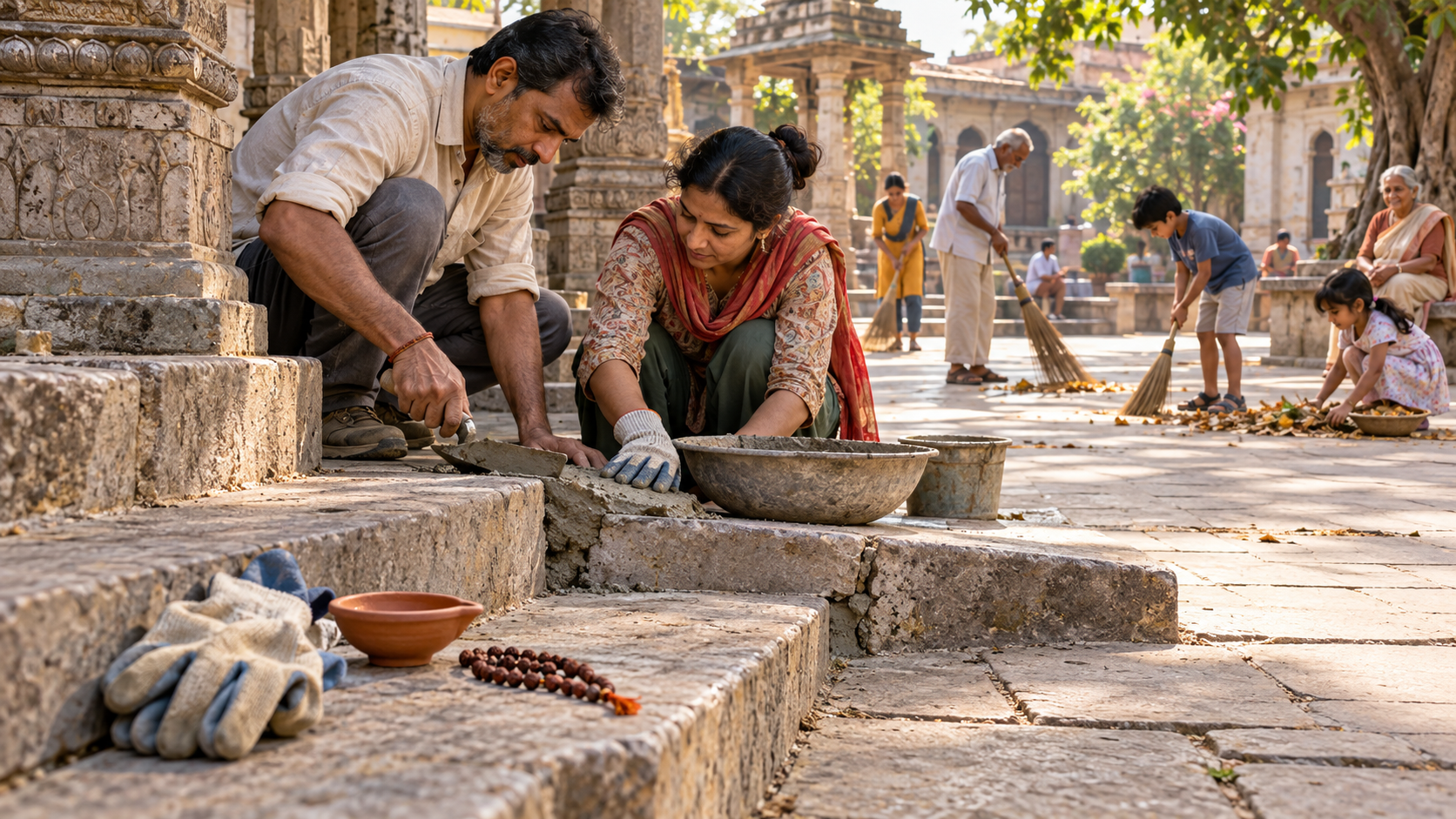
If you want redemption to be more than a comforting idea, work through the following steps in order. Do not rush toward a ritual or a feeling of purity before dealing with the harm itself.
- Name the action plainly. Replace “mistakes were made” with a sentence that identifies what you chose, concealed, neglected, or enabled. Honest language interrupts the mind’s habit of making itself a spectator to its own conduct.
- Stop the continuing harm. An apology has little meaning while the same behaviour remains active. End the act, remove access to the means of repeating it, leave the enabling situation, or establish whatever boundary makes recurrence less likely.
- Understand the pattern beneath it. Notice what preceded the action: anger, greed, fear, envy, intoxication, the desire for approval, or the wish to avoid discomfort. This is not an excuse. It tells you where discipline must be applied.
- Make the repair that is actually owed. Return what was taken, correct a falsehood, fulfil a neglected obligation, or compensate for a loss where that is possible. Do not substitute a donation, pilgrimage, fast, or private prayer for repair to the person who bore the cost.
- Accept consequences without bargaining. The person harmed may decline contact, refuse forgiveness, or require distance. Trust belongs to that person; your remorse does not create a claim on it. If the act was criminal or created an ongoing danger, spiritual practice is not a substitute for lawful accountability and immediate safety measures.
- Choose a sadhana that opposes the harmful tendency. Pair dishonesty with deliberate truthfulness, cruelty with ahimsa, greed with generosity, uncontrolled appetite with restraint, and habitual self-absorption with seva. The corrective practice should reach the trait that produced the conduct, not merely soothe the guilt that followed it.
- Continue after the emotion fades. Remorse can be intense and brief. Abhyasa, repeated practice, turns a moment of recognition into a different disposition. Keep the discipline when no one is watching and when you no longer feel dramatic sorrow.
Repair does not always require direct contact. Contact can sometimes reopen harm, violate a boundary, or put someone at risk. In such a case, use an appropriate intermediary or seek qualified guidance about a safe form of restitution. The purpose is to serve the harmed person, not to secure relief from your own discomfort.
Judge transformation by conduct, not spiritual intensity

A powerful prayer, a moving darshan, or a period of austerity can begin a change. None of them, by itself, proves that the change has taken root. The clearer evidence appears in ordinary situations where the old pattern once controlled you.
- You describe the wrongdoing without minimising it or quietly shifting blame.
- You recognise the conditions that make repetition likely and put safeguards in place before temptation arrives.
- You repair harm without demanding praise, reconciliation, or immediate trust.
- You accept correction without treating it as persecution.
- You make different choices under pressure, not only when calm or spiritually inspired.
- You become more careful about the dignity of others, not merely more concerned with appearing virtuous.
This is why the movement from wrongdoer to saint should not be romanticised as a sudden change of label. Its substance is a sustained reorientation toward dharma. A transformed person may remember the past clearly, but memory no longer functions as either a hiding place or a life sentence. It becomes instruction.
You also need to distinguish guilt from responsibility. Guilt asks you to feel bad; responsibility asks you to tell the truth, prevent recurrence, and repair what can be repaired. Endless self-condemnation can become another form of self-occupation. Once remorse has revealed the duty, put your energy into performing that duty.
Key takeaways
- The Divine presence within a person is not destroyed by wrongdoing, so sincere transformation remains possible.
- Inner divinity does not make the ego infallible or turn adharma into dharma.
- Karma and accountability prevent redemption from becoming an escape from consequences.
- Real repentance stops the harmful pattern, repairs what can be repaired, and accepts that forgiveness cannot be demanded.
- Sadhana should correct the tendency behind the wrongdoing, not merely provide temporary relief from guilt.
- The strongest evidence of redemption is dependable conduct maintained over time and under pressure.
Begin with one unembellished sentence: “This is what I did, and this is what must stop.” Then take the first safe, concrete step of repair before seeking a feeling of absolution. The Divine within gives you reason not to despair; dharma tells you what to do with that hope.
References

Leave a Reply
You must be logged in to post a comment.