
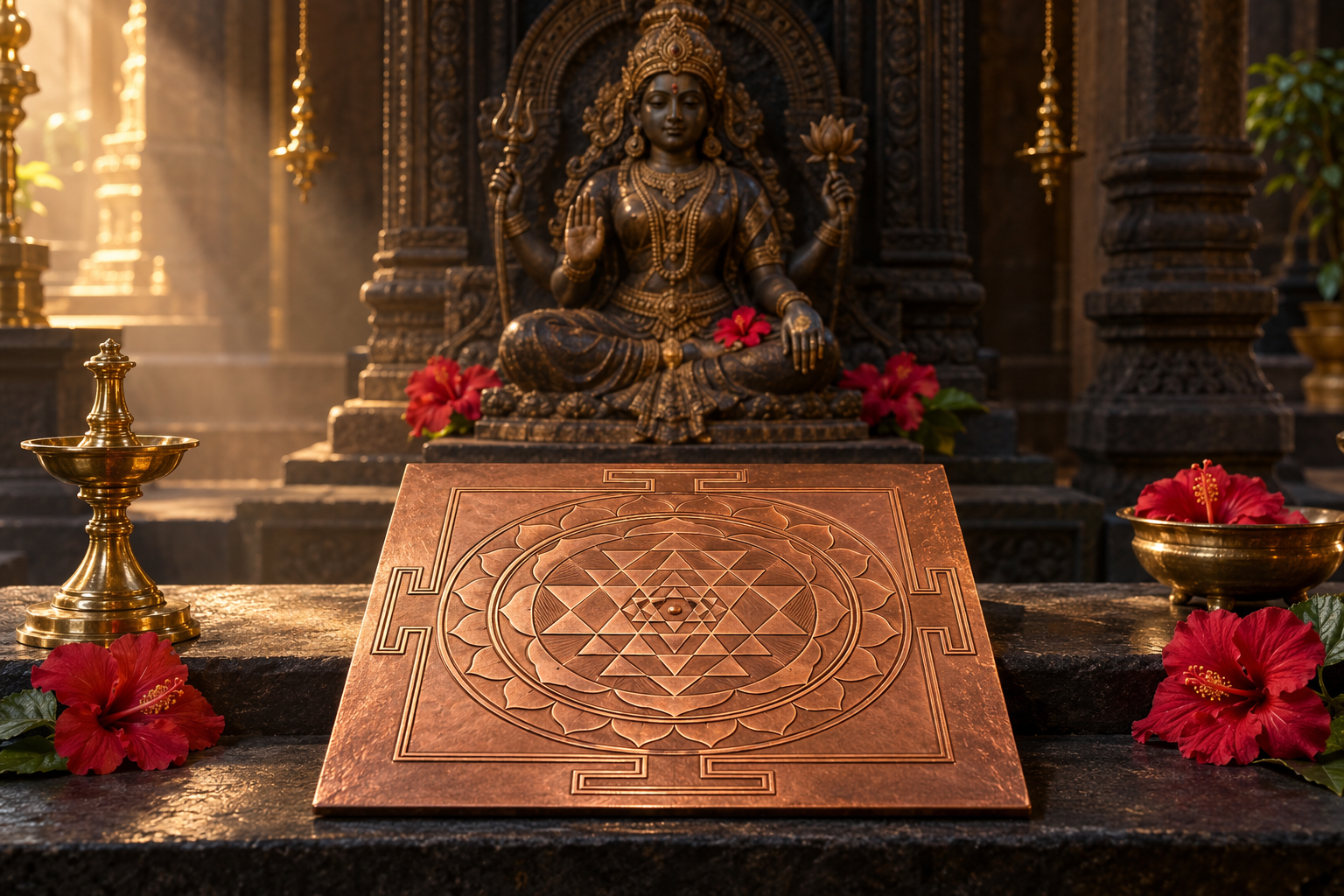
You may recognize a Devi, bow before her and still be unsure how to read what you see. The same problem arises with the Sri Chakra: its symmetry is arresting, but a beautiful pattern alone does not tell you why the form matters or where your attention should go.
The useful question is not, What does every detail mean in isolation? It is, How does this sacred form move the mind from many visible elements toward a unifying centre? Once you learn to follow that movement, both goddess imagery and the Sri Chakra become more intelligible without being reduced to a catalogue of symbols.
First identify the kind of sacred form before you
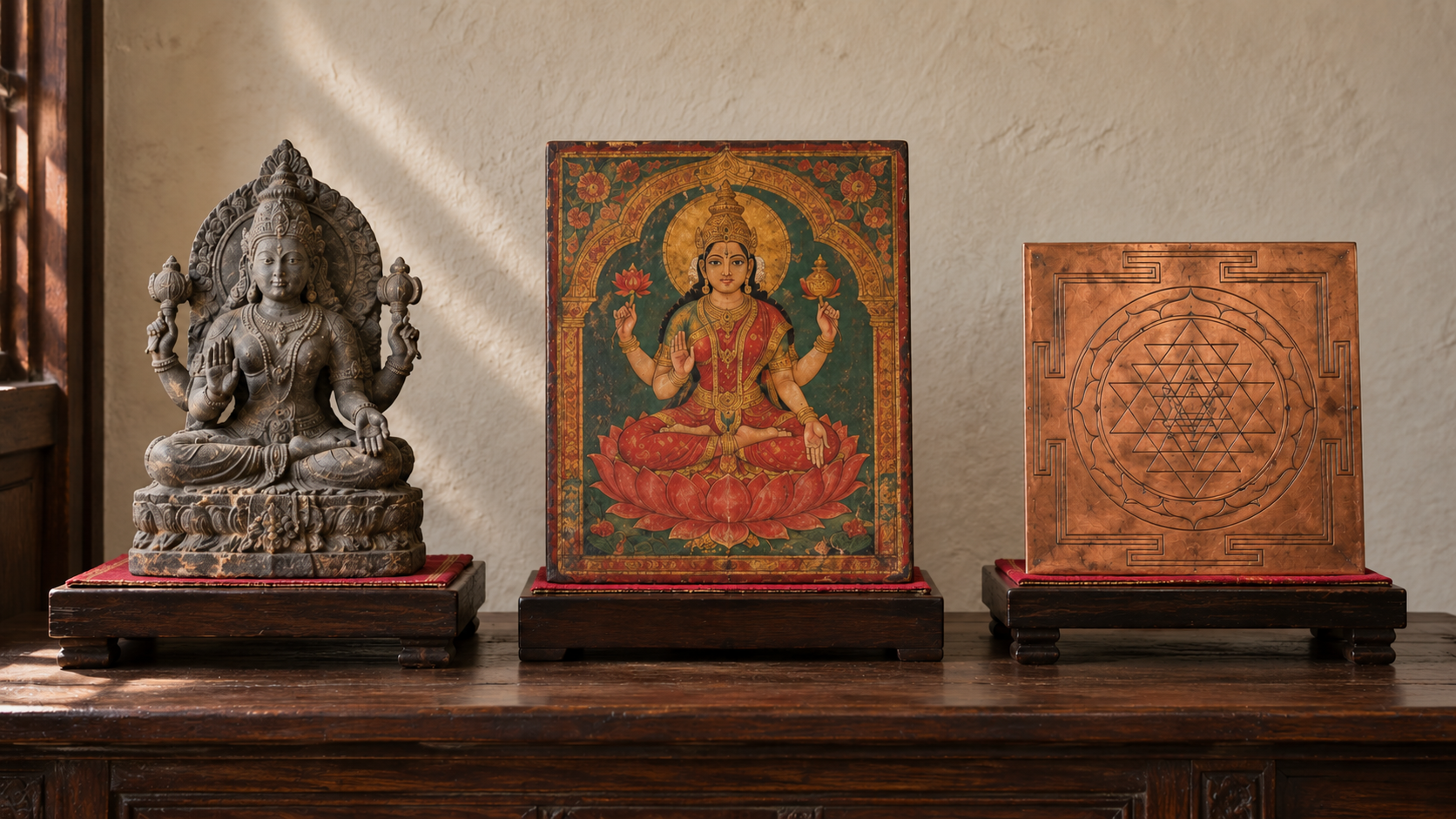
Shakta iconography works through several visual languages. A figurative image of Devi, a geometric yantra and a three-dimensional sacred form may disclose related truths, but they do not communicate in the same way. Your first task is therefore identification, not interpretation.
- A murti or figurative image presents a named divine form through face, body, posture, gestures, colours and held objects. Its details belong together. A hand gesture should not be detached from the identity and complete form of the Devi.
- A yantra communicates through points, boundaries, intersections, repetition and ordered spatial relationships. The Sri Chakra is a highly revered and intricate yantra of Shakta Tantra, not simply an ornamental pattern carrying a religious label.
- The Mahameru is the pyramidal, three-dimensional expression of the Sri Chakra. What appears as centre and enclosure in the plane is experienced as depth, level and culmination when the form rises spatially.
This distinction prevents two common mistakes. The first is to treat every sacred form as a picture that must resemble a person or event. The second is to treat every image as a cipher in which each feature has one universal meaning. A murti addresses you through embodied presence; a yantra orders attention through geometry; the Mahameru gives that geometry a spatial ascent.
When you encounter an unfamiliar object, ask three questions before searching for meanings: Is it figurative, geometric or three-dimensional? What is its exact traditional name? Is it being presented for contemplation, formal worship or decoration? Those answers determine what kind of reading is appropriate.
Read the Sri Chakra as a movement from field to point
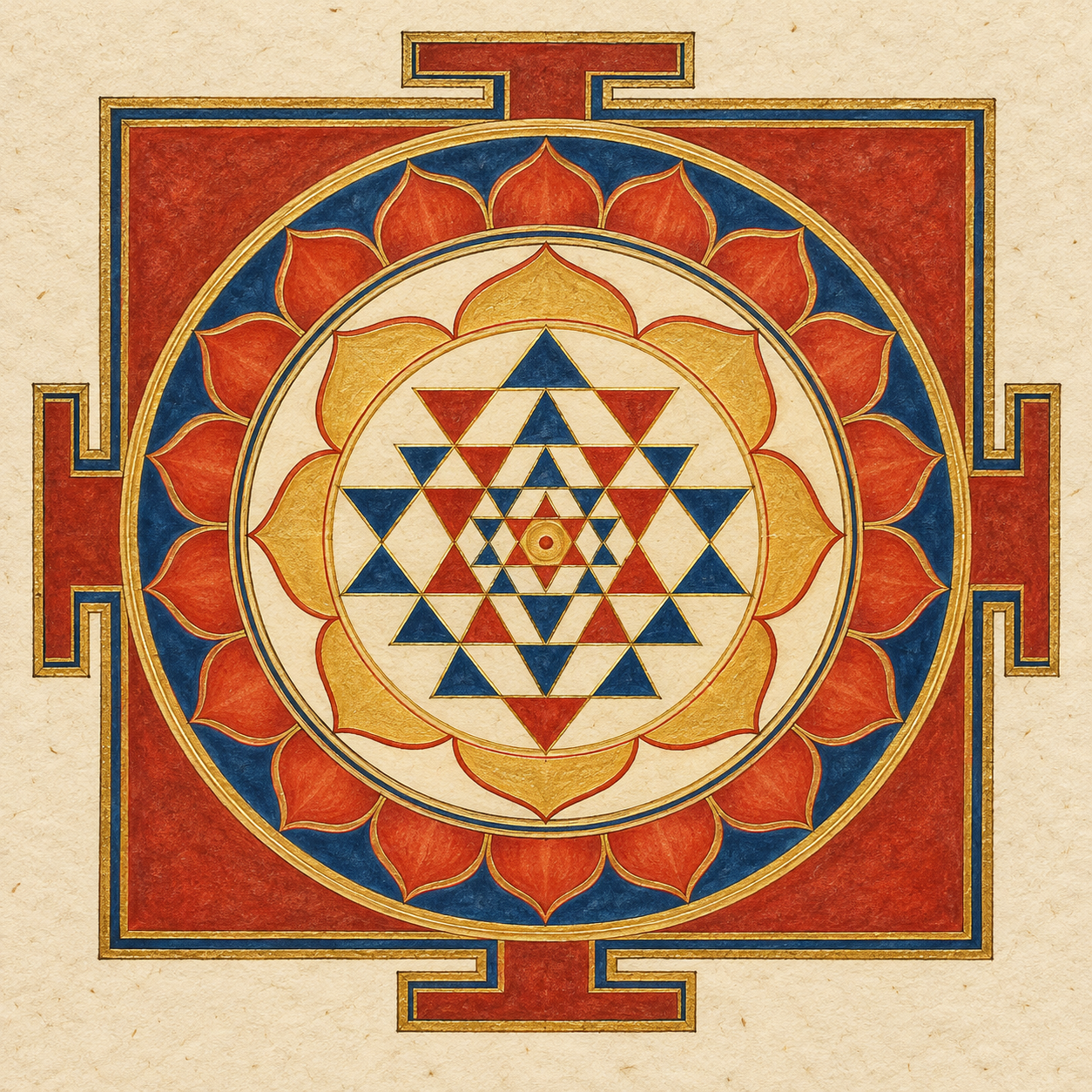
A hurried viewer sees a mass of lines. A patient viewer notices an ordered field. The outer enclosure, lotus forms, intersecting triangles and central point are not competing motifs. Their relationship is the teaching. The whole design asks you to hold plurality and unity in the same act of attention.
The traditional word avarana, or enclosure, is especially helpful. It discourages you from jumping immediately to the centre while dismissing everything around it as secondary decoration. Each enclosure participates in a passage inward. The centre matters because the entire field leads toward it; the field matters because it makes the significance of the centre visible.
Use this sequence when you look at a Sri Chakra:
- Begin with the complete boundary. Notice that the diagram establishes a defined sacred order. Do not start by extracting a single triangle or petal for a private interpretation.
- Follow the nesting of forms. Let your eyes register enclosure within enclosure. The movement is gradual, not a visual leap from outside to centre.
- Observe the intersections. Upward- and downward-pointing forms meet within one coherent design. Before assigning doctrinal labels, notice the more basic fact: difference is neither erased nor allowed to fragment the whole.
- Allow attention to converge. As the surrounding forms narrow toward the centre, simplify your own looking. Stop collecting features and attend to their shared orientation.
- Return to the whole. After reaching the central point, look outward again. The Sri Chakra is not understood by choosing either multiplicity or unity; its structure holds them in relation.
This is a method of visual study, not a substitute for a lineage-specific ritual. You do not need to invent a mantra, assign a deity to every component or pretend to possess initiatory knowledge in order to look carefully. Observation should come before interpretation, and interpretation should stop where your knowledge stops.
Let the bindu govern the meaning of the whole
The bindu is not merely the smallest mark in the design. It is the central point associated with Lalita Mahatripurasundari and the ninth avarana. In the two-dimensional Sri Chakra it is the centre; in the Mahameru it is understood at the crown. This continuity shows why the flat yantra and the raised form should be read as two expressions of one sacred ordering.
Geometrically, a point has no extended surface for the eye to explore. Iconographically, that apparent simplicity is precisely its force. The many lines do not end in another elaborate figure. They converge in concentrated presence. The bindu therefore corrects the assumption that greater spiritual importance must always be represented by greater visual complexity.
It also prevents a second mistake: interpreting the centre as an anonymous emptiness. Within this Shakta and Srividya setting, the bindu is identified with the Goddess in her supreme form. Any philosophical interpretation that removes Devi from the centre has left the iconographic context that gives the Sri Chakra its character.
When contemplating the design, let the bindu function in three ways. Treat it as your visual destination while moving inward, as the organizing centre that makes the surrounding relations intelligible, and as the point from which you reconsider the whole diagram. You are not fleeing form for a supposedly superior formlessness. You are seeing how the many forms disclose, and remain related to, their centre.
The Mahameru makes the same principle spatially vivid. Its three-dimensional form does not add a different final truth to the Sri Chakra. It turns convergence into ascent: the centre of the diagram is encountered as the crown of the raised form. If you see a Mahameru in a shrine or home, look for this continuity rather than treating it as a miniature sacred mountain unrelated to the yantra.
Apply the same discipline to a goddess image
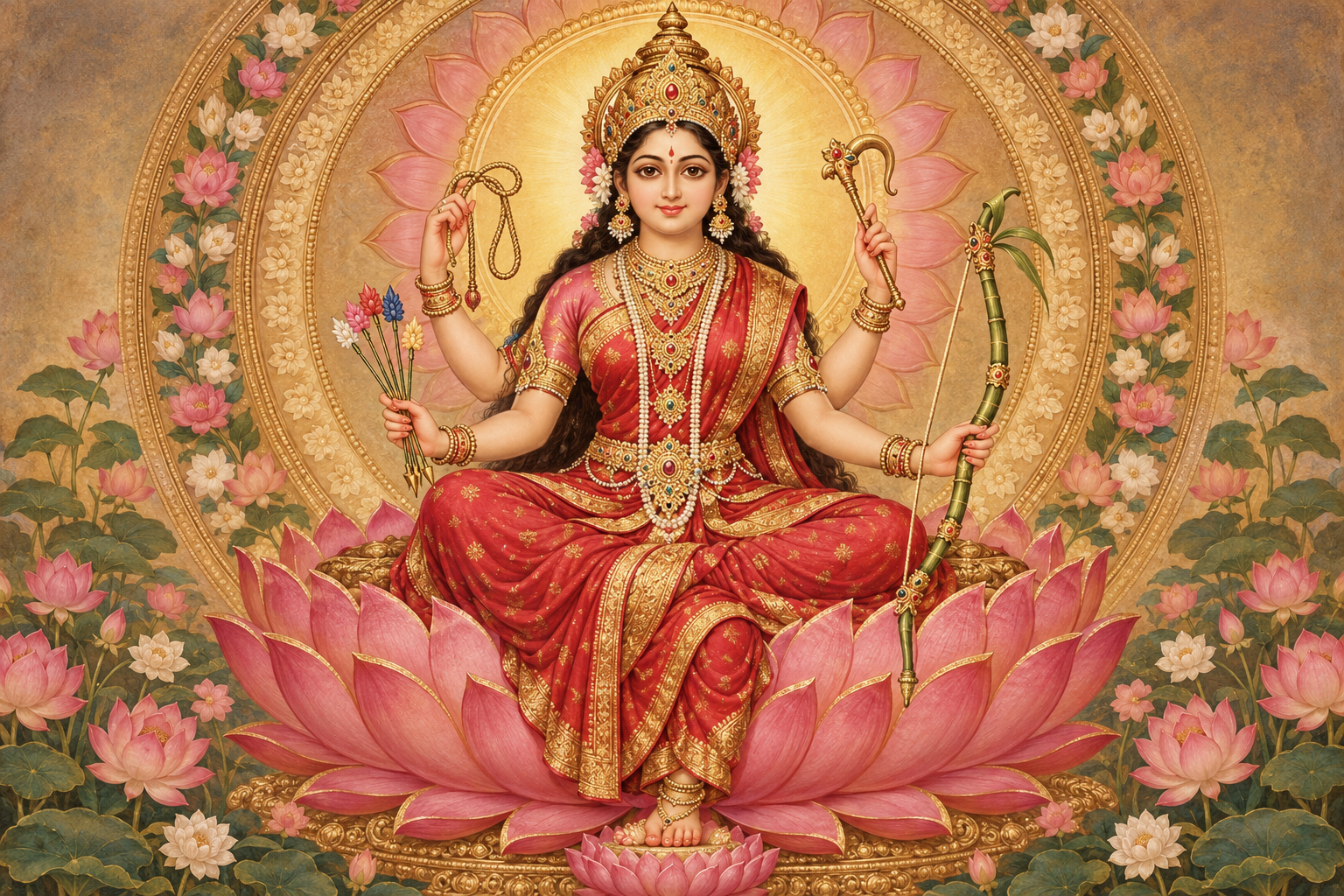
A Shakta image is best read as a complete sentence, not as a bag of symbolic words. Name, colour, hair, posture, gestures and objects qualify one another. Isolating one attribute and assigning it a meaning found elsewhere can distort the form in front of you.
Nilakeshvari offers a useful example. Her name roughly evokes the Goddess with dark or blue-black tresses, and her distinctive iconographic identity conveys a spiritual teaching concerned with passage through the ocean of existence. The visible feature is therefore not incidental portraiture. It directs you toward the identity and work of this particular manifestation of the Divine Mother.
But the name does not authorize unlimited speculation. Knowing that her tresses are significant does not prove every interpretation someone might attach to the colour blue-black. A disciplined reader distinguishes what the name actually establishes from what still requires a tradition-specific explanation.
Use the following method with any unfamiliar form of Devi:
- Establish the exact name. Do not settle for a generic caption such as Goddess or Shakti when the form has a specific identity. Similar visual features can function differently in different manifestations.
- Describe before you interpret. Note the posture, gestures, held objects, colours, hair, seat or vehicle, companions and surrounding setting. Record only what is actually visible.
- Separate confirmation from conjecture. A name, traditional description or reliable ritual context may confirm an attribute. Your personal association with a colour or object does not carry the same weight.
- Read the attributes together. Ask what spiritual condition, danger, protection, passage or realization the whole arrangement addresses. A weapon, blessing gesture or unusual colour changes meaning when removed from that larger purpose.
- Preserve unresolved details. If you cannot account for a feature, leave it open. Honest uncertainty is more faithful than forcing every element into a ready-made symbolism.
The same rule governs the Sri Chakra. Start with the form actually present, understand its internal relationships and resist importing meanings merely because they sound mystical. Shakta iconography rewards accuracy because its visible distinctions are part of its theology.
If you intend to move from study into formal worship, learn the procedure within an appropriate Shakta or Srividya tradition. A diagram copied from the internet can show you the visual form, but it cannot by itself establish the ritual context, discipline or authority with which a particular practice is transmitted. Careful viewing is open to you; constructing a formal practice from disconnected fragments is a different matter.
Key takeaways
- The Sri Chakra is a sacred geometric form whose meaning lies in the relationship between its enclosures, intersections and central bindu, not in isolated shapes.
- The Mahameru is the three-dimensional, pyramidal expression of the Sri Chakra. The centre of the plane becomes the crown of the raised form.
- The bindu is the ninth avarana and is associated with Lalita Mahatripurasundari; it should not be reduced to an empty dot or generic symbol.
- A goddess image must be read as a named, integrated form. Establish what its attributes actually are before assigning meanings to them.
- Visual study and formal ritual are not identical. Study with close attention, and seek tradition-specific instruction before improvising worship.
The next time you stand before a Shakta image or Sri Chakra, do four things: name the form, identify its visual language, follow its internal movement and notice where your evidence ends. With the Sri Chakra, let your gaze travel from the ordered field to the bindu and back again. That patient movement will teach you more than a hurried list of symbolic definitions.
References
- Hindu Blog — Nilakeshvari Devi – Idol Form – Symbolism – Meaning
- Hindu Blog — Goddess or Shakti of 9th Avarana – the Bindu Central Point of Mahameru – Sri Chakra

Leave a Reply
You must be logged in to post a comment.