
You may be trying to settle a direct question: if changing the brain changes perception, memory, or wakefulness, hasn’t neuroscience shown that the brain creates consciousness? Or, after examining awareness in meditation, you may be tempted by the opposite conclusion: hasn’t Advaita already proved that the brain is secondary?
Neither conclusion follows that quickly. You can respect brain science and take Advaita seriously once you separate what is measured, what is experienced, and what is inferred. That distinction gives you a practical way to evaluate consciousness claims without forcing either tradition to say more than it can establish.
Before choosing a side, separate three different problems
Discussions of consciousness often slide between three questions as though they were interchangeable. They are not.
- How do conscious functions work? This includes perception, attention, memory, learning, decision-making, verbal reports, and the ability to distinguish one stimulus from another.
- Why is any processing accompanied by experience? A system may discriminate colours or store information, but why should those operations feel like anything from within? David Chalmers called this the hard problem. The word “hard” identifies an explanatory gap; it does not mean that the other problems are scientifically easy.
- What is consciousness ultimately? Is it produced by physical processes, identical with them, an irreducible feature of reality, or the fundamental reality in which mind and matter appear? That is a metaphysical question, even when scientific evidence constrains the possible answers.
A striking historical wager shows why these distinctions matter. In 1998, neuroscientist Christof Koch bet philosopher David Chalmers that the neural basis of consciousness would be identified within 25 years. When the deadline arrived in 2023, Chalmers received a case of Madeira. The intended scientific explanation had not arrived.
That outcome does not make Advaita the winner of an experiment. It establishes something narrower and more useful: confidence that additional neural detail would automatically close the explanatory gap was premature. A map of the mechanisms associated with experience is not yet an explanation of why experience exists.
When you encounter a strong claim, inspect its verb. “Correlates with,” “predicts,” “enables,” “constrains,” “constitutes,” and “produces” do not mean the same thing. Much confusion disappears when a writer has to defend the exact verb being used.
What a brain finding can justify
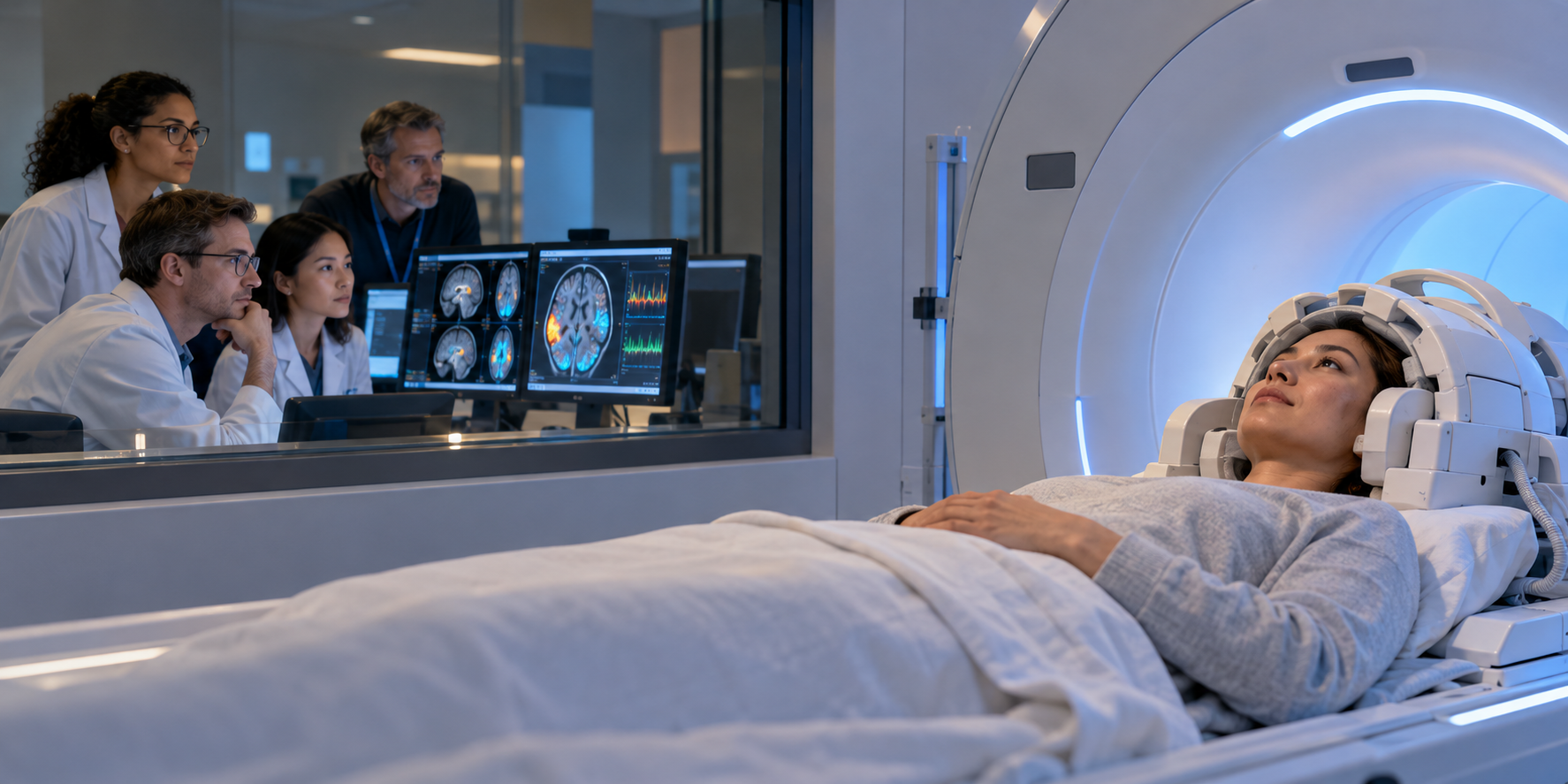
Neuroscience approaches consciousness from the third-person side. It measures neural activity, manipulates physical conditions, records behaviour, and compares those observations with what a person can report. This can reveal which brain systems are required for particular human capacities and which patterns accompany particular contents of experience.
The crucial discipline is to stop at the conclusion warranted by the observation:
| Observation | What it can support | What it does not establish by itself |
|---|---|---|
| A neural pattern varies with whether a person reports seeing a stimulus | The pattern is a candidate correlate of reportable visual experience | The pattern explains why seeing has a felt quality |
| Changing brain activity changes perception, memory, attention, or arousal | The relevant activity causally enables or constrains those human functions | Non-conscious matter produces awareness |
| A model predicts what content a person will report | Information about reportable content is present in the measured signals | Decoding a content explains the existence of experience |
| A person cannot produce a behavioural or verbal report | The capacity to respond or report is impaired or unavailable | Awareness itself has been directly measured as absent |
Dependence, identity, and production must remain distinct. If changing X changes Y, then X matters causally to Y under those conditions. Further argument is still needed to decide whether X enables Y, shapes it, realizes it, or creates it from something wholly non-conscious.
This is not a reason to diminish neuroscience. If you want to understand how visual contents are organized, why memory fails, how attention selects information, or which physical conditions support ordinary waking cognition, brain research is indispensable. Advaita cannot replace that work with a Sanskrit term. Its challenge concerns the philosophical interpretation placed on the findings.
Use four checks when you read a neuroscience claim about consciousness:
- Find the operational definition. Does “consciousness” mean wakefulness, attention, accurate discrimination, verbal report, a particular experience, or awareness itself?
- Identify the measured variable. A scan measures physical signals. A task records behaviour. A questionnaire records a report. None is simply consciousness without an interpretive bridge.
- Locate the inference. Ask where the language moves from correlation or intervention to identity or production.
- Check the competing explanation. A conclusion is stronger when the evidence distinguishes it from genuine alternatives, not merely when it fits a preferred theory.
Advaita reverses the direction of explanation

Advaita begins with an examination of experience rather than a model of the brain. Look around and identify whatever you can encounter: this screen, this sound, this body, this breath, this sensation, this thought. Each is an object of awareness, even when the object is internal and private.
The traditional distinction is between the seen and the seer, or more precisely between whatever is known and that by which it is known. An object need not be material. A memory, emotion, image, doubt, and even the mental sentence “I am the observer” can all be noticed. Because they can be noticed, they belong on the known side of the distinction.
Now ask what knows them. If you produce a mental picture of a witness located behind the eyes, that picture is also known. If you find a peaceful blankness, the blankness is present as an experience. If you formulate a definition, the definition is another thought. Advaita uses this repeated discrimination to show why awareness cannot be found as one more item among the items it reveals.
A brain is also something known. You may encounter it as an anatomical image, a scan, a measurement, a physician’s description, or a concept assembled from prior learning. Even if you watched your own neural activity on a monitor, the screen, the data, and your interpretation would appear within awareness. In this precise epistemic sense, the brain is known through consciousness; consciousness is not first encountered as a brain image.
That establishes an order of knowing. It does not, by itself, complete the stronger metaphysical argument that consciousness is the sole or fundamental reality. Moving from “all evidence is known in awareness” to “only awareness ultimately exists” requires additional reasoning. If you skip that step, you turn a serious inquiry into a slogan.
The same restraint applies to the familiar empty-room objection. A camera can record a room while no person occupies it. Yet you design the test, place the camera, retrieve the recording, and interpret the images within experience. The experiment supports the practical continuity of the room; it does not give you a standpoint literally outside all awareness. Conversely, the fact that the evidence appears in awareness does not prove that your individual mind invented the room.
This is also why Advaita should not be reduced to solipsism. Its claim is not that your personality secretly manufactures every other person. The individual mind, with its memories and limitations, is itself something observed. Advaita places mind, body, and world within a more fundamental being-consciousness rather than elevating the private ego into a cosmic creator.
Dream analysis serves a similarly limited but valuable purpose. A dream can contain a body, other people, places, fear, pleasure, and an apparently external world. On waking, the division between dream subject and dream objects is reinterpreted. This does not prove that waking life is merely a dream. It shows that vividness and an immediate feeling of externality do not, on their own, settle the nature of reality.
Run the inquiry without deciding the answer in advance
You do not have to accept Advaita’s full metaphysics to test its starting distinction. Try the inquiry during an ordinary, alert moment rather than waiting for an unusual meditative state.
- Begin with a clear sensory object. Notice a sound or something in your visual field and silently label it “this sound” or “this sight.”
- Move inward without changing the rule. Label a bodily sensation, breath, emotion, thought, or memory as “this sensation,” “this thought,” and so on.
- Include the apparent observer. If you feel located in the head or behind the eyes, notice that location-sense. If a sentence such as “I am watching” appears, notice the sentence.
- Ask one exact question. Is awareness present as another sight, sensation, image, location, or thought, or is it that to which each of those is evident?
- Do not manufacture a special state. Blankness, calm, light, expansiveness, and silence are experiences with recognizable qualities. Treat each as another known appearance rather than declaring it to be the final witness.
- Separate observation from conclusion. Write down what you directly noticed, then write down what you inferred. “The image of an observer was itself observed” belongs in the first column. “Therefore the universe is consciousness” belongs in the second and still needs an argument.
The exercise can expose a category error: searching for the knower as though it must be another known object. It can also clarify what Advaita means by awareness. It cannot, on its own, prove every Vedantic proposition, invalidate neural evidence, or answer every empirical question about the mind-body relationship.
There is an equal error in the other direction. A scanner produces data about the body, not a view from outside experience. Treating a neural image as though it displays awareness itself quietly assumes the very materialist conclusion under debate. The careful description is that it displays a measured neural condition associated with a task, report, or state.
Key takeaways for judging consciousness claims
- Neuroscience can identify mechanisms, dependencies, and neural correlates of conscious functions without thereby explaining why experience exists.
- Advaita begins from the fact that every object, measurement, and theory is known in awareness; this gives consciousness epistemic priority, not an automatic proof of the entire metaphysics.
- A brain intervention changing experience shows causal dependence under specified conditions. “The brain produces consciousness” is a further philosophical interpretation.
- A contemplative recognition that thoughts and sensations are observed does not make brain science irrelevant. It addresses a different level of the problem.
- The strongest position keeps first-person evidence and third-person evidence in view without pretending that either can simply absorb the other.
For the next consciousness headline you encounter, rewrite its claim in three lines: what was measured, what was observed, and what was inferred. Then apply the subject-object inquiry to the word “consciousness” being used. You will often find that a result about report, attention, or perception has been promoted into a declaration about the ultimate nature of awareness.
Advaita does not need neuroscience’s permission to ask its central question, and neuroscience need not be made to speak Vedanta. Your task is more exacting: let each illuminate the level it can genuinely reach. That is how you preserve both Bharat’s philosophical insight and the integrity of scientific inquiry.
References

Leave a Reply
You must be logged in to post a comment.