
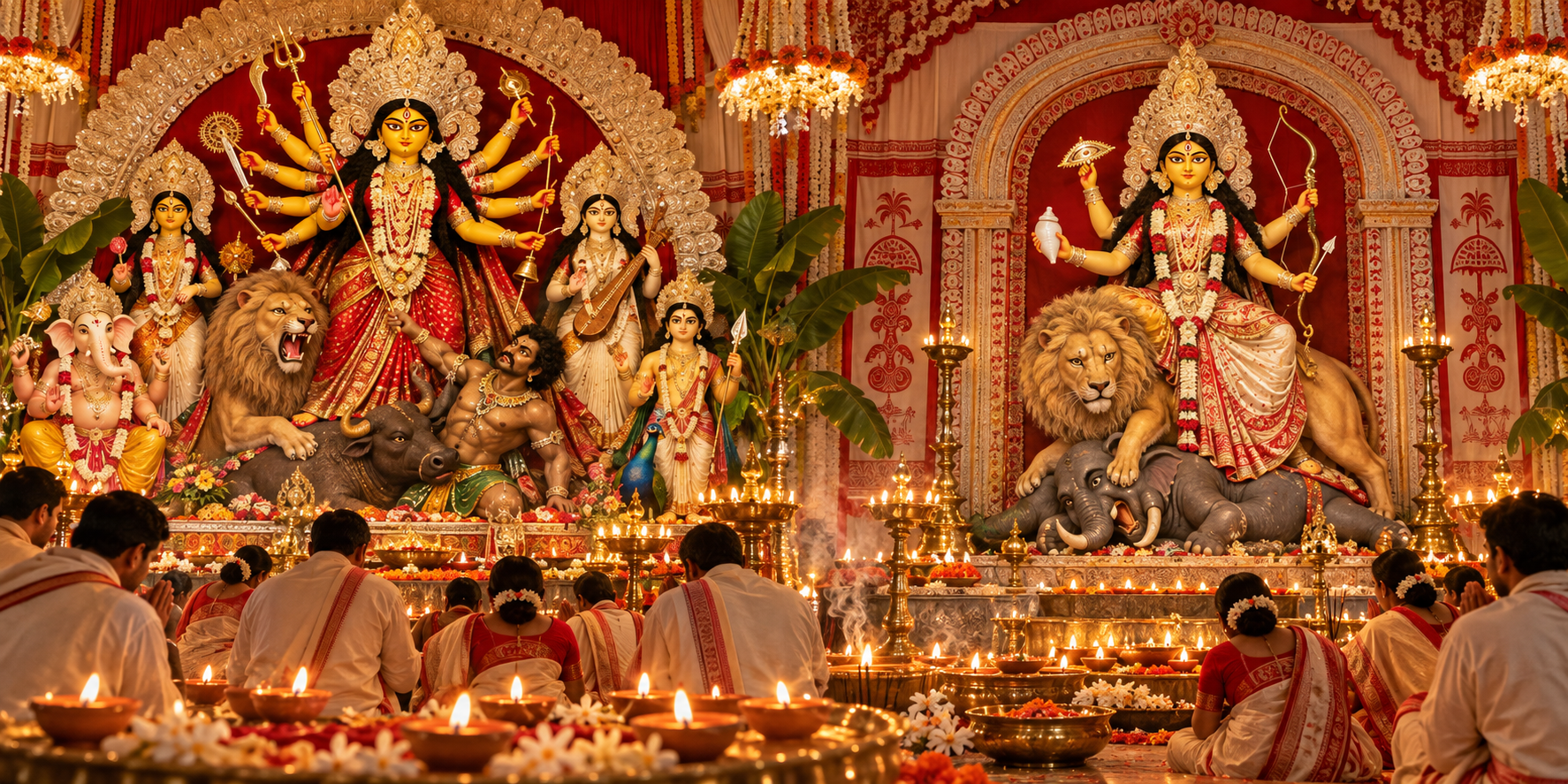
If you encounter Jagadhatri Puja soon after Bengal’s great Durga festivities, you may wonder whether you are seeing another version of the same celebration. The resemblance is real, but treating one puja as a smaller repeat of the other misses what each form of the Goddess asks you to notice.
Both belong to Bengal’s living worship of the Divine Mother. The useful distinction is one of divine action: Durga makes protective power visible through the defeat of adharma, while Jagadhatri reveals the power that bears, governs and sustains the world.
Key takeaways
- Durga and Jagadhatri are not rival goddesses. They are distinct manifestations of the one Adyashakti, the primordial divine power.
- Durga’s familiar image places the defeat of Mahishasura at the centre. Jagadhatri’s image presents the Mother as the upholder of the world and the governor of unruly force.
- Durga Puja and Jagadhatri Puja have their own iconography, ritual atmosphere and community identity. One should not be described merely as a larger or smaller version of the other.
- If you visit both, read the murti before comparing the crowds, decorations or budgets. The visual composition tells you what kind of divine action is being contemplated.
- Local schedules and customs can differ. Check the organising temple or puja committee’s programme instead of assuming that anjali, arati and immersion will follow the same timetable at both celebrations.
One Adyashakti, two forms of divine action
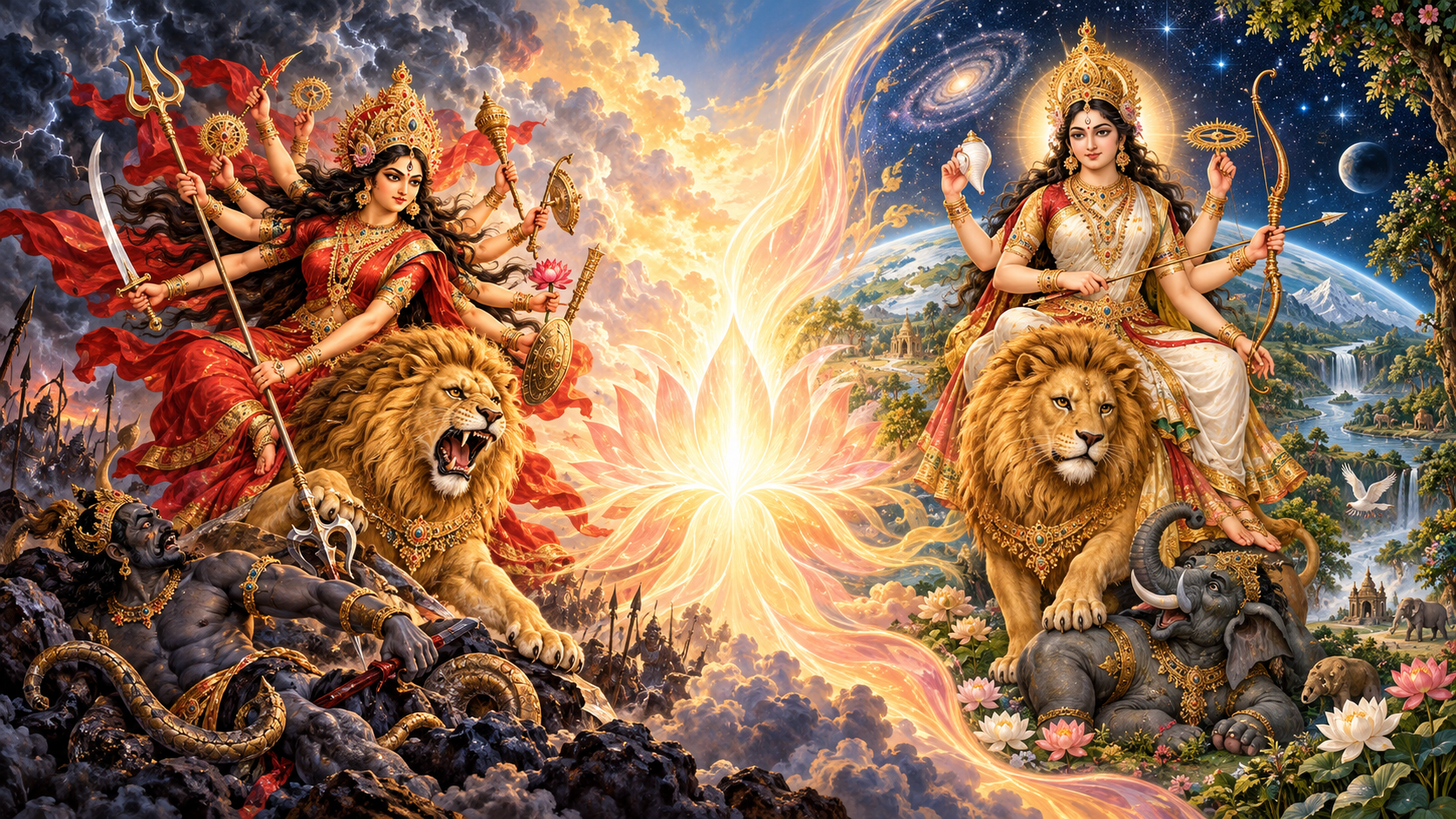
The soundest place to begin is theological rather than seasonal. Bengal honours Durga and Jagadhatri as manifestations of Adyashakti. Their difference therefore does not divide divine power into competing camps. It shows that Shakti performs more than one indispensable work.
Durga confronts a crisis. In her form as Mahishasuramardini, she makes a decisive truth visible: power that becomes arrogant, predatory and hostile to dharma must be checked. Her weapons, lion and victory over Mahishasura are not decorative additions. Together they form a visual teaching about disciplined power overcoming destructive power.
Jagadhatri’s name directs attention to another truth. She is the bearer or sustainer of the world. Creation does not need divine care only when a dramatic enemy appears. It must be continuously held in order. Life persists because Shakti supports it, restrains disorder and prevents uncontrolled force from governing itself.
This distinction changes how you understand the two pujas. Durga’s victory is not meaningful only at the moment of battle, and Jagadhatri’s sustaining presence is not passive. Protection restores order; sustaining power preserves it. The two forms reveal complementary movements of the same Divine Mother.
How to recognise the two sacred images
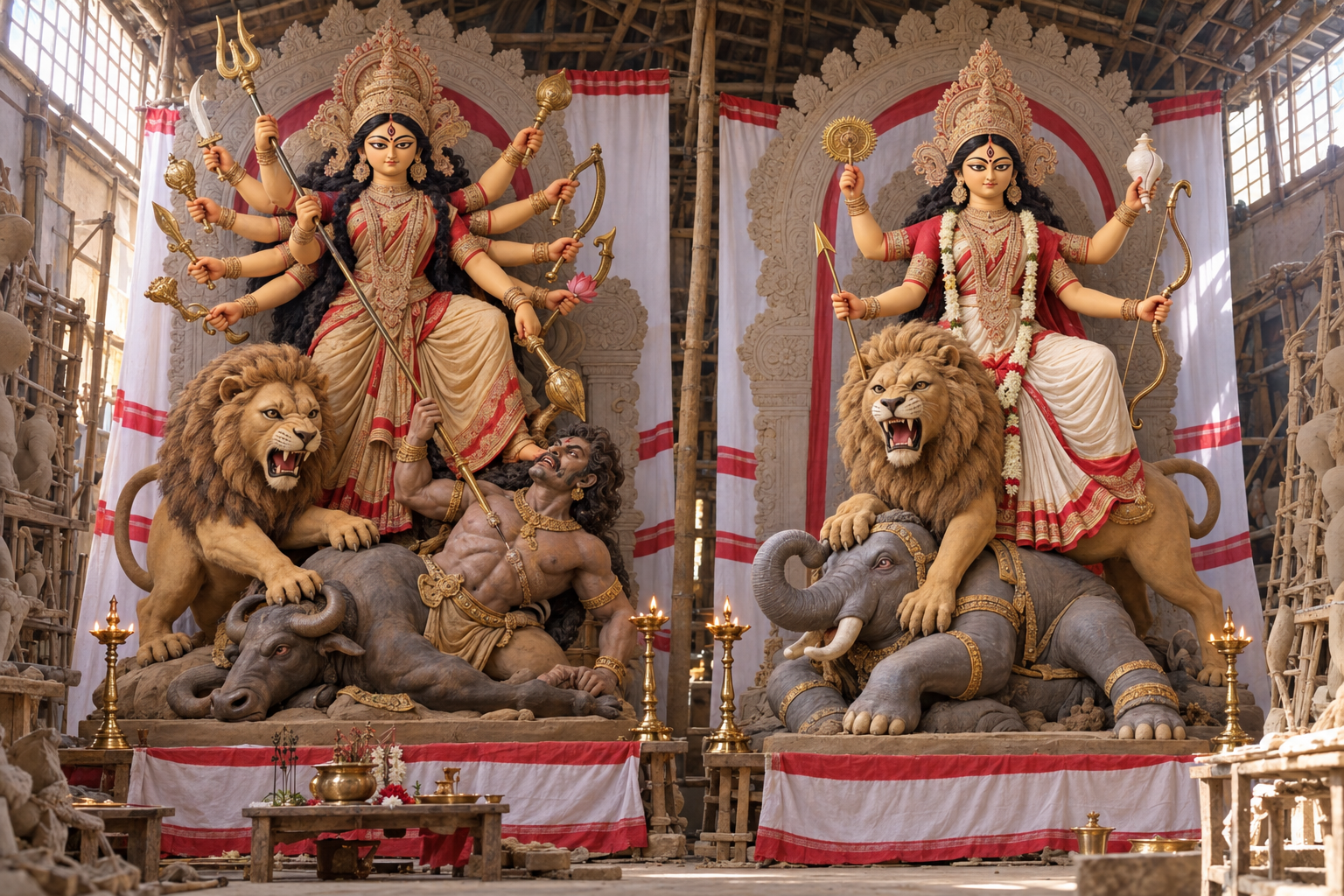
When you enter an unfamiliar pandal or temple, begin with the central action of the murti. Colours, ornaments and artistic themes can change. The underlying iconographic grammar is the more reliable guide.
| What to notice | Durga Puja | Jagadhatri Puja |
|---|---|---|
| Central revelation | The Goddess as the victorious protector who destroys Mahishasura | The Goddess as the divine power that bears and maintains the world |
| Common visual structure | Durga is commonly shown with ten arms, multiple divine weapons, her lion and the defeated buffalo-demon | Jagadhatri is commonly shown with four arms, riding a lion positioned over an elephant figure |
| Wider composition | The Bengali tableau commonly includes Lakshmi, Saraswati, Ganesha and Kartikeya | The composition commonly concentrates attention more tightly on Jagadhatri herself |
| Spiritual question | What must divine courage confront and overcome? | What power sustains order after disorder has been restrained? |
| Common mistake | Reducing the festival to cultural spectacle or family reunion | Calling it a repetition or minor continuation of Durga Puja |
The elephant beneath Jagadhatri’s lion is especially important. The image directs attention toward immense force brought under higher governance. Read spiritually, it warns against confusing strength with mastery. Energy becomes dharmic only when consciousness, restraint and right purpose direct it.
Durga’s tableau carries a related lesson through a different scene. Mahishasura has power, but power detached from dharma turns violent. Durga does not reject strength; she restores its proper moral order. Her victory therefore speaks to the use of power, not merely its possession.
Why Jagadhatri Puja is not a lesser Durga Puja
Public festivals are easily ranked by crowd size, artistic expenditure or fame. That is the wrong measure here. A puja’s religious meaning does not rise or fall with the number of visitors passing through its pandals.
Durga Puja has an unusually expansive place in Bengali public life. Worship, homecoming, neighbourhood organisation, art, food and collective memory meet within it. Jagadhatri Puja may feel more locally concentrated, depending on where you encounter it, but concentration is not inferiority. Its distinctiveness lies in the form being worshipped and the theological emphasis carried by that form.
Calling Jagadhatri Puja a sequel can also distort the sequence. A sequel is usually optional to the main event. Sustenance is not optional. Defeating disorder without maintaining dharma would leave victory unfinished. Jagadhatri makes that continuing responsibility visible.
You can apply this distinction beyond festival interpretation. Some problems require a Durga-like response: identify what violates dharma, summon courage and confront it. Other problems require Jagadhatri’s lesson: carry responsibility steadily, restrain the ego and protect what has already been restored. A mature Dharmic life needs both capacities.
How to attend both pujas with understanding
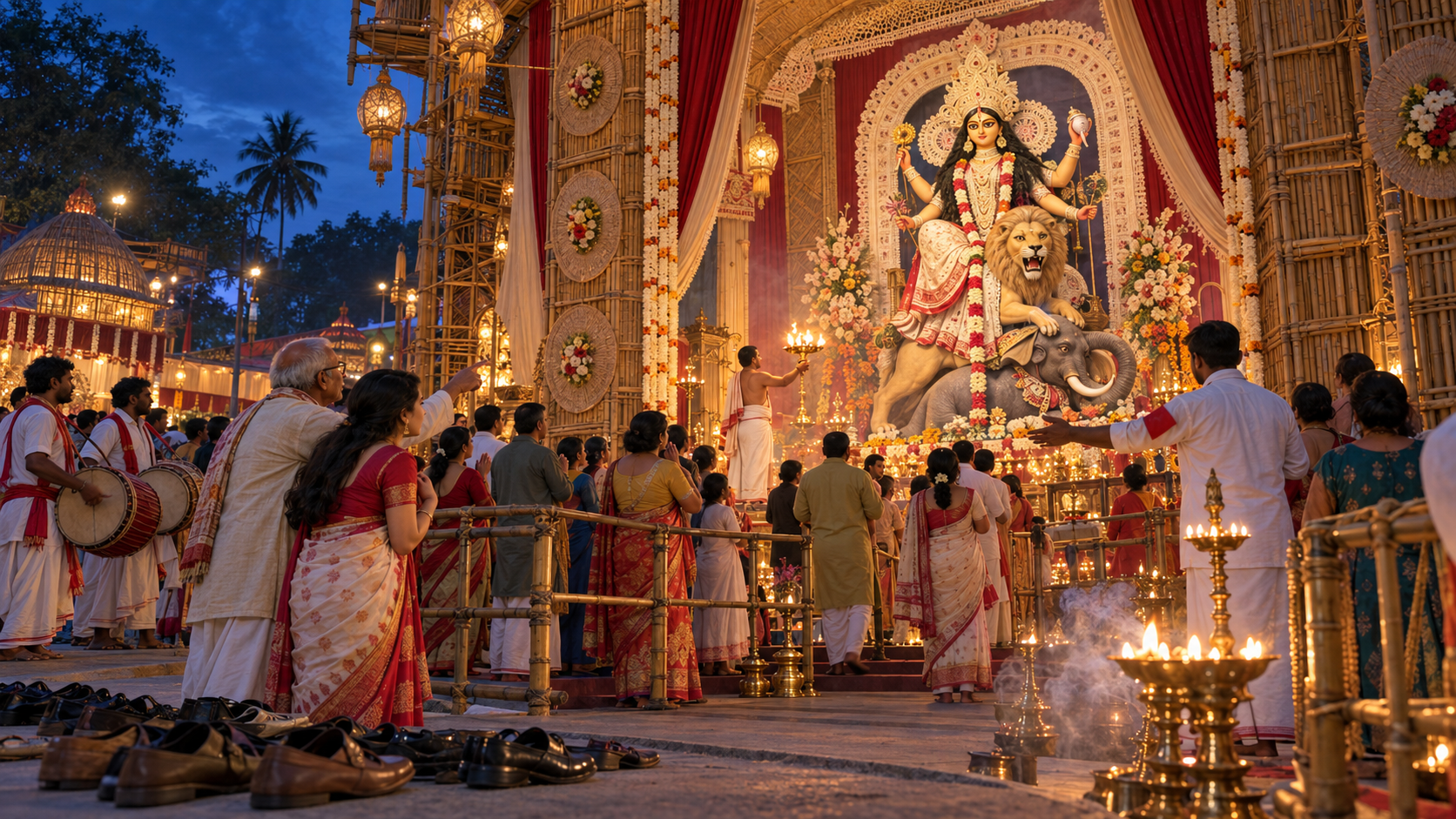
You do not need advanced knowledge of ritual to visit respectfully. You do need enough attention to let each community present its own tradition. A simple approach works well:
- Identify the form before discussing the festival. Look at the central murti and its surrounding figures. Ask a volunteer which visual details are especially significant in that locality.
- Check the local programme. Find the announced times for darshan, anjali, arati, bhog distribution and immersion. Do not carry over a timetable from Durga Puja or from another neighbourhood.
- Follow the worshippers’ physical cues. Observe where footwear is left, where visitors queue and whether photography is permitted. A public pandal remains a place of worship, even when its artistry attracts large secular crowds.
- Pause before photographing. First take in the complete sacred composition: the Goddess, her mount, the subdued adversarial figure, her hands and attributes. The image is theology made visible, not merely a backdrop.
- Use the correct name. Referring to Jagadhatri as Durga may be understandable at first glance, but it erases the form chosen for worship. If you are uncertain, ask rather than guess.
- Receive local explanation without forcing uniformity. Household, temple and community customs can vary. Variation within a living tradition does not automatically indicate error.
If you are taking children, give them one question to answer at each puja. At Durga Puja, ask what the image teaches about courage and the rightful use of strength. At Jagadhatri Puja, ask what it means to support something patiently after the dramatic struggle is over. That small exercise moves the visit from visual consumption to spiritual attention.
What Bengal’s two celebrations ask you to notice
The deepest connection between these pujas is not that Bengal celebrates the Goddess twice. It is that no single image can exhaust the nature of Shakti. The Mother is fierce without being cruel, sustaining without being inert, victorious without becoming arrogant and powerful without abandoning order.
Durga corrects the comforting belief that harmony maintains itself. Jagadhatri corrects the equally dangerous belief that one heroic victory is enough. Adharma must be confronted, but dharma must also be carried through ordinary time.
When you next visit these celebrations, resist the urge to begin with which pandal is larger or which decoration is more impressive. Stand before the murti long enough to identify the divine action being shown. Let Durga sharpen your courage, and let Jagadhatri ask what you are prepared to sustain after courage has done its first work.
References

Leave a Reply
You must be logged in to post a comment.