
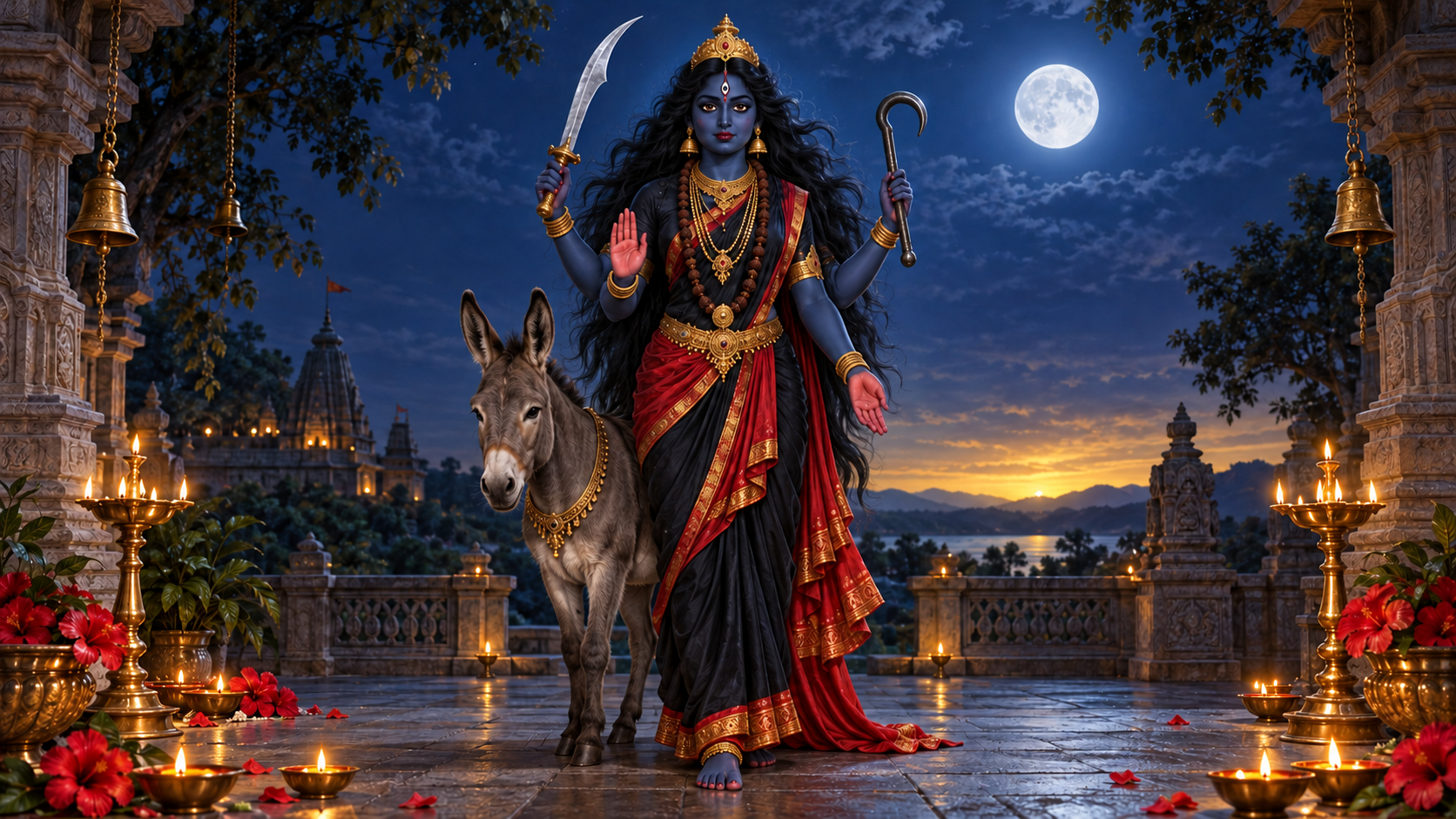
If you are arranging the seventh-day worship of Sharad Navratri in 2026, mark 17 October 2026. The corresponding seventh day of Chaitra Navratri fell on 25 March. Keeping the two Navratri cycles separate will spare you much of the calendar confusion that appears when you search for “Navratri day 7.”
Your first decision is not how elaborate the puja should be. It is which tradition you are following. The Navadurga sequence dedicates this day to Maa Kalaratri, while particular temples and regional Durga Puja traditions may use a different name, alankaram, or ritual sequence. Fix that context first; then perform one coherent observance instead of combining several unrelated instructions.
Confirm the calendar and the tradition before the puja
The seventh day is identified as Devi Saptami, Durga Saptami, or Maha Saptami. In the Navadurga method, Maa Kalaratri is the form worshipped. That gives an independent household a clear starting point, but it does not make every local observance identical.
In Bengal, Assam, and other parts of eastern Bharat, Saptami belongs to the Durga Puja sequence and is observed within that community liturgy. At Vijayawada’s Kanaka Durga Temple, the seventh-day alankaram for 17 October is Sri Mahalakshmi Devi. These practices do not cancel Kalaratri worship. A Navadurga form, a temple alankaram, and a regional festival sequence are related frameworks, not interchangeable labels.
Use this decision rule: follow your family’s parampara when you have one; follow the announced temple procedure when attending a temple; and use the Kalaratri form when conducting an independent Navadurga puja at home. If you need an exact clock time, consult a panchanga calculated for your location or ask the priest serving your community. A festival date is an anchor, but it does not replace local tithi boundaries.
Understand why the fierce form is called Shubankari
Maa Kalaratri represents the destruction of evil forces and darkness. Yet she is also called Shubankari, the one who brings about the auspicious. Her fierce appearance should therefore not be mistaken for inauspiciousness. It expresses protective power: darkness is confronted so that what is truthful, ordered, and life-sustaining can prevail.
For your observance, make that symbolism precise. Do not leave “darkness” as a vague religious word. Before the puja, identify one tendency that is distorting your conduct:
- A fear that keeps you from carrying out a rightful responsibility.
- Anger that has moved from opposing a wrong action to hating a person.
- Dishonesty you excuse because admitting the truth would be inconvenient.
- A harmful habit you keep postponing because the first corrective step is uncomfortable.
Choose one tendency and connect it to one action you can complete. If fear has delayed a necessary conversation, decide when you will begin it. If anger is governing your speech, resolve not to send the message composed in that state. If you have neglected a duty, name the first unfinished part and do it. Kalaratri worship becomes useful when the destruction of darkness produces dharmic conduct rather than merely dramatic language.
This distinction also prevents a serious spiritual mistake: do not designate another human being as the evil to be destroyed. Name the falsehood, cruelty, cowardice, exploitation, or indiscipline that must end. Dharma can require firm opposition to harmful conduct without turning hatred into a form of worship.
Perform a simple Kalaratri puja at home
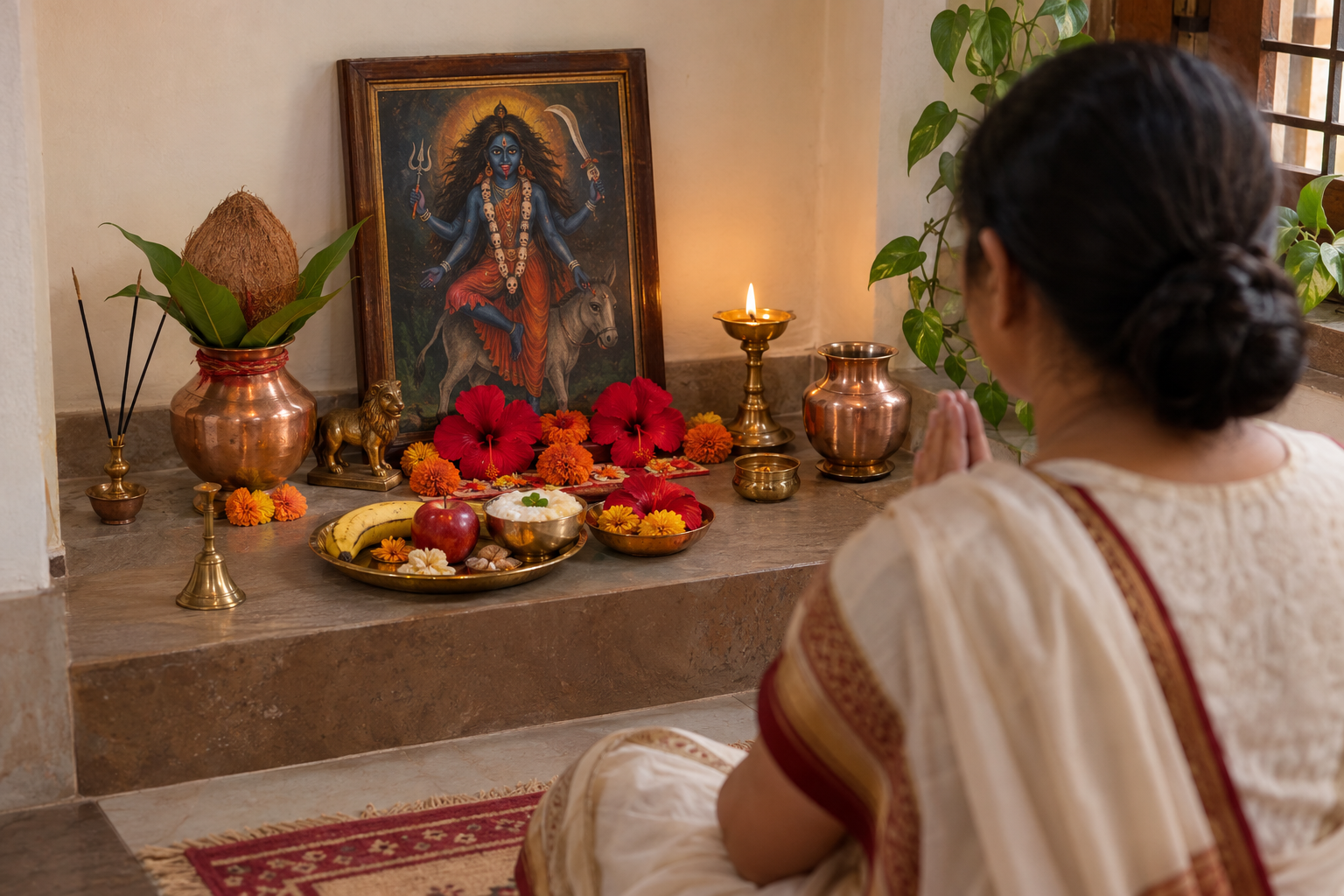
A household puja does not become more sincere because the shopping list becomes longer. Assemble what your family normally uses. A traditional Kalaratri puja list can include turmeric, kumkum, rice, a kalash, water or Ganga water, and camphor, along with the usual lamp, flowers, incense, and food offering available in your home. If a kalash was established at the beginning of Navratri, continue its worship rather than treating the seventh day as a separate installation.
Keep the order steady and understandable:
- Clean the worship space, bathe, wear clean clothing, and place the image or murti of the Devi securely. Put the lamp or camphor plate on a stable, heat-resistant surface and never leave a flame unattended.
- Complete the preliminary worship used in your household. If your family begins with achamanam, the lighting of the lamp, or another customary invocation, retain that order.
- State your sankalpa. Name the occasion, Maa Kalaratri, and the purpose of the worship. A plain-language resolve is sufficient when you have not learned a formal Sanskrit sankalpa.
- Sit quietly and contemplate the Devi as fierce toward adharma and auspicious toward the devotee. Hold the conduct you intend to change in awareness without turning the puja into self-condemnation.
- Offer water, flowers, rice, turmeric, kumkum, incense, and naivedya according to your custom. An item should be offered reverently, not included merely because it appeared on a checklist.
- Recite the Kalaratri mantra, dhyana shloka, stotra, or simple name-remembrance that you know reliably. Steady attention matters more than attempting a long text whose words you cannot verify.
- Perform aarti, offer your pranam, distribute the food as prasad, and remain seated briefly before returning to ordinary activity. Use that pause to reaffirm the action attached to your sankalpa.
If your time or materials are limited, retain the core: a clean place, a lamp, a sincere sankalpa, one respectful offering, remembrance of Maa Kalaratri, and aarti. Do not abandon the observance because you cannot reproduce a temple-scale ritual at home.
Use mantra carefully and carry the vrata beyond the altar
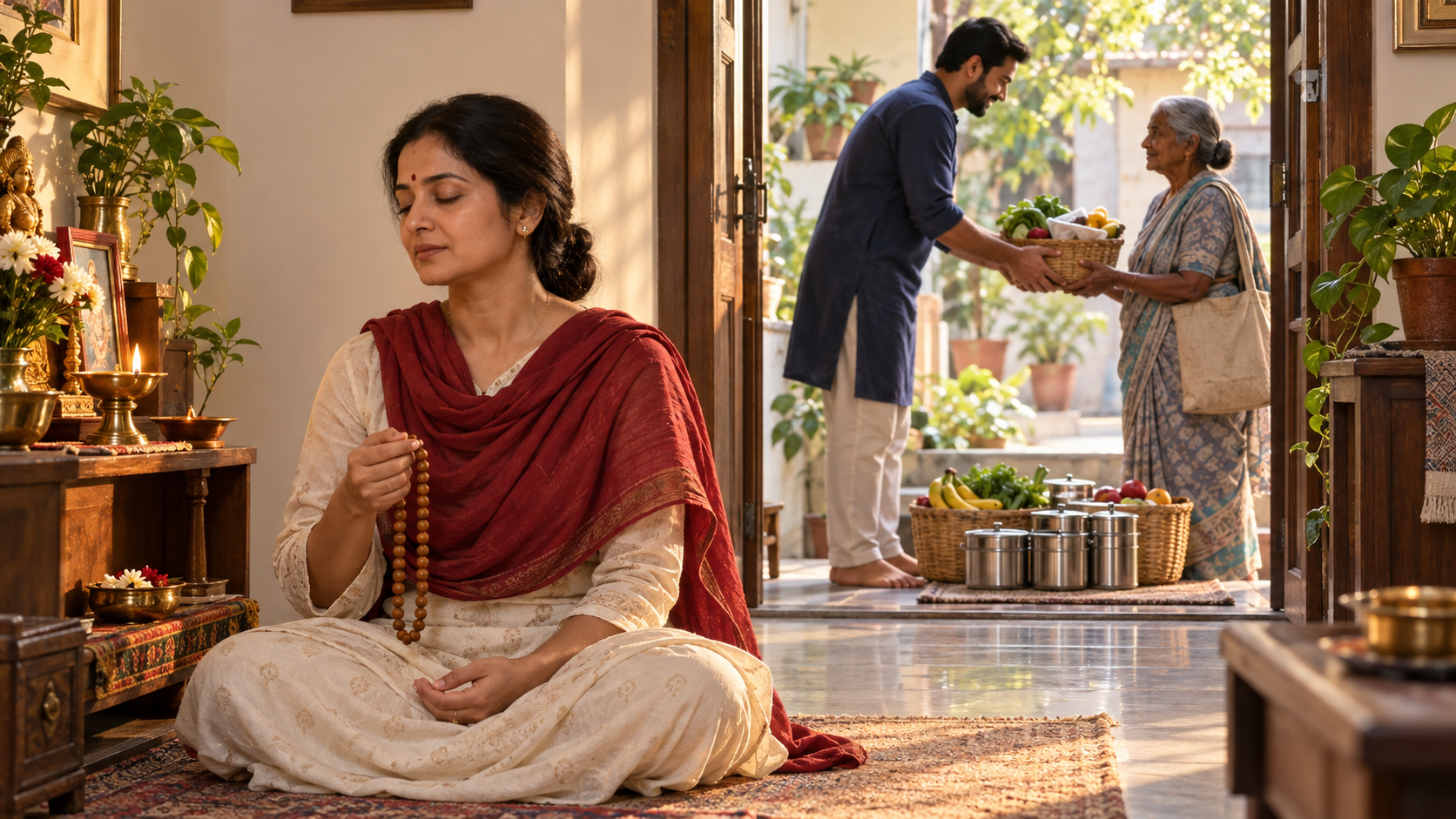
Kalaratri worship includes moola mantra, dhyana shlokas, and stotra recitation. If you received a mantra through your family, guru, or sampradaya, use that form. If you did not, choose a text you can verify and pronounce with care, or repeat the Devi’s name prayerfully. Copying an unfamiliar transliteration and rushing through it is not a necessary condition of worship.
Your household rules may also include fasting, particular foods, or restrictions inherited through family practice. Observe those rules as your health and established tradition permit. Do not shame another devotee whose vrata differs, and do not treat physical strain as proof of spiritual depth. The focus of the day is disciplined worship of the Devi, not a competition in austerity.
After aarti, let the observance enter the rest of the day. You can do that without inventing a new ritual:
- Restrain the harsh sentence you were preparing to justify as honesty.
- Finish the rightful task that fear or inertia made you avoid.
- Correct one false statement instead of protecting your pride.
- Offer practical help quietly, without turning seva into a public performance.
- Remove one influence that repeatedly feeds anger, confusion, or indiscipline.
These actions are not replacements for your family’s vrata or temple rites. They are ways of ensuring that the puja leaves a mark on your conduct. A fierce divine form should make the devotee less ruled by fear and falsehood, not more aggressive toward the world.
Key takeaways for 17 October 2026
- The seventh day of Sharad Navratri falls on 17 October 2026; the Chaitra Navratri seventh day fell on 25 March.
- Maa Kalaratri is worshipped on this day in the Navadurga sequence and is also known as Shubankari.
- Regional Durga Puja sequences and individual temple alankarams can differ without invalidating Kalaratri worship at home.
- Use your family parampara first, the temple’s announced procedure when attending a temple, and a local panchanga for location-specific timing.
- A simple, orderly puja is enough: sankalpa, offerings, reliable recitation or name-remembrance, aarti, prasad, and a concrete dharmic resolve.
- Direct the symbolism of destroying darkness toward fear, falsehood, harmful habits, and adharma – never toward hatred of a person.
Before 17 October, set out the few puja materials you will actually use and decide which unresolved duty will become your sankalpa. When the worship ends, complete its first practical step. That is how Kalaratri’s fierce auspiciousness moves from the altar into the life you must live.
References
- Hindu Pad – 7th day Navratri Puja Muhurat, 17 October 2026
- Hindu Pad – 7th day Alankaram in Vijayawada Dasara Navaratri 2026, 17 October | Mahalakshmi Devi Alankaram
- Hindu Pad – 7th day of Navratri 2026, October 17
- Hindu Pad – 10 Things to do on 7th day of Navratri, 17 October 2026
- Hindu Pad – Kalratri Puja Vidhi | Maa Kalaratri Pooja
- Hindu Pad – Maa Kalratri Mantras – Moola Mantra, Dhyana Slokas, Stotra

Leave a Reply
You must be logged in to post a comment.