

If you worship at or help run a Hindu temple in the United States, a reported plot in Illinois raises an immediate question: should your community change how it gathers? The responsible answer is neither denial nor panic. Treat credible warning behaviour seriously, preserve the evidence, and make sure devotees know whom to contact.
The Illinois case is unsettling because ordinary people appear to have played an important preventive role. Co-workers reportedly alerted police, while a rifle allegedly connected to the plan malfunctioned. The first is a security lesson communities can apply; the second was chance and must never be mistaken for protection.
What is known, and what should remain qualified
A 19-year-old man was reportedly arrested over an alleged white-supremacist plot involving a mass shooting at a Hindu temple in Illinois. Indians were described as the intended targets. Those are grave allegations, but they are still allegations. An arrest is evidence of law-enforcement action, not a finding of guilt.
Without a charging document or official case record before us, it would be irresponsible to supply a temple name, alleged timetable, precise criminal charges, or details about how far the plan had progressed. Do not fill those gaps with social-media claims. If additional information emerges, separate what police or a court has confirmed from what anonymous accounts are repeating.
The alleged selection of both Indians and a Hindu temple matters. Hostility can racialise a community while also targeting its religious identity. A temple is not merely a building in which people of Indian ancestry happen to meet. It is a sacred institution, a place of education and service, and often a centre of intergenerational community life. Describing only the racial element would obscure the anti-Hindu dimension; describing only the religious element could conceal the ethnic hostility.
That distinction also affects incident records. When reporting a threat, note every identity explicitly invoked by the person making it: Hindu, Indian, a particular language community, or another named group. Record the exact words rather than trying to choose a single motive on the spot. Investigators can assess the legal significance later.
The decisive warning may appear outside the temple

The most actionable feature of this case is that co-workers reportedly alerted police. The people who first encounter dangerous behaviour are not always temple officials or devotees. They may be colleagues, classmates, relatives, neighbours, online acquaintances, shooting-range staff, or members of an unrelated organisation.
The task is not to identify everyone who holds an offensive opinion. Focus on conduct that moves from prejudice towards preparation: naming a target, discussing a method, gathering operational information, seeking access, testing a weapon, communicating a timetable, or expressing an intention to act. A single ambiguous remark may need context; a specific target combined with preparation deserves prompt attention.
If you encounter such behaviour, do not confront the person, conduct your own investigation, or try to provoke a clearer threat. That can increase danger and damage useful evidence. Preserve what you already have, record what you directly observed, and pass it to the appropriate authorities. If the danger appears immediate, move to safety and contact emergency services first.
A useful report distinguishes observation from interpretation. Write down the exact language used, where and when it occurred, the identity or account involved, the named target, any apparent access to weapons or restricted places, and who else witnessed it. Then state separately why the behaviour concerned you. “He said these words and displayed this image” is more useful than “he seemed dangerous.”
What to do if you receive or discover a threat

Your first decision depends on immediacy. A person approaching a temple with a weapon, a threat naming an event already under way, or suspicious activity occurring at the premises calls for emergency action. Do not travel towards the temple to see what is happening. Follow instructions from police and authorised temple communications.
For a message or online post that does not present an immediate physical emergency, preserve it before an account can be deleted or altered. A practical evidence package includes:
- The complete message or conversation, not only the most alarming sentence.
- The account name, profile details, platform, web address, and visible date and time.
- Screenshots that retain surrounding context, alongside the original link when available.
- A short note identifying what you personally saw and what someone else forwarded to you.
- The event, temple, person, or community named as the target.
- A record of where the information was reported and any reference identifier you received.
Send the material through a defined temple contact and to law enforcement when the content indicates a credible safety concern. Do not assume that notifying a committee member automatically means police have been contacted, or that a police report automatically reaches temple leadership. Confirm both handoffs without circulating the material through large messaging groups.
Avoid reposting threatening content publicly unless authorities need help identifying its origin. Repetition can spread fear, reward the person seeking attention, expose private information, and reveal what the temple knows. It can also turn an incomplete claim into a community-wide rumour before anyone verifies it.
If you are attending an event after a threat has been reported, use the temple’s official channel for schedule changes. Tell family members where you will meet if the group becomes separated, keep children and dependants close, and mention mobility, hearing, or language needs to an usher when you arrive. These are ordinary preparations, not reasons to abandon worship.
How temple leaders can strengthen security without governing by fear
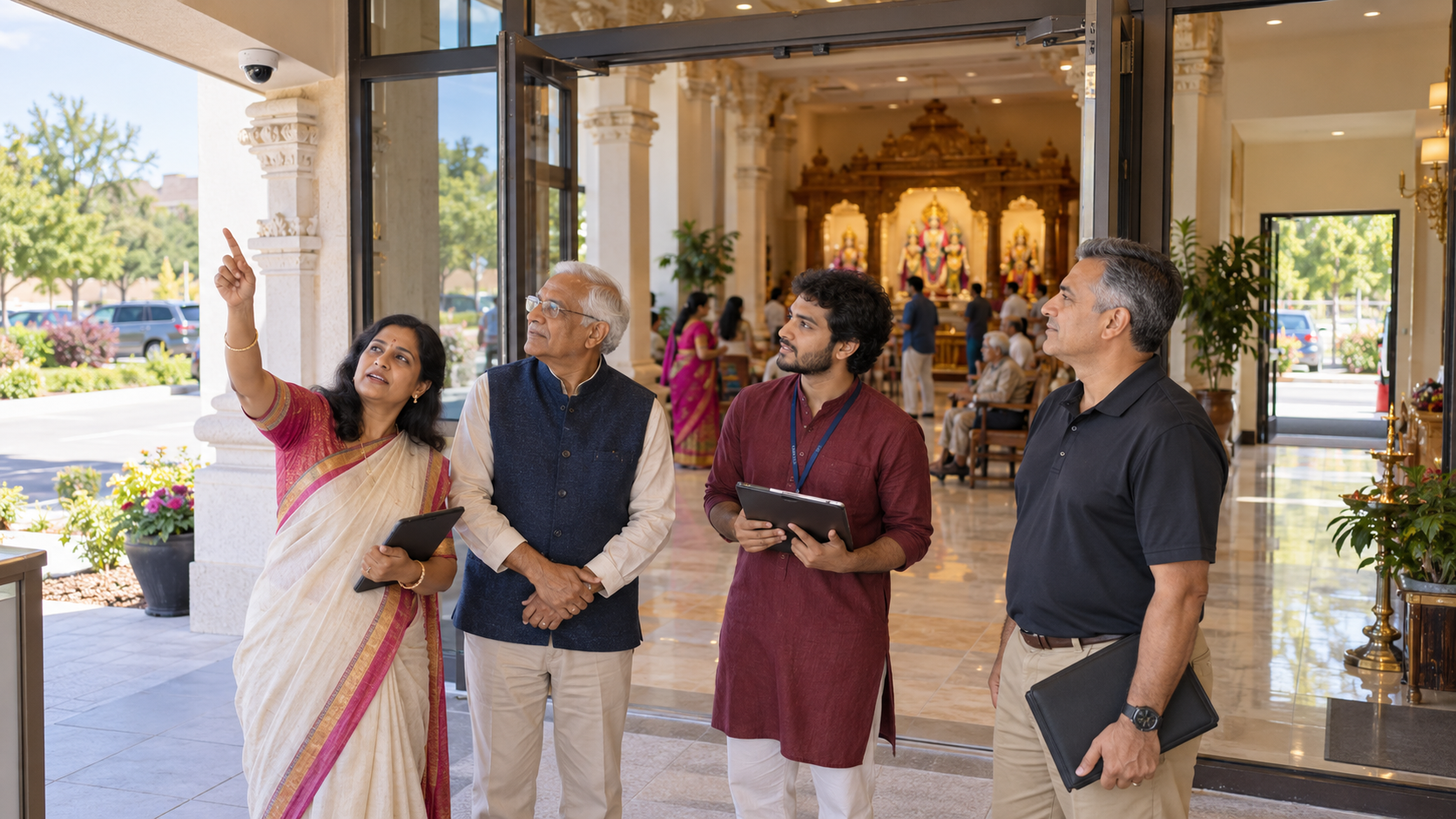
A temple does not need to become a fortress to become harder to harm. The largest operational weakness is often an unclear handoff: a volunteer sees something serious but does not know who has authority to call police, pause an event, issue instructions, or preserve camera footage. Assign those responsibilities before the next crowded gathering.
- Name decision roles. Identify who contacts emergency services, who directs people inside the building, who checks on children and elders, who communicates with families, and who speaks publicly. Provide backups in case the primary person is absent.
- Walk the actual site. Check entrances, exits, gathering halls, classrooms, kitchens, parking areas, and places where a crowd forms. Keep emergency routes usable and make sure volunteers understand which doors serve which purpose.
- Brief the people at the front. Greeters and parking volunteers may notice concerning behaviour first. Give them a direct way to reach the safety lead without leaving their positions or debating the situation publicly.
- Create one threat-intake path. Publish an email address or phone contact that a devotee can use without searching through a committee directory. Ensure that someone monitors it and knows how to escalate urgent material.
- Control sensitive information. Know who can retrieve recordings, secure original messages, and share evidence with investigators. Do not place suspected identities, live camera views, or response positions in public groups.
- Rehearse communication. Volunteers should know the plain-language instructions for leaving, sheltering, accounting for children, and directing arriving families away from danger. A short walk-through exposes confusion that a written plan can hide.
Any decision about armed security requires qualified local advice, careful legal review, and trained personnel. Do not ask an untrained volunteer to improvise an armed response. A weapon in unqualified hands can create additional danger and make it harder for arriving police to distinguish a defender from an attacker.
Security must remain behaviour-based. Race, clothing, accent, caste, nationality, disability, or unfamiliarity with temple customs is not suspicious conduct. A visitor asking basic questions may simply be new. Train greeters to welcome people while noticing actions such as attempts to enter restricted areas, photograph security arrangements after being asked to stop, bypass normal access, or make a threat.
Public communication should be brief and operational. State what has been verified, whether the programme is continuing or changing, where devotees will receive updates, and what information they should avoid sharing. Do not speculate about motive, guilt, accomplices, or the identity of a temple unless authorities have confirmed those points and disclosure serves a safety purpose.
A usable notice can follow this structure: “We are aware of a reported threat affecting [community or event]. [Responsible authority] is handling it. [Event] is [continuing, modified, postponed, or cancelled]. Verified updates will appear through [official channel]. Please do not circulate identities, rumours, or live security details.” Replace every bracketed field with confirmed information; if a fact is not confirmed, leave it out.
Key takeaways
- The reported Illinois case involves an alleged white-supremacist plan to attack a Hindu temple and target Indians; the allegations should not be presented as a conviction.
- Co-workers reportedly raised the alarm. People outside a threatened institution can be crucial when hostility begins turning into preparation.
- A reported rifle malfunction was chance, not a security measure. Prevention depends on human reporting, clear decisions, and competent authorities.
- Preserve exact language, context, account details, timing, and the named target. Separate what you observed from what you inferred.
- Do not confront a suspected attacker, investigate independently, or broadcast operational information. Move to safety and contact emergency services when danger is immediate.
- Temple security should protect worship without profiling visitors or allowing fear to take control of community life.
Before your temple’s next major gathering, ask a concrete question: if a volunteer receives a credible threat tonight, who records it, who contacts the authorities, and how do devotees receive verified instructions? If nobody can answer immediately, fix that handoff first. It is a quiet change that can give vigilance somewhere useful to go.
References

Leave a Reply
You must be logged in to post a comment.