

You know the moment when a thought stops feeling like a suggestion and starts issuing orders. Anger demands an immediate reply. Fear invents a future and calls it certain. Craving narrows your attention until nothing else seems important. You may know that the mind is moving, yet still feel carried along by it.
Betala beneath Bhairava offers a precise response to that condition. Do not obey every movement of mind, but do not waste your strength pretending the movement is absent. See it, contain it and place it under a clearer authority.
Read the posture before explaining the symbol
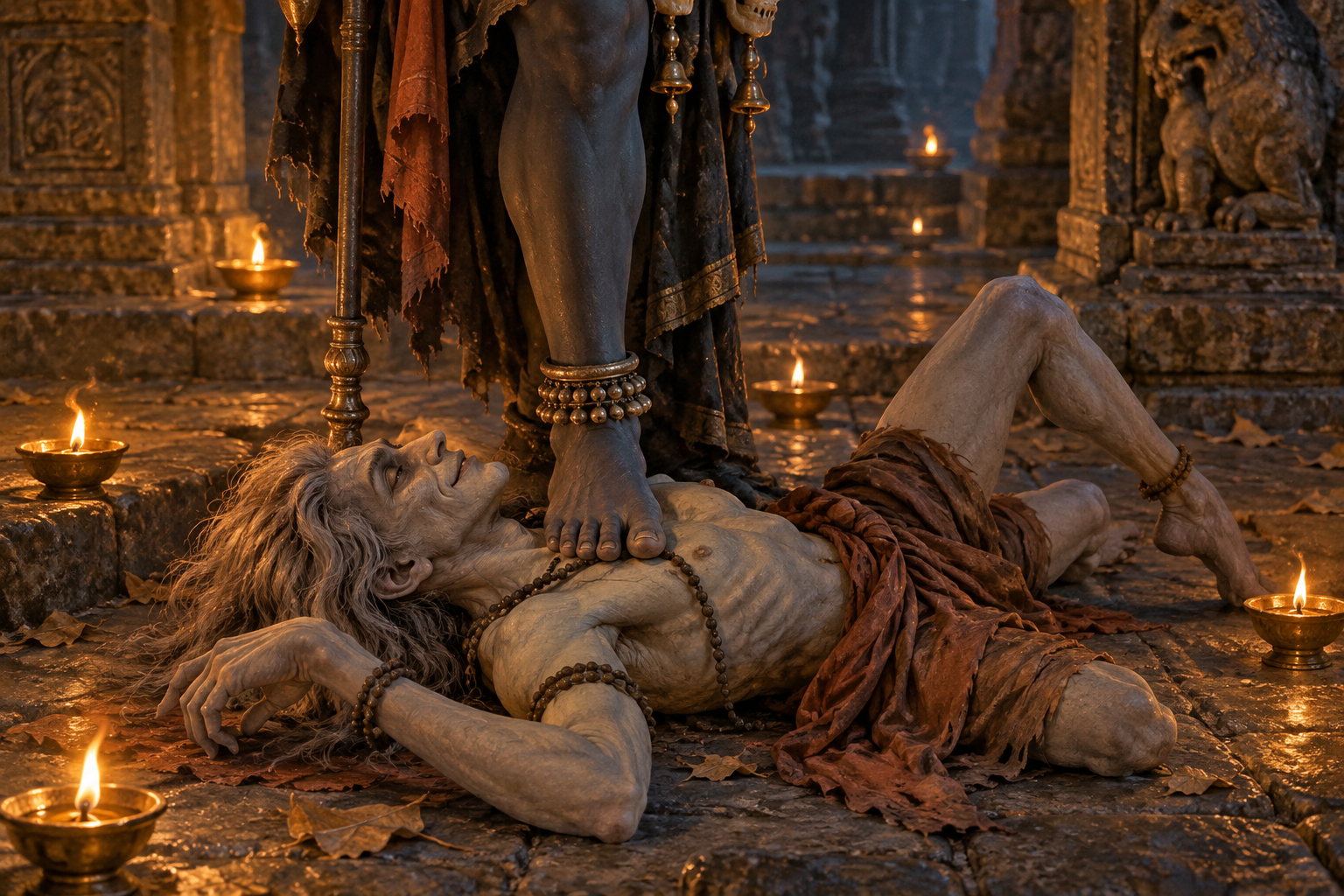
In many Hindu temples in Kathmandu, Nepal, images of Bhairava in stone or bronze show a smaller figure beneath his feet. Devotees and priests identify that figure as Betala. The crucial detail is easy to miss: Betala remains within the composition. He is subdued, not erased.
The arrangement communicates through position. Bhairava stands above; Betala lies below. One governs the scene; the other has lost the freedom to govern it. Read as an image of inner discipline, this is presence without sovereignty. The troublesome force still exists, but it no longer decides what happens next.
This should be treated as a contemplative reading of the image, not as a claim that every Bhairava image has one exclusive meaning. Sacred iconography can carry ritual, theological, local and psychological meanings at the same time. The mental reading is valuable because the visible relationship is so exact: what has not vanished can nevertheless be brought under command.
That distinction changes how you meet your own mind. A thought does not earn authority merely because it appeared. An emotion does not become a command merely because it is intense. An impulse does not become your identity merely because it returns. In this reading, Bhairava represents the awareness and discipline capable of keeping those movements in their proper place.
Mastery changes who gives the order
The mind is not an enemy to be destroyed. You need memory, imagination, anticipation and desire to live intelligently. The difficulty begins when one mental movement captures the whole field and speaks as though it were the self.
- Suppression says, “This thought must not exist.” The unwanted thought is driven out of sight, where it can continue shaping conduct without examination.
- Indulgence says, “Because I feel this strongly, I must follow it.” Intensity is mistaken for truth or moral permission.
- Mastery says, “This is present, but it is not in command.” The thought can be observed, tested and either used or refused.
Betala’s continued presence matters here. If the figure had disappeared, the image could be mistaken for a promise that disciplined people never experience disorder. Instead, the symbol allows for a more honest aim. Fear may arise. Resentment may return. Attention may wander. Mastery is shown by the relationship you establish with those movements, not by claiming never to have them.
You can test that relationship with three questions: Can you notice the movement without calling it your whole identity? Can you examine what it is asking you to do? Can you let dharma, rather than urgency, determine your next act? If the answer to any of these is no, the mental movement is still standing where Bhairava should stand.
Use the image when the mind tries to capture you

The following is a personal contemplative exercise inspired by the image. It is not a claim about a prescribed temple ritual. Use it when you notice yourself rehearsing an insult, preparing an angry message, avoiding a duty or treating a fearful prediction as an established fact.
- Interrupt obedience. Before replying, deciding or reaching for the object of craving, become physically still. Feel your feet on the ground and allow one unforced breath to finish. You are not trying to become serene. You are creating enough space to prevent an impulse from turning immediately into action.
- Name your Betala precisely. Complete the sentence, “My mind is pushing me to…” Name the proposed action, not a grand judgement about yourself. “My mind is pushing me to humiliate him” is useful. “I am a terrible person” is not. Precise naming reveals the command that must be governed.
- Identify the hook. Ask what gives the command its force: fear, injured pride, craving, envy, avoidance or the wish to be seen as right. You do not need to solve your entire history in that moment. You need to recognize the handle by which the mind is pulling you.
- Place a dharmic criterion above the impulse. Ask which available action is truthful, non-harming, responsible and appropriate to your actual duty. The relevant criterion may be restraint, courage, honesty, patience or a firm boundary. Do not ask only what will end the discomfort fastest.
- Make mastery visible in conduct. Delay the hostile reply, return to the neglected responsibility, leave the situation that feeds the craving, or obtain facts before acting on fear. The test is behavioural. Insight that changes no choice has not yet become mastery.
If the same movement returns, do not declare the practice a failure. The image itself does not depend on Betala ceasing to exist. Restore the hierarchy again. Repeatedly returning the mind to its proper place is abhyasa: discipline expressed through renewed action rather than a dramatic claim of permanent victory.
This also gives you a practical way to review a difficult day. Do not ask only, “Did I feel angry, afraid or distracted?” Ask, “What did that feeling get me to do?” A strong emotion that was noticed and ethically governed is not defeat. A seemingly calm choice made under concealed resentment may still show that Betala was directing the scene.
Do not confuse mastery with crushing what is human

A fierce image can be misread as permission for inner violence. That would reverse its ethical value. The person under discipline is not to be hated. The body is not to be punished for having needs. Emotion is not evidence of spiritual inferiority. Another human being must never be treated as the Betala you are entitled to crush.
Emotions can carry information without deserving control. Fear may point to danger. Anger may reveal a violated boundary. Grief may show what you valued. Desire may reveal an unmet need. Listen for the information, then decide whether the proposed action accords with dharma. Mastery preserves that power of discernment; suppression discards it.
The symbol also cannot make every inner struggle a private failure of will. Recurring thoughts, panic, compulsions or other mental distress can require skilled care, especially when they cause significant suffering or interfere with daily life. In that situation, consult a qualified mental-health professional. Contemplation may accompany appropriate care, but it should not replace it.
A reliable test is whether your discipline increases truthful, responsible and non-harming action. If a practice produces shame, self-injury, cruelty or contempt for people who struggle, it is no longer serving mastery. Bhairava’s position above Betala symbolizes governance, not licence for abuse.
Key takeaways
- Betala remains present beneath Bhairava, so the image points to subordination of a disruptive force rather than denial of its existence.
- Mental mastery does not require you to stop having difficult thoughts or emotions. It requires you to stop granting them automatic authority.
- Name the action an impulse is demanding before you judge yourself for experiencing it.
- Place truthfulness, non-harming, responsibility and duty above the wish for immediate relief.
- Measure mastery by the next ethical action, not by how calm or spiritually accomplished you manage to feel.
The next time your mind speaks with the force of an order, remember the arrangement beneath Bhairava’s feet. Say plainly, “This is present, but it is not in command.” Then choose the smallest concrete action that restores dharma to the higher position. That choice is where the stone image becomes a living discipline.
References

Leave a Reply
You must be logged in to post a comment.