
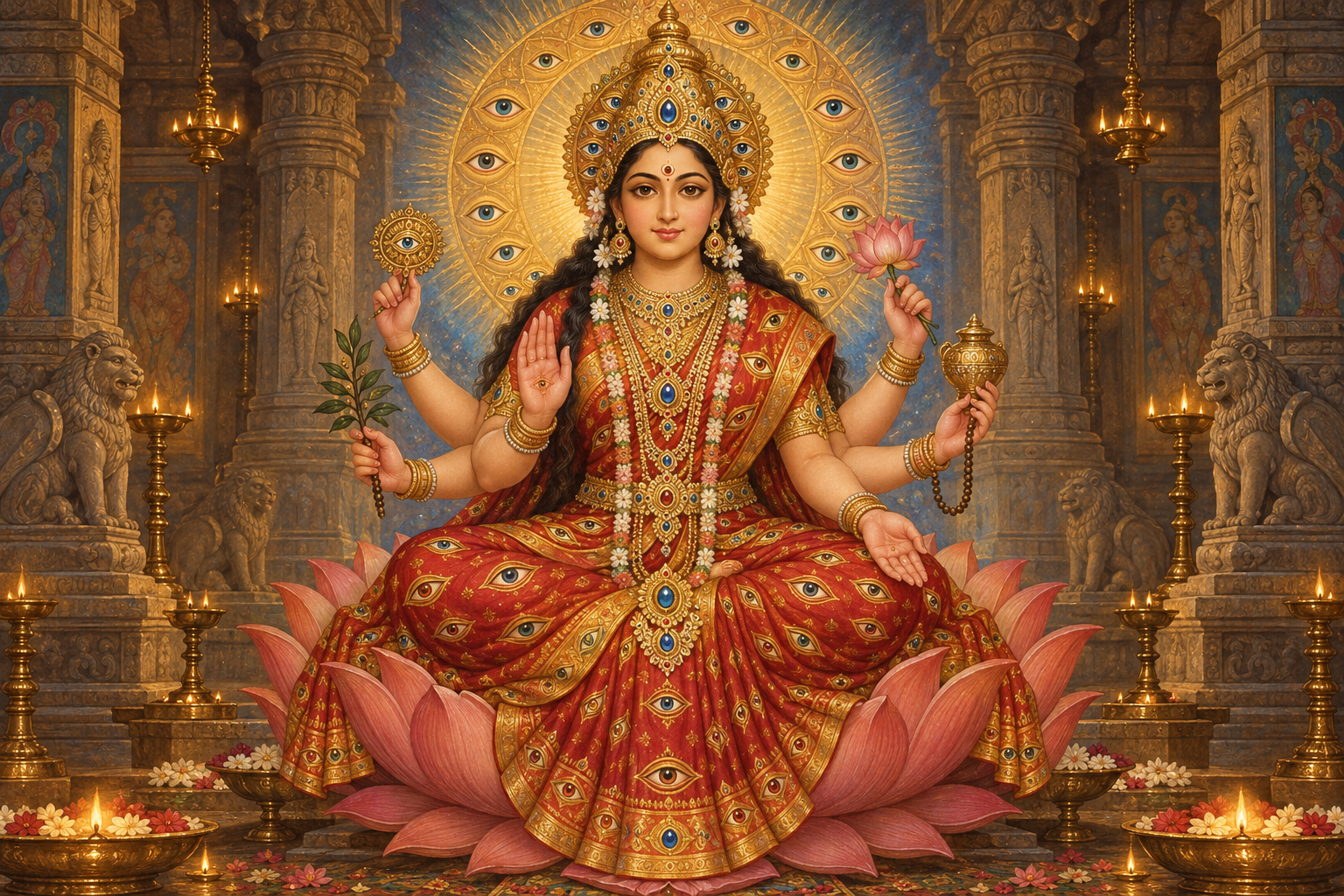
You may encounter Indrakshi Devi in a temple image, a devotional hymn, or a contemporary print and wonder what actually identifies her. The temptation is to search for a rigid visual checklist. With this Devi, that approach can obscure more than it reveals.
The surest place to begin is her gaze. Indrakshi is remembered as a distinctive protective form within the Shakta tradition, and her many eyes communicate the quality of her presence: vigilant, far-seeing, and available wherever danger arises. Once you understand that central symbol, variations in artistic form become easier to read without mistaking every variation for a contradiction.
Start with the name, not a count of visual attributes
Indrakshi carries two closely related interpretations. Her name can mean “she whose eyes resemble Indra,” while popular devotional understanding knows her as the thousand-eyed Devi. The first emphasizes the extraordinary character of her eyes; the second expands that quality into an image of vision present in every direction.
That distinction matters when you look at an image. “Thousand-eyed” need not function as an instruction to place exactly one thousand anatomical eyes on a sculpture or painting. It can be read as sacred abundance: ordinary sight is confined to one position, but the Devi’s awareness is not. A work may therefore communicate her identity through a proliferation of eyes, through an exceptionally prominent gaze, or through its ritual context rather than through literal arithmetic.
Use the name as your first interpretive key. Ask what the eyes are doing within the composition. Do they dominate the face? Do they appear beyond the ordinary pair? Does the surrounding devotional setting identify the figure as Indrakshi? Those questions are more reliable than deciding that any many-eyed goddess must be her—or that an image cannot be hers unless hundreds of eyes are visible.
Why her iconography must be read through text and image

Some Hindu deities have forms set out extensively in major iconographic compendiums. Indrakshi receives comparatively limited treatment there. Her sacred form has instead been carried through devotional hymns and later ritual digests. Her iconography is therefore textual as well as visual.
This changes how you should assess a representation. A captioned ritual image connected to an Indrakshi hymn may be more securely identified than an unlabelled figure that merely resembles what you expected. Conversely, a regional or contemporary rendering should not be dismissed simply because it differs from another picture found elsewhere. Limited standardization permits variation; it does not make every interpretation equally authoritative.
When you need to identify or describe an Indrakshi image, use this order:
- Establish the ritual context. Look for the name Indrakshi in the caption, shrine, hymn, worship manual, or accompanying explanation.
- Identify the defining idea. Give priority to the extraordinary gaze and protective character rather than assuming that every ornament or object uniquely identifies her.
- Separate attested details from interpretation. Say “this tradition depicts” when a feature belongs to a particular representation; do not silently turn it into a universal rule.
- Ask which devotional text guides the form. Where a community uses a particular hymn or ritual digest, that connection can explain features that a general iconographic handbook does not.
- State uncertainty honestly. If the context is missing, describe the visual resemblance without making a firm identification.
This method is useful beyond academic description. It prevents you from building worship around an attractive but unverified label, and it allows regional traditions to speak in their own vocabulary rather than forcing all sacred art into a single modern template.
The thousand eyes signify protective awareness
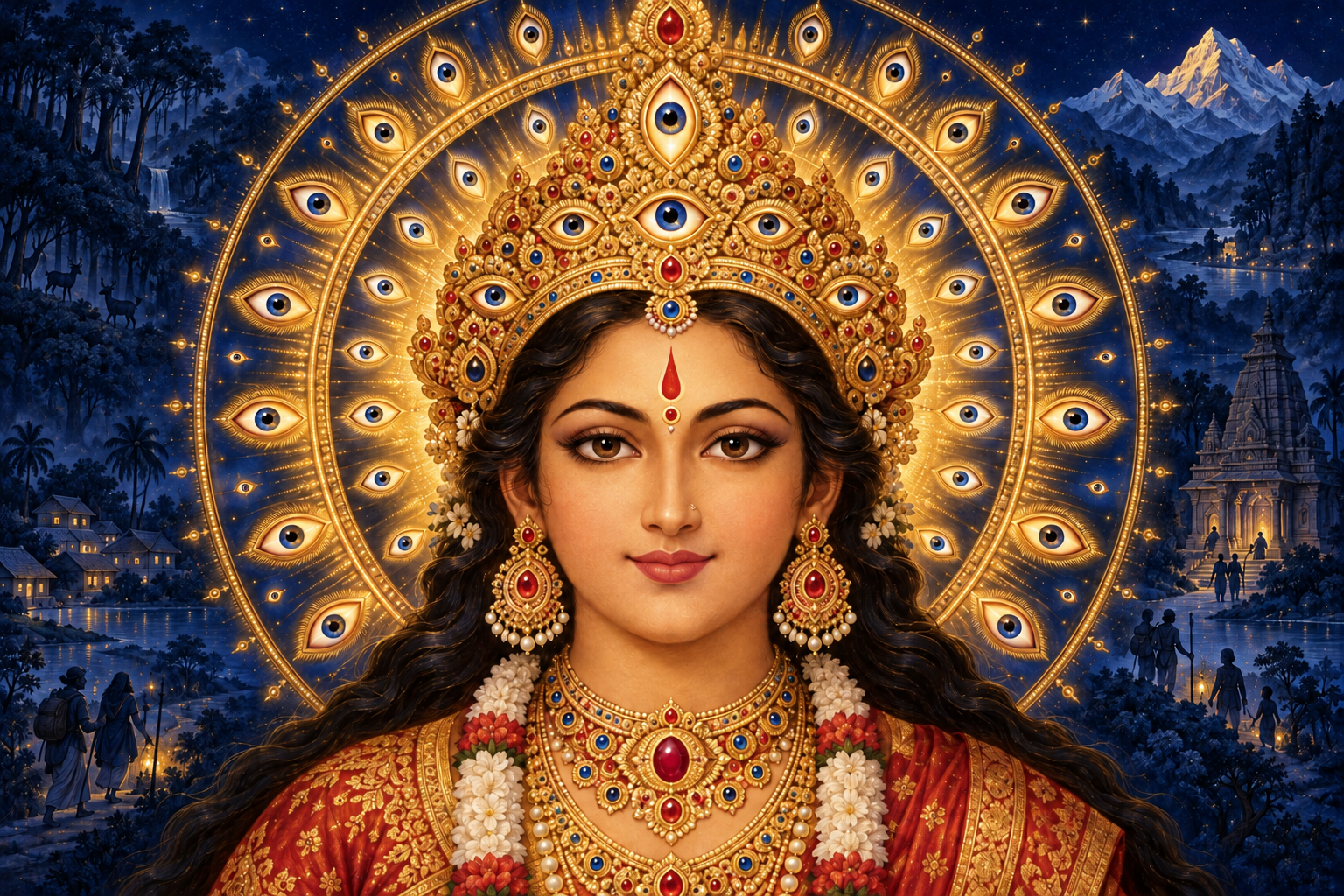
The eye is not merely a decorative emblem here. Seeing is the first movement of protection: danger must be perceived before it can be answered. The thousand eyes make that insight cosmic. No single direction exhausts the Devi’s field of attention, and no ordinary blind spot limits the symbolism of her watchfulness.
This does not have to be understood as surveillance. The devotional meaning is closer to unbroken attentiveness—the assurance that vulnerability is not invisible to the divine. Indrakshi’s gaze is protective because it recognizes what threatens order, courage, and spiritual steadiness.
Her gaze also turns a question back toward the devotee. If the Devi sees in every direction, what are you refusing to notice? A recurring harmful habit, an evasion of duty, or fear disguised as passivity may persist because attention has narrowed. Contemplating her eyes can therefore become a discipline of honest seeing rather than a demand for a supernatural guarantee.
A simple way to work with the symbol is to pause before prayer and name three things plainly: the danger or confusion you perceive, the dharmic responsibility that remains yours, and the next action you can take without delay. This keeps devotion and responsibility together. You seek protection while refusing to make spiritual language an excuse for inaction.
This is a symbolic reading, not a claim that every lineage explains each eye in identical terms. When a teacher, temple, or family tradition gives a more specific interpretation, retain that context instead of replacing it with a generalized one.
Read “protectress” as Shakti in action
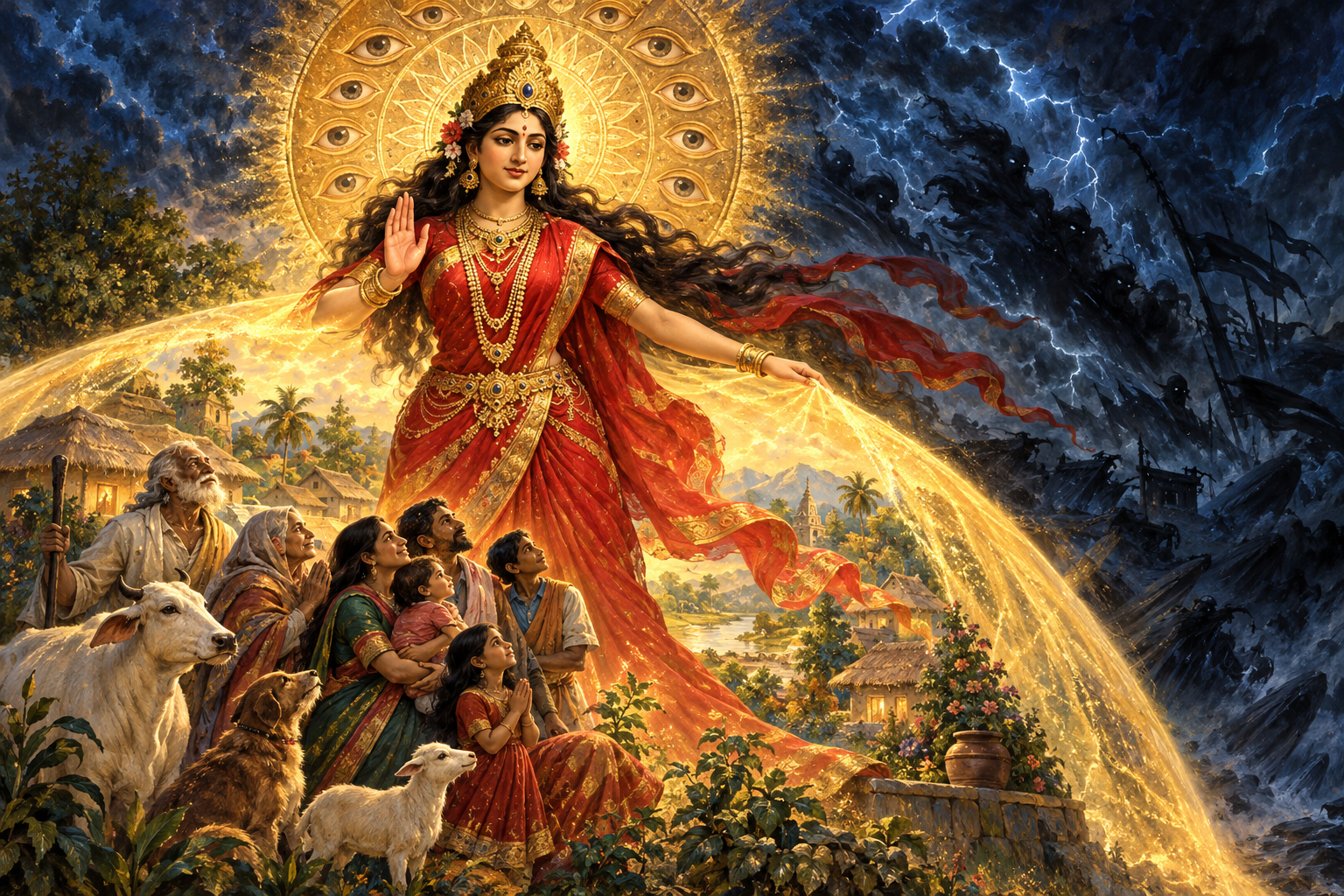
Indrakshi belongs within the Shakta understanding of Devi as active divine power. Her protection is consequently not best imagined as passive shelter. The many-eyed form joins awareness to readiness: she perceives, distinguishes, and responds.
This also explains why protective sacred imagery may carry intensity as well as compassion. A formidable presence need not indicate hostility toward the devotee. Its force can be directed against disorder, fear, or whatever obstructs a life aligned with dharma. Refuge and power are not opposites in this visual language; effective refuge requires the power to confront what endangers it.
When you stand before an image of Indrakshi, do not stop at asking what each visible feature “stands for.” Ask what response the complete form requests from you:
- What deserves your full attention now?
- Where has fear made your vision narrower than the situation demands?
- What must be protected because it sustains dharma rather than merely personal comfort?
- What action belongs to you, even while you place the outcome before Devi?
These questions preserve the practical edge of her iconography. They convert a many-eyed image from an artistic curiosity into a mirror for alert, responsible devotion.
Key takeaways for viewing or worshipping Indrakshi Devi
- Begin with her name: it can evoke eyes resembling Indra and, in popular understanding, the thousand-eyed Devi.
- Treat the thousand eyes as a sign of inexhaustible awareness, not automatically as a mandatory anatomical count.
- Use captions, shrine context, hymns, and ritual usage before identifying an unfamiliar many-eyed figure as Indrakshi.
- Expect some variation because her form is preserved strongly through devotional and ritual literature rather than extensive treatment in the major iconographic compendiums.
- Distinguish a feature documented in one tradition from a rule supposedly binding every depiction.
- Let the protective gaze sharpen your own attention: name the danger, recognize your duty, and take the next dharmic step.
The next time you encounter Indrakshi Devi, spend less time trying to force the image into a universal inventory and more time tracing the relationship between name, gaze, ritual context, and protection. If the representation belongs to a living temple or lineage, ask which hymn or practice informs it. That one question will usually take you closer to the sacred form than a collection of disconnected images will.
References

Leave a Reply
You must be logged in to post a comment.