
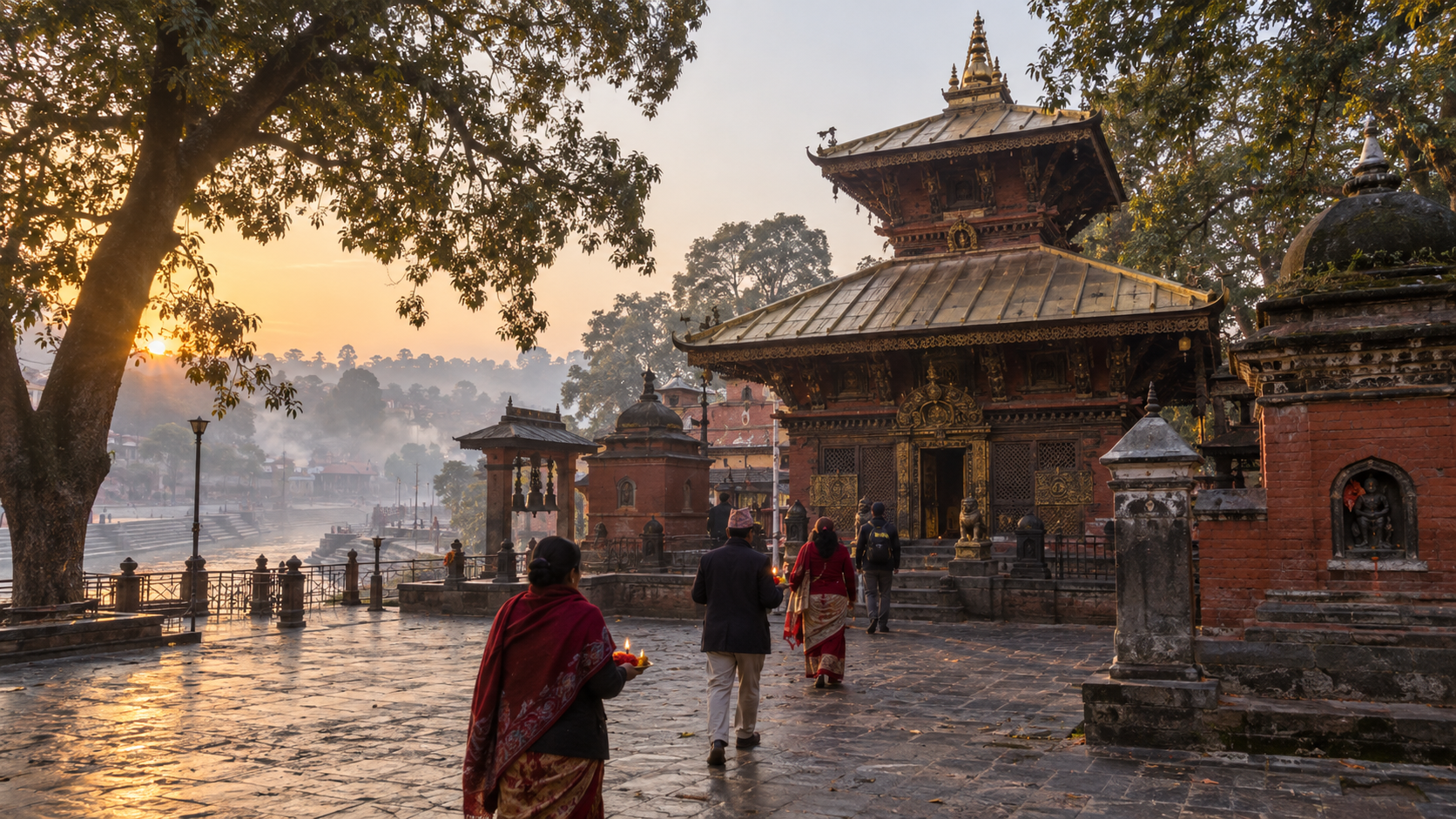
If you are planning to visit Guhyeshwari after Pashupatinath, do not treat it as a minor stop added to a larger pilgrimage. Its importance lies not in scale or spectacle, but in the way one sacred place is approached through two distinct Dharmic traditions: Hindu Shakta worship and Vajrayana Buddhism.
The useful question is not, “Is Guhyeshwari Hindu or Buddhist?” That forces the temple into a modern either-or category. Ask instead what Shakta and Vajrayana practitioners each recognise there, which ritual language they bring, and why shared reverence does not require identical theology.
Begin with Guhyeshwari’s sacred geography

Guhyeshwari stands on the eastern bank of the Bagmati River, barely a kilometre from Pashupatinath Temple. That proximity is the first thing to notice. The two shrines belong to the same sacred landscape, but they should not be collapsed into one object of worship.
Pashupatinath directs the devotee toward Shiva. Guhyeshwari is revered as a principal Shakti Peetha, a sacred seat of the Goddess. Visiting both can therefore be understood as movement through a Shaiva-Shakta landscape: Shiva is not approached as an isolated male divinity, and Shakti is not reduced to a secondary companion. Their relation expresses the inseparability of consciousness and power, stillness and manifestation.
This changes how you should move through the area. Do not judge Guhyeshwari by whether it visually competes with Pashupatinath. In a tirtha, spiritual weight is not measured by the height of a structure or the length of a queue. Pause at the Bagmati, notice the relationship between the shrines, and enter Guhyeshwari as a destination in its own right.
What a Shakta devotee recognises at the temple
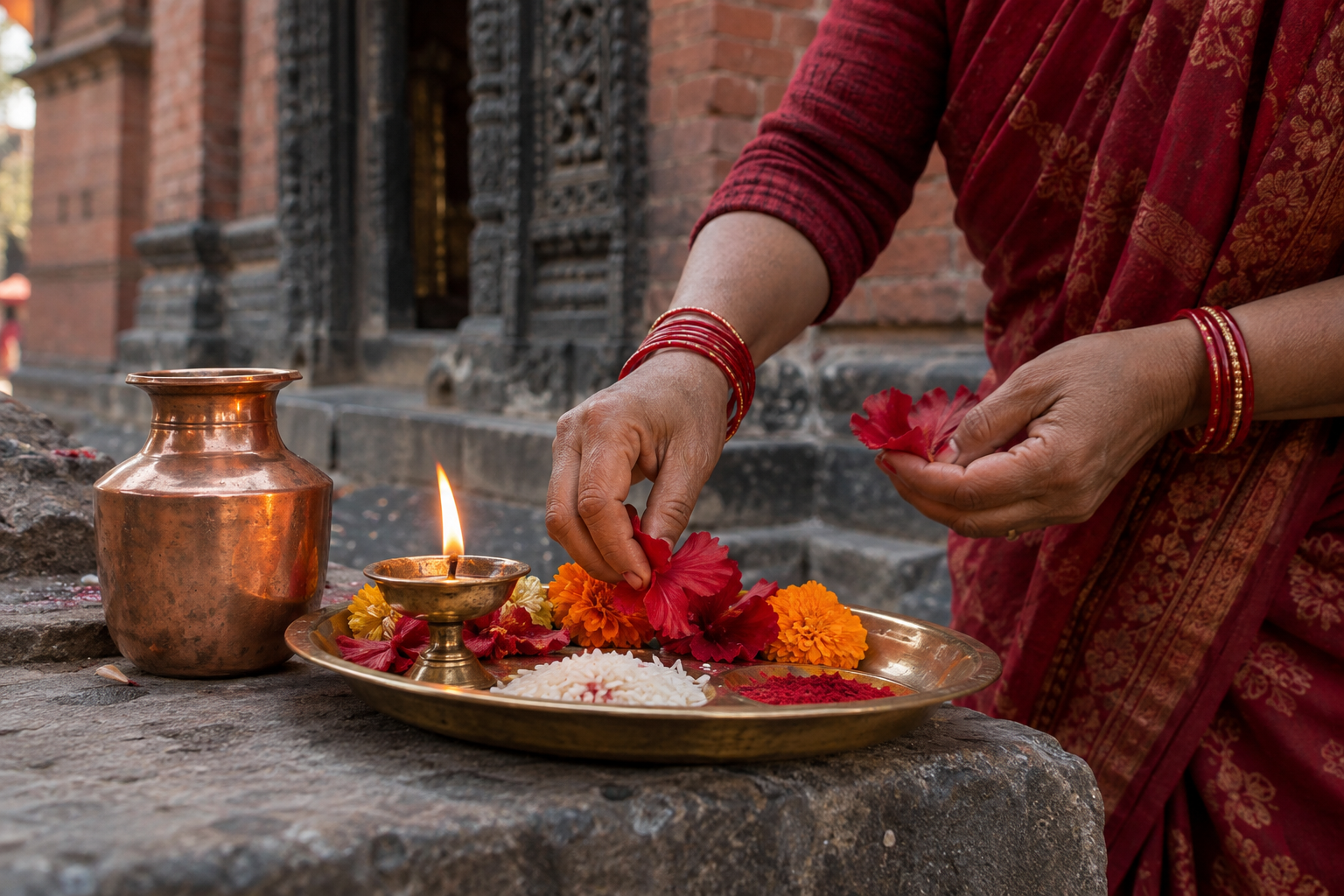
Shakta traditions worship the Divine as Shakti: the power through which reality appears, acts, sustains itself and returns to its source. A Shakti Peetha is consequently more than a monument associated with an old story. It is treated as a living seat of divine presence.
That distinction matters. If you approach Guhyeshwari only to identify a legendary detail, photograph the building and leave, you may collect information without understanding the shrine. The Shakta approach begins with presence. The appropriate response is reverence, disciplined attention and worship conducted according to the temple’s living customs.
It also helps to avoid a common mistake: treating every Goddess shrine as interchangeable. “Shakti” names the one divine power, but a particular peetha has its own ritual identity, local memory and forms of observance. Before repeating a claim about the temple’s precise symbolism, ask which lineage or local tradition preserves that explanation. A confident internet label is not a substitute for the temple’s own ritual vocabulary.
For a Hindu pilgrim, the practical emphasis should therefore be straightforward:
- Approach the shrine as a place of active worship, not as an archaeological exhibit.
- Let the temple’s priests, attendants and posted instructions determine what you may enter, offer or photograph.
- Keep the relationship between Shiva and Shakti in view when combining Guhyeshwari with Pashupatinath.
- Do not reduce the Goddess to a single physical association; the peetha signifies divine presence, power and practice together.
Why Vajrayana Buddhists can revere the same place
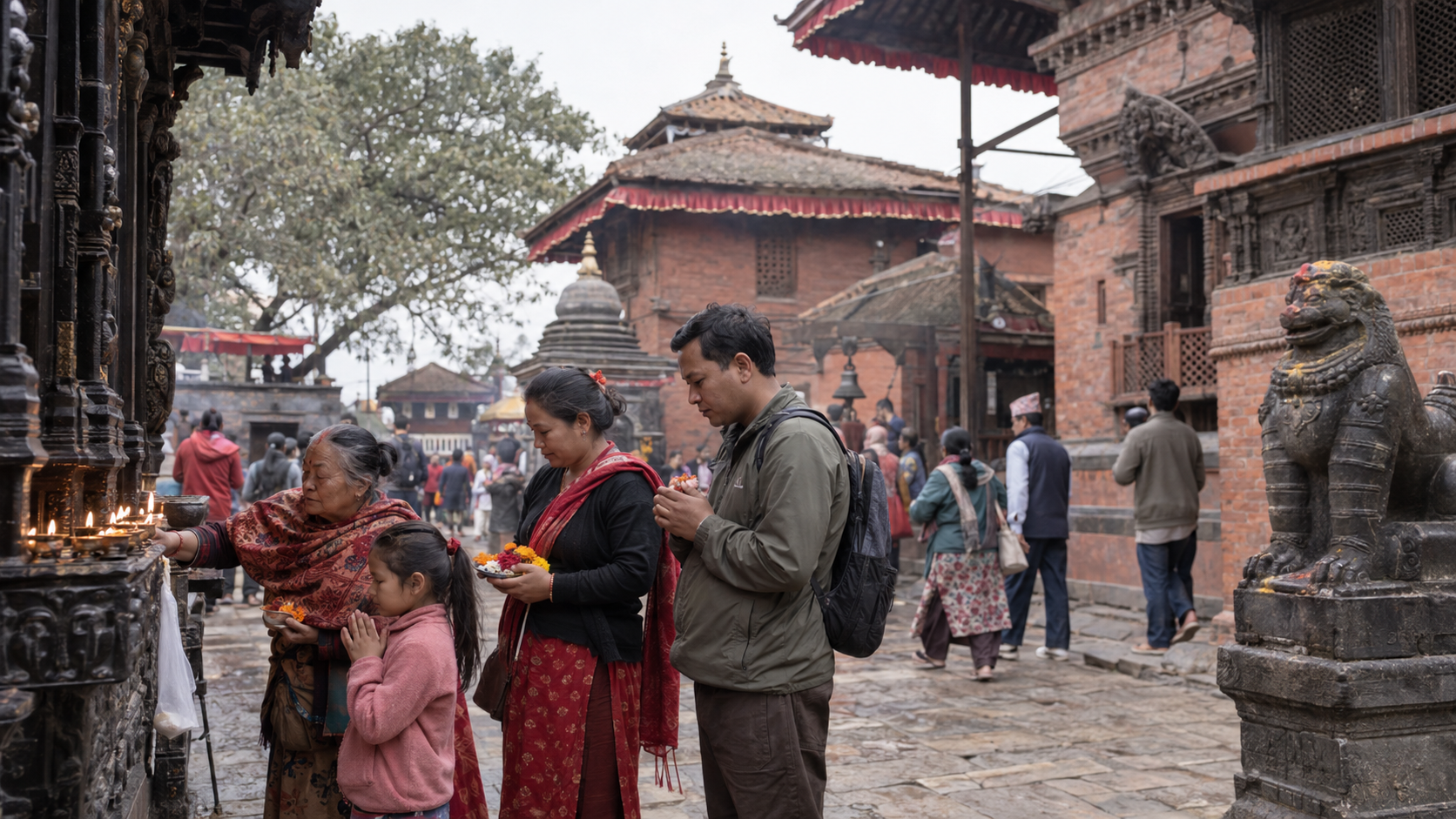
Guhyeshwari is revered by Hindu Shaktas and Vajrayana Buddhists. This does not mean that one community has accidentally entered the sacred space of another. Nor does it mean that both traditions secretly teach the same doctrine under different names.
Vajrayana is a Buddhist path in which mantra, visualisation, deity practice, ritual action and transmission through a qualified lineage may become means of transformation. Its sacred geography is therefore not merely commemorative. A place can be approached as a field of practice in which awakened qualities are contemplated and ritually embodied.
That helps explain how Vajrayana practitioners can recognise profound sanctity at a site also worshipped as a Shakti Peetha. The shared location provides a meeting point, while the Buddhist practitioner interprets and engages it through a Buddhist lineage, goal and ritual framework.
If you encounter a Buddhist explanation of Guhyeshwari, do not force it into Shakta terminology merely because the temple is a Goddess shrine. Ask three precise questions: Which figure or principle is being invoked? Which lineage carries the interpretation? What practice, if any, is associated with it? Those questions reveal more than asking whether the Buddhist account is “really” a disguised Hindu one.
The same courtesy works in the other direction. A Hindu interpretation should not be treated as an incomplete version of a Buddhist teaching. Each community approaches the place through a complete sacred vocabulary of its own.
Shared tantric ground does not erase real differences
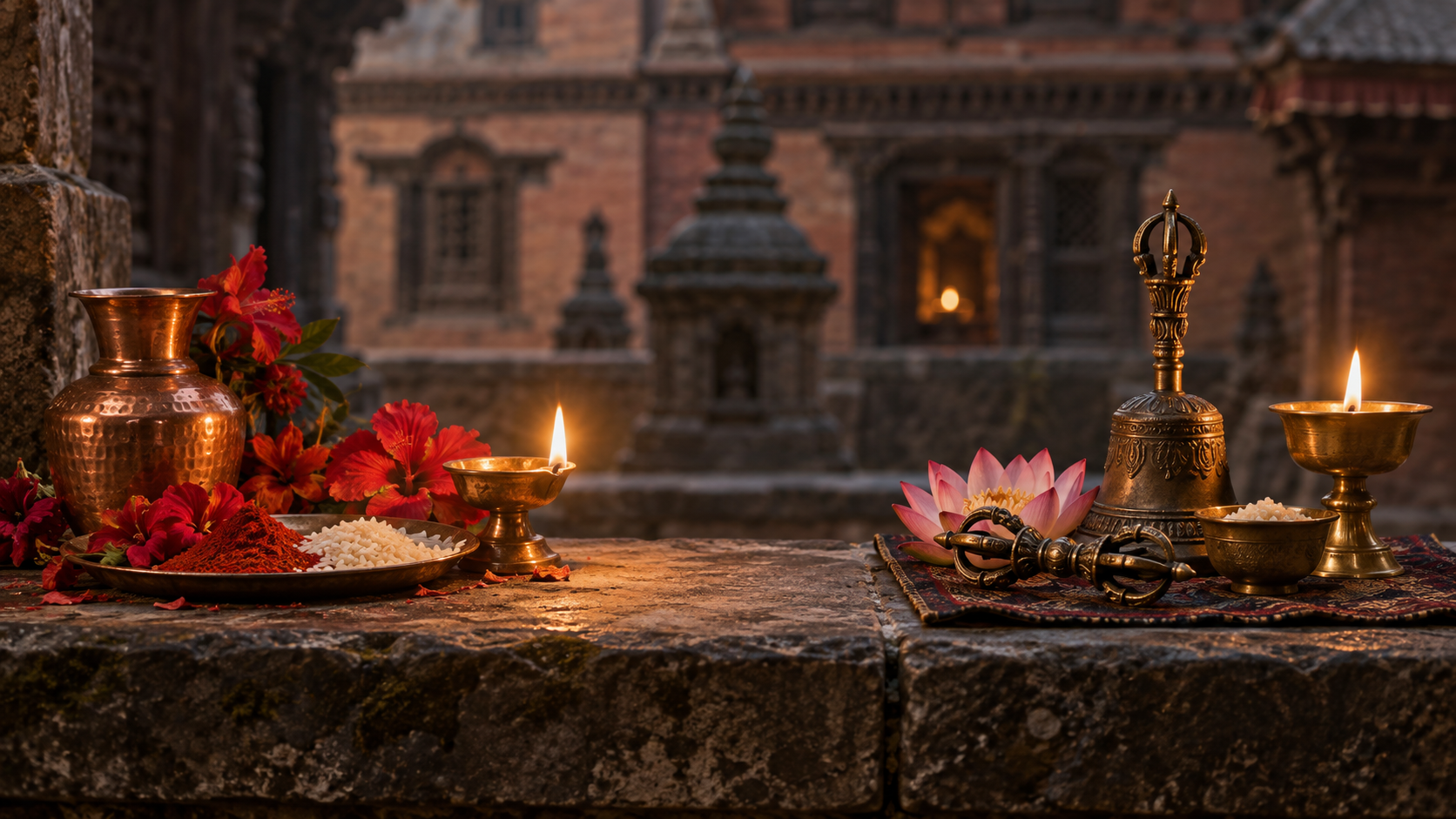
Shakta and Vajrayana traditions can sound strikingly close when described from a distance. Both may work with mantra, sacred images, ritual diagrams, disciplined visualisation and an understanding of the body as more than an obstacle to spiritual life. Both can treat ritual as a method of inner transformation rather than as public symbolism alone. Both also preserve teachings whose proper use depends on preparation and context.
These affinities make the meeting at Guhyeshwari intelligible. They do not make the traditions identical. Shakta practice is grounded in Hindu understandings of the Goddess and Shakti. Vajrayana remains Buddhist in its view of awakening, lineage and the purpose of its practices. Similar ritual instruments can operate inside different accounts of reality.
Think of the distinction in three layers:
- Place: The physical sacred site can be shared.
- Practice: The communities may use comparable tantric forms, but the instructions and ritual sequences belong to particular traditions.
- Meaning: The deity, doctrine and final purpose cannot be assumed to be the same merely because outward forms resemble one another.
This framework avoids two equal errors. The first is rigid separation: the belief that Hindu and Buddhist traditions must occupy sealed cultural boxes and that shared reverence is therefore an anomaly. The second is careless fusion: the claim that every tantric deity, mantra and doctrine is interchangeable. Guhyeshwari asks you to hold relationship and distinction at the same time.
The word “secret” should also be handled carefully in a tantric setting. It need not imply a puzzle hidden for dramatic effect. It can point to knowledge that becomes meaningful through discipline, initiation, practice and the guidance of a lineage. If a rite is not open to you, respectful restraint is a more Dharmic response than attempting to imitate it from fragments.
How to approach Guhyeshwari with understanding
You do not need to settle every theological question before visiting. You do need to distinguish pilgrimage from consumption. A useful approach is to prepare your attention as carefully as your route.
- Place the temple in its landscape. Notice the Bagmati and Guhyeshwari’s proximity to Pashupatinath. Read the journey between them as part of the encounter, not as dead travel time.
- Identify the tradition speaking. When you hear an explanation, ask whether it is Shakta, Vajrayana, local, lineage-specific or a modern attempt to combine them.
- Observe before interpreting. A similar gesture, image or ritual object can carry different meanings in different traditions. Do not assign a meaning solely from outward resemblance.
- Respect ritual boundaries. Follow local instructions about access, offerings, footwear and photography. Do not photograph a sanctum or private rite without explicit permission, and do not copy mantras or gestures whose context you do not know.
- Ask narrow questions. “What is this place called in your tradition?” and “What does a practitioner recognise here?” will usually produce clearer answers than “Which religion owns the temple?”
- Leave room for more than one valid map. You can honour the Shakti Peetha as a Hindu sacred seat while recognising that Vajrayana Buddhists approach the same location through their own inherited framework.
Key takeaways
- Guhyeshwari is a principal Shakti Peetha near Pashupatinath, not merely an optional extension of that temple.
- Shakta worship approaches the shrine as a living seat of the Goddess and her power.
- Vajrayana reverence operates through Buddhist doctrine, lineage and tantric practice; it should not be relabelled as Shakta worship.
- Shared place and similar ritual forms do not prove identical theology.
- The most useful visitor’s habit is to ask whose interpretation you are hearing before deciding what a symbol or practice means.
When you visit or study Guhyeshwari, carry two questions with you: “Who is being worshipped in this account?” and “Which lineage gives the ritual its meaning?” Those questions will let the temple disclose its layered character without forcing either tradition to disappear.
References

Leave a Reply
You must be logged in to post a comment.