
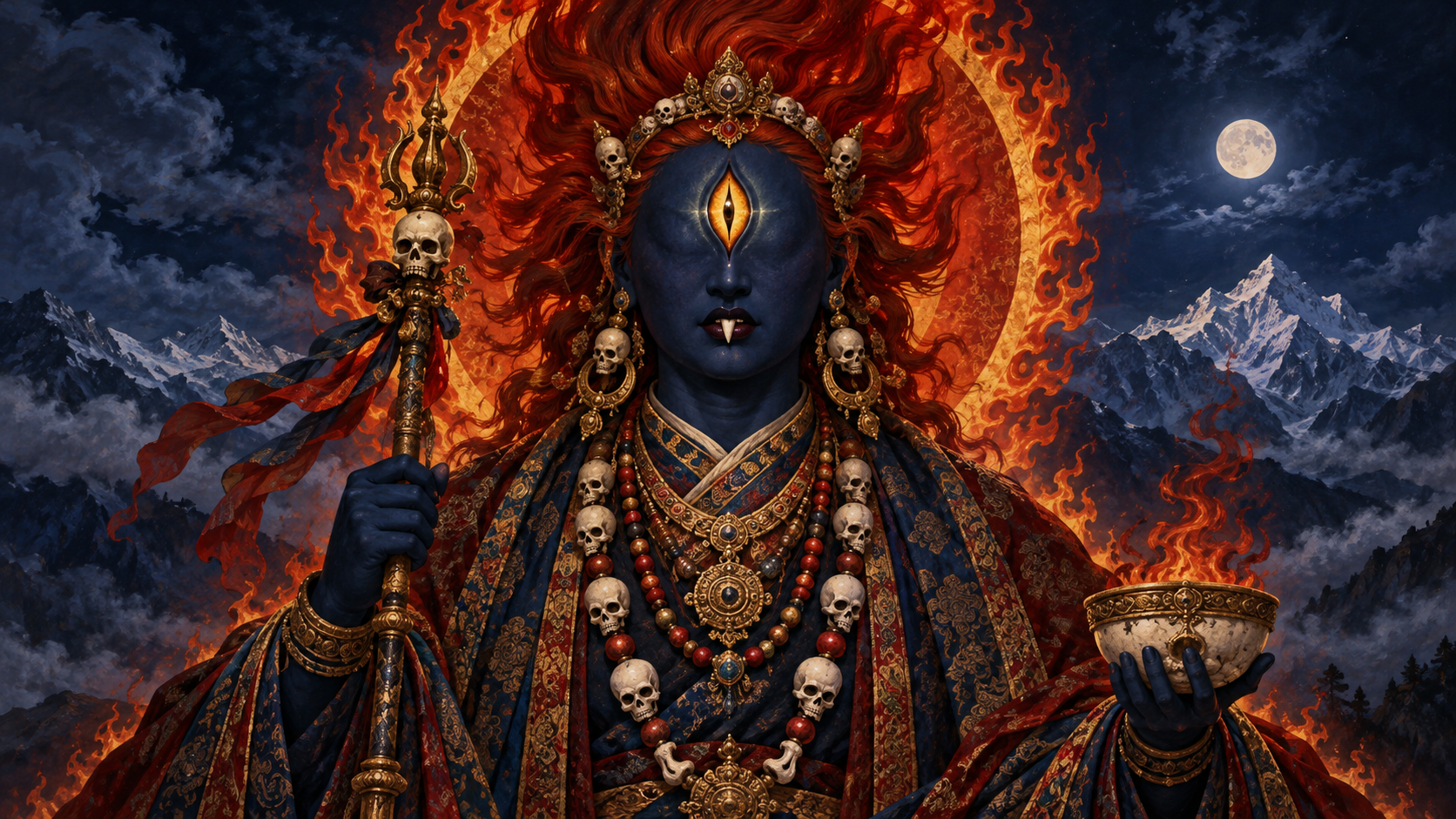
If Ekajata’s single eye has stopped you in front of an image, your question is probably simple: why is the Goddess shown this way, and what are you meant to understand from it? Looking for a literal explanation will take you in the wrong direction. The eye is a spiritual instruction expressed through sacred form.
The shortest answer is that Ekajata’s one eye signifies the vision of supreme wisdom. It is not lesser sight, but sight gathered into unity: concentrated, undivided, and capable of seeing beyond the preferences and fears that fragment ordinary perception.
What the single eye tells you

In Tantric tradition, Ekajata is revered as a fierce and protective manifestation of the Divine Mother and one of the eight forms of Mahavidya Tara. Her eye must therefore be read as part of a complete sacred personality. Wisdom, protection, fierceness, and compassion meet in the same form.
That context changes the question. Instead of asking, “Why does she have only one eye?” ask, “What kind of seeing requires only one gaze?” The first question treats the image as unusual anatomy. The second approaches it as iconography: a visible form that communicates an invisible quality.
Ordinary seeing is divided. You look at a situation through attraction and aversion, hope and fear, duty and convenience. Even when the facts are clear, self-interest can select the part you prefer. Ekajata’s single eye can be contemplated as the opposite of that fragmentation. It represents a gaze gathered around what is ultimately true rather than scattered among competing impulses.
“Single” therefore does not mean deficient. It means undivided. “Eye” does not mean passive observation. It points to insight. And “wisdom” here is not simply possessing more information. It is the capacity to see without being deceived by the divisions created by a restless or self-protective mind.
Why fierce protection belongs with supreme wisdom

Ekajata’s eye is not presented in a mild form detached from the world’s difficulties. She embodies the fierce, protective aspect of the Divine Mother. That means her wisdom has consequence. It identifies what must be guarded, what must be faced, and what must not be allowed to continue unchecked.
Fierceness in this setting should not be confused with uncontrolled anger. Anger can narrow perception until you see only an enemy. Ekajata’s symbolism moves in the other direction: the eye is associated with supreme wisdom, while the form remains protective and compassionate. Her fierceness is meaningful because it serves clear seeing rather than replacing it.
This gives you a practical test whenever you invoke “fierce compassion” in your own decisions. Ask two questions together: “What is true here?” and “What response genuinely protects?” If you ask only the first, truth can become cold abstraction. If you ask only the second, attachment can disguise itself as compassion. Ekajata’s form refuses that separation.
A protective response may require a firm boundary, an unwelcome warning, or the courage to stop participating in something harmful. Yet the image offers no license for cruelty. If your response depends on hatred, humiliation, or the pleasure of punishment, it has already lost the union of wisdom and compassion that gives the symbolism its force.
How not to misread Ekajata’s eye
Sacred images become easier to understand when you first clear away the readings they do not support. Five mistakes are especially likely.
- Do not treat the eye as a physical defect. The image is communicating a spiritual quality. Counting what appears to be missing is less useful than noticing what the remaining eye expresses: concentrated vision.
- Do not reduce it to generic focus. Concentration by itself can serve any purpose, including a selfish one. Ekajata’s focus is joined to supreme wisdom, protection, and compassion.
- Do not equate fierceness with hostility. Her fierce appearance expresses the active power of protection. Reading it as ordinary rage removes the wisdom that governs the form.
- Do not automatically substitute a familiar “third-eye” explanation. Ekajata’s one-eye motif deserves to be read on its own terms. Its most direct emphasis is not an additional eye but a single, undivided vision.
- Do not assume that understanding the symbol authorizes improvised Tantric ritual. Reflecting on iconography is not the same as undertaking formal practice. Mantra, ritual, or initiatory disciplines should be learned within an appropriate lineage rather than assembled from fragments.
These distinctions prevent the symbol from becoming either a curiosity or a blank screen for whatever meaning you want to project onto it. Begin with the qualities actually held together in Ekajata: wisdom, fierceness, protection, and compassion. Let any further interpretation remain accountable to that combination.
A five-minute contemplation of the single eye

You do not need to invent a ritual to let the image instruct you. The following exercise is a simple form of reflection, not a claim to formal Tantric sadhana.
- Look before interpreting. Spend a quiet minute with an image of Ekajata. Notice the single eye, the directness of the gaze, and the fierce character of the form. Resist the urge to explain each feature immediately.
- Name one division in your own perception. Choose a real decision in which you are pulled between truth and convenience, duty and approval, or protection and avoidance. Keep the issue specific.
- Ask what you are refusing to see. Do not ask which outcome you prefer. Ask which fact remains true even when it is uncomfortable. This is the point at which the symbolism becomes a mirror rather than an object of curiosity.
- Join clarity to compassion. Ask what action protects without dehumanizing anyone involved. A wise boundary can be firm. A compassionate response can still say no.
- Choose one undivided action. Write down the next concrete step: speak honestly, withdraw consent, keep a commitment, seek guidance, or postpone action until you can see more clearly. The step should follow from what you recognized, not from the emotion of the moment.
The value of this contemplation lies in its sequence. First see, then test your motives, then act. If you begin with action, fierceness can become impulsiveness. If you stop at contemplation, wisdom never becomes protective. Ekajata’s symbolism holds vision and consequence together.
Key takeaways
- Ekajata’s single eye signifies supreme wisdom rather than impaired or incomplete sight.
- The one eye can be contemplated as an undivided gaze that is not scattered by competing preferences and fears.
- Her fierceness is protective and must be understood alongside compassion, not as ordinary hostility.
- The motif should not be flattened into a generic third-eye explanation or detached from Ekajata’s identity as a form of Mahavidya Tara.
- You can use the image to examine a divided decision, but formal Tantric practices call for proper guidance rather than improvisation.
The next time you encounter Ekajata, do not stop at the strangeness of the single eye. Stay with the gaze long enough to identify where your own seeing is divided. Then carry one clear perception into one compassionate, protective action. That movement from sight to responsibility is where the symbol begins to work on you.
References

Leave a Reply
You must be logged in to post a comment.