
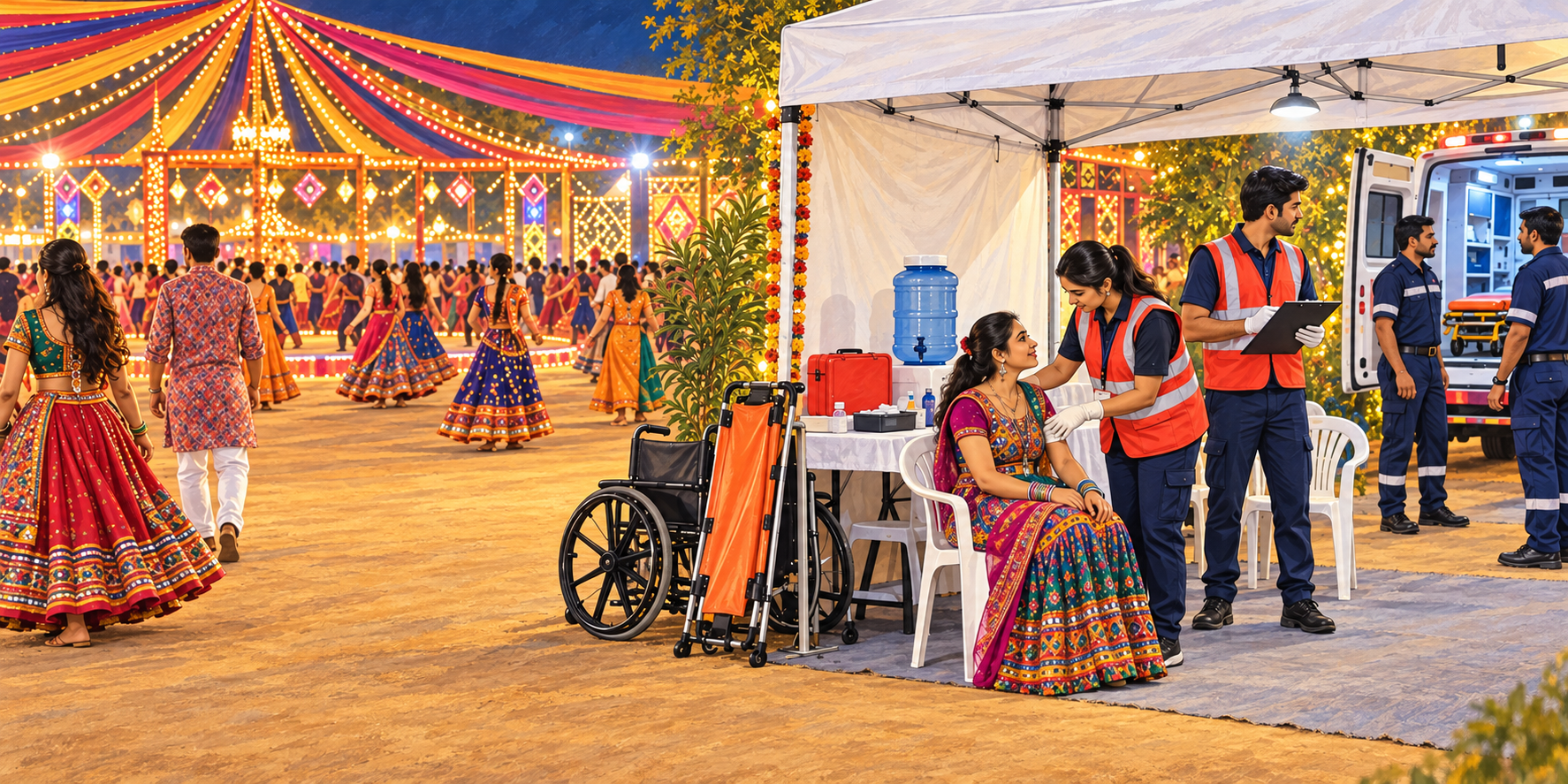
If you are organising a Navratri gathering, serving as a volunteer, or accompanying family to a crowded celebration, decide how you will get medical help before anyone needs it. A first-aid point should be visible, staffed and connected to professional care. It should not become an improvised table that people discover only after an emergency begins.
A useful model comes from Akurdi in Pune, where the Shri Tuljabhavani Devasthan Trust and Hindu Janajagruti Samiti established a Navratri first-aid stall. The effort combined emergency guidance, written material and practical demonstrations. That combination matters: a devotee needs immediate help during an incident, but volunteers also need enough preparation to respond calmly and safely.
Make the first-aid point a bridge to medical care
The first-aid point has a limited but vital purpose: protect the devotee, begin appropriate basic care and arrange a safe handoff to qualified medical professionals. It is not a temporary clinic, and an enthusiastic volunteer should never diagnose an illness or attempt a procedure beyond their training.
Organisers should define that boundary in writing. Put a trained person in charge of medical decisions. Other volunteers can call emergency services, guide responders through the venue, manage the surrounding crowd and locate the devotee’s companion. Clear roles prevent several well-meaning people from giving contradictory instructions.
Treat loss of consciousness, difficulty breathing, severe bleeding, a seizure, chest pain, sudden confusion or a serious fall as an emergency. Contact the local emergency service promptly. If a trained responder is present, let that person lead and follow the emergency dispatcher’s instructions. Do not give food, water or tablets to an unconscious or confused person. Do not move someone after a serious fall unless remaining in place creates an immediate danger or a qualified responder directs the move.
The stall should not distribute medicines casually. A medicine that is suitable for one person may be unsafe for another because of an allergy, health condition, prescription or interaction. Devotees should use their own prescribed medicines as directed; volunteers should not share medicines or recommend a dose.
Design the route to help, not just the stall
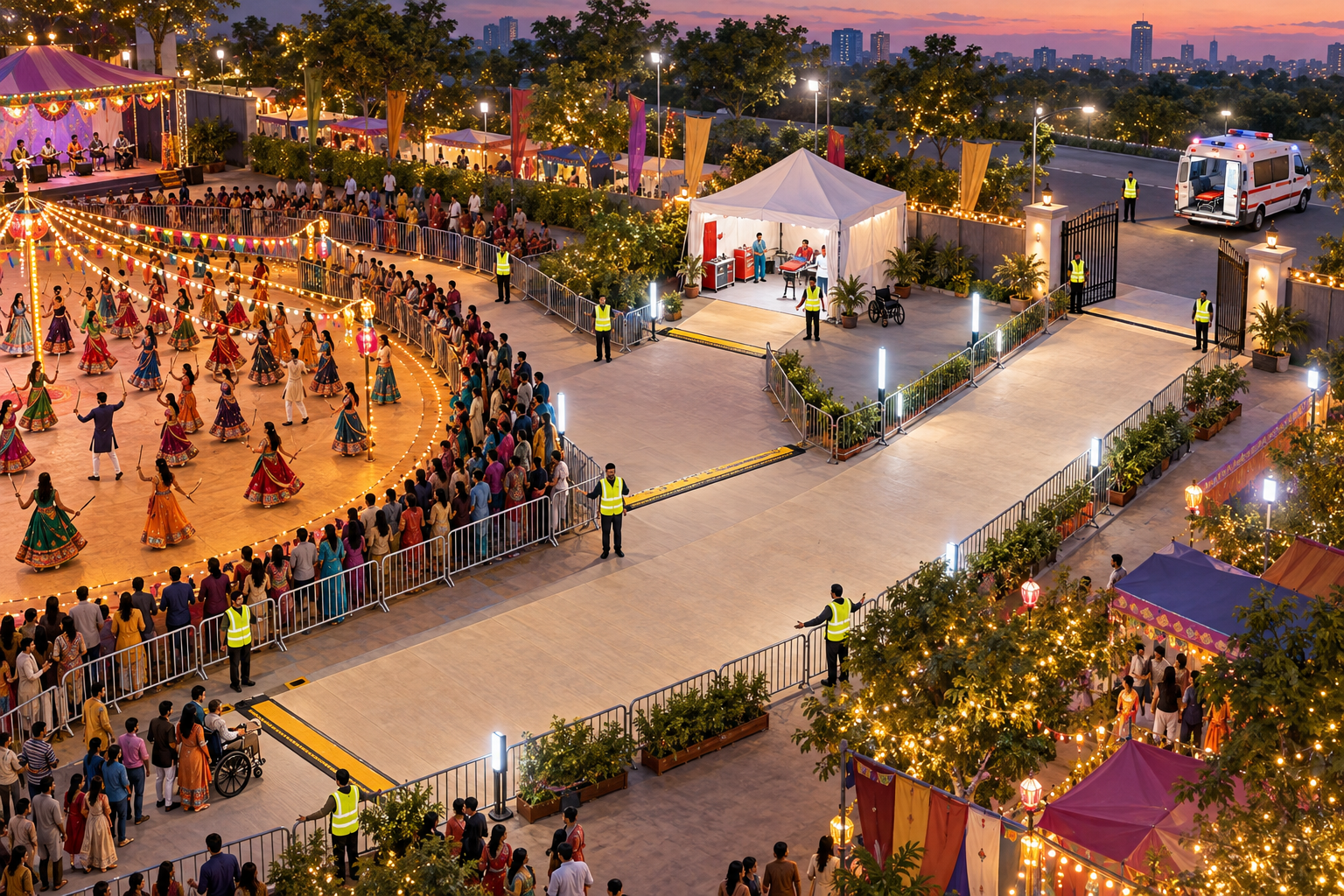
A well-equipped station can still fail if nobody can find it or an ambulance cannot reach it. Walk through the venue as if you were an unfamiliar devotee. Start at every entrance, follow the normal movement of the crowd and check whether the first-aid signs remain visible when queues form.
- Place clear signs at entrances, gathering areas and decision points where paths divide.
- Tell security personnel, seva volunteers and announcement teams exactly where the first-aid point is.
- Keep an unobstructed route between the station, an exit and the place where emergency transport can arrive.
- Make the station accessible to a person with limited mobility and to someone being assisted by companions.
- Display the local emergency contact and the venue’s precise address where callers can read them.
- Keep a charged communication device with the responsible team, and name a backup contact if the main person cannot be reached.
Test this arrangement before devotees enter. Ask a volunteer who did not design the layout to find the station and explain how an emergency vehicle would be guided in. Confusion during that test is valuable: it shows you what must be corrected while there is still time.
Accessibility also includes language and dignity. Instructions should be easy to understand for the people expected at the celebration. A devotee asking for help should not have to discuss private medical information within hearing of a crowd. Use a quieter space when possible, while keeping the patient visible to the responsible responder and companion.
Give volunteers a simple emergency handoff
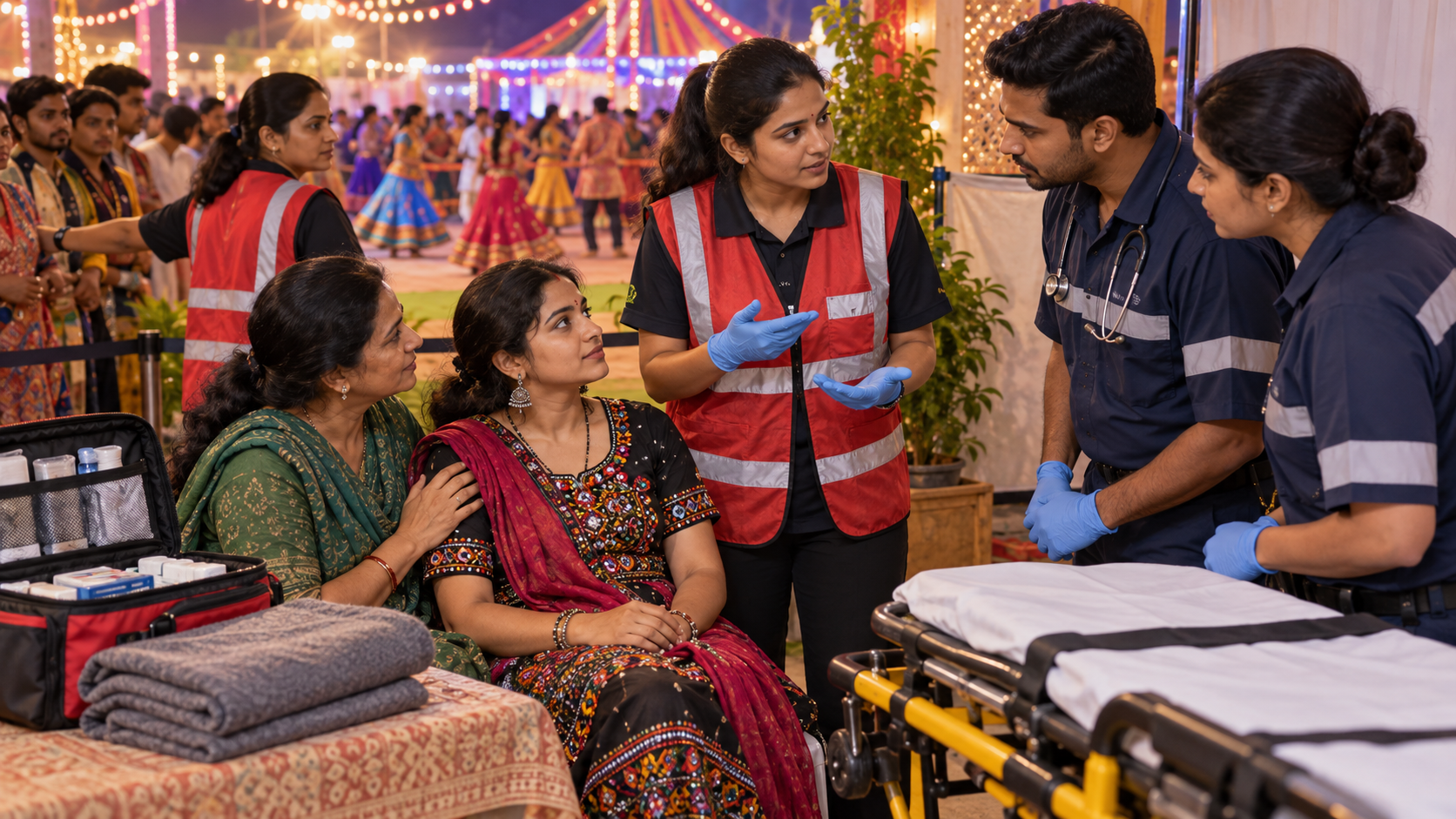
When someone becomes unwell, the most useful volunteer is often the one who performs a small assigned task correctly. Organisers can rehearse the following sequence without turning untrained volunteers into medical responders.
- Make the immediate area safe. Stop crowding, remove nearby hazards when that can be done safely and give the trained responder room to work.
- Call the designated lead. State the exact location and what is visibly happening. Avoid guessing at a diagnosis.
- Escalate serious signs. Contact the local emergency service promptly when the person is unresponsive, has difficulty breathing, is bleeding severely or shows another serious warning sign.
- Send someone to meet professional responders. That volunteer should remain at the agreed entrance and guide them directly to the patient.
- Find a companion. A relative or friend may know about the person’s health conditions, allergies, prescribed medicines or recent events.
- Protect the devotee’s privacy. Move onlookers back. Do not take photographs or circulate the person’s medical details.
- Give a concise handoff. Tell the professional responder what happened, what was observed, what help was given and whether the person’s condition changed.
Record only what the organiser genuinely needs for safety and follow-up. An incident note can identify the location, the observable event, the response taken and the handoff. It should not contain speculation about the cause or be shared casually among volunteers.
Practical demonstrations are especially useful here. Volunteers can rehearse calling for help, clearing a route, meeting an ambulance and handing over essential information. Any demonstration of CPR, bleeding control or other medical techniques should be led by a properly trained instructor; watching a demonstration does not by itself qualify someone to perform every intervention.
Prepare yourself as a devotee or family companion

You do not need to wait for organisers to solve every part of the problem. When you arrive, notice the nearest exit, identify the first-aid point and agree on a meeting place with your companions. If you are responsible for a child, an older relative or someone who may need assistance, make sure another named person can take over if you are separated.
Carry prescribed medicine you may need and keep it identifiable. Tell a trusted companion about a serious allergy or health condition that emergency responders may need to know. A phone note or medical information card can help if you cannot speak for yourself, but it should contain only information you are comfortable carrying.
Fasting is a personal religious observance, not a reason to conceal worsening symptoms. If you feel faint, confused, unusually weak or otherwise unwell, stop what you are doing, sit or lie down safely and tell someone. Seek assessment rather than attempting to push through the celebration. If a health condition or prescribed medicine affects whether you can fast safely, make that decision with your own qualified clinician before the festival.
If another devotee collapses, call for trained help and keep the area clear. Do not crowd the person, force them to drink, offer an unfamiliar medicine or film the incident. If you have current first-aid training, identify yourself and act within that training. Otherwise, following the responder’s or emergency dispatcher’s directions is the safer form of seva.
Key takeaways
- A Navratri first-aid point should support immediate safety and rapid transfer to professional care, not attempt to replace medical treatment.
- Visibility, an open access route and volunteers who know the location are as important as the station itself.
- Assign separate roles for first-aid leadership, emergency calling, crowd management and guiding responders into the venue.
- Escalate loss of consciousness, breathing difficulty, severe bleeding, seizures, chest pain, sudden confusion and serious falls promptly.
- Do not give an unconscious or confused person food, drink or medicine, and do not move someone after a serious fall unless immediate danger or qualified direction makes it necessary.
- As a devotee, locate help on arrival, carry your prescribed medicine and tell a trusted companion about important medical needs.
Before the next aarti, garba gathering or temple programme begins, walk the emergency route once with the volunteer team. Correct the missing sign, blocked passage or unclear responsibility you discover. Quiet preparation is practical seva: it allows devotion to continue while ensuring that a person in distress is neither overlooked nor left to the crowd.
References

Leave a Reply
You must be logged in to post a comment.