

You have found a murti, painting or caption labelled Tiraskarani Devi and want to know what you are actually looking at. Start with relationship, not resemblance: in Sri Vidya, she is an upanga devata, or attendant deity, of Dandanatha Varahi.
That placement prevents two common errors. Tiraskarani should not automatically be equated with Dandanatha Varahi, and every feature associated with Varahi should not be transferred to her attendant. Tiraskarani’s own name points toward concealment, obstruction and veiling. Those ideas provide the soundest starting point for understanding her protective significance.
Place her correctly in Lalita’s sacred order

Tiraskarani’s identity is relational. You can map that relationship in three levels:
- Devi Lalita is the divine centre whose armies are being described.
- Dandanatha Varahi is the boar-faced commander-in-chief of those armies.
- Tiraskarani Devi serves as Dandanatha Varahi’s upanga devata, an attendant associated with a particular protective function.
The word upanga tells you how to locate Tiraskarani within this sacred order. It does not mean that she is spiritually insignificant. It identifies a supporting relationship: her role becomes intelligible beside Dandanatha Varahi and within the larger Sri Vidya vision of Devi Lalita.
Association, however, is not identity. The description “boar-faced” belongs explicitly to Dandanatha Varahi in this relationship. You should not move that attribute to Tiraskarani merely because the two deities are connected. In the same way, the office of commander-in-chief belongs to Dandanatha. Tiraskarani’s distinctive field is concealment and the protection accomplished through it.
This distinction matters whenever you catalogue an image, write a temple caption or explain the deity to someone else. “Connected with Varahi” is not the same claim as “another name for Varahi,” and “attendant of the commander” is not the same as “commander.” Keeping those statements separate is the first discipline of accurate iconographic reading.
Read her name as a function, not a literal costume

The name Tiraskarani is connected with the Sanskrit root tiraskarana. Its semantic range includes concealment, obstruction and veiling. These are not three unrelated definitions. Together they describe a protective logic in which access, exposure or passage is restricted.
- Concealment directs your attention to withdrawal from unwanted exposure.
- Obstruction suggests a boundary placed before something that should not be allowed to pass.
- Veiling concerns the controlled disclosure of what is sacred or protected.
This gives you a better interpretation than the vague label “goddess of secrecy.” Sacred concealment is not an endorsement of deception. It is a way of guarding a presence, space or purpose by limiting access to it. Tiraskarani’s protection is therefore best understood through the act of veiling rather than through an imagined display of brute force.
Do not turn that meaning into an unsupported visual inventory. The name does not, by itself, prove that every image must contain a curtain, veil, shield or other literal object. A semantic function and a physical attribute are different kinds of evidence. If a veil is visible, describe it. If it is not visible or securely identified, do not manufacture one from the meaning of the name.
The same restraint applies to colour, posture, mount, weapons, hand gestures and number of arms. Those details can be decisive when they are securely transmitted, but they should never be filled in by borrowing features from a neighbouring deity. Iconography is a disciplined visual language. A convincing guess is still a guess.
Use a five-step test before naming an image
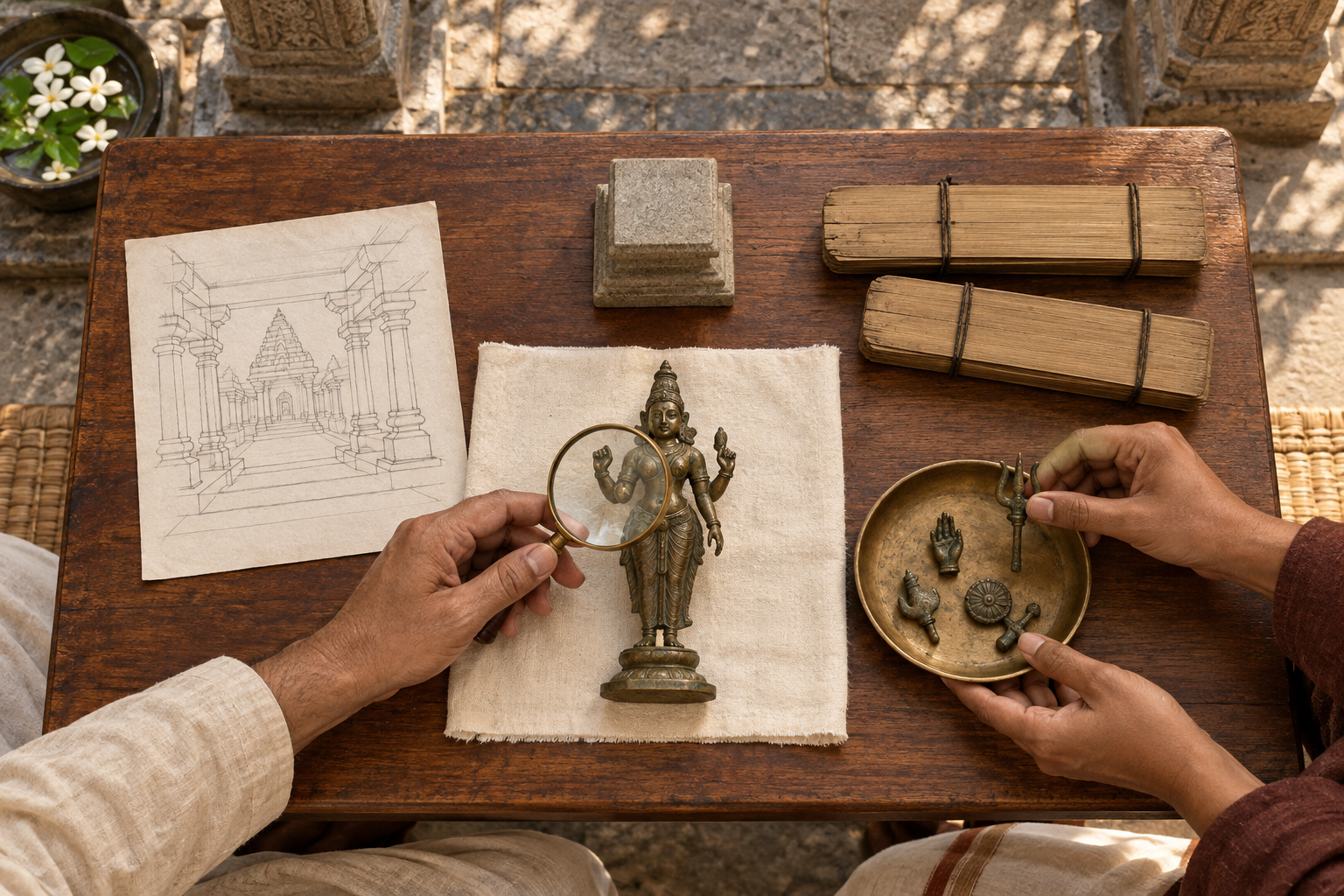
If an image is already labelled Tiraskarani Devi, you can test that identification without pretending that appearance alone settles the matter.
- Record the exact name. Copy the spelling used in the inscription, temple label or traditional caption. If you encounter Tiraskarini rather than Tiraskarani, preserve that form in your notes instead of silently correcting it.
- Look for relational context. An image situated in a Sri Vidya setting, especially one explicitly connected with Dandanatha Varahi or Devi Lalita, has stronger contextual support than an isolated image circulating without provenance.
- Separate inherited facts from visible facts. “Attendant of Dandanatha Varahi” is a theological identification. The number of arms, posture and objects held are visible observations. Record the two categories separately.
- Do not transfer attributes. Dandanatha Varahi’s boar face and military office do not automatically belong to Tiraskarani. Connection within a sacred hierarchy is not permission to merge two iconographic identities.
- State your level of certainty. Treat an inscription or established traditional identification as stronger evidence than resemblance. If only the surrounding context supports the name, call the identification contextual or probable rather than certain.
A useful three-level notation is “identified,” “contextually attributed” and “unidentified.” Use “identified” when the name comes with a reliable traditional label. Use “contextually attributed” when placement supports the identification but no direct label is present. Use “unidentified” when an image has been detached from its original setting and resemblance is doing all the work.
A careful short caption can read: “Tiraskarani Devi, identified in Sri Vidya as an upanga devata of Dandanatha Varahi and associated with concealment, obstruction and veiling.” Add details about her physical form only when the particular representation or its tradition establishes them.
FAQ: quick answers for study and respectful use
Is Tiraskarani Devi another name for Dandanatha Varahi?
Not in the Sri Vidya relationship described here. Tiraskarani is placed as Dandanatha Varahi’s upanga devata rather than equated with her. If a particular temple or lineage uses different nomenclature, preserve that local identification and do not force it into a generic caption.
Does upanga mean that she is merely a minor deity?
No. The term explains relationship and placement, not spiritual worth. It tells you that Tiraskarani’s role should be read in connection with Dandanatha Varahi. Translating a relational category into a judgement of importance obscures the very structure the term is meant to preserve.
Can a boar face alone identify Tiraskarani?
No. In this hierarchy, the boar-faced deity is Dandanatha Varahi. A boar face may point you toward a Varahi context, but it cannot by itself establish that the image represents Tiraskarani. You still need a name, provenance or tradition-specific identification.
What should you do before using an image for worship or publication?
For publication, retain the image’s provenance and distinguish a traditional identification from your own visual inference. For worship, seek the interpretation and practice transmitted by the relevant Sri Vidya tradition rather than constructing ritual instructions from an online image. Iconography can help you recognise a sacred relationship; it does not independently provide a complete ritual method.
When you next encounter an image labelled Tiraskarani, keep three notes beside it: the exact label, its relationship to Dandanatha Varahi and the attributes actually visible. If a further detail cannot be supported, leave it unnamed. That restraint protects both scholarly accuracy and reverence for the tradition.
References

Leave a Reply
You must be logged in to post a comment.