
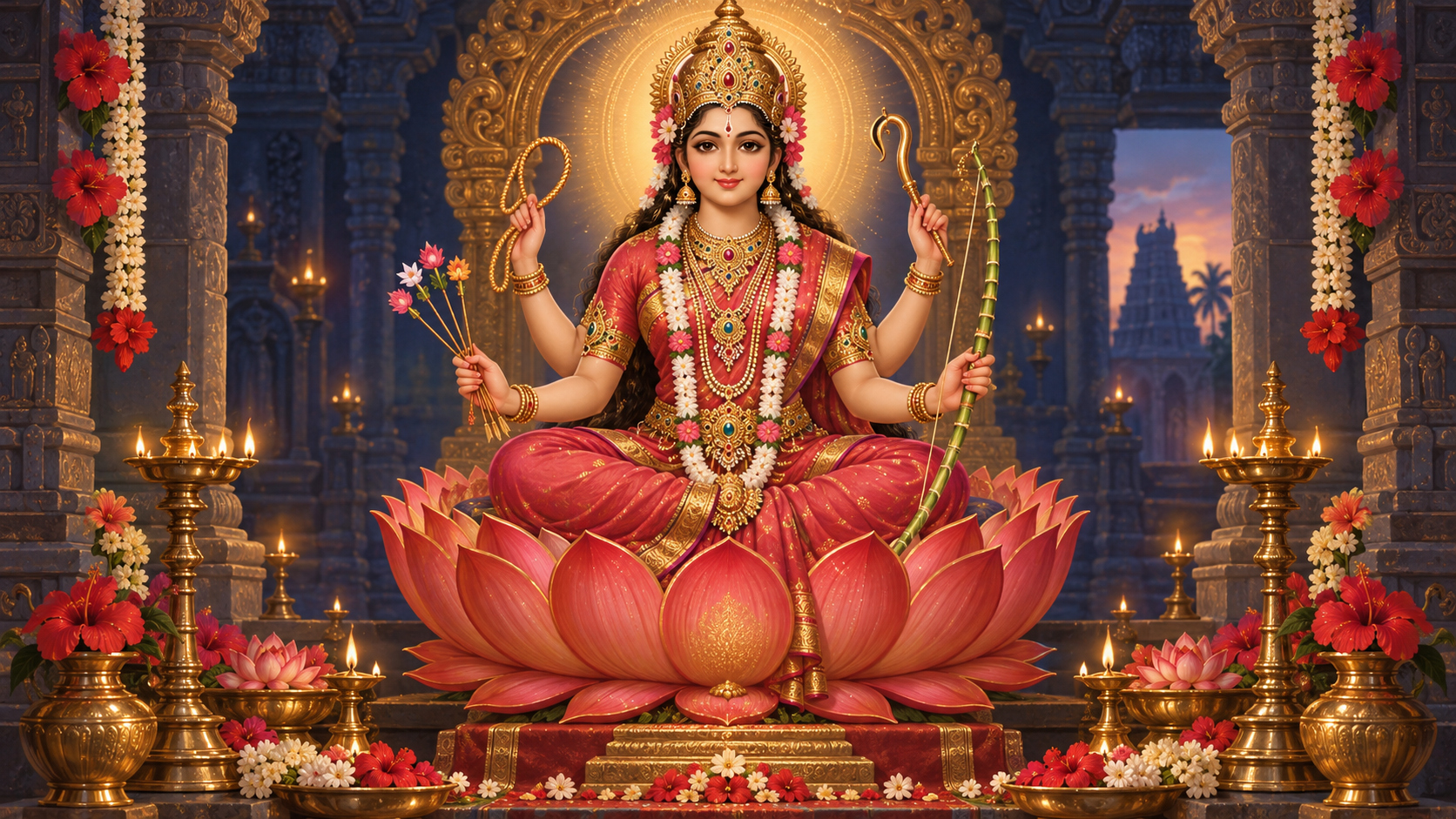
You may have found a Lalita Tripura Sundari mantra online and wondered what it means, whether you may chant it, and how to worship Devi without claiming an initiation you have not received. The first distinction is the most important: simple devotion through her name is not the same as practising a lineage-taught mantra.
You can begin reverently without collecting secret formulas or constructing an elaborate ritual from internet fragments. Learn what the name communicates, identify the kind of mantra in front of you, and keep your practice within what you genuinely understand.
Start with the name before reaching for a mantra
Lalita is commonly understood as the graceful, charming, or playful one. Tripura Sundari can be rendered as the Beautiful One of the threefold realm. Different traditions unfold the meaning of tripura through different sacred triads, so that literal rendering is a doorway rather than an exhaustive definition.
The stable devotional centre is that Lalita Tripura Sundari is a form of Shakti associated with beauty and grace. Here, beauty need not be reduced to physical attractiveness. You can approach it as harmony: thought, speech, desire, and action being brought into a more truthful relationship with dharma.
This understanding changes how you enter worship. Instead of beginning with a demand for a result, write one clear intention in your own language. You might seek greater clarity in speech, steadiness in family duties, or the grace to correct a harmful habit. That sentence is not the mantra. It is your sankalpa, the conscious direction you bring to the practice.
Keep the distinction clear: Lalita is not merely an aesthetic ideal, and mantra is not a mechanism for obtaining whatever the ego happens to want. Worship asks you to become capable of recognising sacred beauty and embodying it through disciplined conduct.
Mantra meaning has more than a dictionary layer

In Chapter 10 of the Varahi Tantra, Devi asks Shiva about mantra and the worship of Mahatripurasundari. The response treats a mantra as carrying four distinct meanings, including bhavartha, the literal or intended sense, and a meaning received through tradition. The practical lesson is simple: translation is necessary, but translation by itself does not exhaust a mantra.
When you encounter a supposed Lalita mantra, examine it through four questions. This is a practical reading method, not a substitute for the Tantra’s complete technical teaching:
- What is the exact text? Obtain it in a trusted Indic script or reliable transliteration. A decorative image, an uncaptioned recording, or an inconsistent Roman spelling is not enough to establish the formula.
- What do its ordinary words mean? Identify the divine name, form of address, action, and intention wherever normal grammatical words are present.
- What bhava does it require? Ask whether the mantra is approached through reverence, surrender, contemplation, praise, or another devotional orientation. Meaning includes the consciousness with which the sound is offered.
- How is it used in its tradition? Find out whether it is a public prayer, a name suitable for ordinary remembrance, or a mantra transmitted with specific instructions.
This method prevents two opposite mistakes. The first is treating sound as meaningless because it cannot be translated neatly. The second is inventing a convenient English sentence and assuming it captures the whole practice.
A mantra may contain ordinary Sanskrit words, divine names, and seed syllables. A seed syllable does not behave like an ordinary vocabulary word with a single dictionary equivalent. Its place, sound, symbolism, and traditional application matter. If someone gives every syllable an effortless one-line translation but cannot establish the exact text or its lineage, treat that explanation cautiously.
Pronunciation also belongs to meaning. Do not race through an unfamiliar formula merely to reach a large repetition count. First verify the sounds, listen to a trustworthy recitation, and learn a short portion accurately. If the mantra came from a teacher, that teacher’s instruction takes precedence over a conflicting recording or transliteration found elsewhere.
Decide whether the formula is yours to practise
The label Lalita Tripura Sundari mantra can be applied online to very different things. It may refer to a simple invocation of Devi’s name, a public devotional verse, or a technical mantra belonging to an initiatory discipline. The title of a video or image does not tell you which one you have found.
Use this decision rule:
- If it is a familiar public name or prayer: learn its words and meaning, then use it as part of straightforward devotion.
- If it was given to you by a guru: preserve its exact form and follow the accompanying instructions. Do not combine it with procedures collected from unrelated traditions.
- If its status is unclear: pause that formula and ask a competent teacher from the tradition in which it is practised. In the meantime, continue with Lalita’s name, respectful prayer, and a hymn whose status and meaning you know.
Uncertainty does not prove that a formula is forbidden. It means you have not yet established what it is. That is a reason to verify, not a reason to experiment.
Be especially cautious when a presentation promises automatic power, guaranteed worldly outcomes, or immediate mastery while saying nothing about pronunciation, conduct, lineage, or preparation. Where initiation is required, it carries more than permission. It provides the sound, method, corrections, devotional framework, and living context that a translation cannot supply.
You should also respect confidentiality. A mantra received personally is not material to publish, modify, or teach merely because you can type its syllables. Fidelity to the way it was entrusted to you is part of the practice.
Build a simple home practice, including Lalita Panchami

A worship sequence you can follow without improvising esoteric rites
If you are uninitiated, or if you are still verifying a mantra, a restrained home practice lets you worship sincerely without pretending to technical knowledge you do not possess.
- Prepare the place. Wash your hands, tidy the shrine or chosen surface, and reduce distractions. Use an image of Devi if it helps you focus.
- Settle your attention. Sit quietly and let hurried breathing return to a natural rhythm before beginning words.
- State your sankalpa. Name one dharmic intention plainly. Avoid bargaining language or a long list of desires.
- Make a simple offering. Water, a flower, fruit, or another clean household offering is enough. If you light a lamp, place it securely and never leave the flame unattended.
- Recite only what you know. Use Lalita Tripura Sundari’s name, a public prayer you understand, or the mantra taught to you according to its instructions. Do not choose an arbitrary large count to make the worship appear more advanced.
- Leave room for silence. After the recitation, sit without adding new requests. Notice the quality of mind the worship has produced.
- Carry the intention into conduct. Conclude by choosing one action that expresses the worship, such as correcting harsh speech, completing a neglected duty, or restoring order to the place where you live.
Formal puja can contain many more elements, but unfamiliar complexity is not a measure of devotion. Attention, cleanliness, truthful intention, and continuity give a modest practice its integrity. Add technical ritual components only when you have learned what they mean and how your tradition uses them.
How to observe Lalita Panchami without turning it into a performance
Lalita Panchami is observed on the fifth day of Navratri in honour of Lalita Tripura Sundari. The cited 2026 observance falls on 15 October. Because Panchami is a tithi rather than merely a civil-date label, confirm the applicable timing with your local panchang and family or temple tradition.
You do not need to acquire a new mantra for the festival. Strengthen the practice you can perform correctly. Clean the shrine carefully, prepare a simple offering, recite the prayer or name you already know, and spend time understanding one phrase instead of multiplying unverified formulas.
You can also let the meaning of Lalita shape the day. Bring beauty back into one neglected space, make your speech firm without cruelty, or complete a duty with care rather than resentment. These are practical devotional choices, not substitutes for a ritual prescribed by your sampradaya.
Key takeaways
- Lalita Tripura Sundari is worshipped as Shakti associated with beauty and grace; her name points beyond physical attractiveness toward sacred harmony.
- A mantra’s translation is only one layer of meaning. Its exact sound, devotional orientation, and traditional use also matter.
- Identify whether a formula is a public prayer, a teacher-given mantra, or an unverified internet text before you chant it.
- If the formula’s status is uncertain, continue with Devi’s name and simple worship while seeking reliable guidance.
- Lalita Panchami is the fifth day of Navratri, but its local observance should be checked through the appropriate panchang.
Before your next recitation, place four things on paper: the exact text, its plain meaning, where you received it, and the instructions attached to it. If one of those lines is blank, keep your worship simple while you resolve the gap. Careful practice is not hesitation. It is respect for Devi, mantra, and sampradaya.
References
- HinduPad – Things to do on Lalita Panchami
- Hindu Blog – Beyond Literal Meaning: The Four Meanings of a Mantra in Hinduism

Leave a Reply
You must be logged in to post a comment.