
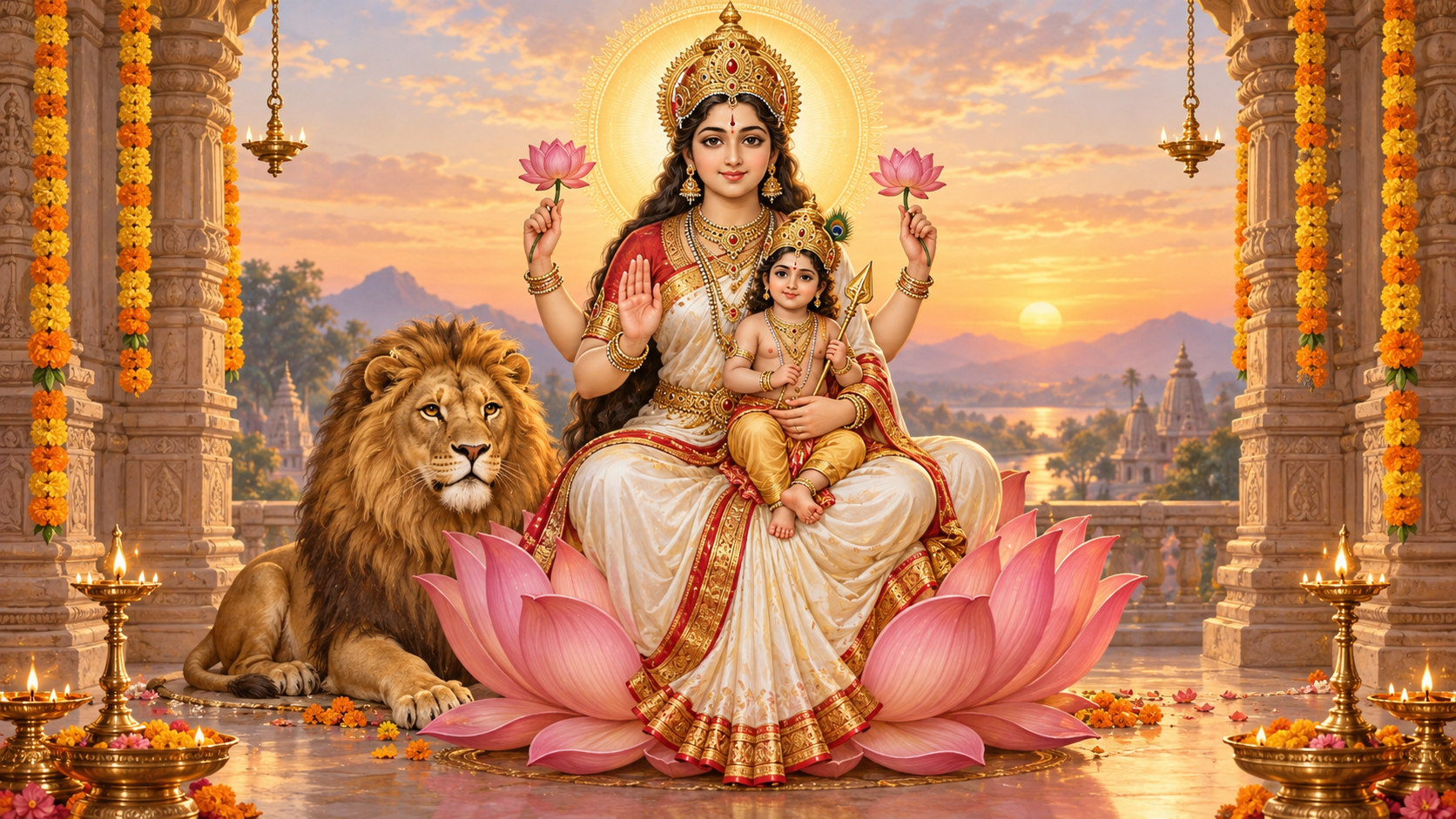
You may have found several names for the fifth day of Navratri and wondered which one belongs on your family calendar. The practical answer is clear: for Sharad, or Ashwin, Navratri in 2026, mark 15 October 2026.
In the Navadurga sequence, you worship Maa Skandamata, the mother of Lord Skanda, also known as Kartikeya. Your family or temple may instead emphasize Lalita Panchami, Upang Lalita Vrata, Lakshmi Panchami, Naga Puja or a regional form of Devi. These are different living expressions of Panchami, not reasons to doubt your observance.
Key takeaways for Navratri day five
- Date: The fifth day of Sharad Navratri 2026 falls on 15 October 2026.
- Navadurga form: Worship Maa Skandamata, whose motherhood unites tenderness with protective strength.
- Other observances: Lalita Panchami, Upang Lalita Vrata, Sri Lakshmi Panchami and Naga Puja may also be associated with Panchami.
- Temple tradition: At Vijayawada’s Kanakadurga Temple, the fifth-day alankaram is Sri Lalitatripura Sundari Devi.
- Best approach: Follow your family, sampradaya or temple tradition consistently instead of combining every regional practice into one compulsory ritual.
Set the right date before choosing a puja time
Panchami is a lunar tithi, not simply the period from one civil midnight to the next. If you are making a formal sankalpa, beginning a vrata or arranging a community puja, consult the panchanga used in your location. Tithi boundaries and the suitable worship period can depend on place, so an exact time copied from another city may not apply to you.
There is another possible source of confusion. Skandamata Pujan is also listed on 23 March 2026 in the year’s Navratri calendar. That is separate from the Sharad Navratri date addressed here. When sharing plans with relatives, write the complete label: Sharad Navratri day five – 15 October 2026. This small distinction prevents a spring Navratri date from being carried into an autumn observance.
For a simple household puja, first confirm the date with the calendar your family normally follows, then select a time that allows unhurried worship. If an inherited vrata requires a particular tithi window, let the local panchanga or your temple guide the timing rather than an undated online checklist.
One Panchami can hold several valid forms of Devi
The fifth day does not look identical across every Hindu community. The important distinction is between a broad Navadurga sequence and a particular regional, temple or family paddhati.
| Tradition or setting | Fifth-day emphasis | What you should do |
|---|---|---|
| Navadurga worship | Maa Skandamata, mother of Skanda or Kartikeya | Use Skandamata as your principal form when your household follows the nine forms of Durga. |
| Lalita-centred observance | Lalita Panchami or Upang Lalita Vrata | Follow the vrata procedure received from your family, guru or temple if this is your tradition. |
| Vijayawada Dasara Navaratri | Kanakadurga Mata adorned and worshipped as Sri Lalitatripura Sundari Devi | Understand this as the temple’s fifth-day alankaram; a household need not reproduce the temple’s complete ritual. |
| Other Panchami calendars | Sri Lakshmi Panchami and Naga Puja | Include these only where they belong to your established local or family practice. |
| Nepal | Dashain continues with the customary worship of Goddess Durga | Follow the Dashain procedure transmitted in your household or community. |
The word “dedicated” can create a false dilemma here. A Navadurga devotee can rightly call Panchami the day of Skandamata, while a temple following its own alankaram sequence can rightly present Lalitatripura Sundari Devi. A calendar may also preserve a connected vrata or local observance. Each description answers a different ritual question.
Do not stack every listed practice into one puja out of anxiety. Decide which lineage or household custom you are following, name that form of Devi in your sankalpa, and complete the observance with attention. Coherence is more useful than an overloaded ritual assembled from unrelated lists.
A simple Skandamata puja you can complete at home
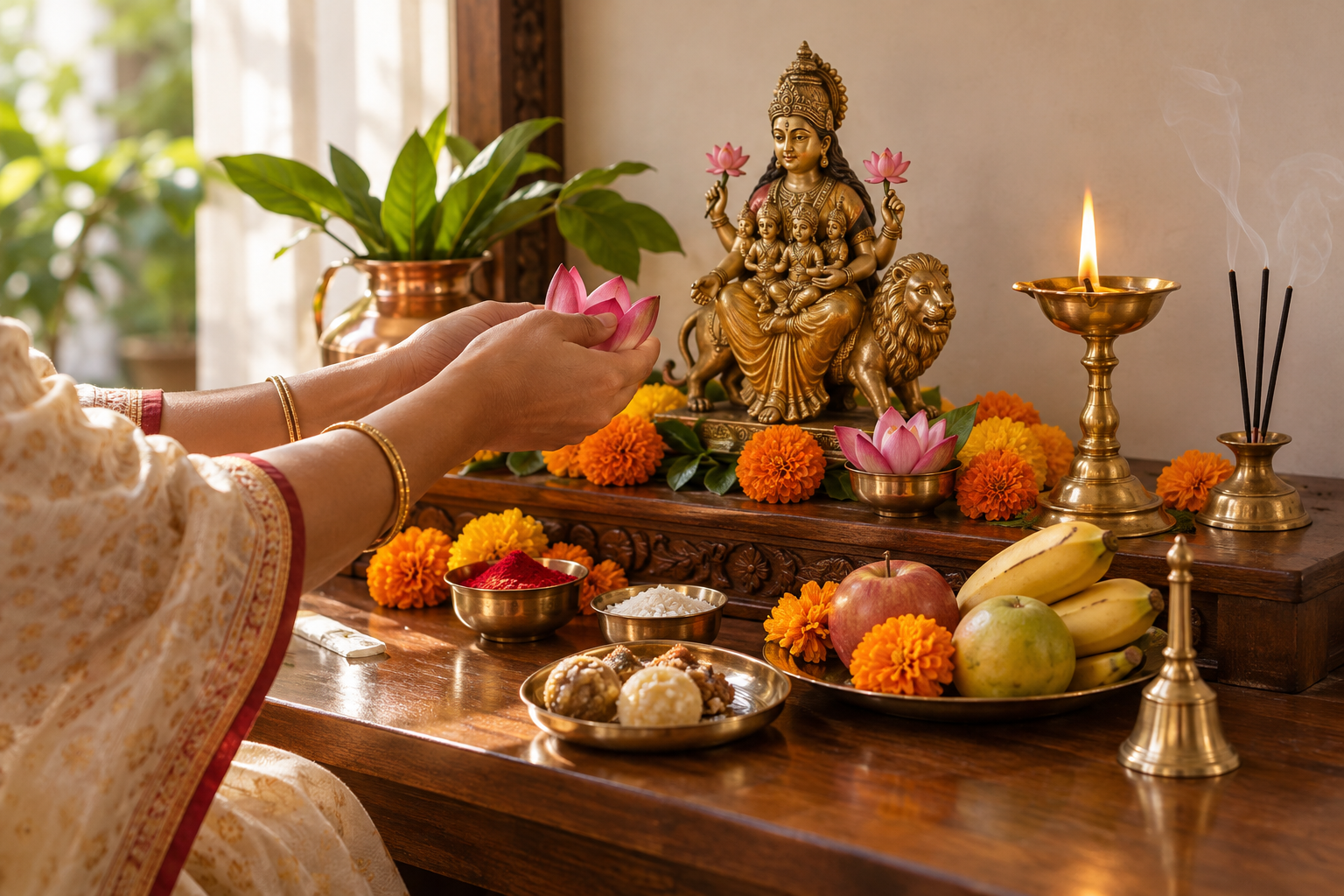
If you have an inherited paddhati, use it. If you do not, the following is a modest household outline rather than a substitute for temple vidhi. It keeps the focus on worship without inventing mandatory colors, costly materials or unsupported mantra counts.
- Choose your devotional focus. Use Maa Skandamata when you follow the Navadurga sequence. If your family keeps Lalita Panchami or another Panchami vrata, retain that tradition instead of replacing it.
- Prepare the worship space. Clean the area and place the murti or image you ordinarily use. A clean, dedicated space for Skandamata worship is more important than elaborate decoration.
- Gather simple offerings. Use a lamp, clean water, flowers and fruit or home-prepared prasad where these accord with your custom. You do not need to purchase a special item merely because an online list labels it essential.
- Begin quietly. Wash, sit for a moment and settle your attention before lighting the lamp. Keep the phone and unrelated conversation away from the shrine for the duration of the puja.
- Make a clear sankalpa. State that you are observing the fifth day of Sharad Navratri and worshipping Devi in the form recognized by your tradition. You may dedicate the worship to clarity, peace in the household and the strength to protect without anger.
- Offer prayer or japa. Use the mantra taught in your lineage. If you have not received one, repeat the name of Maa Skandamata respectfully or pray in your own language. Do not treat a mantra count copied without context as a universal requirement.
- Perform aarti and offer pranam. Let the closing be deliberate rather than rushed. Share prasad according to your household custom.
- Carry the worship into conduct. Choose one concrete act of patient care, responsible protection or service and complete it that day.
If vrata or fasting is part of your observance, follow the rules received from your family, guru or temple. A vrata is a discipline of attention and conduct, not simply a competition over food. Do not stop prescribed medicine or ignore a health condition for a fast; if dietary restriction may affect your health, ask a qualified clinician what is safe and keep the devotional commitment in a suitable form.
Let Skandamata change how you care and protect
Maa Skandamata represents motherly love joined with fierce protection. Devotees approach her for peace, prosperity and spiritual liberation. That combination gives Panchami a sharper purpose than a generic request for comfort: genuine care must nourish growth, and genuine protection must remain free of cruelty.
Bring that principle into your prayer by examining one relationship for which you carry responsibility:
- Are you helping someone grow, or making them dependent because letting go feels difficult?
- Have you confused harshness with strength when a calm boundary would protect more effectively?
- Is someone in your household carrying a care burden that you could share today?
- Does a child, elder or vulnerable person need your attentive presence rather than another instruction?
You do not need a dramatic vow. Choose one repair that can be finished: take over a neglected duty, end a needless quarrel, make time for someone who depends on you, or set a firm boundary without humiliation. This is how the image of protective motherhood becomes dharmic practice rather than festival decoration.
Before 15 October, send your household four details: the date, the form of Devi you will worship, the chosen time and the offerings each person should bring. On Panchami, complete the puja you can sustain with sincerity. Then let one act of compassionate courage carry Skandamata’s worship beyond the shrine.
References
- Hindu Pad – 5th day of Navratri 2026, October 15
- Hindu Pad – 5th day Alankaram in Vijayawada Dasara Navaratri 2026 – October 15 | Lalitatripura Sundari Devi
- Hindu Pad – Things to do on 5th day of Navratri Vrat, 15 October 2026
- Hindu Pad – 5th day Navratri Puja Timings, 15 October 2026

Leave a Reply
You must be logged in to post a comment.