
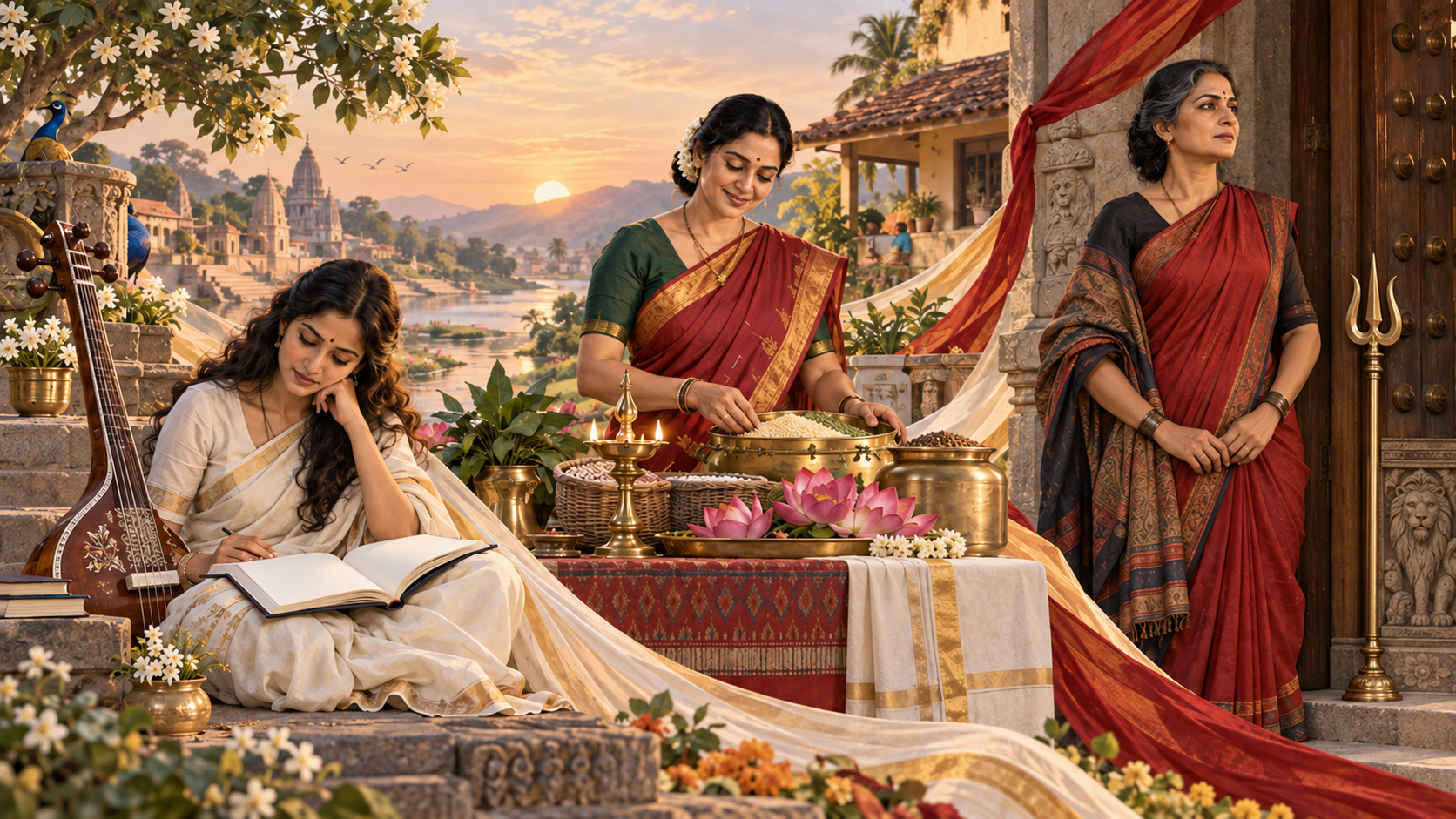
If someone tells you that Hindu tradition has only one respectable role for a woman, you don’t need to answer with a slogan. Ask a sharper question: which form of the Devi are they leaving out?
The honest answer is not that every Hindu family or society has always treated every woman justly. It is that Hindu sacred imagination offers a much wider account of womanhood than submission, domesticity or marital status. It recognizes knowledge, prosperity, protection, renunciation, motherhood and disciplined self-direction as expressions of feminine power. You can use that framework both to answer stereotypes and to examine whether your own customs honour the ideals invoked in worship.
Begin with Shakti, not a prescribed social role

Navratri begins from a decisive image: the Goddess, as Mahishasuramardini, defeats Mahishasura. The feminine is not waiting at the edge of the story for somebody else to restore order. She recognizes the threat, confronts it and acts.
That matters because Shakti is not merely a compliment paid to women. It names active power: the capacity through which knowledge is pursued, prosperity is created and protected, injustice is resisted, and spiritual discipline is undertaken. The divine feminine therefore cannot be reduced to a job description for human women.
This distinction protects women from two opposite mistakes. The first makes femininity synonymous with obedience. The second praises women as goddesses while demanding that they be endlessly patient, self-sacrificing and capable. A living woman does not have to prove her sacred worth by carrying every burden without complaint. Devi is a theological vision of power, not a demand that every woman become superhuman.
When you encounter a family expectation or community custom, test it with four concrete questions:
- Does it respect a woman’s capacity to seek, interpret and transmit knowledge?
- Does it give her a meaningful voice in decisions involving wealth and shared resources?
- Does it honour her right to establish boundaries and protect herself and others?
- Does it leave room for more than one vocation, including paths that do not centre marriage or motherhood?
A custom does not become Dharmic merely because it is familiar. If it repeatedly denies the capacities represented by the Goddess, invoking tradition cannot end the discussion.
Read Saraswati, Lakshmi and Durga as capacities, not boxes
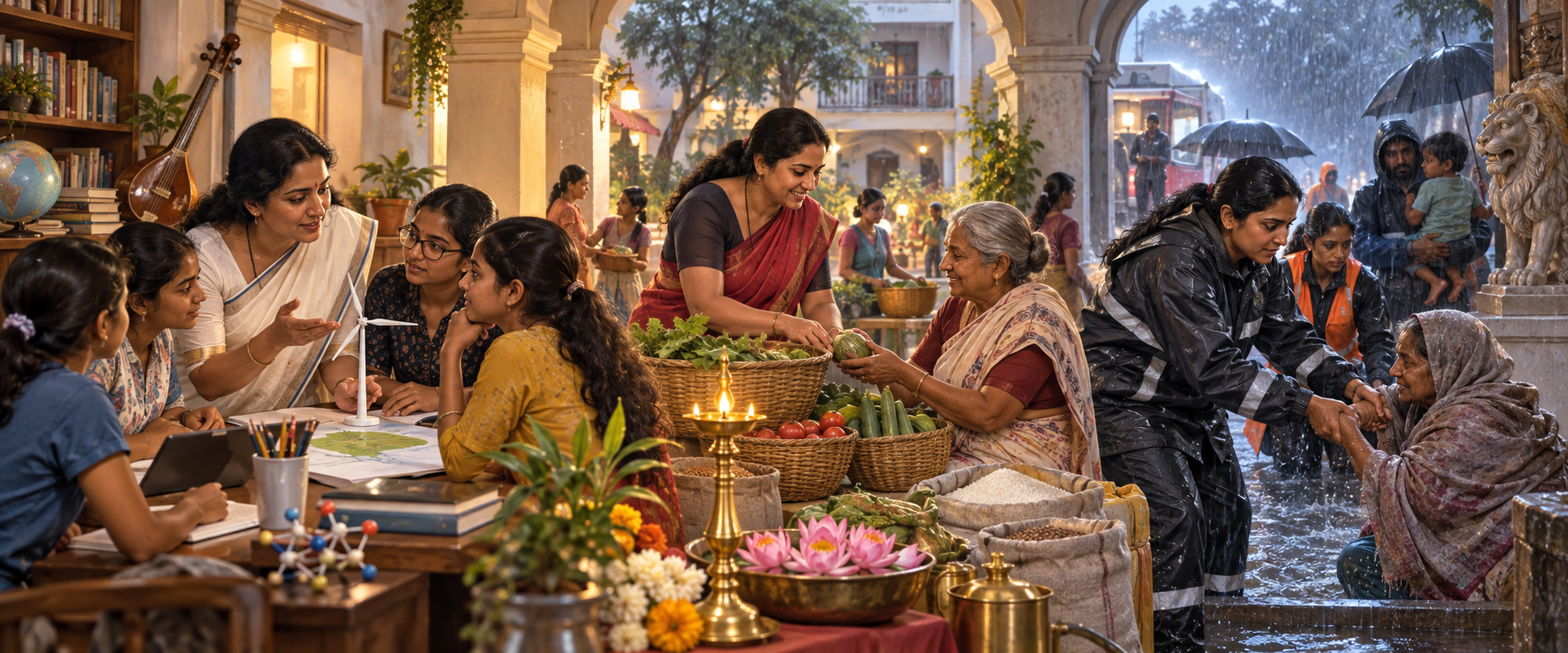
Many Hindu communities centre their Navratri devotion on Saraswati, Lakshmi and Durga. They should not be turned into three approved personality types. Read together, they reveal three capacities that a healthy family and society must allow women to exercise.
Saraswati: authority begins with the freedom to know
Saraswati represents learning, knowledge and disciplined expression. This is more than encouragement to earn good marks. Knowledge becomes agency when a woman can ask difficult questions, interpret inherited wisdom and speak with intellectual authority.
The presence of Gargi and Maitreyi in the Upanishadic world of philosophical inquiry makes an important point: women are not only recipients of sacred teaching. They can be seekers, interlocutors and custodians of it.
Apply that principle wherever learning happens. In a home, notice whether sons and daughters receive comparable time, encouragement and educational resources. In a temple discussion, notice whether women only arrange the event or also interpret, question and teach. If a girl is praised before Saraswati but discouraged from serious inquiry, the ritual language and the lived practice are pulling in opposite directions.
Lakshmi: reverence without economic agency is incomplete
Lakshmi represents wealth and prosperity. The familiar idea that Lakshmi enters a home with a new bride can express welcome and reverence. It can also become hollow if the woman being praised has no voice in the household’s financial life.
Do not reduce Lakshmi to the expectation that a woman should bring luck, maintain harmony or serve everybody else’s prosperity. The stronger reading concerns economic agency: knowing how resources are managed, participating in consequential decisions, developing skills, directing generosity and being trusted with responsibility.
Ahilyabai Holkar provides a historical model of a woman using wealth, authority and influence for charitable purposes. The practical question for your home is therefore not simply whether women are called Lakshmi. Ask who sees the accounts, who helps set priorities, who chooses where donations go and whose ambitions receive investment.
Durga: protection is also feminine
Durga breaks the habit of confusing femininity with harmlessness. Her power is protective, morally directed and willing to confront danger. Rani Lakshmibai belongs to the same civilizational memory as a queen who took up arms in defence of society.
You do not have to interpret protection only as combat. It includes setting a firm boundary, opposing mistreatment, reporting wrongdoing, learning practical self-protection and accepting responsibility for the safety of others. A family cannot worship Durga coherently while teaching its daughters that courage, physical competence or a direct refusal makes them unfeminine.
The three forms strengthen one another. Knowledge without room to act can become ornamental. Prosperity without participation can conceal dependency. Protective power without wisdom or ethical purpose can become domination. Hindu womanhood is not a choice among intelligence, abundance and courage; it makes room for their integration.
Let the many forms widen vocation rather than police it
Navratri’s nine forms of Durga include such identities as daughter, mother, ascetic and warrior. Their value lies in plurality. They should not be rearranged into a compulsory sequence through which every woman must pass.
- Daughter: Her value belongs to the present. She is not merely somebody’s future wife or mother.
- Mother: Motherhood can be sacred without becoming a universal obligation or the sole measure of female fulfilment.
- Ascetic: Spiritual discipline and inward vocation are not failures of social participation. They disclose a path that cannot be explained only through family relationships.
- Warrior: Compassion and strength are not opposites. Protection may require firmness, risk and resistance.
This plural vision also means that no woman must display every virtue at once. She need not be an exceptional scholar, income earner, flawless caregiver, tireless volunteer and fearless defender before her choices deserve respect. Freedom includes concentrating on one path, moving between roles over a lifetime and declining roles that others prefer for her.
Before defending an expectation as tradition, ask who chose it, whether it can be reconsidered and whether comparable duties are placed on men. Also ask what happens when a woman says no. A role that is praised only when it is compulsory is not being honoured in the same way as a freely embraced vocation.
Answer the submissive-woman stereotype without denying reality
A stranger cannot infer a Hindu woman’s agency from her bindi, clothing, marriage or religious practice. The assumption that devotion must have been imposed by a husband merely replaces curiosity with an inherited picture of Hindu women as uniformly passive and oppressed.
You can answer that stereotype clearly without making the opposite mistake of claiming that injustice never occurs in Hindu communities:
- Reject the single-role premise. Hindu sacred life presents female figures associated with knowledge, prosperity, protection, motherhood, daughterhood and asceticism.
- Name concrete precedents. Gargi and Maitreyi represent philosophical inquiry; Ahilyabai Holkar represents the responsible exercise of wealth and authority; Rani Lakshmibai represents armed protection.
- Keep the claim honest. Sacred ideals do not prove that every person or institution has lived up to them. They do prove that subordination is not the only model available within the tradition.
A concise response might be: ‘Hindu traditions do not prescribe one form of womanhood. Their own sacred and historical memory includes women as seekers of knowledge, stewards of prosperity, ascetics and defenders. That does not erase real injustice, but it makes the stereotype of inherent female passivity untenable.’
If someone raises a real instance of mistreatment, address the mistreatment rather than hiding behind divine imagery. Dharma is not defended by pretending that every Hindu practice is just. The better question is whether the conduct honours or violates the capacities that Hindu worship already recognizes as sacred.
It also helps to make broad accusations precise. Is the claim about a scripture, a regional custom, a particular historical period, a law, one institution or one family’s behaviour? Those are different claims and require different evidence. Refusing a caricature does not require refusing honest self-examination.
Make devotion visible in household and community decisions
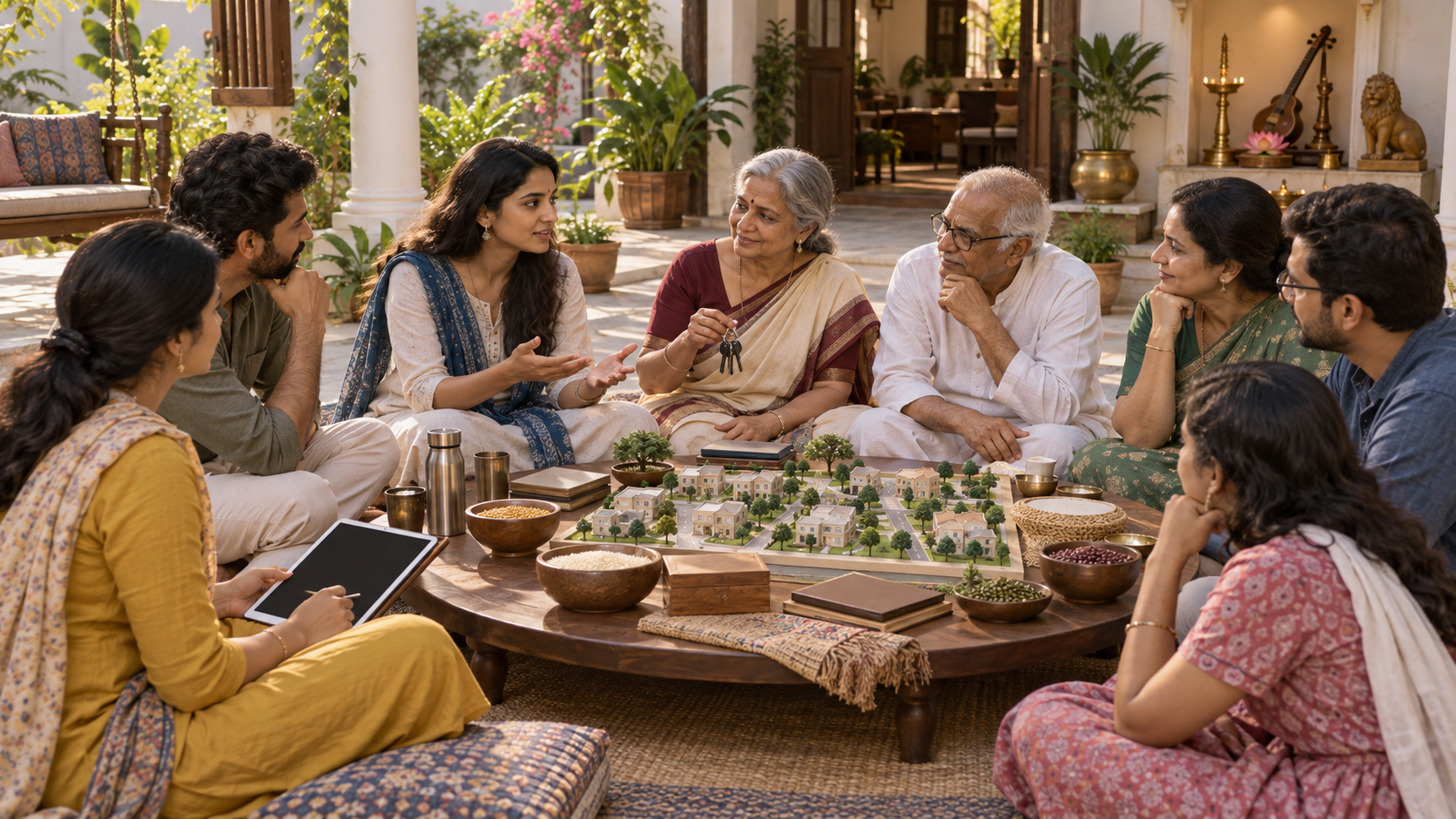
The most useful celebration of the divine feminine is not another flattering description of women. It is the removal of a specific contradiction between what a community venerates and what it permits. You can begin with a five-part audit:
- Audit knowledge. Compare the educational time, encouragement and resources given to girls and boys. Notice who is invited to ask questions, interpret teachings and speak with authority.
- Audit prosperity. Check whether adult women participate in budgets, major purchases, savings priorities and charitable giving. Praise for Lakshmi should correspond to trust and decision-making power.
- Audit protection. Treat a woman’s no as a boundary, not an opening bid. Support practical confidence, self-protection and service in roles concerned with public safety when she chooses them.
- Audit vocation. Listen for the hierarchy hidden inside family praise. A scholar, entrepreneur, caregiver, public servant or spiritually focused woman should not have to imitate another path to be considered complete.
- Audit participation. When a community teaches about goddesses, notice whether women and girls are also visible as learners, organizers, donors, questioners and teachers. Symbolic presence and actual voice are not interchangeable.
Key takeaways
- Shakti describes active capacity, not passive respectability.
- Saraswati, Lakshmi and Durga point toward intellectual, economic and protective agency.
- The many forms of Devi widen the range of legitimate vocations; they do not create a new checklist for women.
- Goddess worship is an ideal against which conduct can be judged, not proof that every Hindu society has achieved justice.
- The clearest defence of Hindu womanhood is a practice that gives women genuine choice, responsibility and voice.
This Navratri, choose one mismatch you can actually correct. Give a girl uninterrupted time to study. Invite a woman into a financial decision that affects her. Stop treating a firm boundary as disrespect. Make space for a woman to explain Dharma rather than merely prepare the room. One concrete alignment between worship and conduct will say more about the divine feminine than another season of praise left unapplied.
References

Leave a Reply
You must be logged in to post a comment.