
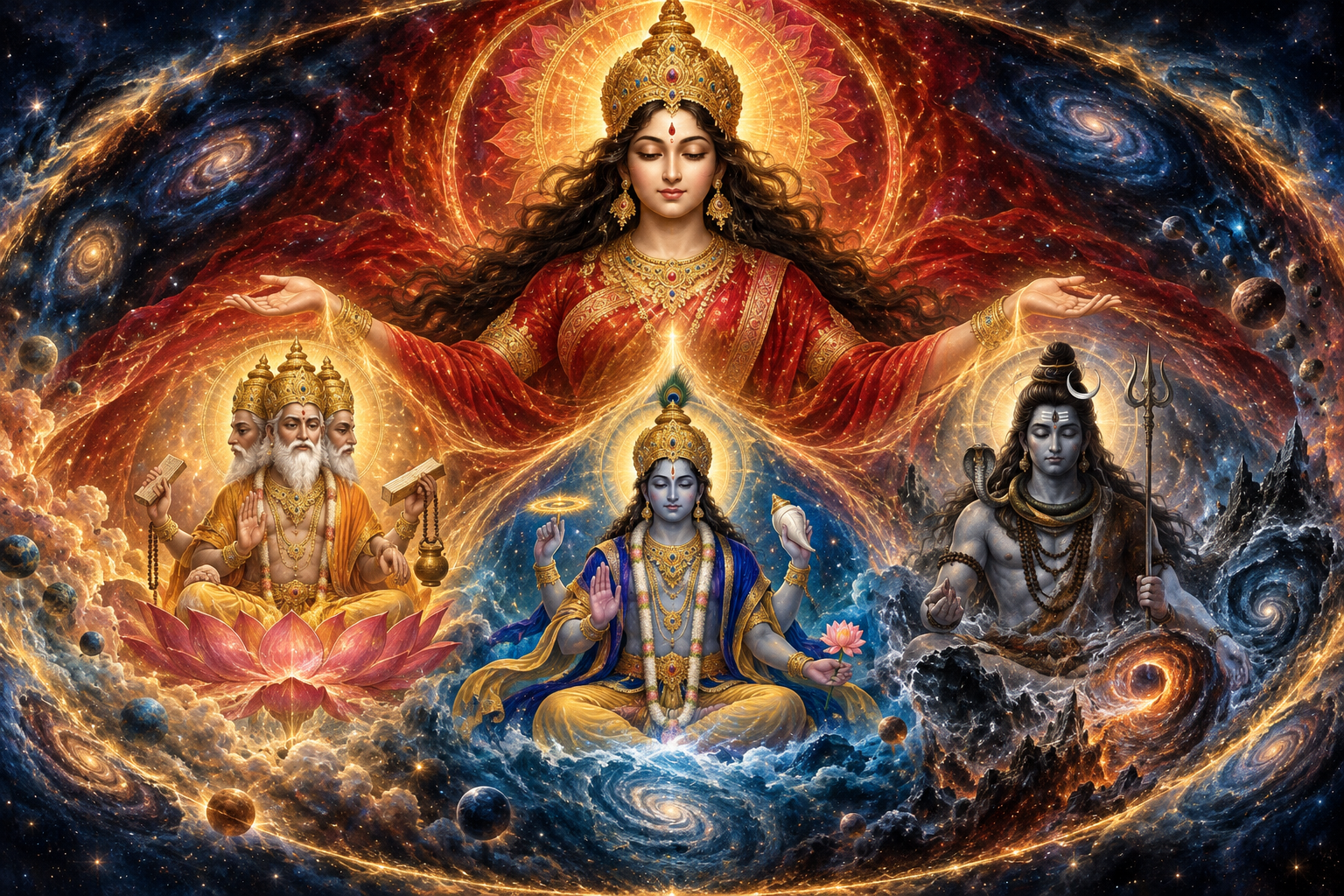
If you have heard that Adi Shakti created Brahma, Vishnu and Shiva, you may be wondering how literally to take it. Did the Goddess exist for a period of time and then produce three separate gods? Does the account make the Trimurti subordinate? Or is it expressing something deeper than a divine family tree?
The key is to distinguish sacred priority from ordinary chronology. Here, Adi Shakti precedes time, matter and formed consciousness, and Brahma, Vishnu and Shiva arise from her. The symbolism therefore concerns the ground of cosmic action: before anything can be created, sustained or dissolved, there must be the power by which those acts become possible.
Key takeaways
- ‘Before creation’ indicates metaphysical priority, because ordinary clock time does not yet exist.
- Brahma, Vishnu and Shiva represent the cosmic functions of manifestation, preservation and dissolution or transformation.
- Adi Shakti is not a fourth specialist alongside the Trimurti. She is the primordial power enabling all three functions.
- Dependence on Shakti does not make the Trimurti unimportant. It explains how their distinct powers belong to a deeper unity.
- This is a Shakta theological vision. Other Hindu sampradayas may express divine primacy through different names and relationships.
Why ‘before creation’ is not a date in cosmic history
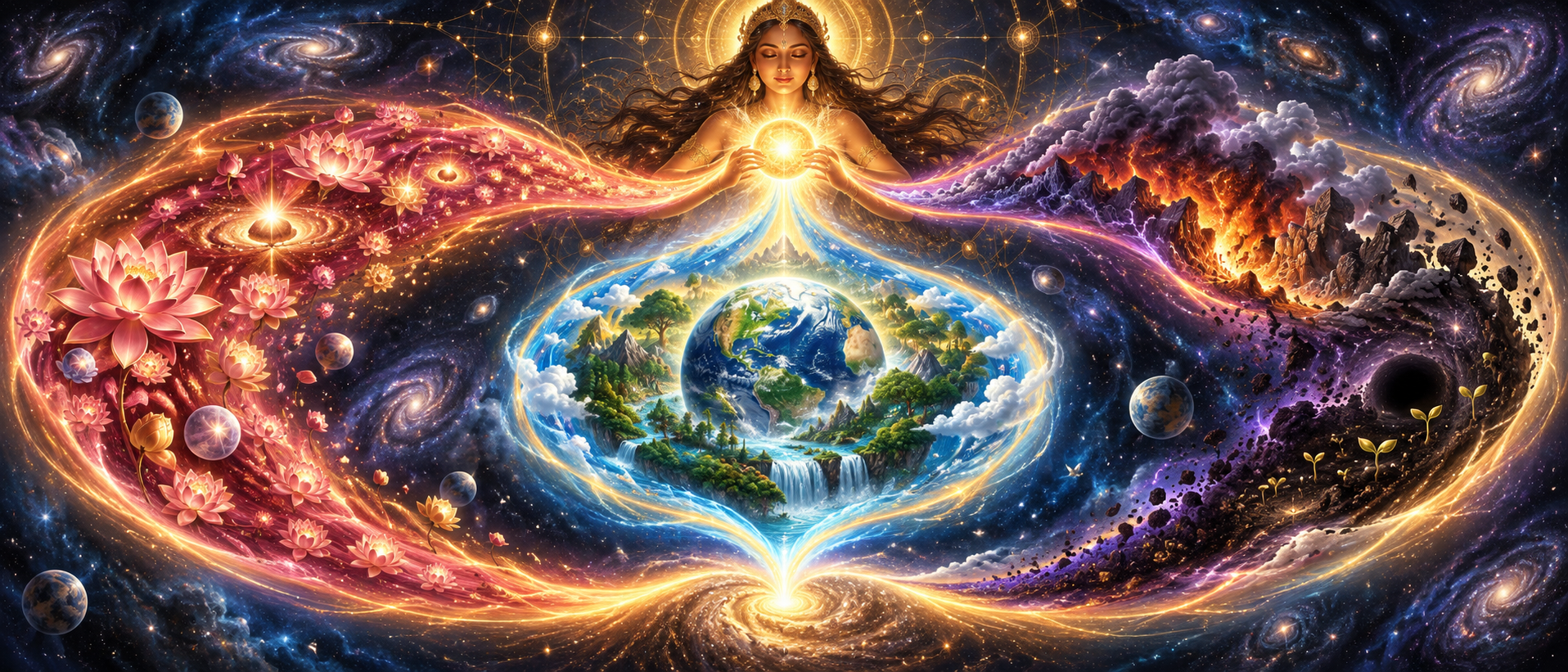
Ordinary sequence works only after time exists. One event occurs, an interval passes, and another event follows. But if Adi Shakti is present before time itself takes form, ‘before’ cannot mean an earlier hour, year or age. There is no cosmic clock against which such an interval could be measured.
‘Before’ instead marks a priority of being. Adi Shakti is first in the sense that the other divine functions depend on her primordial power. The word Adi points to what is original or primordial; it does not assign the Goddess a date inside the universe she enables.
This distinction resolves an apparent contradiction. The creation of the Trimurti does not have to be imagined as a physical event occurring somewhere in pre-existing space. Space, time and the conditions for events are themselves part of what has not yet become manifest. The language of origin gives the mind a way to approach dependence that cannot be pictured directly.
Use this as a reading rule whenever a sacred narrative reaches beyond the beginning of time: do not immediately ask how many moments separated one event from another. First ask what the stated order reveals about ultimate reality. In this case, the order declares that divine power is not a late addition to an already functioning cosmos. It is the condition under which cosmic functioning becomes possible.
One Shakti expressed through three cosmic functions
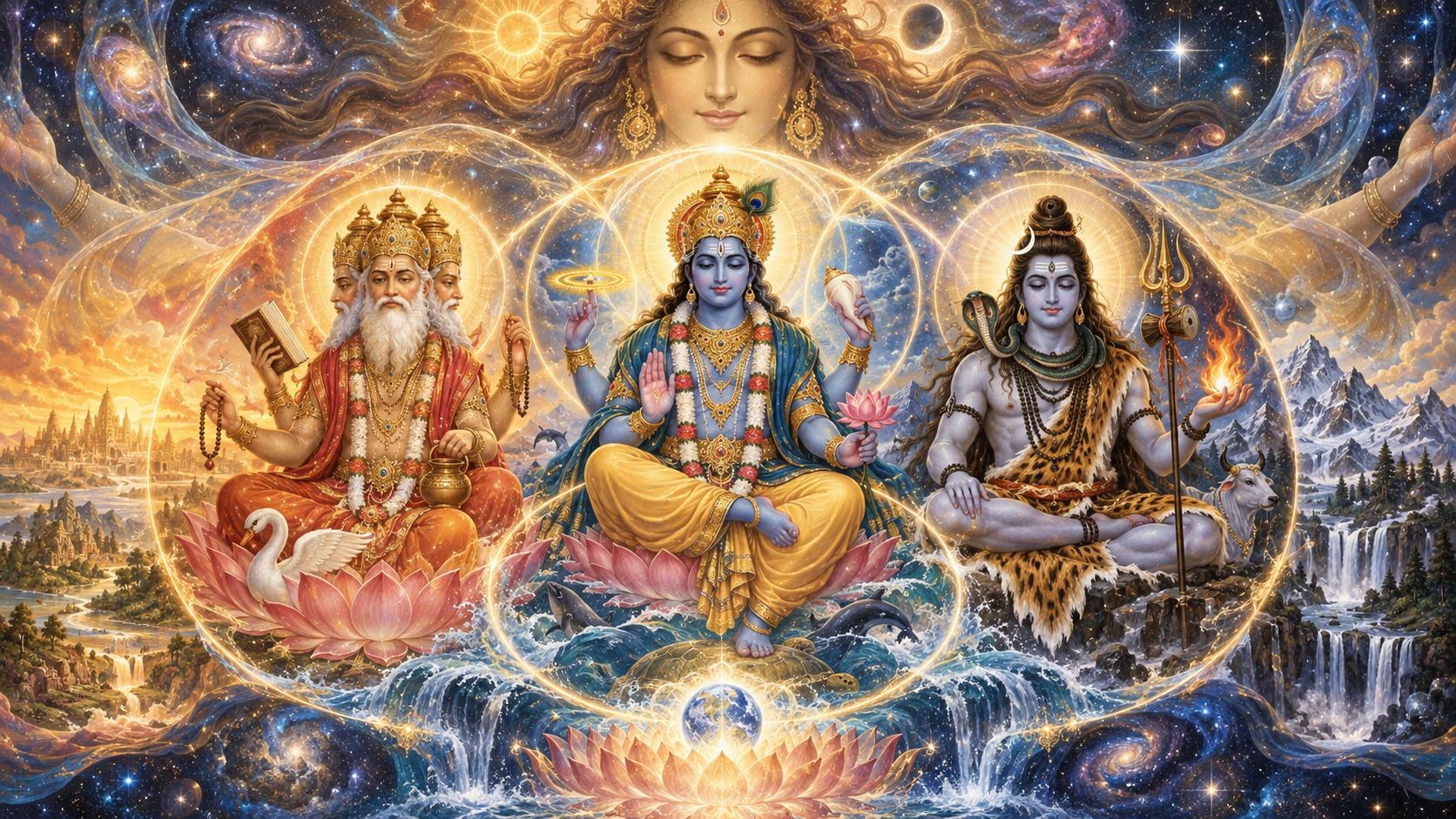
The Trimurti gives three recognisable faces to the movement of existence:
- Brahma represents creation or manifestation: the coming forth of forms, beings and ordered worlds.
- Vishnu represents preservation: the continuity, support and order through which manifested existence can endure.
- Shiva represents dissolution and transformation: the ending of forms and their return from a particular condition.
These are not merely three jobs allocated among unrelated deities. They are inseparable dimensions of one cosmos. A form must arise before it can be sustained. What is sustained still changes. When a form ends, the ending alters the conditions from which something else may arise. The three functions are distinct, but none is intelligible in complete isolation.
Adi Shakti is the unity beneath this functional distinction. She is not confined to the first function simply because she brings forth the Trimurti. If Brahma creates, the capacity to create is Shakti. If Vishnu preserves, the capacity to preserve is Shakti. If Shiva dissolves and transforms, the capacity to dissolve and transform is Shakti. Her primacy extends through the entire cycle.
It is also misleading to reduce Shakti to physical energy. Measurable energy is a feature of the manifested world. Adi Shakti, in this symbolism, names primordial divine potency and agency: that by which manifestation and its governing functions are possible at all. ‘Energy’ can be a useful English approximation, but only if you do not shrink the Goddess into an impersonal mechanism.
When you encounter the Trimurti in an image, story or act of worship, notice both levels. Attend to the distinct deity and function before you, then notice the Shakti without which that function could not operate. This preserves difference without losing unity.
What the symbolism says about hierarchy and the Divine Feminine
The statement that Adi Shakti creates the Trimurti is a strong Shakta claim. It does more than add a goddess to a group of already supreme male gods. It places the Divine Feminine at the very source of their capacities. She is not presented merely as a consort who completes a power originating elsewhere; divine power itself is primordial and feminine in this theological vision.
That does not turn Brahma, Vishnu and Shiva into powerless or dispensable figures. A function can depend on its source while remaining real and indispensable within the manifested order. Their dependence explains the unity of their powers; it does not erase their identities.
Nor must the relationship be flattened into a contest between female and male deities. The sharper question is not which divine personality defeats the others. It is whether creating, preserving or dissolving can occur through an independent power detached from the ultimate ground. The Shakta answer presented here is no: every such capacity is an expression of Adi Shakti.
Hindu sampradayas do not all organise divine names into one identical hierarchy. A Shakta may begin from the supremacy of Devi, a Vaishnava from the supremacy of Vishnu, and a Shaiva from the supremacy of Shiva. You do not understand this plurality by forcing every account into one neutral diagram. Read each vision from within its own devotional and philosophical centre before asking how it relates to another.
This also guards against two opposite mistakes. The first is to insist that the creation of the Trimurti must be a literal biological birth. The second is to dismiss the deities as decorative symbols for an abstract theory. Sacred symbolism can communicate metaphysical meaning while the divine forms remain objects of genuine devotion. You do not have to sacrifice theology to recover symbolism, or sacrifice symbolism to preserve reverence.
A practical method for reading the creation symbolism
Use the following questions when studying this account or another Hindu creation narrative. They prevent a mythic image from being reduced either to literal chronology or to vague metaphor.
- Identify the frame. If the setting is before time, matter or formed consciousness, read temporal words carefully. They are likely marking metaphysical priority rather than clock time.
- Name what is ultimate within that tradition. Here, Adi Shakti is not one being inside a completed universe. She is the primordial divine power from whom its governing functions arise.
- Map each divine form to its function. Brahma manifests, Vishnu sustains, and Shiva dissolves or transforms. Keep the forms distinct long enough to understand why all three are necessary.
- Ask what ‘creation’ means in context. It may indicate manifestation, derivation, dependence or the disclosure of a latent function. Do not assume it must mean manufacturing an object from external material.
- Return from the functions to their source. Ask what enables creation, preservation and dissolution alike. This movement from plurality back to power is where the central Shakta insight becomes visible.
Use the triad as a contemplative map
You can carry the symbolism into reflection without pretending that your personal life is the whole meaning of the cosmology. When facing a transition, ask three concrete questions: What now needs to come into form? What deserves continued care? What has completed its purpose and should be released?
Then add the question that the creation of the Trimurti places beneath all three: what power makes each movement possible? Beginning requires capacity; continuity requires capacity; release requires capacity. The circumstances change, but Shakti is present through the entire movement rather than only at its beginning.
Keep the personal analogy in its proper place. It can train your attention, but it does not replace the cosmic claim or reduce Adi Shakti to a psychological technique. If you belong to a lineage, let its established mantra, puja and interpretation govern devotional practice. Use the three questions to deepen attention to that practice, not to invent a new one from fragments.
The next time you meet the statement that Adi Shakti created Brahma, Vishnu and Shiva, move past the question of who appeared first on an imagined timeline. Ask what must be primordial for manifestation, preservation and transformation to exist at all. That question opens the symbolism on its own terms and turns a puzzling genealogy into a coherent vision of Shakti.
References

Leave a Reply
You must be logged in to post a comment.