
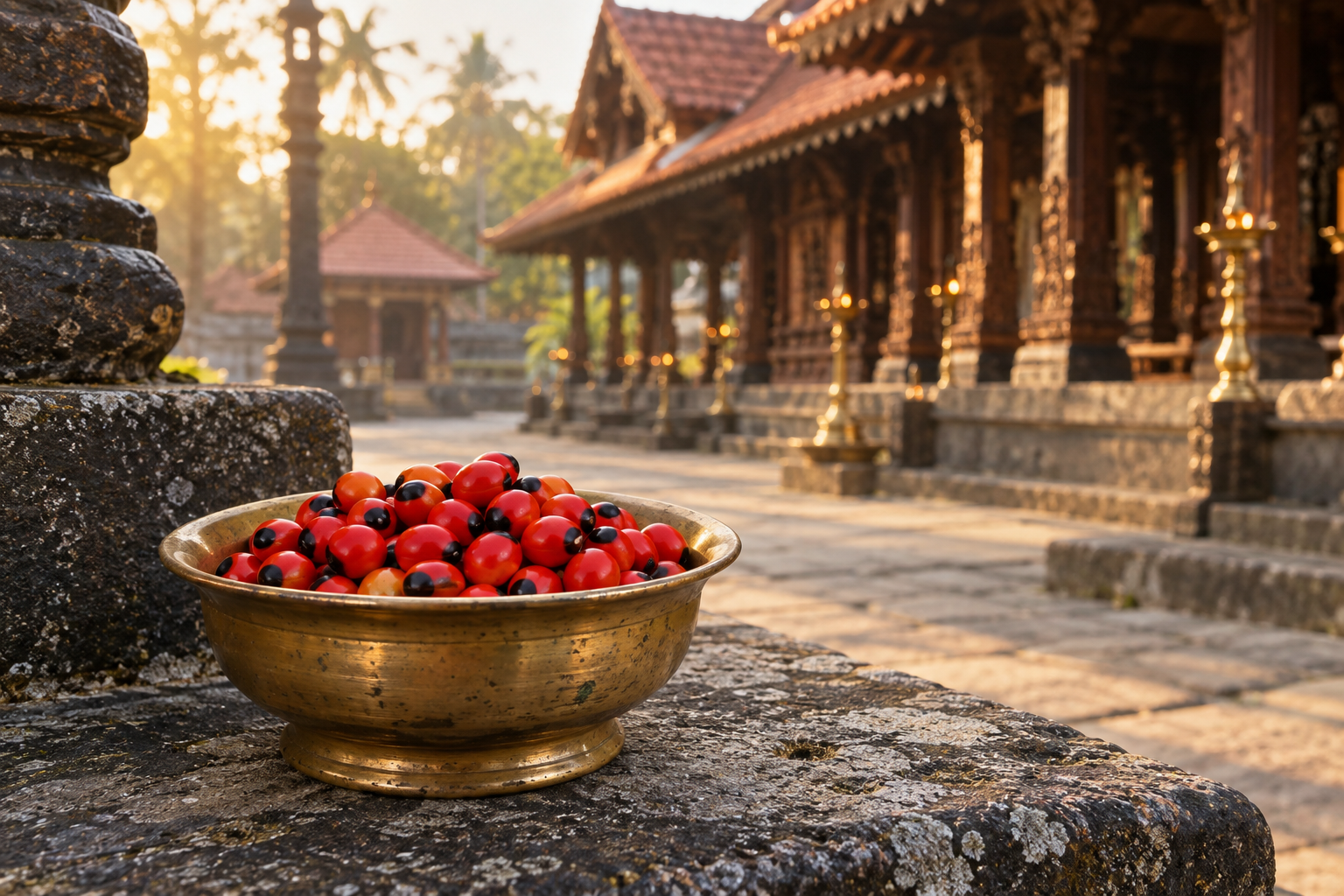
If you are planning darshan at Guruvayur, you may be wondering whether Kunnikuru is something you must offer, something you can request at the temple, or a symbolic custom you should understand before participating. The answer begins with a simple distinction: the seed is the visible offering, but devotion is the substance of it.
At Guruvayur Sri Krishna Temple, Kunnikuru, also called Manjadikuru, means the bright red-and-black seeds of the Rosary Pea plant. Their material value is modest. That modesty is precisely what makes the tradition memorable: you do not need an expensive object to approach Bhagavan Krishna with sincerity.
What you are actually offering
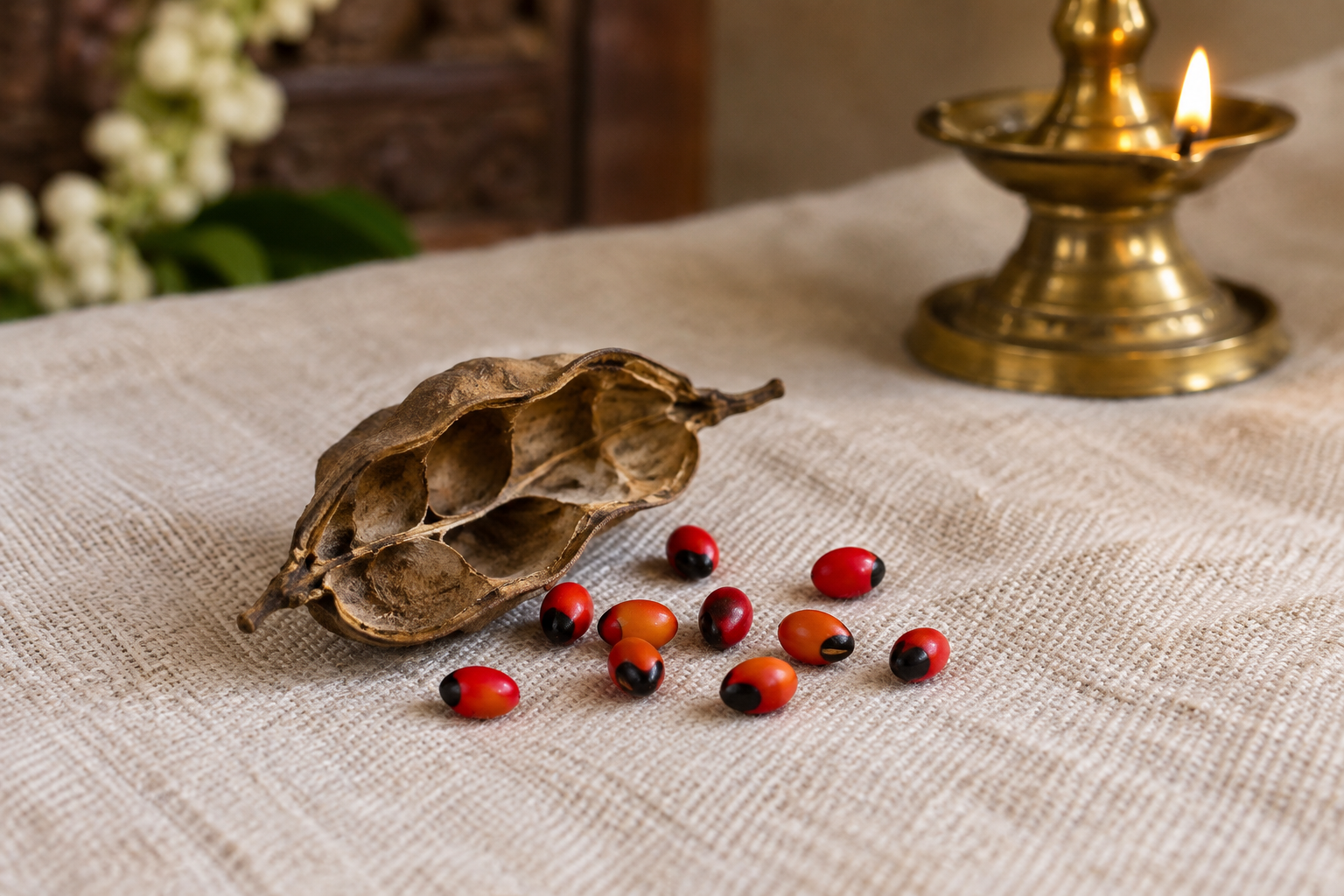
Kunnikuru and Manjadikuru are two names used for the same distinctive seeds. In the Guruvayur tradition, they belong among the many material offerings through which devotees express love and faith toward Sri Krishna.
Yet the physical object is only one part of the act. A seed can be handled mechanically, displayed proudly, or offered with complete inward attention. Outwardly, those actions may look similar. In the language of bhakti, however, their inner quality is not the same. The offering acquires devotional meaning through your bhava: the intention, humility, gratitude, and loving remembrance accompanying it.
This is why Kunnikuru should not be understood as a fee paid to Krishna. Bhagavan does not need the devotee’s possessions. The devotee needs a way to surrender possessiveness, pride, and calculation. A materially small object can serve that purpose unusually well because it leaves little room to confuse price with spiritual worth.
Why such a small offering carries a large lesson
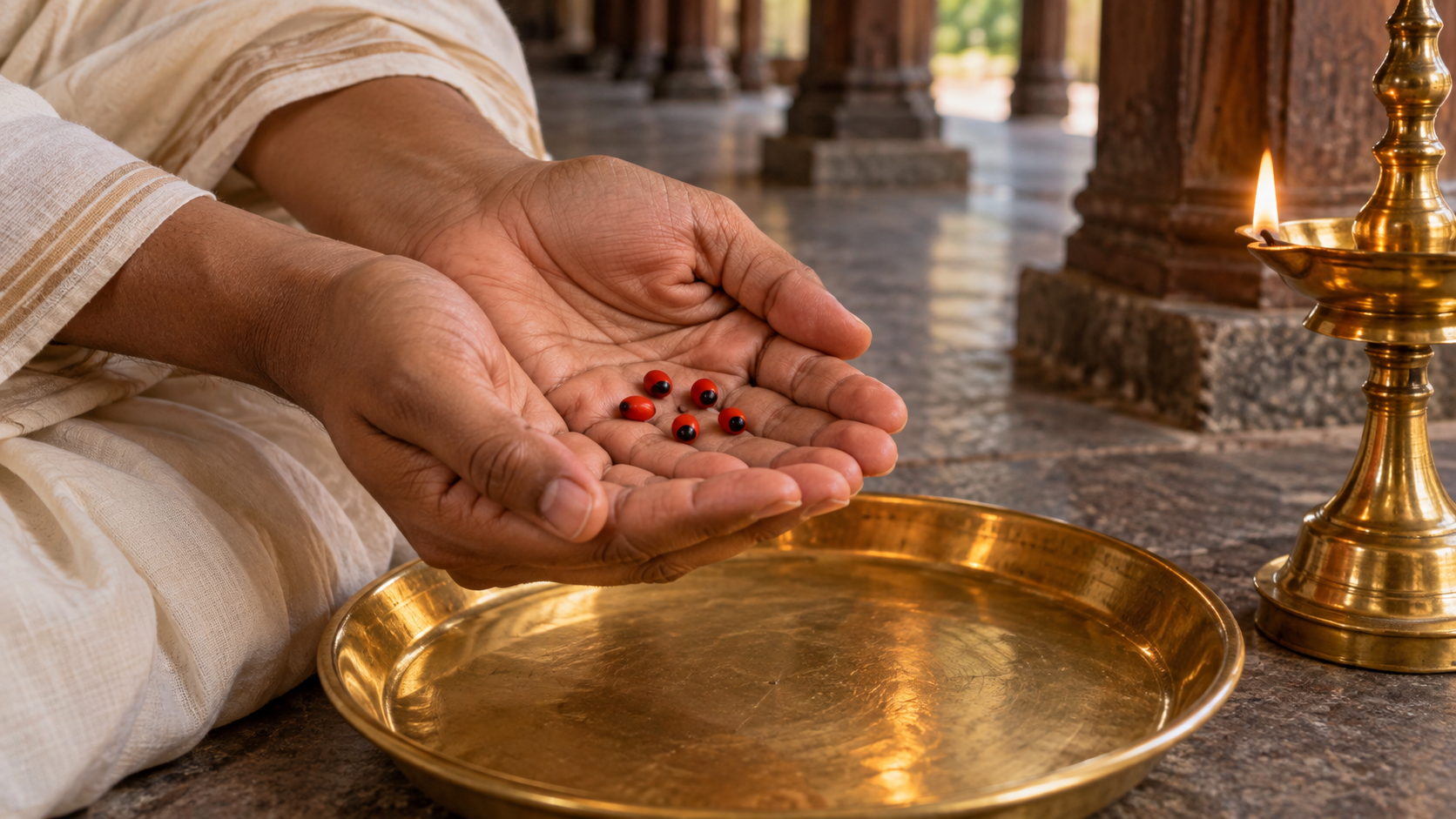
The traditional account associated with Kunnikuru at Guruvayur is remembered as a lesson in pure devotion. Its governing insight is clear even before you enter into every detail of the narrative: an offering does not become sacred merely because it is costly. It becomes an act of worship when it truthfully expresses the devotee’s relationship with the Divine.
That corrects a common anxiety. You may see elaborate offerings and assume that your own prayer is inadequate because you cannot match them. Kunnikuru turns that assumption around. The right question is not, “How impressive is my gift?” It is, “What am I honestly placing before Krishna through this gift?”
You might be offering gratitude after receiving help, surrender during a difficult period, repentance for conduct you want to change, or a simple wish to remember Krishna without asking for anything. Naming that intention makes the ritual more focused. It also prevents the offering from becoming a transaction in which devotion is reduced to “I give this, so Bhagavan must give me that.”
The seed’s smallness therefore is not a defect to overcome. It is the teaching. It directs attention away from display and toward sincerity, where bhakti properly begins.
How to approach the offering during a Guruvayur visit

The devotional meaning is enduring, but temple procedures are practical matters and can change. Do not assume that a story about an offering gives you permission to carry loose seeds into every area or place them wherever you choose. Confirm the current arrangement at an official counter or with authorized temple staff when you arrive.
- State your intention before joining the flow of darshan. Use one plain sentence, such as, “Krishna, I offer this with gratitude,” or, “May this remind me to act without pride.” A clear intention is more useful than an elaborate formula you do not understand.
- Ask where and how the offering is presently received. Use the designated arrangement and follow the instructions given by temple staff. This preserves both temple order and the dignity of the act.
- Do not treat the seeds as food or playthings. Rosary Pea seeds can be hazardous if damaged, chewed, or swallowed. Keep them intact and away from young children. If you possess loose seeds, store them securely rather than carrying them casually.
- Keep the prayer proportionate and honest. You do not need to manufacture an intense emotional experience. Attention, reverence, and sincerity are enough.
- Complete the offering through conduct. Choose one small action that expresses the prayer after you leave: keep a promise, restrain a harsh word, perform quiet seva, or set aside time for nama-japa. This turns a temple moment into a lived discipline.
If temple staff tell you that the offering is handled differently from what you expected, accept that direction without disappointment. The heart of the practice does not depend on improvising a particular physical gesture. Following the temple’s order can itself be part of the humility you came to cultivate.
Four misunderstandings that weaken the practice
- More seeds do not automatically mean more devotion. Quantity can count objects; it cannot measure surrender. Do not turn a lesson in simplicity into another form of competition.
- The offering is not a contract for a guaranteed result. You may bring a prayer or wish before Krishna, but bhakti is not a purchase. Leave room for grace without dictating its form.
- The object is not a substitute for inner work. Offering Kunnikuru while knowingly continuing harmful conduct misses the point. Attach the prayer to one change you can actually make.
- Humility does not require public display. You do not have to announce what you offered, what you asked for, or how devout the act made you feel. Quiet remembrance is often closer to the lesson embodied by the humble seed.
These distinctions matter because a ritual can preserve its external form while losing its spiritual direction. The safest test is simple: after the offering, are you a little less possessive, less demanding, or less concerned with comparison? If not, return to the intention rather than adding more objects.
Key takeaways
- Kunnikuru and Manjadikuru are names for the red-and-black Rosary Pea seeds associated with a humble offering to Sri Krishna at Guruvayur.
- The tradition emphasizes pure devotion rather than the monetary value or outward size of the gift.
- Confirm the temple’s current procedure with authorized staff instead of assuming that you may carry or place loose seeds yourself.
- Keep the seeds intact and away from children because they are not edible and can be hazardous when damaged or swallowed.
- Give the ritual a practical continuation through prayer, self-restraint, seva, or another small act consistent with your intention.
Before your Guruvayur visit, write your intention in one sentence and decide on one action that will carry it into daily life. Then let the Kunnikuru remain what it is meant to be: a small offering that directs you toward a devotion larger than the object in your hand.
References

Leave a Reply
You must be logged in to post a comment.