
You have reached the second day of Navratri and want to worship Brahmacharini properly, but two questions can easily distract you: which mantra should you recite, and what does her connection with Mars actually mean?
Keep the order clear. Approach Brahmacharini first as the form of Devi who directs energy into tapas, restraint and steady effort. Treat the astrological dimension as a supporting intention, not as a bargain with a planet or a reason to fear your horoscope.
Begin with Brahmacharini, not with fear of Mars
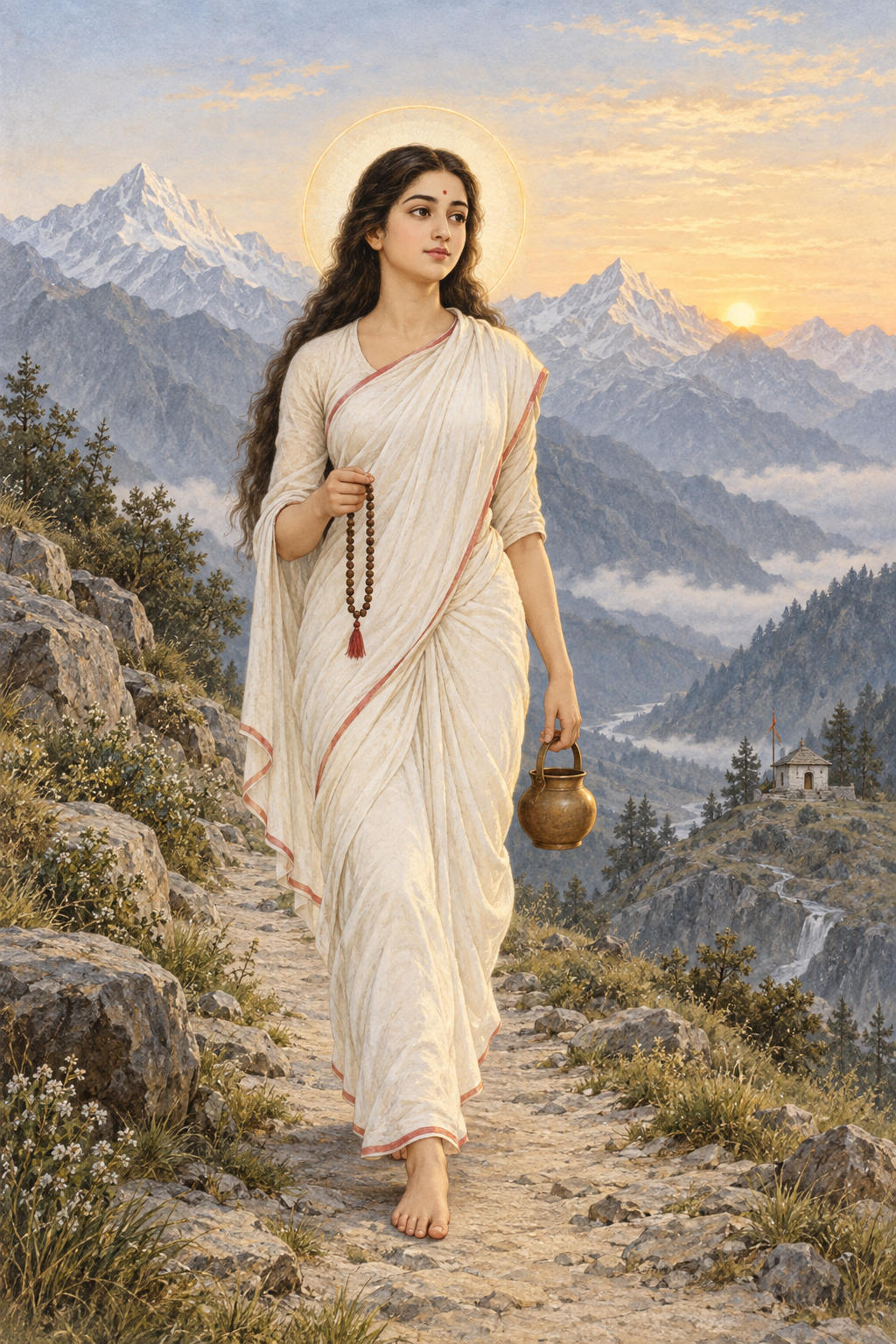
Brahmacharini is the second of the Navadurga forms and is worshipped on the second day of Navratri. Her name and ascetic form direct attention toward brahmacharya, tapas, simplicity and purposeful self-command. For a householder, this need not mean withdrawing from ordinary life. It means refusing to let appetite, irritation or distraction decide what you do next.
This distinction matters because people sometimes approach a graha-related puja only as damage control: a planet is thought to be difficult, so the worshipper tries to make the difficulty disappear. Brahmacharini worship asks for something more demanding and more useful. It asks you to become capable of carrying energy without wasting it.
Before beginning, choose a sankalpa that names a quality you can practise. You might pray for steadiness before an important decision, restraint in speech, concentration during study or the will to complete an obligation. Avoid asking vaguely for every problem to be removed. A precise intention gives the puja a place to enter your conduct.
A simple Brahmacharini puja you can sustain at home
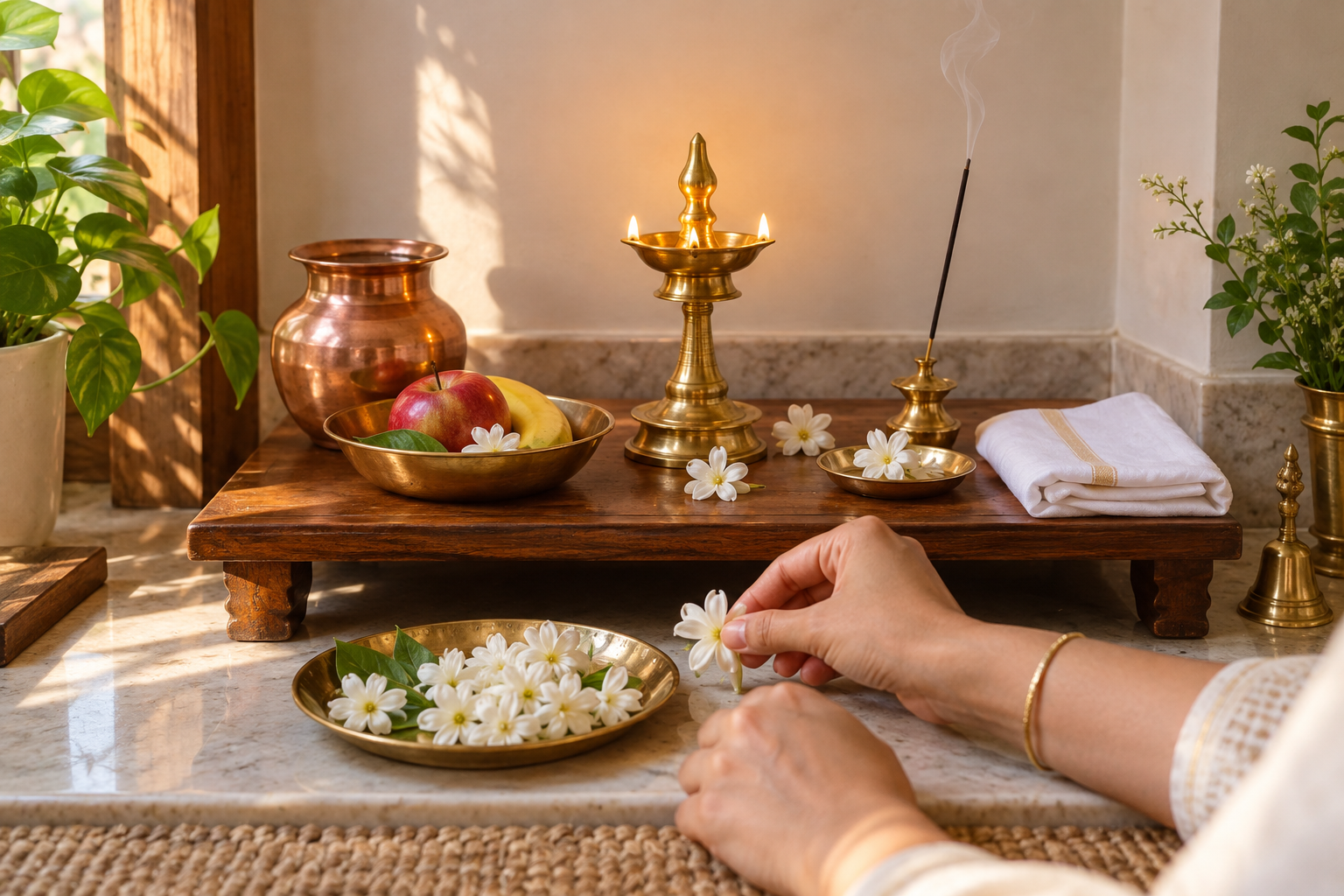
If your family, sampradaya or temple has an established procedure, follow it. A simple home observance is not meant to displace inherited practice. It gives you a workable structure when you do not have a detailed paddhati or a priest guiding the worship.
- Prepare the place and yourself. Clean the worship area and settle before you begin. Place an image or murti of Devi if that is part of your practice. Keep only the offerings you can handle attentively; an elaborate arrangement is not a measure of devotion.
- State the sankalpa plainly. Name the discipline you are offering and seeking. For example: “May this worship strengthen clear action, measured speech and constancy in my chosen duty.”
- Make the customary offering. Offer a lamp, water, flowers or whatever your household tradition ordinarily uses. Do not interrupt the practice to chase a supposedly compulsory colour, food or accessory that your own tradition has never required.
- Recite one Brahmacharini invocation carefully. Read slowly enough to preserve the word groups. If you are learning, clarity is more valuable than speed or an ambitious repetition count.
- Sit without adding another request. After the recitation, remain quiet and notice where your energy is presently leaking through anger, haste, avoidance or distraction.
- Close with pranam and a concrete vrata. Choose one action that will embody the prayer that day. Finish a delayed duty, pause before an angry reply or keep a period of focused study without unnecessary interruption.
The last step prevents the puja from becoming purely transactional. An offering to Brahmacharini should produce a corresponding act of discipline. The action can be modest, but it should be observable: by the end of the day, you should know whether you kept it.
Use one mantra with attention before adding more texts

A commonly used Brahmacharini invocation is:
Dadhana kara-padmabhyam akshamala-kamandalu |
Brahmacharini invocation
Devi prasidatu mayi Brahmachariny anuttama ||
The sense of the verse is: “Holding a rosary and water pot in her lotus-like hands, may the unsurpassed Goddess Brahmacharini be gracious to me.” The akshamala evokes sustained japa and the kamandalu the simplicity of the ascetic path. Together they turn the worshipper away from restless display and toward patient practice.
Romanized Sanskrit is written in several ways, so spacing and spelling may differ between prayer books. Preserve the main word groups rather than reading the line as though it were an English sentence:
- Dadhana kara-padmabhyam: bearing in her lotus-like hands.
- Akshamala-kamandalu: the rosary and water pot.
- Devi prasidatu mayi: may the Goddess be gracious to me.
- Brahmachariny anuttama: the unsurpassed Brahmacharini.
Do not become paralysed by minor differences in Roman spelling. Learn the sounds from a competent teacher, priest or a trusted recitation in your own lineage when precise Sanskrit pronunciation matters to your observance. Until then, recite slowly, avoid swallowing the compounds and keep the same version throughout a single practice.
You may encounter a basic invocation, a dhyana shloka and a longer stotra. They serve different practical purposes. The short invocation supports repeated remembrance; a dhyana verse helps establish the form of the Goddess in the mind; a stotra develops praise through a longer sequence. You do not need to rush through all three. Choose the form you can recite with attention, then expand the practice after its meaning has become familiar.
What Brahmacharini’s connection with Mars means

In this devotional Jyotisha understanding, Brahmacharini is connected with Mangal, or Mars. Her worship is believed to calm the difficult expression of Martian energy, particularly aggression and impulsiveness, while supporting emotional balance, mental focus and willpower.
The connection becomes clearer when Mars is understood as force that needs direction. Courage, drive and decisive action can serve dharma when governed by discernment. The same force becomes destructive when it appears as needless conflict, impatience or action taken before thought. Brahmacharini represents the discipline that contains heat without extinguishing purposeful effort.
This is a traditional spiritual and astrological interpretation, not a guaranteed mechanism. A puja does not promise that every conflict will disappear, and a short temper by itself does not establish that Mars is afflicted in your birth chart. Jyotisha assesses a chart as a whole; reducing a person to one planet or one personality trait encourages fatalism rather than discernment.
If Mangal is part of your sankalpa, pair the worship with conduct that addresses the quality you are praying about:
- If the concern is impulsive speech, delay your response until you can state the point without insult.
- If the concern is scattered effort, choose one unfinished duty and bring it to completion before opening another.
- If the concern is anger, identify the boundary or responsibility underneath it instead of treating intensity itself as strength.
- If the concern is weak resolve, keep one reasonable commitment exactly as made rather than adopting a severe austerity you will abandon.
These actions do not replace the worship. They give the worship a field in which to work. The appropriate question after puja is not merely “Has Mars become favourable?” It is also “Am I using force with greater restraint, clarity and responsibility?”
Key takeaways
- Brahmacharini is worshipped as the second Navadurga on the second day of Navratri.
- Her practice centres on tapas, restraint, simplicity and the steady direction of energy.
- For home worship, use a clear sankalpa, one carefully recited invocation and one concrete act of discipline.
- The mantra portrays her with an akshamala and kamandalu, signs that orient the mind toward sustained practice and austerity.
- Her association with Mangal belongs to devotional Jyotisha and is traditionally invoked to soften aggression and impulsiveness while strengthening focus and willpower.
- Astrological worship should deepen responsibility, not create fear or promise automatic results.
On the second day of Navratri, decide what you will actually place before Brahmacharini: not only a flower or a lamp, but one unruly habit and one unfinished duty. Recite with care, keep the vrata you chose, and let steadier conduct become the visible continuation of the puja.
References
- HinduPad — Astrological Importance of Brahmacharini Pooja
- HinduPad — Brahmacharini Mantras: Moola Mantra, Dhyana Sloka, Stotra

Leave a Reply
You must be logged in to post a comment.