
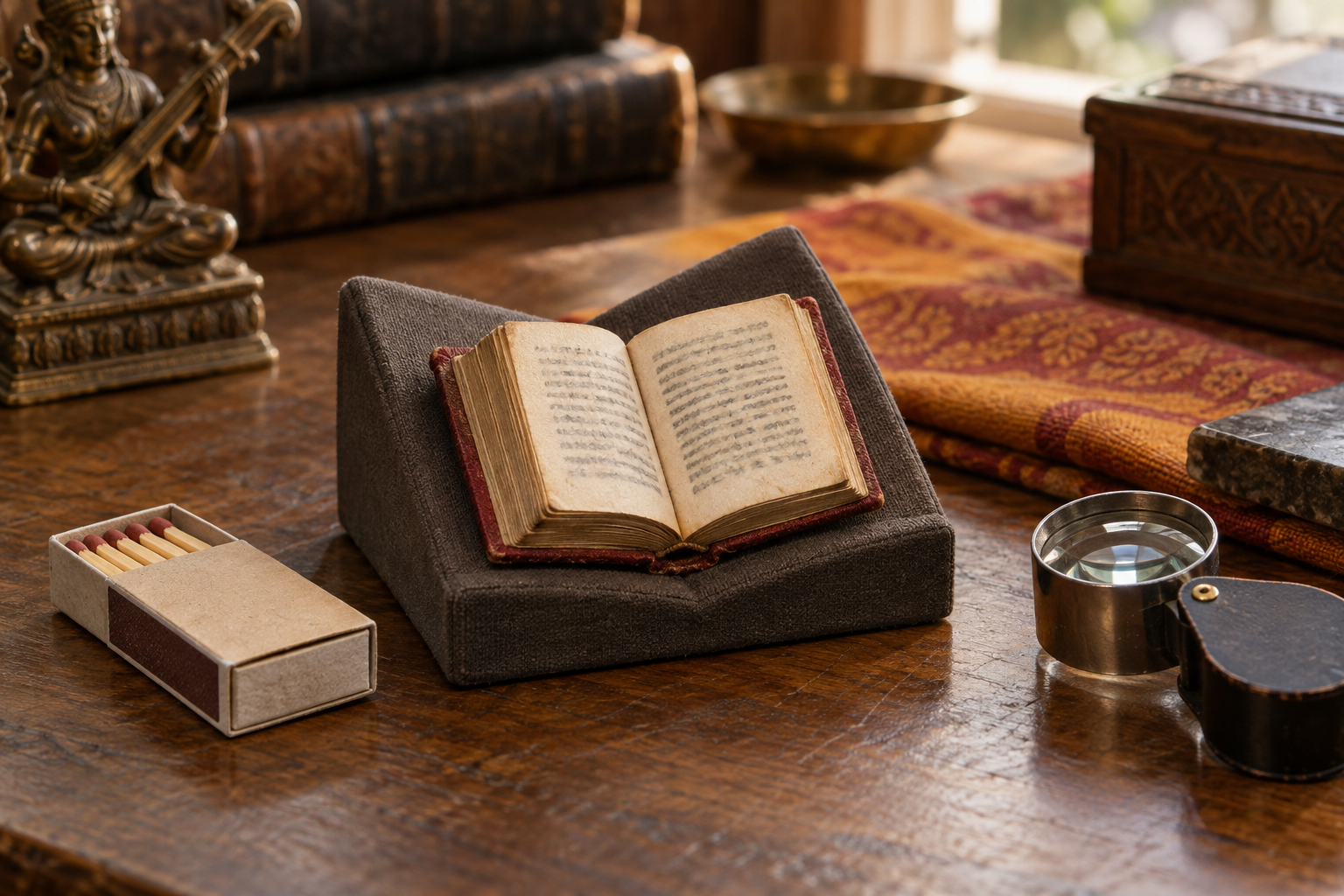
If the matchbox-sized Bhagavad Gita from Tikamgarh left you wondering whether it is really a manuscript, how rare it is, or why it matters, begin with one correction: its importance does not need exaggeration. This is a remarkably small printed sacred book, and that is significant in its own right.
The responsible next step is not to repeat an impressive label after seeing one photograph. It is to separate verified facts from assumptions, identify the edition and printing process, and protect the object before enthusiastic handling causes damage.
What is known about the Tikamgarh Gita
In Khargapur, Tikamgarh, Surendra Pratap Singh, also known as Baby Raja, has custody of a Bhagavad Gita measuring just 4 x 4.4 centimetres, containing approximately 350 pages, and believed to be about 130 years old. Most importantly for identifying the object, its text was printed rather than written by hand.
Those details give us a useful starting point, but their qualifications matter:
- About 130 years old is an estimated age, not an exact printing date. It should not be silently converted into a specific year unless a title page, colophon, inscription, catalogue entry, or other evidence supports that year.
- Approximately 350 pages is not the same as 350 leaves. A leaf has two sides, while a page is one side. A cataloguer should verify whether the reported total counts numbered pages, printed sides, leaves, or the entire physical sequence.
- Khargapur is the book’s present location, not necessarily its place of manufacture. The printer and printing place must come from evidence inside the volume or a reliable bibliographic match.
- Printed identifies the broad kind of object, not the exact production method. Determining how such small text was reproduced requires close examination; size alone cannot settle the question.
- Rare does not automatically mean unique. Rarity has to be established by comparing this copy with other surviving examples and records of the same edition.
This distinction between observation and inference is essential. It protects the book from being burdened with claims that later examination may overturn, while preserving what is already remarkable about it.
Why this is a printed book, not a manuscript
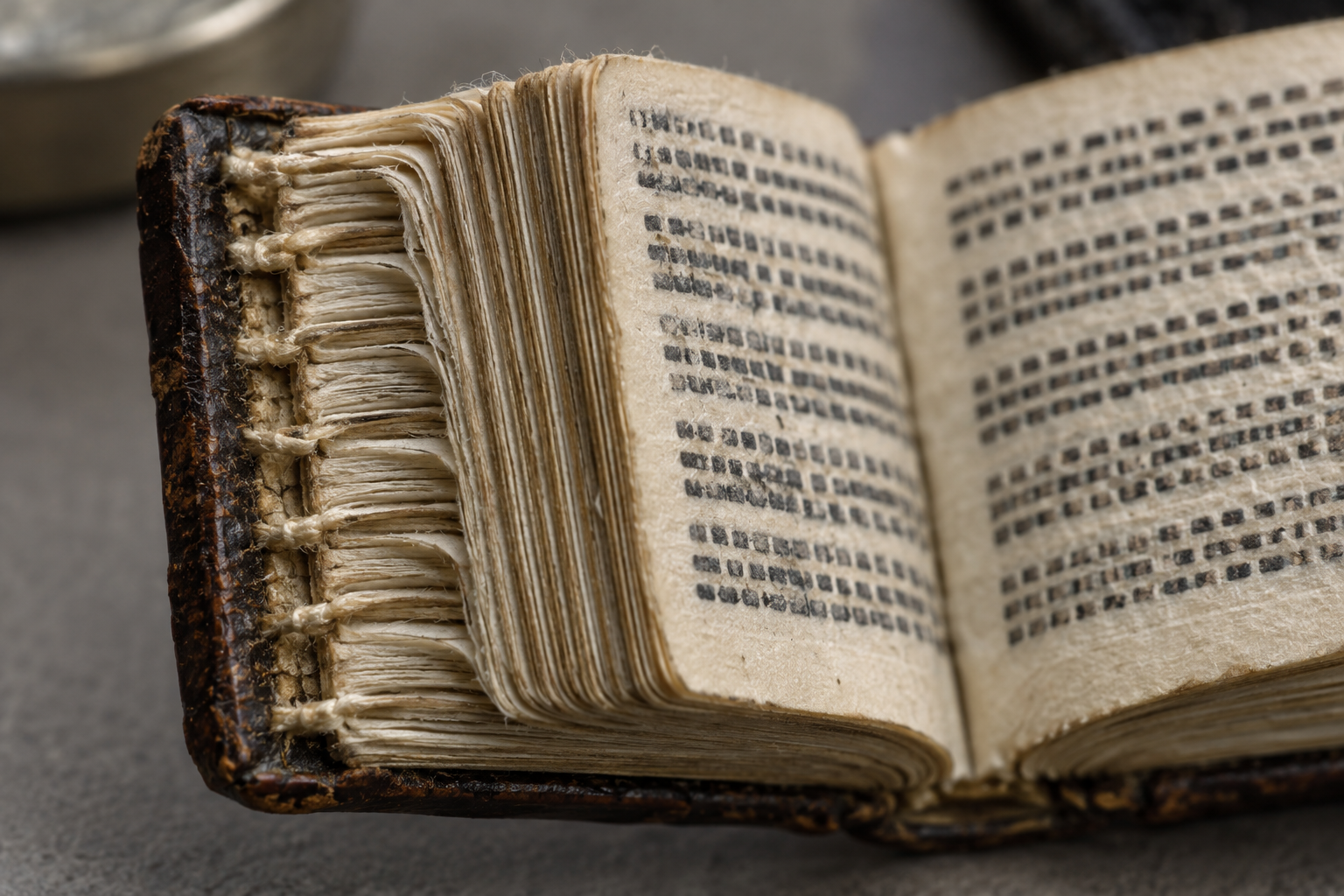
In bibliographic use, a manuscript is written by hand. Because the Tikamgarh Gita was produced through printing rather than handwriting, the more accurate terms are miniature printed book, miniature edition, or printed copy. Calling it a manuscript may sound more venerable, but it sends researchers toward the wrong questions.
For a manuscript, you would examine scribal hands, copying practices, corrections, and the preparation of writing material. For a printed volume, you need to identify the printer, publisher, edition, type or reproduction process, pagination, binding, and relationship to other copies produced from the same setting or master.
The correction does not reduce the object’s Dharmic value. Printing is part of the history of how sacred knowledge moved beyond a single handwritten copy and reached readers in repeatable editions. Fitting hundreds of pages into a book only a few centimetres wide also raises legitimate questions about production skill, intended use, legibility, portability, and devotional practice.
Those questions should remain questions until physical evidence answers them. The book may have been intended for portable reading, private devotion, presentation, technical display, or more than one of these purposes. Its miniature format alone cannot prove the maker’s intention.
How to establish whether a miniature Gita is truly rare
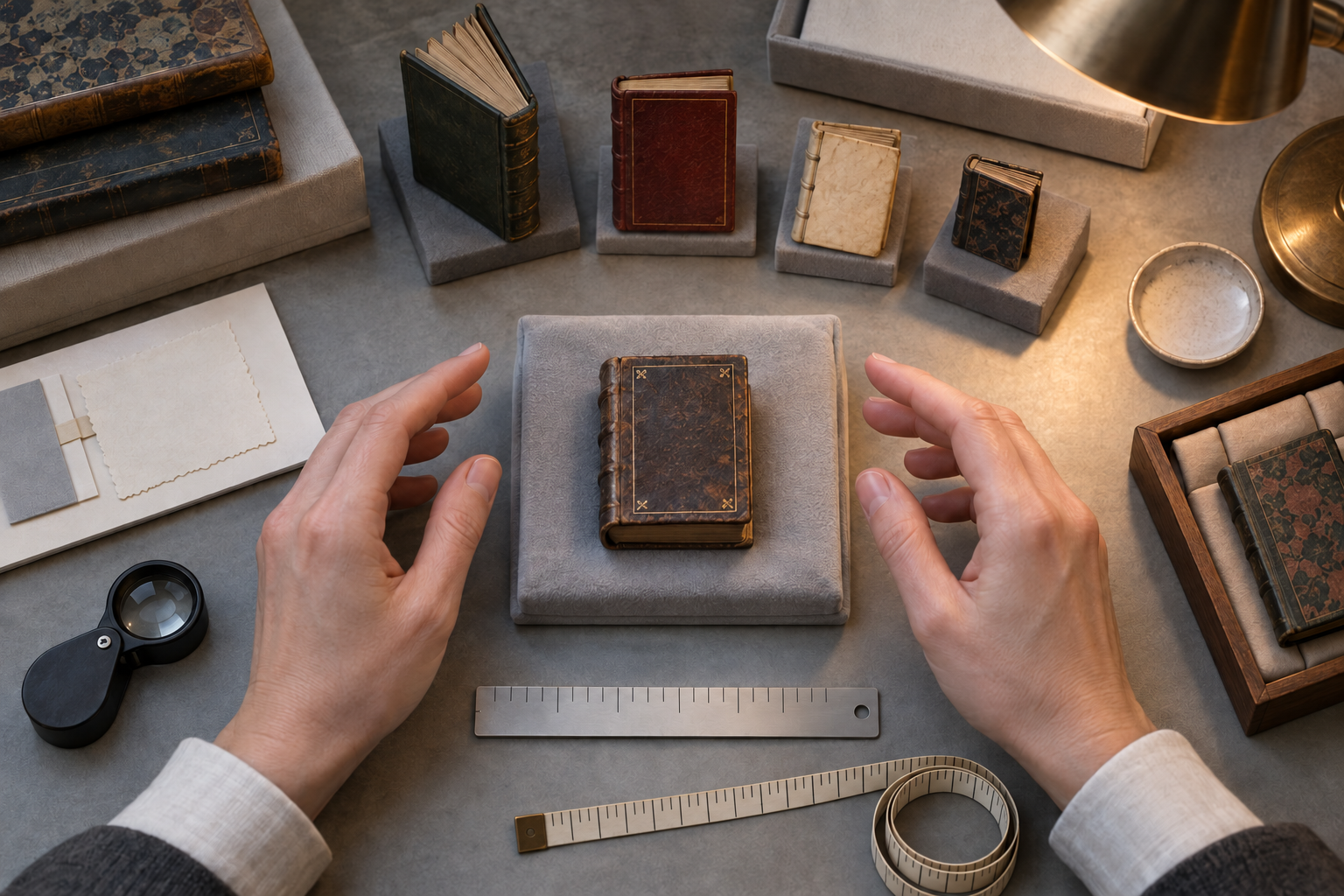
A tiny format attracts attention immediately, but rarity is a comparative conclusion. Before using phrases such as “one of a kind,” “the world’s smallest,” “the only surviving copy,” or “ancient manuscript,” a custodian should complete a basic bibliographic examination.
- Photograph the identifying matter first. Record the front and back covers, spine, title page, first printed page, final printed page, colophon, publisher’s devices, advertisements, ownership stamps, inscriptions, and any handwritten notes. Do not force the binding open to obtain an image.
- Transcribe exactly what the book says about itself. Preserve original spelling, punctuation, script, numerals, and line breaks in the working record. Do not modernise unfamiliar text or fill a missing word from memory.
- Measure the object consistently. Record height, width, and thickness when closed. Note whether the measurement describes the covers or the trimmed text block, and include a metric scale in at least one photograph.
- Verify the physical count. Distinguish leaves from pages, note whether pagination is printed, and record missing, duplicated, blank, or unnumbered leaves. A reported total can otherwise make two different editions appear identical.
- Build the ownership history. Write down who held the book, where it was kept, when it changed hands, and which labels, letters, receipts, family records, or photographs support that history. Keep documented facts separate from family tradition, while recording both.
- Compare like with like. Search institutional library catalogues, bibliographies of Indian printing, museum collections, and securely identified copies for the same title wording, dimensions, pagination, printer, and edition. Similar size alone does not establish a match.
- Use the right specialists. A book conservator can assess structure and condition. A bibliographer or historian of Indian printing can identify an edition and production context. Someone competent in the language and script can transcribe identifying text without guessing.
A reliable catalogue record keeps three layers separate: what can be seen, what a contemporary inscription or printed statement declares, and what a modern examiner infers. For example, a measured dimension is an observation; an approximate age may be an assessment; a claim about devotional purpose is an interpretation. Mixing those layers is how an interesting object becomes an unreliable story.
Until comparative work is complete, a defensible description would be: “A miniature printed Bhagavad Gita in Khargapur, Tikamgarh, measuring 4 x 4.4 centimetres, containing about 350 pages, and believed to be roughly 130 years old.” That wording tells readers what makes the copy noteworthy without claiming an unproved record.
How to protect a miniature sacred book during examination
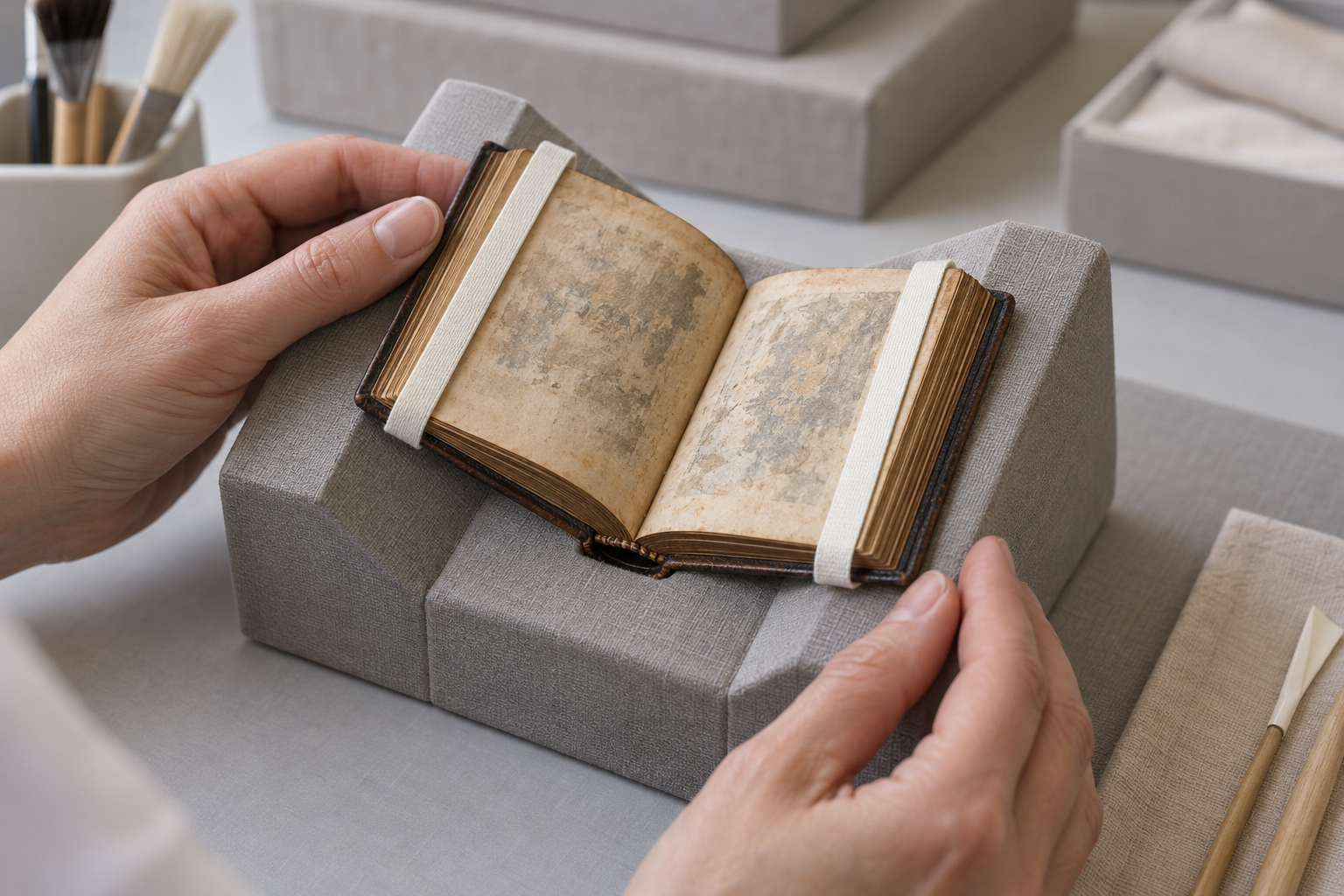
The urge to open every page is understandable, especially when the volume reportedly contains hundreds of them. Yet a complete page-by-page inspection also means hundreds of movements at the binding. Preservation should therefore come before comprehensive photography or public display.
Make the first inspection gentle and reversible
- Work on a clean, dry, uncluttered surface away from food, drinks, open windows, lamps, incense, and direct sunlight.
- Use clean, dry hands unless a conservator examining the particular materials advises otherwise. Bulky gloves can reduce control when pages are exceptionally small.
- Support the book at the angle it opens naturally. Never press it flat merely to expose text near the inner margin.
- Stop if the cover resists, sewing tightens, paper cracks, pigment or ink flakes, or a leaf begins to detach.
- Record existing tears, loose sections, stains, insect damage, deformation, and previous repairs before moving anything. Photographs taken before treatment protect both the object and its history.
Do not use household tape, glue, oil, lamination, pressure-sensitive labels, erasers, or cleaning fluids. Do not trim uneven edges or remove an old inscription because it appears untidy. Such interventions can cause permanent damage and can also destroy evidence needed to identify the edition and provenance.
Create a digital record without sacrificing the binding
Begin with a short identification sequence rather than trying to capture all 350 reported pages in one session. Photograph the exterior, spine, title matter, colophon or final matter, representative text pages, damage, inscriptions, and ownership marks. Include a scale and an identifying card in the first frame, but never place adhesive labels on the volume.
A camera positioned above a supported book is usually less demanding on the binding than pressing the volume onto a flat scanner. Keep full-resolution master files unchanged, create separate copies for sharing, and use filenames that preserve page order. Store the catalogue notes with the images so future readers do not have to reconstruct which side or leaf they are seeing.
If the book cannot reveal its identifying pages without strain, stop. A conservator may be able to design a support or recommend a safer imaging method. No photograph is worth splitting the sewing or detaching a leaf.
Separate reverence from direct contact
A sacred book can be honoured without placing flowers, water, kumkum, oils, food, lamp heat, or incense residue on its paper and binding. If the volume is displayed for darshan or teaching, place ritual materials beside its protective enclosure rather than on the object itself. Use a digital reproduction for frequent reading and reserve the original for carefully supervised access.
Stable, clean storage is more valuable than an ornate but poorly fitted case. The enclosure should protect the volume from dust, crushing, dampness, excessive heat, and unnecessary light without forcing it into position. A book conservator should select materials and design for the actual binding rather than relying on a generic miniature box.
What the miniature Gita means beyond its size
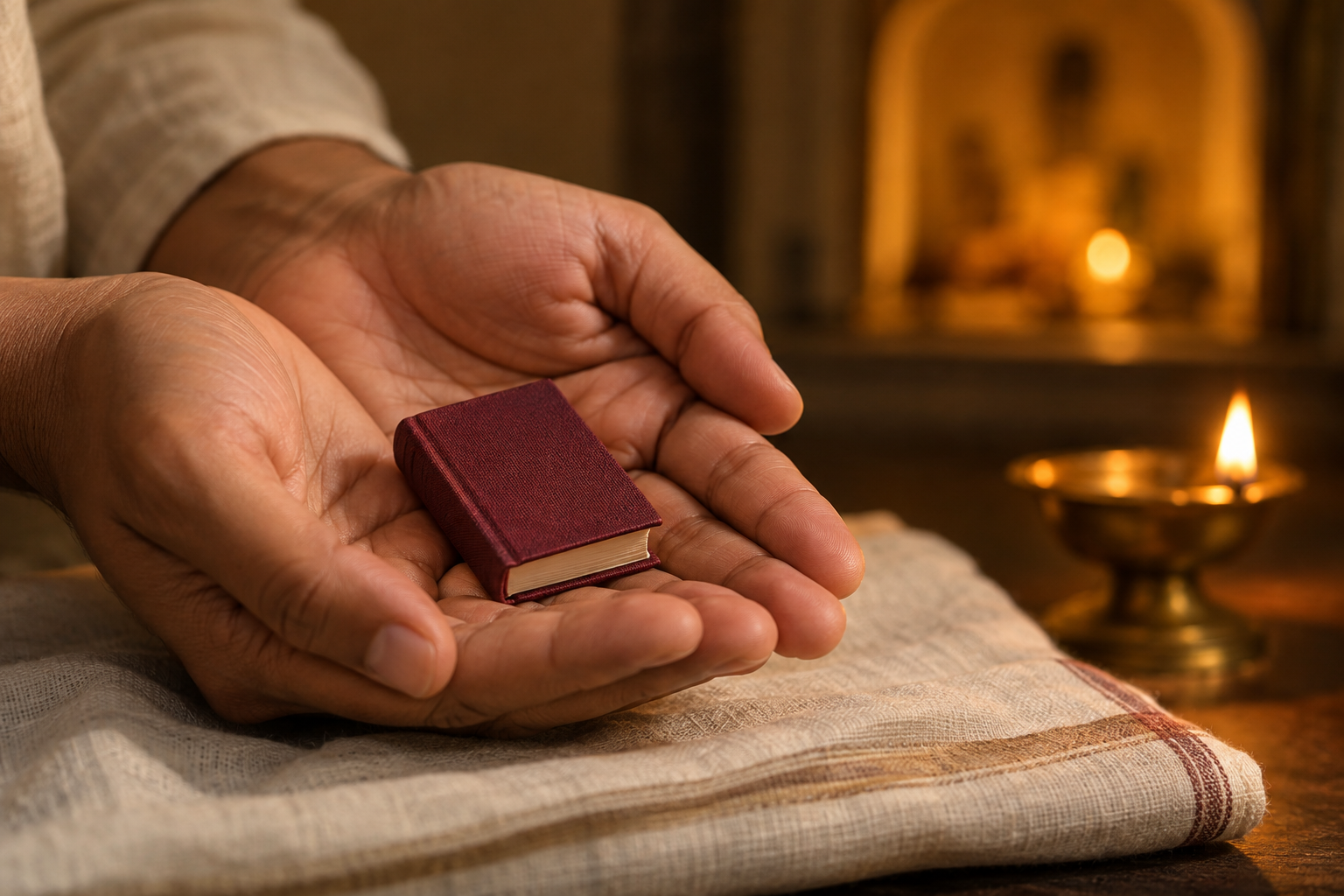
The Bhagavad Gita carries the dialogue of Bhagwan Krishna and Arjuna across generations because people recite it, teach it, print it, translate it, and preserve it. A miniature copy belongs to that history of transmission. Its dimensions invite wonder, but wonder should lead to closer attention rather than a race for superlatives.
For a Dharmic reader, the most useful question is not simply, “How did so much text fit into so little space?” It is also, “What can this copy teach us about the people who made, carried, read, protected, and handed on the Gita?” Answering that requires the material evidence: edition details, printing characteristics, signs of use, ownership marks, repairs, and provenance.
This is why accurate naming is an act of respect. Describing a printed book as printed does not make it spiritually lesser. Refusing unsupported claims does not make its survival less moving. Careful documentation allows its devotional life and its material history to stand together without one being invented to embellish the other.
Key takeaways
- The Tikamgarh object is a miniature printed Bhagavad Gita, not a handwritten manuscript.
- Its established headline features are its 4 x 4.4 centimetre size, approximately 350 pages, estimated age of about 130 years, and current association with Khargapur.
- An estimated age is not an exact date, a page count is not automatically a leaf count, and a current location is not proof of printing origin.
- Words such as unique, oldest, smallest, and only surviving require comparative bibliographic evidence.
- Identification should begin with title matter, colophon, measurements, pagination, inscriptions, ownership history, and non-destructive photography.
- Do not flatten, tape, glue, laminate, clean, or ritually mark the original. Seek a book conservator before repair or extensive imaging.
If you care for a similar family-held volume, start now with careful photographs, exact measurements, an unaltered transcription of its identifying text, and a written ownership history. Then arrange expert examination before repair, valuation, or exhibition. That sequence turns a moment of wonder into a trustworthy record that another generation can use.
References

Leave a Reply
You must be logged in to post a comment.