
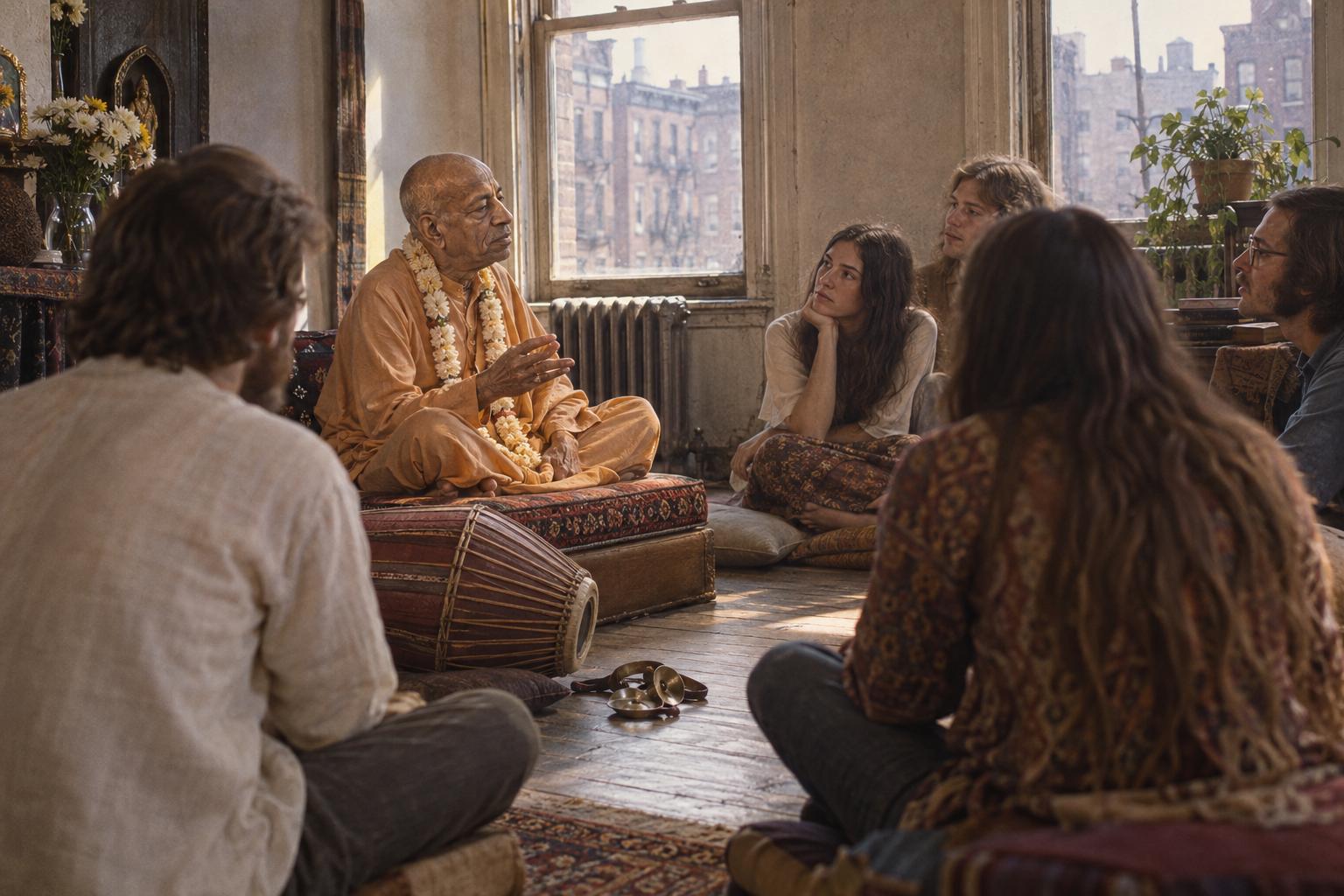
If you have come looking for a neat account of what Srila Prabhupada was like in New York, personal memories ask something more valuable of you. They let you consider how a guru was encountered through the attention, limitations, and later understanding of his disciples.
Bali Mardan and Krsnamurti, identified as two New York devotees, share their memories of Srila Prabhupada. The useful way to hear them is neither as casual nostalgia nor as a flawless transcript. Listen for what each person actually remembers, what meaning he draws from it, and what you can responsibly carry into your own spiritual life.
Ask what the memory truly lets you know
A recollection can preserve something that a formal chronology rarely captures: what a disciple noticed, what surprised him, and what remained important long afterward. That makes testimony valuable. It also gives it a definite boundary. A remembered exchange tells you how an encounter was experienced; it does not automatically preserve every word, motive, or circumstance.
Begin by separating observation from explanation. When a devotee remembers an action, instruction, correction, or response, write down the action before deciding what it means. If you cannot restate the remembered moment without adding a motive, you have probably moved from testimony into interpretation.
Use these questions as you listen:
- What does the speaker explicitly remember Srila Prabhupada saying or doing?
- Which part is the speaker’s later understanding of that moment?
- What changed in the devotee’s conduct, outlook, or service?
- What would require confirmation before being treated as a general teaching?
This discipline does not drain the devotion from a memory. It prevents your own assumptions from covering the human encounter you are trying to understand.
Listen on two tracks: the teacher and the disciple
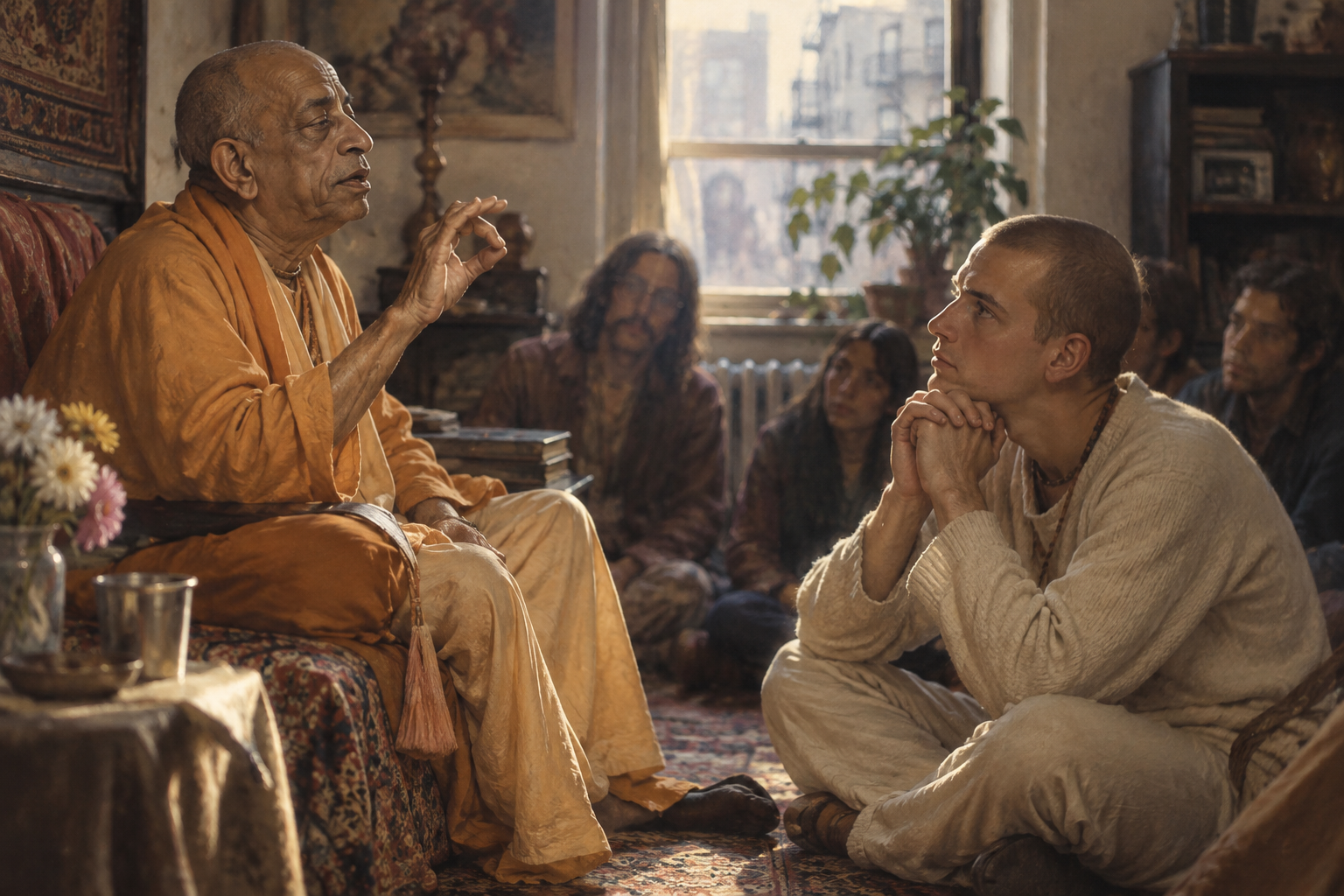
A disciple’s memory always carries two stories. One concerns the teacher who is being remembered. The other concerns the disciple who learned how to see him. If you listen only for facts about Srila Prabhupada, you may miss how discipleship formed the person speaking. If you listen only for emotion, you may miss the teaching embodied in the remembered encounter.
On the first track, notice what kind of action receives emphasis. Does the speaker dwell on an instruction, a personal exchange, a standard of service, an act of care, or something initially misunderstood? Do not supply an answer that the recollection itself does not provide.
On the second track, notice what the devotee learned to value. A person may remember an incident because its importance became clearer through years of practice. That later clarity is meaningful, but it should remain visibly distinct from the original event.
A simple note-taking format helps: write the remembered event, the meaning assigned to it, and the effect it had on the speaker. Those entries correspond to encounter, interpretation, and formation. Keeping them separate makes the testimony easier to understand without fragmenting it.
Hold devotion and historical care together

Devotional respect and historical care are not rivals. Respect gives you a reason to listen attentively. Historical care keeps you from making Srila Prabhupada responsible for words or intentions that a witness did not actually attribute to him.
Be especially careful with broad devotional descriptions. Words such as compassionate, demanding, grave, humorous, or powerful may express a speaker’s sincere conclusion. Ask which remembered act supports that conclusion. The concrete moment is what allows another listener to understand the quality rather than merely repeat the adjective.
The presence of two voices also requires judgment. Bali Mardan and Krsnamurti should not be blended into a single composite witness. Where they remember the same theme, note the convergence. Where their emphasis differs, preserve the difference. Where only one person addresses a matter, do not turn the other’s silence into agreement or disagreement.
Agreement between members of the same devotional community can strengthen your confidence that an emphasis was shared, but it does not make every associated detail independently verified. Conversely, different emphases need not amount to a contradiction. Two disciples can encounter the same guru from different responsibilities, temperaments, and stages of understanding.
The practical rule is straightforward: compare only what genuinely overlaps. Mark a claim as a recollection, an interpretation, or an application. If you later repeat it, preserve that status. This is how reverence becomes more precise rather than less warm.
Key takeaways
- Hear a personal memory as testimony about an encounter, not as a word-for-word transcript.
- Separate the remembered event from the meaning the disciple later drew from it.
- Listen for both sides of the relationship: what is recalled about Srila Prabhupada and how the devotee was formed by the encounter.
- Keep Bali Mardan’s and Krsnamurti’s voices distinct, comparing them only where their recollections actually overlap.
- Do not turn an isolated remembered instruction into a universal rule without checking it against Srila Prabhupada’s broader teachings.
- Complete your listening by choosing a concrete application, not by accumulating anecdotes.
Carry the memory into practice

Remembrance in a Dharmic setting is not merely the storage of information. It can direct attention, deepen gratitude, and clarify conduct. Yet application must arise from what was genuinely remembered, not from a lesson imposed in advance.
After listening, make a short practice note:
- Describe a remembered moment in neutral language.
- Name the spiritual quality that the moment may illustrate.
- Identify the evidence within the recollection that supports that reading.
- Choose a small, observable way to practise that quality in your present responsibilities.
If a memory points to attentiveness, decide where your attention has become casual. If it points to steadiness, identify a duty you have been performing according to mood. If it points to service, choose the person or responsibility that should receive your care. These are examples of translation, not claims about the particular recollections; let the devotees’ actual words determine the application you make.
A personal recollection can illuminate a principle, but it should not be made to carry the entire weight of doctrine. Check broad conclusions against Srila Prabhupada’s established teachings and the responsible guidance of the devotional tradition. An anecdote becomes most useful when it returns you to disciplined hearing and practice.
Listen with a notebook open. Preserve what Bali Mardan and Krsnamurti remember, distinguish it from what you infer, and leave with one change you can make in your own conduct. That is a more faithful response than admiration that ends when the recording does.
References

Leave a Reply
You must be logged in to post a comment.