
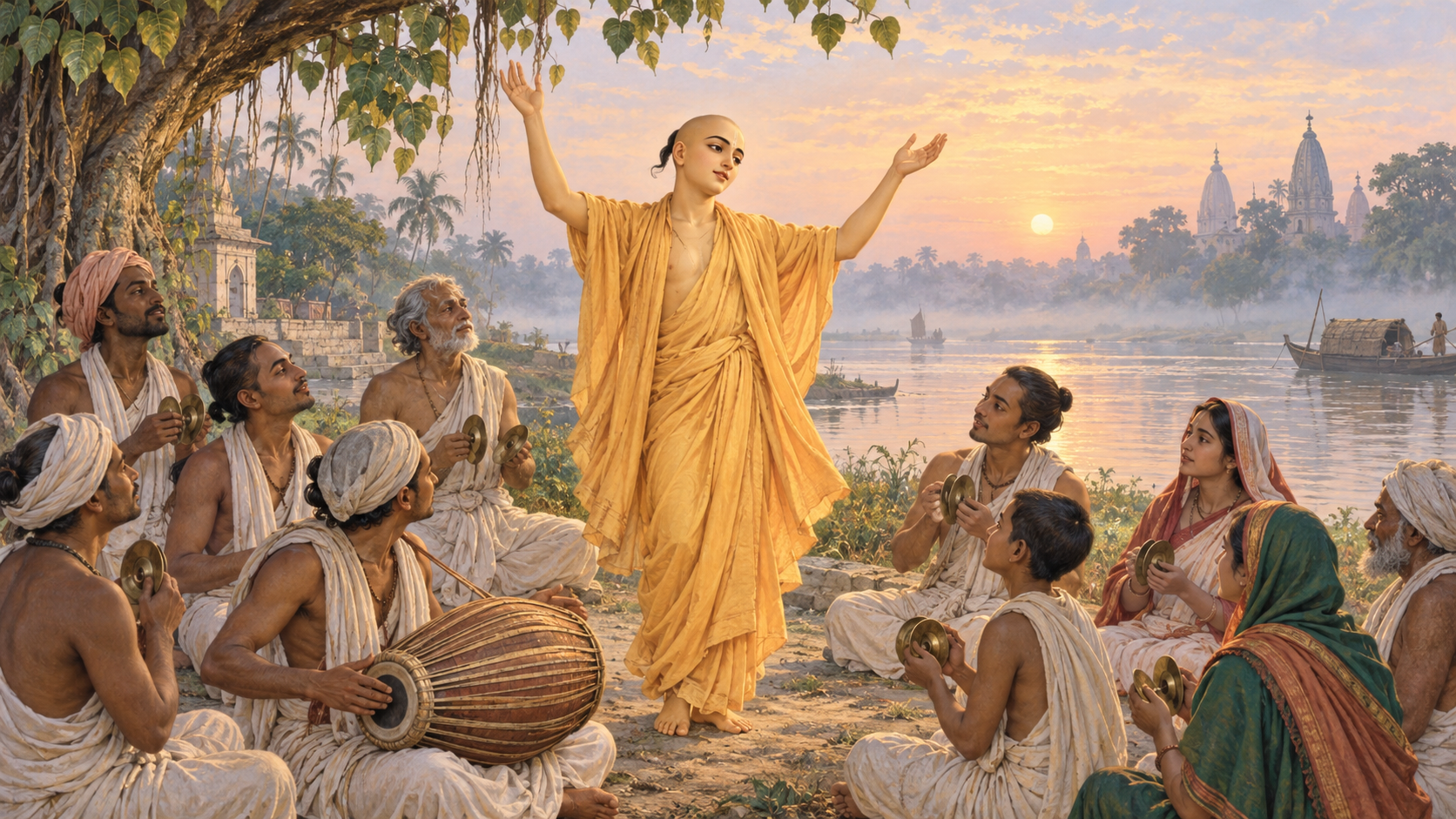
You may feel drawn to chanting yet keep postponing it because your mind is restless, your habits are uneven, or your life does not look spiritual enough. Lord Caitanya’s mercy speaks directly to that hesitation: you do not become qualified and then approach the holy name. You begin with the holy name.
The practical question is not whether you can produce an exalted experience today. It is whether you can make a small, sincere place for divine remembrance and return to it tomorrow. Here is how to begin without turning grace into another achievement project.
Mercy removes the waiting room

Many spiritual intentions fail before the first practice begins. You tell yourself that you should become calmer, purer, better informed, or more disciplined first. That sounds humble, but it quietly makes your present condition a permanent barrier.
Lord Caitanya reverses the sequence. His gift is the holy name, and access is not restricted by age, sex, caste, creed, colour, or prior fitness. These differences may shape a person’s worldly circumstances, but they do not determine permission to chant. Mercy is the beginning of qualification, not a prize awarded after it.
This also explains why the gift can be described as something received without collateral or repayment. The comparison is meant to remove anxiety: you are not negotiating a contract with Bhagavan. Yet grace is not passive indulgence. Once the gift enters your life, gratitude naturally asks for a response – continued remembrance, better conduct, and a willingness to make the same opportunity available to others.
Your first decision can therefore be very small: stop asking whether you are worthy enough to chant. Ask whether you are willing to chant now, in the condition you actually occupy.
Use a seven-day beginning that is too clear to postpone

A practice needs a definite place in the day. “I will chant when I have time” usually means that whatever is loudest will take the time. For the next seven days, use the following structure. Seven days is a practical trial period, not a scriptural quota or a claim that transformation follows a timetable.
- Choose one fixed cue. Begin immediately after waking, after bathing, or before going to bed. Use the same cue each day so that you do not have to renegotiate the practice.
- Protect five minutes. Put the phone out of reach, sit or stand steadily, and decide in advance that ordinary distractions can wait until the five minutes end.
- Chant the complete maha-mantra. Recite: Hare Krishna, Hare Krishna, Krishna Krishna, Hare Hare / Hare Rama, Hare Rama, Rama Rama, Hare Hare. Speak clearly enough to hear each name yourself.
- Return without scolding yourself. When attention wanders, do not begin an argument with the mind. Notice the wandering and come back at the next name. The return is part of the practice.
- Record one honest sentence. After chanting, note what made attention easier or harder. Do not grade the session as spiritually successful or unsuccessful.
On the eighth day, make one decision: keep the same five minutes, extend the period modestly, or add a congregational chanting session. Change only one variable. A sustainable practice grows more reliably when you can tell what actually helped.
Pronunciation deserves care, but fear of imperfect pronunciation should not become another delay. Listen attentively, learn respectfully from experienced practitioners, and improve through repetition. Sincerity does not remove the value of learning; it removes the demand that learning be complete before devotion begins.
Look for upliftment deeper than a passing mood
The devotional promise is that remembrance of the Lord through His names brings auspiciousness and freedom from material suffering. That promise should not be reduced to the expectation that every illness, loss, conflict, or practical difficulty will disappear on your preferred schedule. Chanting is not a technique for controlling events or manufacturing a pleasant mood.
Keep three questions separate. Did chanting feel pleasant today? Was your attention steady? Is your relationship with the practice and with other people gradually changing? A difficult session can still contain a sincere return. A pleasurable session can still leave pride untouched. The deepest question concerns the direction in which your consciousness and conduct are moving.
Once a week, examine concrete signs. Are you returning to the mantra more readily after distraction? Are you less tempted to abandon the practice because one day felt dry? Do you pause more often before speaking harshly? Are you becoming more willing to include others rather than judge their eligibility? These questions do not measure divine grace. They help you notice whether you are cooperating with what you have received.
If you are dealing with physical illness, severe psychological distress, abuse, or immediate danger, chanting can accompany appropriate care but should not replace it. Seek qualified medical, mental-health, safeguarding, or emergency help as the situation requires. Spiritual upliftment does not demand neglect of the body, mind, or duties placed in your care.
Let private remembrance grow into shared chanting

Lord Caitanya did not keep the holy name inside an elite circle or restrict it to solitary contemplation. He propagated congregational chanting and offered the maha-mantra openly. Private repetition can establish steadiness, but shared chanting expresses another dimension of mercy: the gift is received in a form that can be given without being diminished.
Choose one outward step that suits your circumstances. Attend a kirtana where you can learn by listening. Invite one willing friend or family member to chant with you. If you already belong to a devotional community, help create an entry point where a newcomer can participate without first mastering terminology or ritual detail.
For a small gathering, keep the beginning simple. State when the chanting will start and finish. Display the mantra so nobody has to pretend to know it. Let newcomers listen before joining. Avoid turning the close into a test, debate, or demand for commitment. An invitation reflects Caitanya’s openness; social pressure contradicts it.
Sharing also requires discernment. You do not need to force a sacred practice into every conversation. Offer it where there is interest, make participation voluntary, and let your conduct carry part of the teaching. If chanting makes you eager to correct everyone but unwilling to correct your own speech, the outward movement has outrun the inward work.
Key takeaways
- Do not wait to feel spiritually qualified. In Lord Caitanya’s path, the freely available holy name is where qualification begins.
- Anchor five minutes of chanting to the same daily cue for seven days, then make one modest adjustment based on what you observed.
- When attention wanders, return at the next name instead of turning distraction into self-condemnation.
- Judge progress less by temporary emotion and more by steadiness, humility, speech, and openness toward others.
- Let private chanting expand into voluntary, welcoming congregational practice without pressure or gatekeeping.
- Use chanting alongside responsible care for material needs, not as a reason to ignore illness, danger, or necessary professional help.
Begin with the next five available minutes. Chant clearly, hear the names, and return when the mind wanders. Then keep tomorrow’s appointment. Lord Caitanya’s mercy is not made practical by waiting for a dramatic moment; it becomes part of your life through the door you consistently leave open.
References

Leave a Reply
You must be logged in to post a comment.