
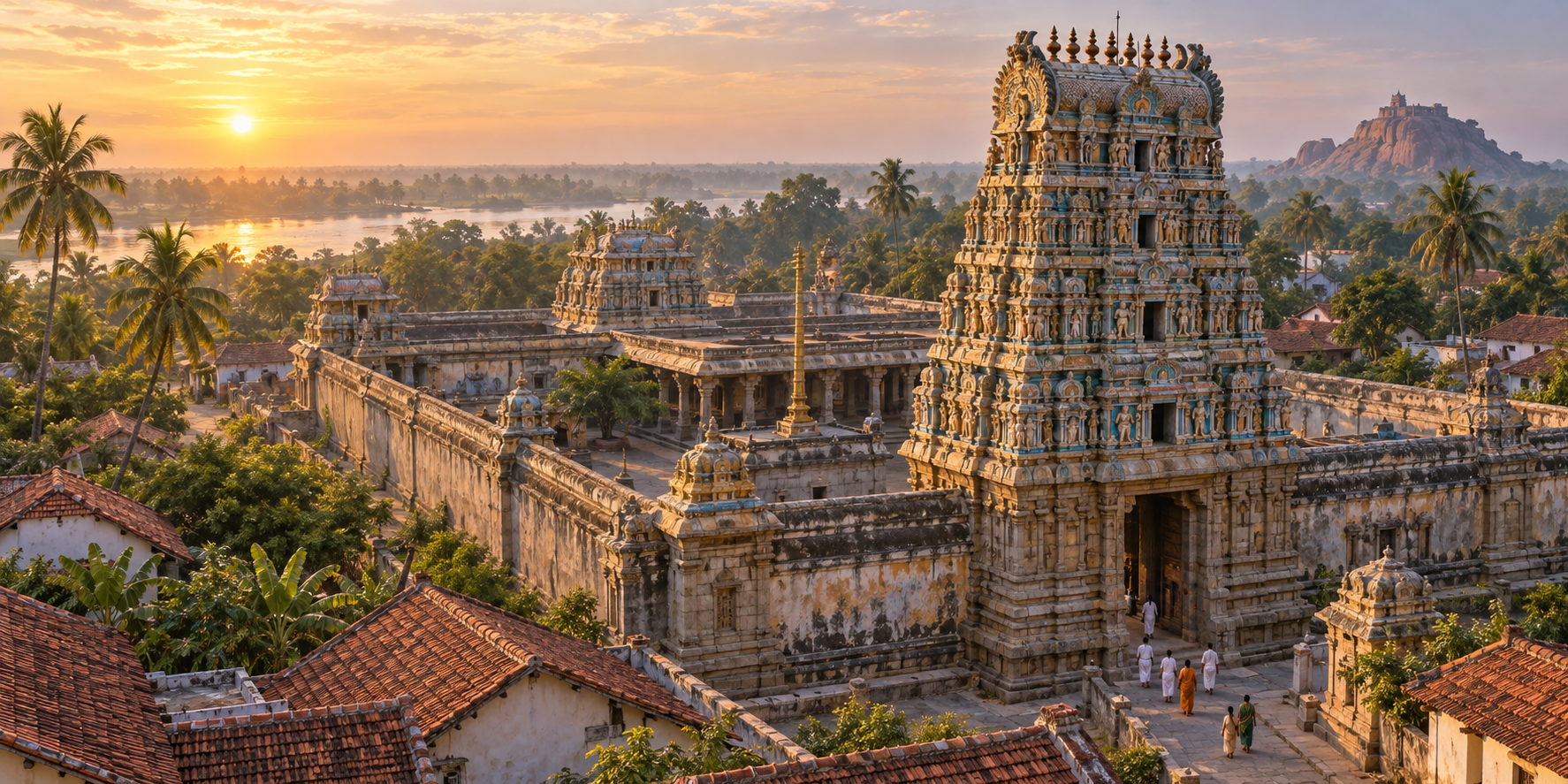
If you found Uthamar Kovil while planning a pilgrimage or trying to understand the Hindu Trimurti, the central question is simple: what does it mean to worship Brahma, Vishnu and Shiva in one place? The answer is richer than the familiar formula of creator, preserver and destroyer.
At this village temple near Tiruchirappalli in Tamil Nadu, the three deities are worshipped in the same temple complex together with their consorts. The place is also known as Thirukkarambanoor and Bhikshandar Kovil. Its arrangement gives you a concrete way to contemplate unity without erasing distinction, and divine order without turning the deities into interchangeable symbols.
What Uthamar Kovil makes visible
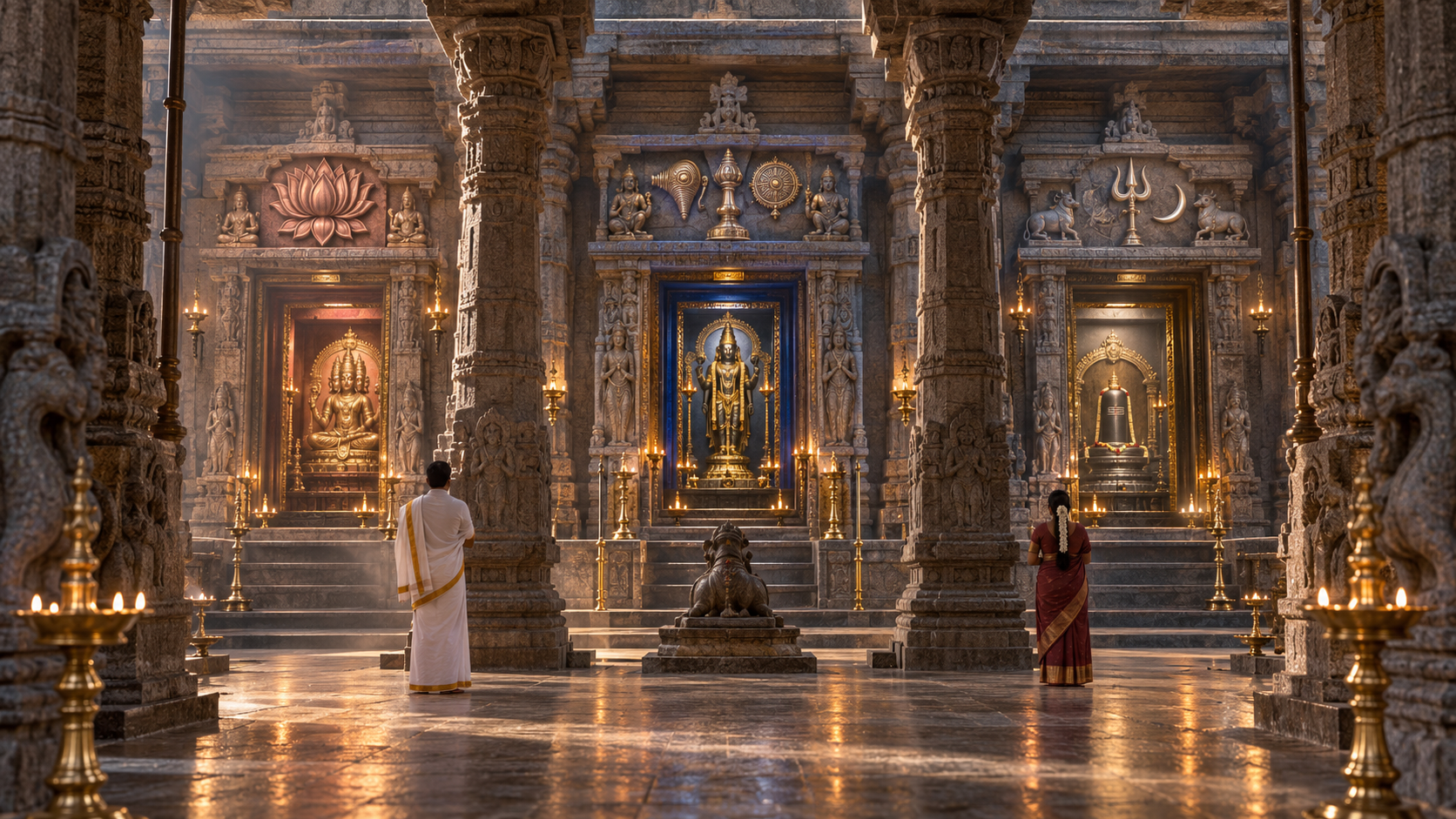
A temple does not communicate only through explanation. It communicates through presence, placement, worship and relationship. At Uthamar Kovil, Brahma, Vishnu and Shiva are not merely names in a philosophical scheme. All three belong to the sacred life of the same complex.
That matters because discussions of the Trimurti often become an argument about rank: Which deity is highest? Are the three equal? Is one only a form of another? Uthamar Kovil does not require you to settle every question that Hindu sampradayas answer differently. It first asks you to notice something more basic: differentiation need not mean opposition.
Brahma remains Brahma, Vishnu remains Vishnu, and Shiva remains Shiva. Their presence together does not make their identities meaningless. Nor does distinction require three rival sacred worlds. You can therefore read the temple as an invitation to hold two truths at once: the divine can be encountered through distinct forms, and those forms can participate in a larger coherence.
This is the first practical lesson to carry into darshan. Do not rush to collapse the three into one, and do not rush to divide them into competing camps. Attend to each form as itself, then attend to the relationship created by their shared setting.
The Trimurti is a framework, not the whole of Hinduism
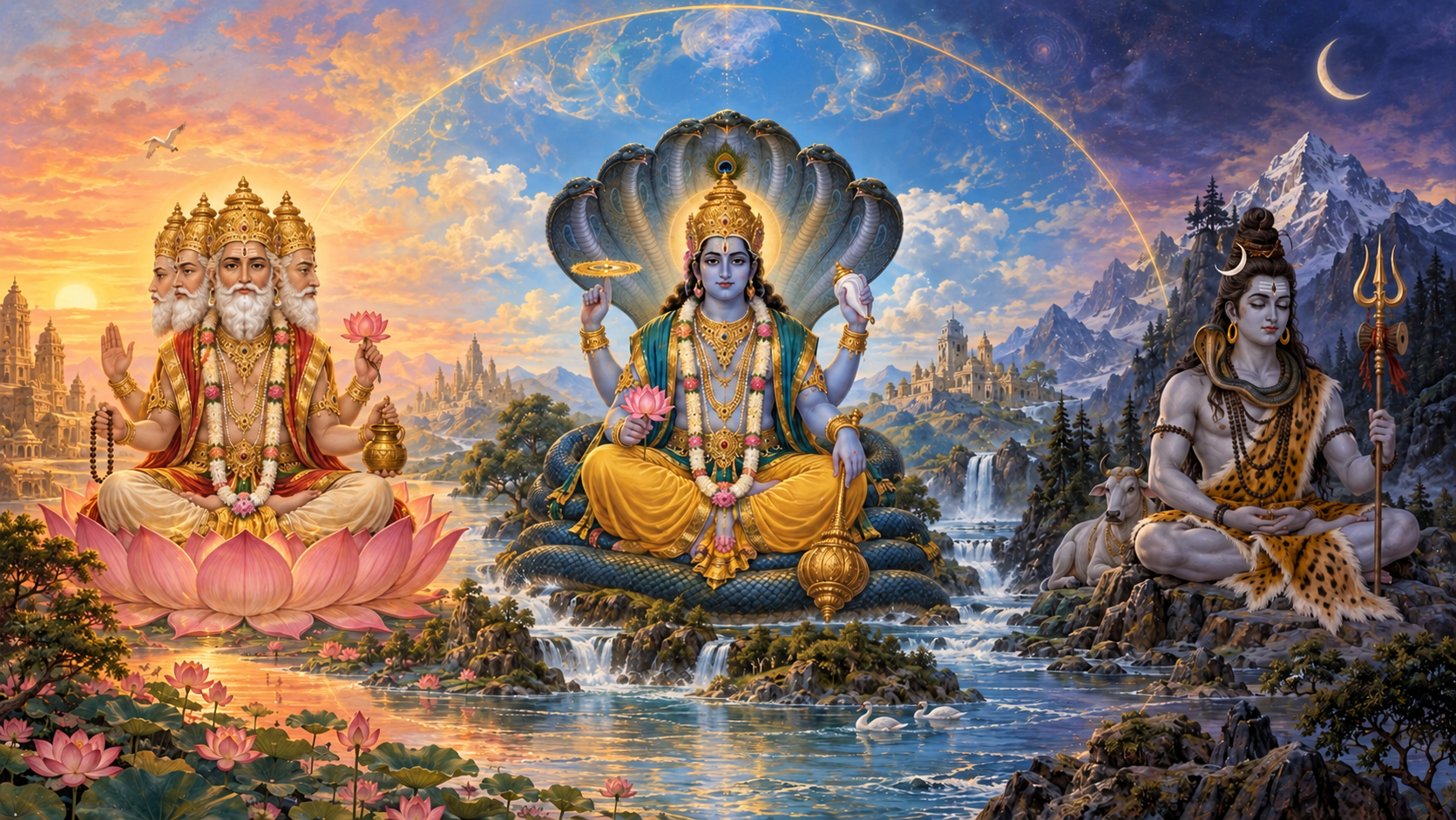
The most familiar account associates Brahma with creation, Vishnu with preservation, and Shiva with dissolution or transformation. These three movements offer a useful grammar for understanding existence. Things arise, continue for a time, and pass from one condition into another.
Yet the formula becomes misleading when treated as a complete chart of Hindu theology. Hindu traditions do not all begin with the Trimurti, give it the same importance, or interpret the relationship among the three deities identically. Vaishnava, Shaiva, Shakta and other traditions possess their own theological centres, scriptures, practices and accounts of the ultimate. A shared temple complex does not cancel those differences.
You should also resist translating the Trimurti as though it were simply the Hindu version of the Christian Trinity. The resemblance stops at the number three. The doctrines arise from different sacred histories and make different claims about divine personhood, unity and manifestation. Calling both arrangements a trinity may help someone begin a conversation, but it cannot finish the explanation.
A better way to use the Trimurti is as a contemplative framework. Creation asks how manifestation begins. Preservation asks what sustains an ordered world. Dissolution asks how forms end, change and make room for renewal. Those questions are connected, but they are not identical.
This distinction changes how you interpret Shiva’s role in particular. Dissolution is not best understood as pointless ruin. Without endings, no transition is possible. Preservation is likewise not mere resistance to change; it is the maintenance of conditions in which dharma and life can continue. Creation is not an isolated event either, because whatever arises immediately enters processes of continuity and transformation.
When you use the three functions, treat them as doors into reflection rather than labels that exhaust the deities. Brahma is more than a job title called creation, Vishnu more than preservation, and Shiva more than destruction. The framework helps you see a pattern. It does not contain everything Hindu traditions understand about them.
The consorts prevent an incomplete reading
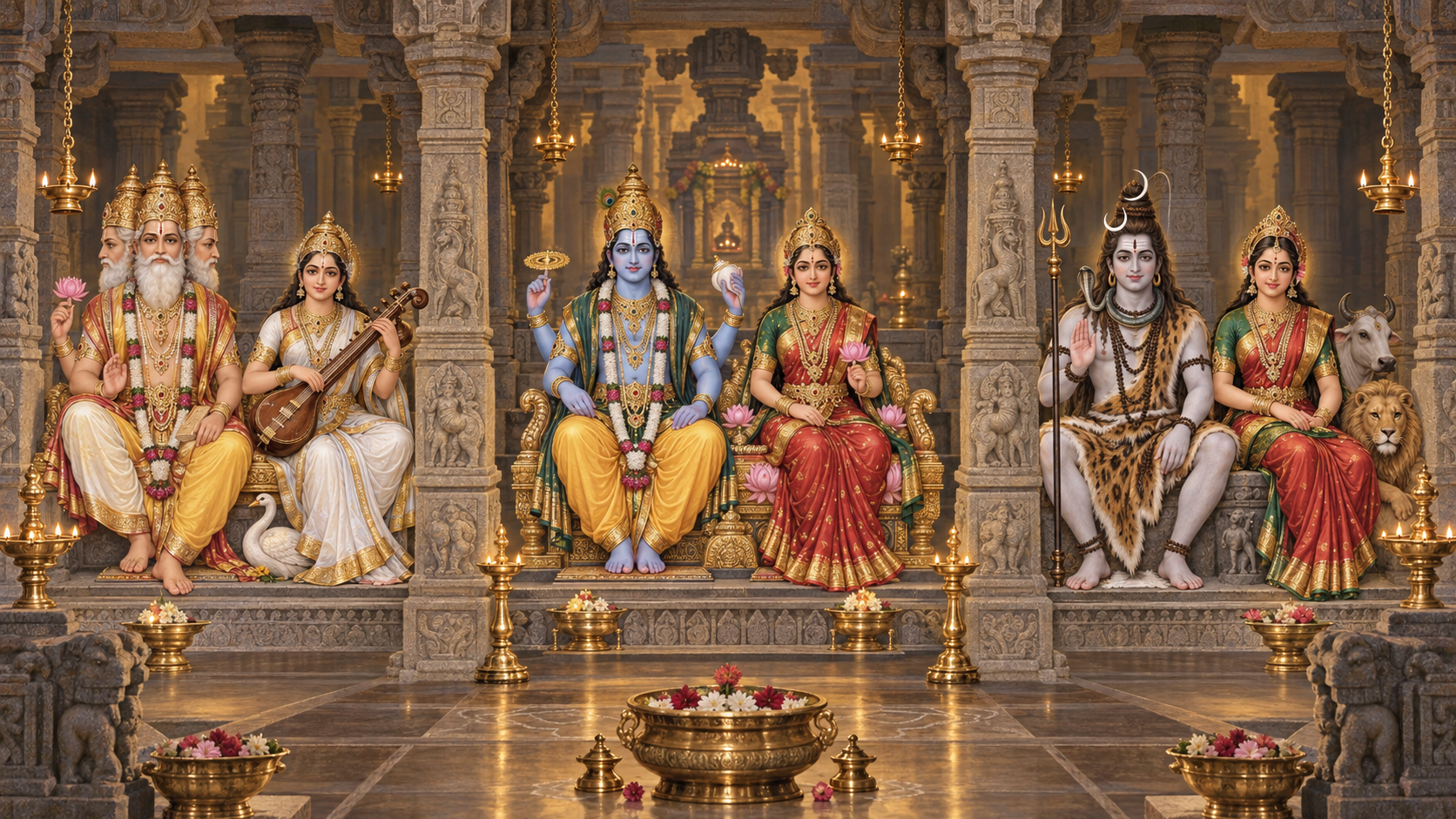
It is easy to speak of Uthamar Kovil only as the place of three male deities. That would miss a defining feature: Brahma, Vishnu and Shiva are worshipped there with their consorts. The divine feminine is therefore not a decorative addition to the temple’s meaning.
Across Hindu traditions, the relationship between deity and consort can express dimensions of power, knowledge, abundance, order, compassion and active divine presence. The precise theology varies, so it should not be reduced to one universal equation. The essential discipline here is simpler: do not discuss the temple’s sacred arrangement while leaving the goddesses out of it.
Their inclusion also corrects a mechanical picture of the cosmos. Creation, preservation and transformation are not three departments operated by isolated figures. Sacred activity is relational. Power is expressed through complementarity, and the manifested world depends upon relationships rather than solitary action.
When you contemplate the temple, ask paired questions. What is brought forth, and what power makes that manifestation possible? What is protected, and what nourishes it? What must end, and what energy carries the transition? This keeps the Trimurti from becoming a dry list of functions and brings the consorts into the centre of your attention.
Do not turn that complementarity into a rigid statement about ordinary men and women. Temple theology cannot be flattened into modern gender slogans, whether approving or dismissive. Notice what the sacred arrangement presents before deciding how far an analogy can responsibly travel.
How to approach Uthamar Kovil thoughtfully
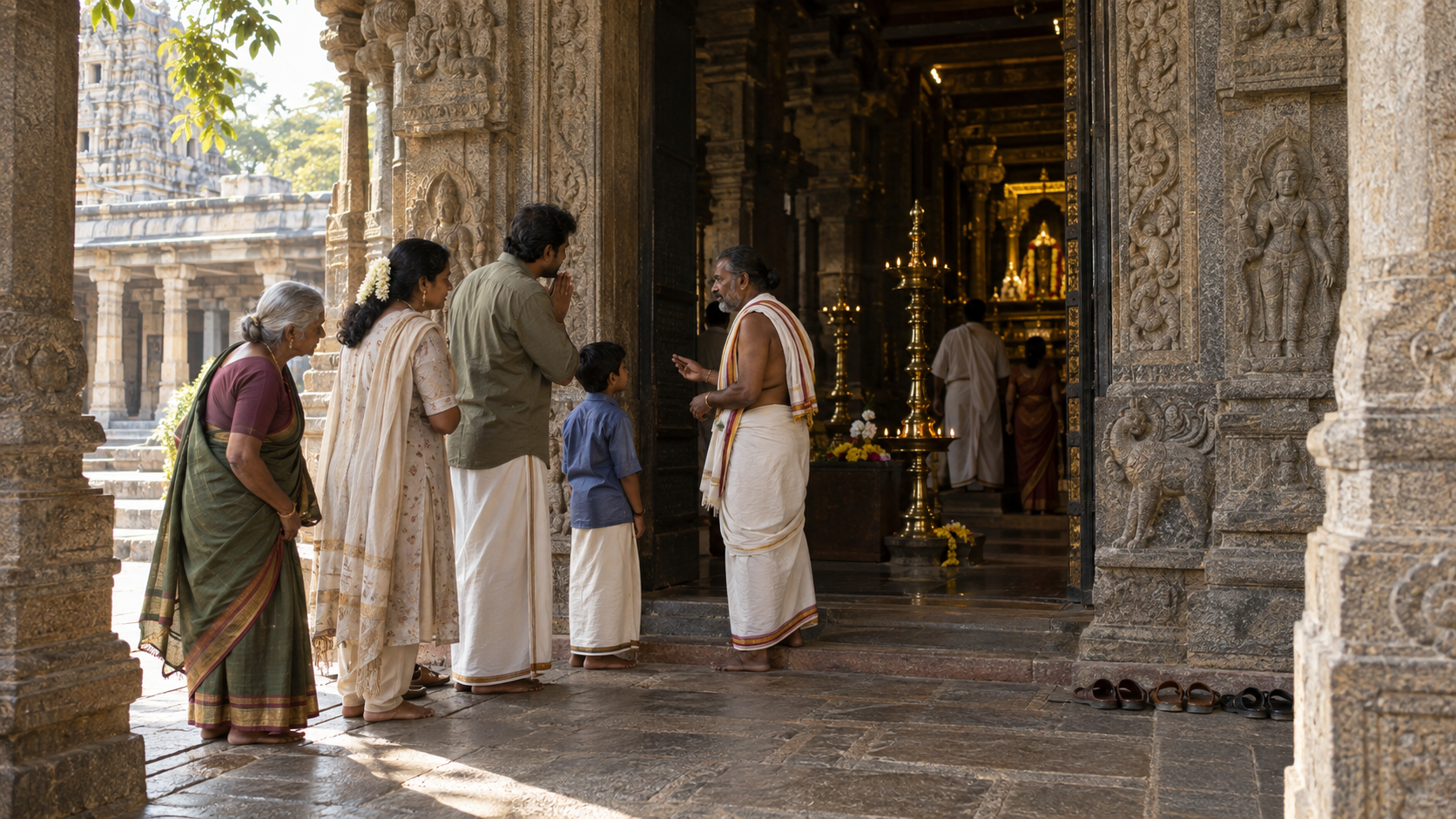
You do not need to resolve every philosophical dispute before approaching the temple. A disciplined sequence will give you more than arriving with a ready-made conclusion.
- Recognise the names. Uthamar Kovil may also appear as Uttamar Koil, Thirukkarambanoor or Bhikshandar Kovil. Keep those names together when identifying the place or reading about it.
- Begin with what the temple actually presents. Brahma, Vishnu and Shiva are worshipped within one complex, and their consorts are part of that sacred arrangement. Establish that before adding a broader interpretation.
- Give each deity full attention. Do not mentally hurry past one form to reach the deity closest to your own sampradaya. The unusual value of the place lies precisely in allowing all three presences to confront you.
- Notice relationship before ranking. Ask how creation, preservation and transformation depend upon one another. A world that only begins but is never sustained cannot flourish; what is sustained forever without transformation cannot renew itself.
- Include the divine feminine. If your interpretation can describe the entire temple while ignoring the consorts, it is incomplete. Ask what changes when divine power is understood relationally rather than as the possession of isolated male figures.
- Separate observation from doctrine. You may see the complex as expressing harmony among divine forms. Do not automatically claim that it erases the real differences among Hindu schools or proves one universal hierarchy. Let the temple deepen your understanding without making it carry an argument it was not asked to settle.
This method is also useful when speaking about the temple to children or to someone unfamiliar with Hindu traditions. Start with the concrete fact of shared worship. Explain the three cosmic functions next. Only then introduce the important qualification that Hindu theology is more diverse than a single three-part formula.
Key takeaways
- Uthamar Kovil, near Tiruchirappalli in Tamil Nadu, brings Brahma, Vishnu and Shiva together in one temple complex with their consorts.
- The Trimurti commonly points to creation, preservation and dissolution or transformation, but it is not a complete map of every Hindu tradition.
- Shared worship expresses coherence without making the three deities interchangeable or eliminating the distinctive teachings of different sampradayas.
- The presence of the consorts is central to the temple’s meaning and prevents an exclusively male or mechanical account of divine activity.
- The most responsible way to interpret the temple is to begin with what it presents, contemplate the relationships among the forms, and avoid forcing the complex into a foreign theological template.
When you next encounter Uthamar Kovil, use it as more than an example attached to the word “Trimurti.” Let the temple train your attention. See each divine form clearly, include each consort in your understanding, and then consider how creation, continuity and transformation belong to one sacred order. That is a more faithful starting point than either rivalry or oversimplification.
References

Leave a Reply
You must be logged in to post a comment.