
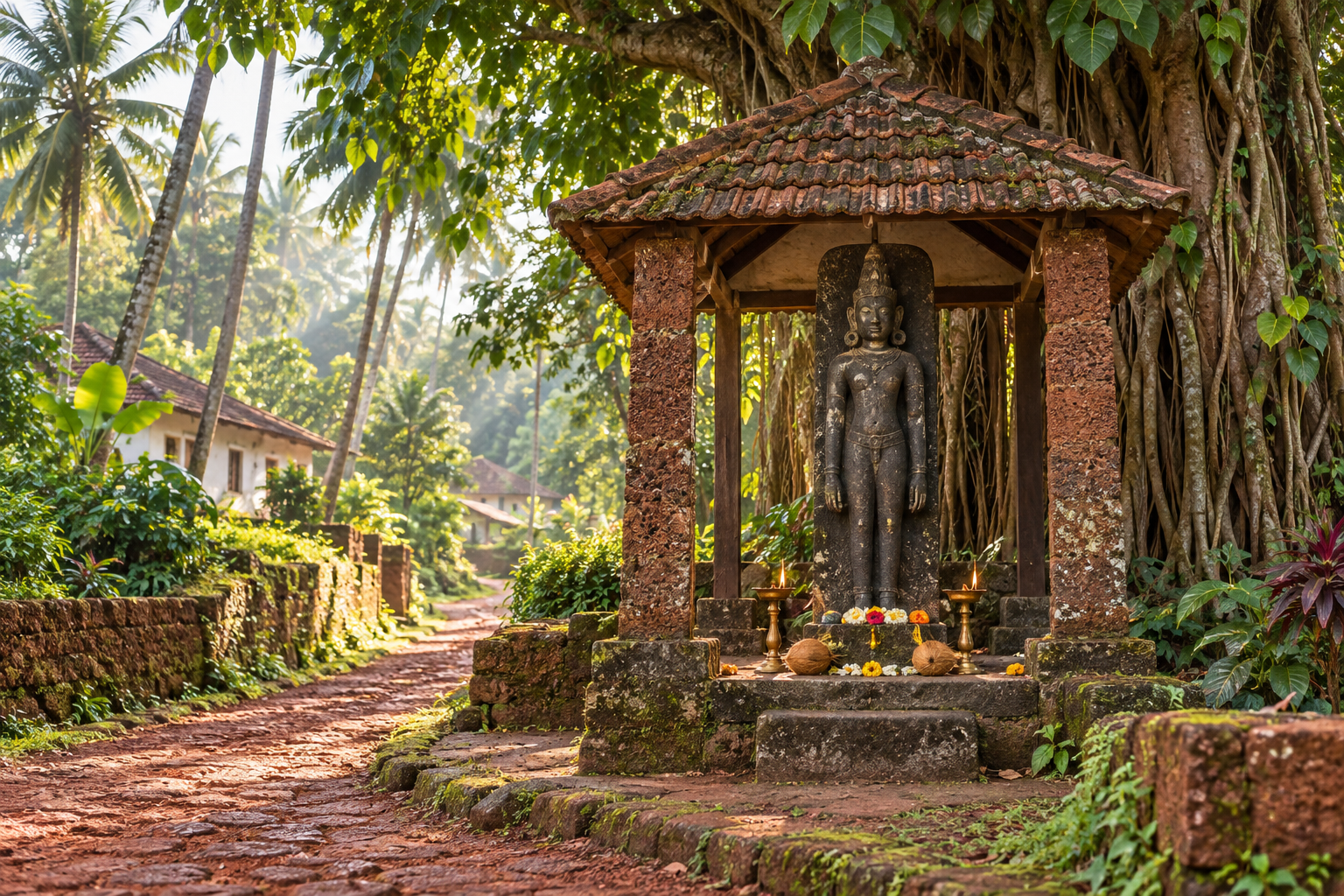
If you arrived here wondering whether Nagdo Betal is simply Goa’s version of the corpse-dwelling Vetala in the Vikramaditya tales, the short answer is no. That resemblance of names is real, but treating the two figures as interchangeable leads you away from the Goan tradition.
The useful way to understand Nagdo Betal is to begin with his place in Goan village religion: a locally revered guardian deity whose meaning comes from a living community and its sacred landscape. The literary association can clarify the name, but it cannot define the deity.
The first distinction: Goan Betal is not Vikram’s Vetala
Many readers first encounter the word Vetala through the stories associated with King Vikramaditya. In that narrative world, the Vetala is a supernatural being connected with a corpse. Nagdo Betal belongs to a different religious setting: Goa’s Konkan tradition treats Betal as a deeply revered village deity, not merely as the corpse-inhabiting figure of those famous stories.
This is more than a minor difference between regional versions. One figure belongs to a literary narrative familiar across India; the other is approached through local devotion, guardianship and village identity. A shared label does not prove that the beings have the same character, function or religious status.
Use a simple context test whenever you encounter the name. If the discussion concerns Vikramaditya and a corpse inhabited by a spirit, you are dealing with the literary Vetala. If it concerns a Goan village deity and guardian, begin with the local understanding of Nagdo Betal. Do not import the first context into the second.
What the name tells you, and what it cannot tell you
The Konkani name provides two useful clues. Nagdo means “naked,” while Betal denotes a supernatural spirit or Vetala. These meanings explain why an English-language reader may immediately associate the deity with strangeness, spirits or the familiar Vetala stories.
But a translation is not a complete theology. “Naked” is the lexical meaning of Nagdo; it does not, by itself, establish every detail of the deity’s appearance, symbolism or worship. Likewise, the word Betal does not prove that the Goan deity inhabits corpses. That conclusion comes from carrying a feature of one narrative tradition into another setting where it does not belong.
Keep the boundary between translation and interpretation clear:
- The name establishes that Nagdo carries the meaning “naked” in Konkani.
- The name connects Betal linguistically with the supernatural term Vetala.
- The name does not make Nagdo Betal identical to the Vetala of the Vikramaditya cycle.
- The name alone does not establish a particular origin story, ritual, offering, festival or iconographic detail.
This discipline matters because folk deities often become distorted in retelling. A vivid translation attracts attention, and an already famous story supplies an easy explanation. The result may sound plausible while erasing the community-specific identity that makes the deity meaningful.
Why “folk religion” does not mean fictional folklore
The word “folk” can cause a second misunderstanding. In this context, it points to a tradition rooted in local community life. It does not mean that the deity is merely a fictional character, a decorative curiosity or a lesser form of religion.
Nagdo Betal is described as one of the mysterious and deeply revered village deities of Goan culture. Reverence is the essential clue. You may study the deity through language and folklore, but the people who sustain the tradition encounter Nagdo Betal within a religious relationship. A responsible account must preserve that difference in viewpoint.
The term “guardian” also directs your attention to relationship rather than spectacle. The first questions should concern how a community understands the deity’s protective place, not how quickly the deity can be fitted into a pan-Indian story. The answers to questions about particular rites, sacred places, representations and observances must come from the relevant local tradition; they should not be filled in from the name alone.
This gives you a reliable reading rule: establish the religious context before interpreting a supernatural label. A being in a tale, a term in a dictionary and a deity worshipped by a community are not interchangeable categories, even when the same or a related word appears in all three.
How to approach Nagdo Betal without flattening the tradition
Whether you are visiting Goa, writing about its culture or trying to understand a reference you encountered, the following sequence will keep your interpretation grounded.
- Begin with the local identity. Describe Nagdo Betal first as a revered Goan village guardian deity. This prevents the better-known Vikramaditya narrative from taking over the explanation.
- Translate the name without pretending the translation is exhaustive. Explain that Nagdo means “naked” and that Betal refers to a supernatural spirit or Vetala. Then state plainly that this etymology does not settle the deity’s complete meaning.
- Make the literary distinction explicit. If you mention the corpse-inhabiting Vetala, do so to prevent confusion. Do not use that figure as the template for Nagdo Betal.
- Separate established facts from local details still needing confirmation. Do not manufacture an origin legend, iconography, list of offerings, ritual calendar or temple history merely because such details would make an account feel complete.
- Let the relevant community explain its practice. Ask how the name is pronounced locally, how devotees understand the guardian role, which observances are appropriate and whether any parts of worship should not be photographed or casually reproduced.
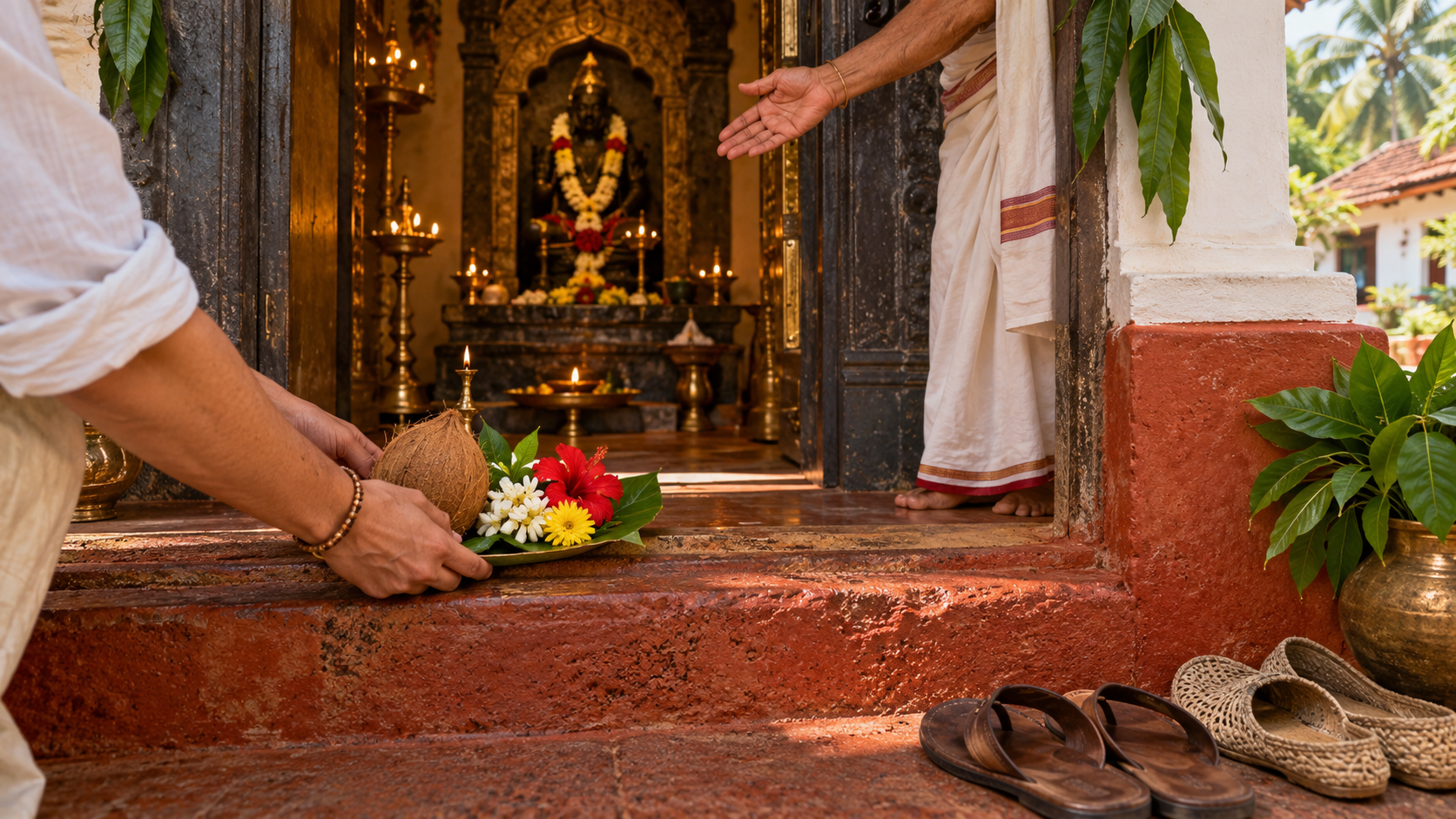
If you visit a sacred place associated with the tradition, ordinary temple respect is the sound starting point: follow posted or spoken instructions, ask before taking photographs, and do not touch a sacred representation or offering without permission. The important intellectual shift is also the practical one. You are entering a place of reverence, not inspecting an illustration from a supernatural story.
When writing or speaking about Nagdo Betal, a careful opening description would be: “Nagdo Betal is a revered village guardian deity in Goan tradition; despite the name Betal, he should not be identified with the corpse-inhabiting Vetala of the Vikramaditya tales.” That sentence gives the reader the necessary orientation without claiming details that have not been established.
Key takeaways
- Nagdo Betal is understood in Goan culture as a revered village guardian deity.
- In Konkani, Nagdo means “naked,” while Betal refers to a supernatural spirit or Vetala.
- The Goan deity is not the same as the corpse-inhabiting Vetala in the Vikramaditya stories.
- Etymology is a starting point, not a complete explanation of iconography, ritual or theology.
- For local practices, rely on the understanding and instructions of the community that sustains the tradition.
Your best next step is to keep the distinction intact whenever you encounter the name: identify the Goan devotional context first, use the literary comparison only to prevent confusion, and leave unverified local details open until the relevant community can answer them.


References

Leave a Reply
You must be logged in to post a comment.