
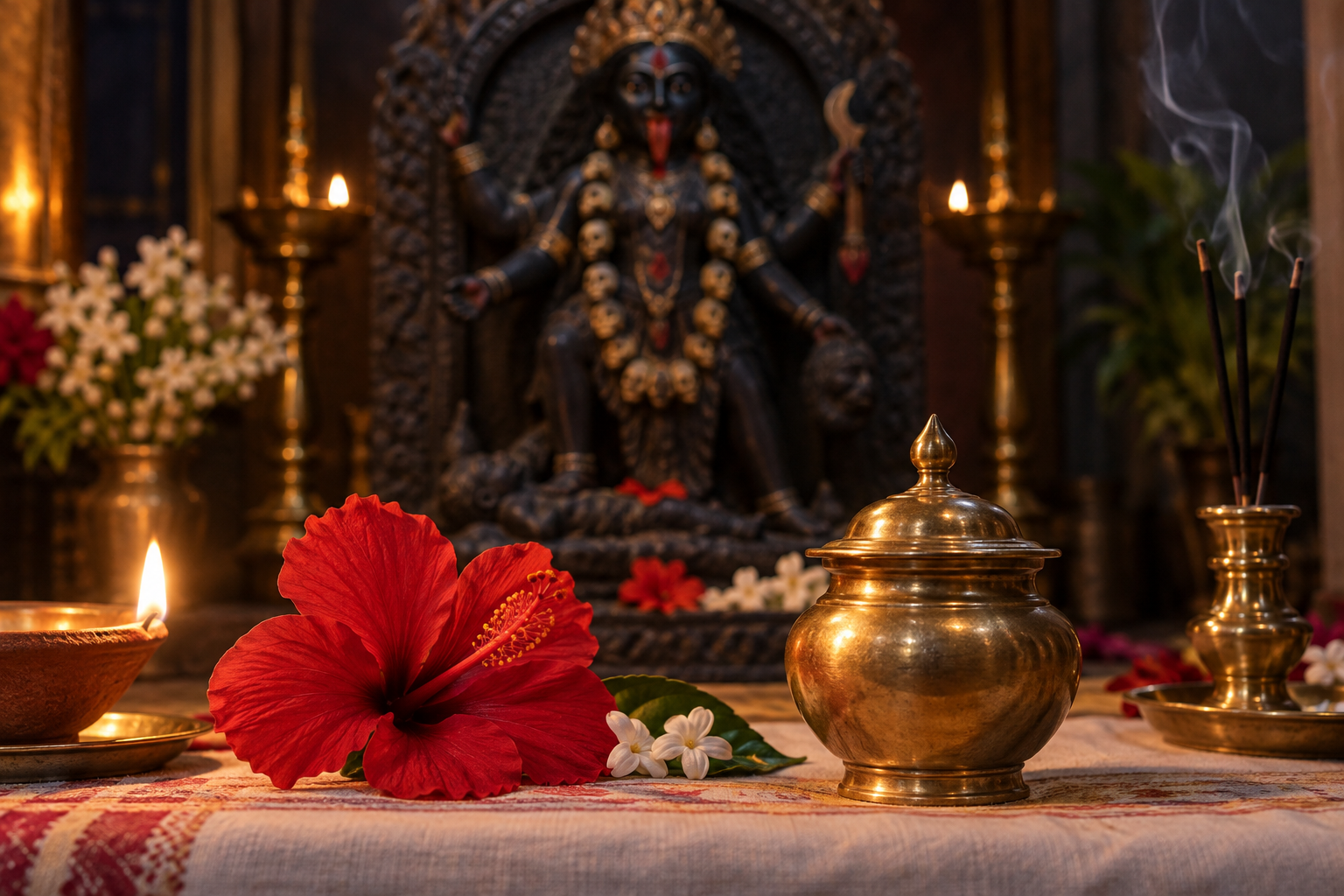
If you have seen a red hibiscus placed at Kali’s feet and heard that some worshippers offer alcohol, the obvious question is whether both acts belong to the same devotional world – and whether you should imitate them. The short answer is that both can be meaningful, but they do not mean the same thing, and neither is a universal requirement.
Kali worship makes little sense when an offering is separated from its tradition. The right question is not simply, “What is offered?” It is, “What does this offering ask the devotee to surrender, transform, or see clearly?” That distinction will help you approach unfamiliar practices without either condemning them or copying them blindly.
An offering is a language, not a shopping list
In the devotional life, an offering creates a relationship. Its significance comes from the object, the form of the deity being worshipped, the inherited ritual method, and the worshipper’s intention. Remove any of those elements and the symbol becomes easy to misread.
This is especially important with Kali. Her fierce appearance confronts realities that ordinary life encourages us to hide: fear, mortality, attachment, uncontrolled desire, anger, and the collapse of identities we thought were permanent. Fierce does not mean evil. It means that the Divine Mother is not limited to forms that make us comfortable.
An offering before Kali therefore need not be an attempt to placate a frightening deity. It can be a disciplined way of bringing something intense into sacred attention. In that setting, the devotee does not merely place an external object before the Goddess. The object represents something within the devotee that must be acknowledged and offered.
- The object provides the visible symbol.
- Kali’s form gives that symbol its devotional direction.
- The sampradaya, temple, or family custom supplies the ritual boundaries.
- The devotee supplies attention, restraint, and the willingness to change.
This is why there cannot be one universal list of compulsory offerings for every Kali devotee. A practice may be proper in one lineage, absent in another, and prohibited in a third. Difference here is not necessarily inconsistency. It reflects the diversity of Hindu ritual traditions.
Why the red hibiscus is offered to Kali
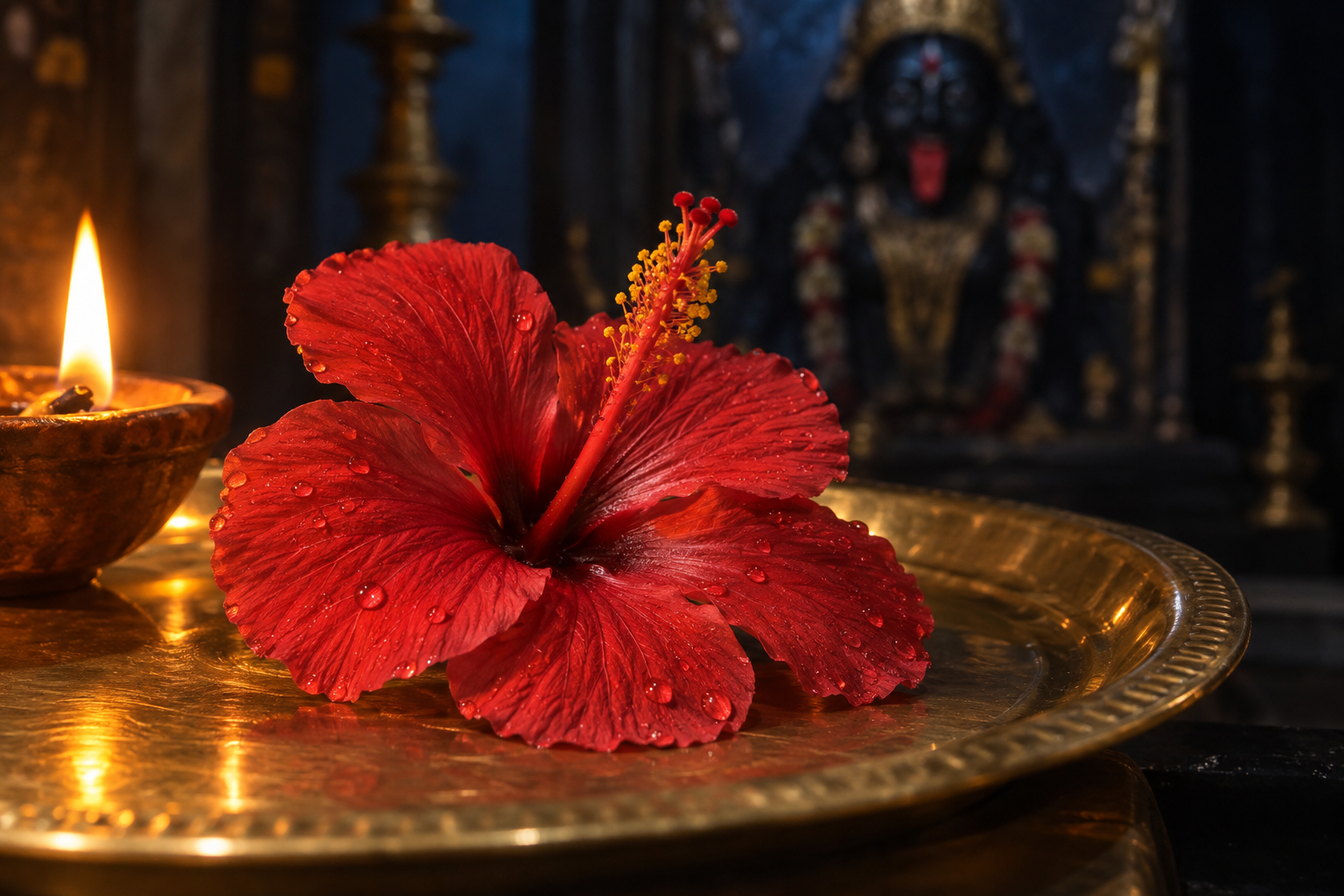
The red hibiscus carries layered spiritual significance in Kali worship. Its colour immediately suggests intensity. Red can evoke blood, life, heat, activity, passion, and the dynamic force of Shakti. Before Kali, those associations are gathered into a single visible act of devotion.
It is tempting to reduce the flower to a substitute for blood. That reading is too narrow. Red may evoke blood and embodied life, but the hibiscus also remains a living flower: vivid, beautiful, delicate, and temporary. It blooms and fades. Offering it can therefore hold vitality and impermanence together – a pairing especially suited to a deity who confronts the devotee with both life-giving power and dissolution.
The flower also helps you understand what surrender need not mean. You are not being asked to become colourless, passive, or emotionally numb. The red hibiscus can represent the offering of your intensity itself. Anger, courage, longing, fear, ambition, and passion are not denied; they are placed before the Mother so that they no longer rule you unconsciously.
That inner reading should not be turned into a rigid claim that every devotee or lineage assigns exactly the same meaning to the flower. Ritual symbols can carry several meanings at once. The useful question is what the symbol teaches within the form of worship you actually follow.
If red hibiscus is accepted in your household or temple tradition, offer it cleanly and respectfully. Do not become so preoccupied with obtaining a particular flower that the ritual becomes an exercise in anxiety. The flower is a vehicle of attention, not a test by which Kali measures the value of your devotion.
Why alcohol appears in some Kali traditions
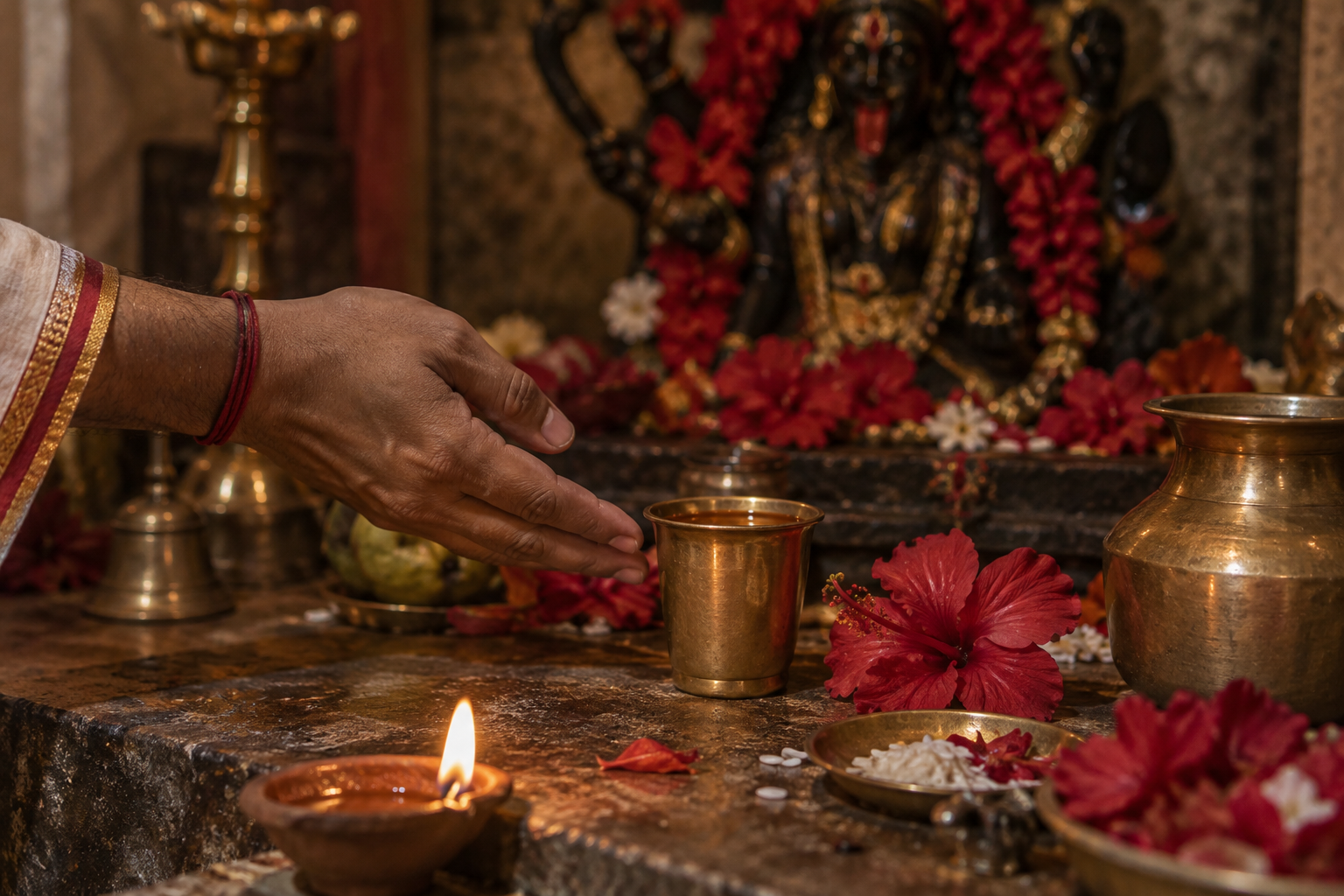
Alcohol is offered to Kali only in certain Tantric, Shakta, and folk traditions. Its presence should not be expanded into a claim about all Kali worship, all Tantra, or Hindu practice as a whole.
Within the traditions that employ it, alcohol carries force precisely because it is intoxicating and socially sensitive. It stands near desire, loss of control, pleasure, danger, and the boundary between what a community calls pure and impure. Bringing such a substance into a tightly governed rite can express a Tantric principle: spiritual discipline must confront powerful forces rather than pretending that they do not exist.
That does not make Tantra a licence for impulsive rule-breaking. A ritual use of a taboo substance is meaningful only because it is bounded by a particular method, authority, and purpose. Remove those boundaries and the act may be nothing more than ordinary consumption decorated with religious language.
The offering can also challenge a shallow division of reality into things supposedly outside the Divine and things fit for sacred life. Kali cannot be confined to polite appearances. Yet this insight does not abolish judgement. Transcending a category is not the same as losing discernment, and reverence is not the same as indulgence.
For that reason, you should not introduce alcohol into personal worship merely because you saw it at a shrine, in a video, or in an account of Tantric ritual. First establish whether it belongs to your sampradaya, family practice, or temple discipline. If it does not, there is no spiritual deficiency in leaving it out. Alcohol is not a higher offering, and using it does not make a devotee more courageous, more Tantric, or more beloved by Kali.
The material consequences also remain real. Consecration does not remove alcohol’s intoxicating effects. If drinking is unsafe for you, conflicts with recovery, violates the law, or is forbidden by your religious discipline, do not consume it or use ritual symbolism to rationalise it. Follow a non-intoxicating form of worship accepted by your tradition.
How to choose an offering without copying blindly
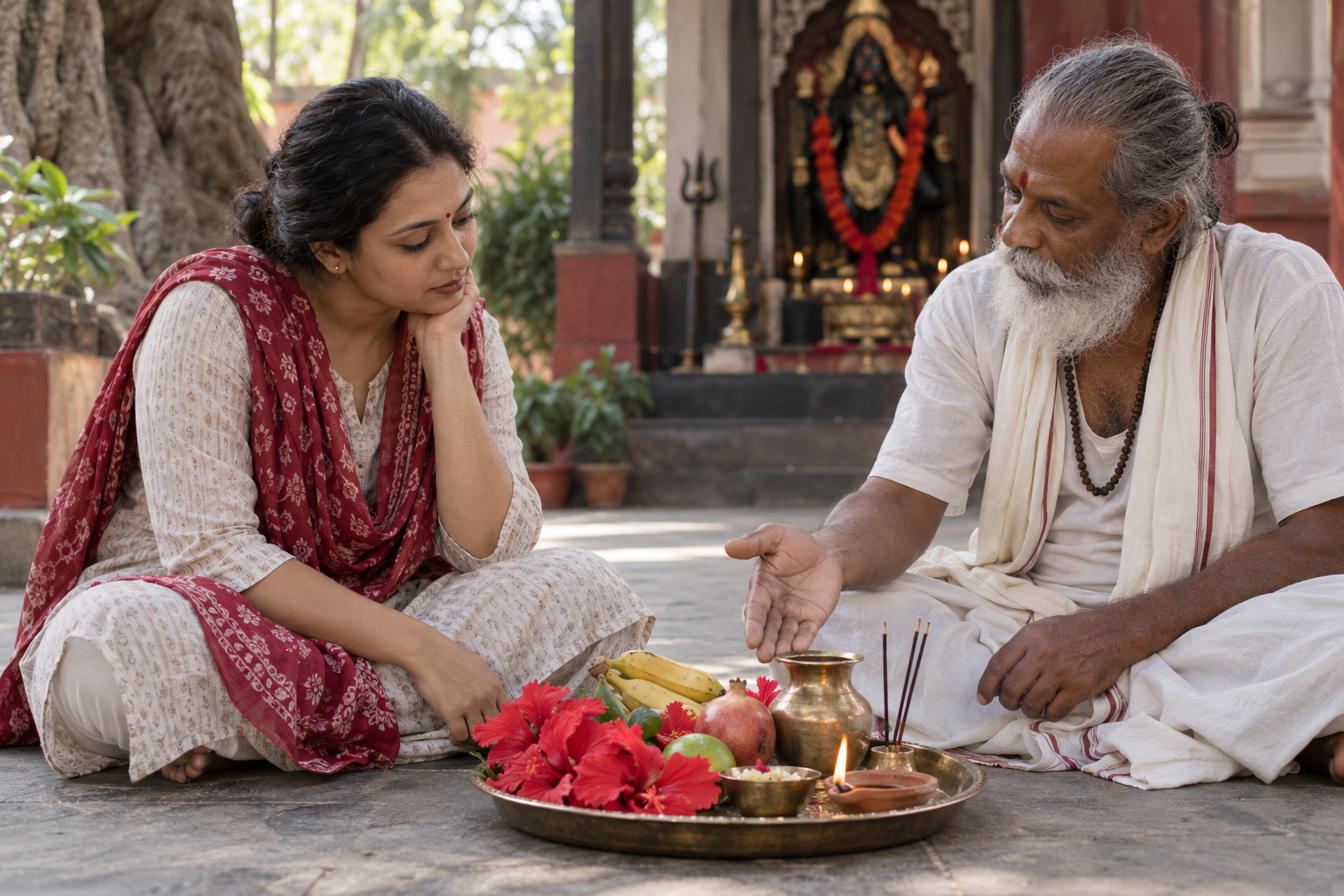
The red hibiscus and alcohol reveal two different ways an offering can speak. The flower presents vivid life, beauty, intensity, and impermanence. Alcohol, where ritually authorised, confronts intoxication, taboo, desire, and control. Both may bring powerful human experience before Kali, but that shared logic does not make the objects interchangeable.
When you encounter an unfamiliar Kali practice, use the following sequence before adopting it:
- Identify the setting. Determine whether the practice belongs to a public temple, a regional folk tradition, a Tantric lineage, or ordinary household worship. A visible ritual act does not explain its own authority.
- Ask whether it is prescribed or merely permitted. Something used on a special occasion by an authorised practitioner may not be a daily offering for everyone.
- Consult the tradition you actually follow. Ask a knowledgeable priest, guru, elder, or temple authority what is appropriate in that specific setting. Avoid assembling a personal ritual from disconnected practices.
- Choose the simplest authorised offering. When you lack instruction, sincerity does not require experimentation with taboo substances. A familiar non-intoxicating offering accepted in your tradition is the sounder choice.
- Name the inner offering. Before finishing the puja, identify what you are placing before Kali along with the physical object: fear, anger, attachment, pride, craving, or the need to control an outcome.
- Judge the fruit in conduct. If worship leaves you more disciplined, truthful, courageous, and aware of your impulses, the symbol is doing spiritual work. If it becomes an excuse for display, intoxication, fear, or claims of superiority, return to the fundamentals.
This approach protects two things at once: the integrity of inherited practice and the devotee’s capacity for honest inner work. It also prevents a common mistake – assuming that the most startling ritual must be the most spiritually advanced one.
Key takeaways
- Kali’s offerings form a symbolic language; they are not a universal checklist for every devotee.
- The red hibiscus can evoke active Shakti, embodied life, intensity, beauty, and impermanence.
- Offering the flower can mean surrendering powerful emotions for transformation, not suppressing them or being ruled by them.
- Alcohol belongs only to certain Tantric, Shakta, and folk forms of worship. It is neither compulsory nor evidence of greater devotion.
- Ritual symbolism does not erase alcohol’s intoxicating effects or make unsafe consumption spiritually acceptable.
- When a practice is unfamiliar, follow your own lineage or temple’s guidance and choose a simple authorised offering.
The next time you stand before Kali, do not measure the puja by how unusual its objects appear. Ask what you are prepared to place honestly at the Mother’s feet. Begin with what your tradition permits, offer it attentively, and let the outward act expose the inward attachment that needs to loosen.
References
- Hindu Blog – Why Is Alcohol Offered To Goddess Kali – The Reason
- Hindu Blog – Symbolic Connection Of Red Color And Hibiscus Color Flower Offering To Goddess Kali

Leave a Reply
You must be logged in to post a comment.