
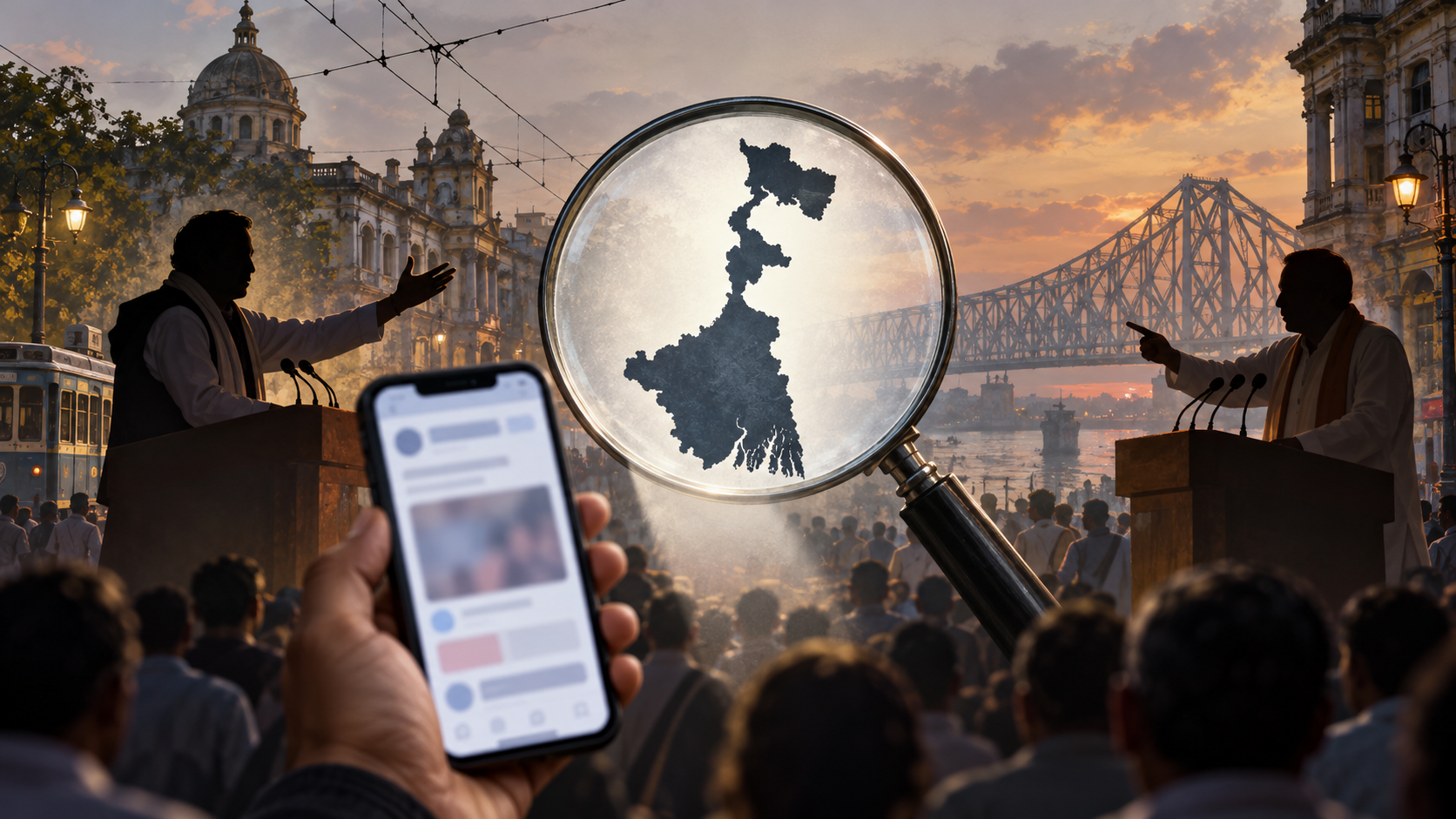
If you have encountered West Bengal’s latest Hindutva controversy through a headline, screenshot, or partisan caption, you still need an answer to the most basic question: what exactly was said? Until that is clear, choosing a side means choosing a narrative rather than judging the dispute.
On 10 October 2026, West Bengal Chief Minister Suvendu Adhikari gave CPM leader Bikash Bhattacharya 24 hours to remove or correct a post he characterized as anti-Hindutva. That establishes the confrontation, the demand, and the deadline. It does not, by itself, settle the meaning or accuracy of the disputed words.
Start with what is known, then mark the gaps

The established core is narrow. Adhikari objected to a post associated with Bhattacharya, described it as hostile to Hindutva, and demanded removal or correction within 24 hours. You should resist adding motives, threats, legal consequences, or a final outcome unless you can see evidence for each one.
Four missing elements determine how the controversy should be judged: the complete wording of the original post, the context surrounding it, the exact objection raised by Adhikari, and Bhattacharya’s response after the deadline. A cropped image or paraphrased accusation cannot substitute for that record.
Use a simple evidence card before forming an opinion:
- Disputed words: Copy the relevant sentence exactly, without correcting its grammar or shortening it.
- Target: Identify whether the sentence concerns Hindus, Hindu practices, Hindutva, a political party, or an individual leader.
- Nature of the claim: Mark it as a factual allegation, political judgement, ideological criticism, insult, or prediction.
- Requested remedy: Record whether removal, correction, retraction, or apology was actually demanded.
- Current status: Note whether the content remains unchanged, has been edited, has been deleted, or has received a reply.
This method prevents a common error: treating the loudest description of a dispute as though it were the disputed statement itself.
Hindus, Hindutva, and party politics are not interchangeable

The controversy cannot be read accurately unless you separate three overlapping but distinct subjects. Hindu refers to broad religious, philosophical, cultural, and civilizational identities. Hindutva is used as a cultural and political idea, but its meaning changes with the speaker and setting. A party or politician is a particular actor whose conduct can be criticized without that criticism automatically applying to every Hindu.
The reverse mistake is equally serious. Political vocabulary can be used to disguise contempt for Hindu identity, customs, institutions, or equal civic participation. Calling an attack ideological does not make its actual target irrelevant. You must examine the sentence, not merely the label attached to it.
A useful grammatical test is to ask what the sentence makes its subject and what it claims about that subject. Consider the difference among these possibilities:
- A claim about a particular decision made by a political leader.
- A criticism of Hindutva as an electoral or ideological programme.
- A generalization about Hindus as a community.
- A disparaging assertion about Hindu worship, traditions, or civilizational identity.
Those are not equivalent claims. A responsible pro-Hindu position should not erase the distinctions. Precision makes it easier to expose genuine anti-Hindu prejudice because opponents cannot dismiss the objection as an attempt to shield every politician from criticism.
A 24-hour demand creates urgency, not proof

The deadline matters politically because it compresses the response cycle. Supporters may interpret silence as defiance, while critics may interpret an edit as surrender. Neither interpretation follows automatically. Someone can remove words without admitting the accusation against them, and someone can refuse a demand without proving the original words were sound.
The remedy also matters. These actions answer different problems:
- Correction identifies an inaccurate proposition and replaces it with a defensible one.
- Removal takes content out of circulation but may leave the underlying position unexplained.
- Retraction withdraws a claim rather than merely changing its wording.
- Apology acknowledges fault or harm and is not implied by every correction or deletion.
The reported demand was framed as removal or correction. Do not silently convert it into a demand for an apology, a legal verdict, or proof of communal hostility. The deadline tells you how quickly Adhikari wanted action; it does not independently prove that his characterization was correct.
Verify the dispute before you circulate it

If you plan to discuss the controversy publicly, build a small record first. This takes more effort than forwarding a screenshot, but it protects both Hindu advocacy and your own credibility.
- Locate the original wording. Prefer the complete post in its original location. If it has disappeared, look for a capture that includes the account, date, surrounding text, and link rather than a cropped sentence.
- Preserve the sequence. Record what appeared first, when the objection was made, and whether the wording changed before or after the 24-hour demand.
- Compare line by line. Put the exact disputed sentence beside the exact objection. Identify which word or proposition is alleged to be false or hostile.
- Separate fact from interpretation. A factual statement can be checked against evidence. A political judgement must be assessed for reasoning, fairness, and implications. An insult should be identified as an insult rather than inflated into a factual controversy.
- Check the response. A correction, deletion, defence, or refusal can change the status of the dispute. Do not describe an early demand as though it were the final outcome.
- Share the record, not just your verdict. Give readers the relevant wording and context so they can test your conclusion for themselves.
If the original material remains unavailable, say so plainly. The accurate position is then limited: a Hindutva-related accusation and a 24-hour demand are known, while the merits remain unproven from the material in hand. Uncertainty is not weakness; pretending that missing evidence exists is.
How to make a firm pro-Hindu argument without overclaiming
A pro-Hindu response should defend dignity, equal political participation, freedom of worship, and civilizational continuity. It should also meet a demanding standard of accuracy. Hindu interests are not served when a vague accusation replaces the original words or when criticism of one politician is presented as an attack on an entire community without textual evidence.
Build your response in five sentences:
- State the disputed wording exactly.
- Name its actual target: Hindus, Hindutva, a party, a policy, or a person.
- Explain what is inaccurate, prejudicial, or politically objectionable about it.
- Identify the evidence supporting your judgement.
- Ask for a remedy proportionate to the problem: clarification for ambiguity, correction for error, retraction for an indefensible claim, or apology for an unjust attack.
That structure keeps the argument focused on conduct. It also denies opponents an easy escape through semantic confusion. If the language stereotypes Hindus, identify the stereotype and its target. If the disagreement concerns an ideological programme, answer the argument on political grounds. If the claim is factually false, show the error before demanding its withdrawal.
Key takeaways
- The confirmed dispute concerns Suvendu Adhikari’s 24-hour demand that Bikash Bhattacharya remove or correct a post characterized as anti-Hindutva.
- The original wording, full context, precise objection, and subsequent response are necessary before the merits can be settled.
- Criticism of a politician, criticism of Hindutva, and disparagement of Hindus are different claims and should be evaluated separately.
- A deadline creates political pressure, but it does not prove guilt, accuracy, prejudice, or illegality.
- The strongest response quotes the disputed words, identifies their real target, supplies evidence, and asks for a proportionate remedy.
Your next step is practical: obtain the original post and any response, place them beside the demand, and judge the actual language. If it contains anti-Hindu stereotyping, name that precisely. If it is a political argument, answer it politically. That discipline protects Hindu interests while preserving the credibility needed to defend them.
References

Leave a Reply
You must be logged in to post a comment.