

If you came across a snow-made Ganesha from Antarctica and wondered whether it was merely a charming festival moment, look again. Its deeper value is practical: it shows what you can preserve when distance, climate and limited materials strip a celebration down to its essentials.
At Maitri research station, Indian scientists celebrated Ganesh Chaturthi roughly 15,000 kilometres from India. They did not try to reproduce a large public festival in an unsuitable setting. They adapted the form while retaining a recognisable ritual sequence.
What the Maitri team actually preserved

The celebration began with a handmade murti of Lord Ganesha shaped from snow. The scientists decorated the murti with a garland and small flowers, performed puja inside the station, and then carried Bappa for visarjan. The group prayed, clapped and chanted “Ganpati Bappa Morya” before sharing handmade modaks.
None of those elements required a large pandal, elaborate ornamentation or familiar surroundings. Together, however, they formed a coherent observance: a sacred image was prepared, worship was offered, the community participated, visarjan marked the conclusion, and prasad restored the warmth of home.
That sequence is more important than the novelty of a snow sculpture. It demonstrates how a tradition remains intelligible after its scale and materials change. The outward form responded to Antarctica; the devotional purpose did not disappear.
The defensible claim should remain narrow. A group of Indian scientists celebrated Ganesh Chaturthi at Maitri in this way. There is no basis here for saying that every station resident participated, that this was Antarctica’s first such celebration, or that one group’s arrangement defines the correct observance for every Hindu community. When you share the event, its verified details are strong enough without embellishment.
A laboratory is not a culture-free zone

The image of scientists standing before a Ganesha murti unsettles a familiar but false opposition. Scientific work and Hindu worship are not rival procedures for doing the same job. A puja is not a laboratory method, and scientific discipline does not require cultural amnesia.
This distinction matters when you explain the event. It is accurate to say that Indian scientists at Maitri practised their dharma while serving at a research station. It would be inaccurate to claim that the celebration scientifically proves a religious proposition. It would be equally unreasonable to suggest that scientific competence requires a person to abandon worship, family tradition or civilisational identity.
Ganapati is widely worshipped at beginnings and in relation to obstacles. That meaning naturally acquires resonance in a remote and demanding setting, where ordinary tasks take place far from home. But resonance should remain what it is: a meaningful interpretation of the worship, not data about the scientists’ research.
You can therefore appreciate the scene without forcing it into a culture-war slogan. The scientists do not need to be portrayed as choosing faith over reason, or reason over faith. Their professional method governed their scientific work; their Ganesh Chaturthi observance expressed devotion and cultural continuity.
Eco-friendly visarjan requires more than a natural murti
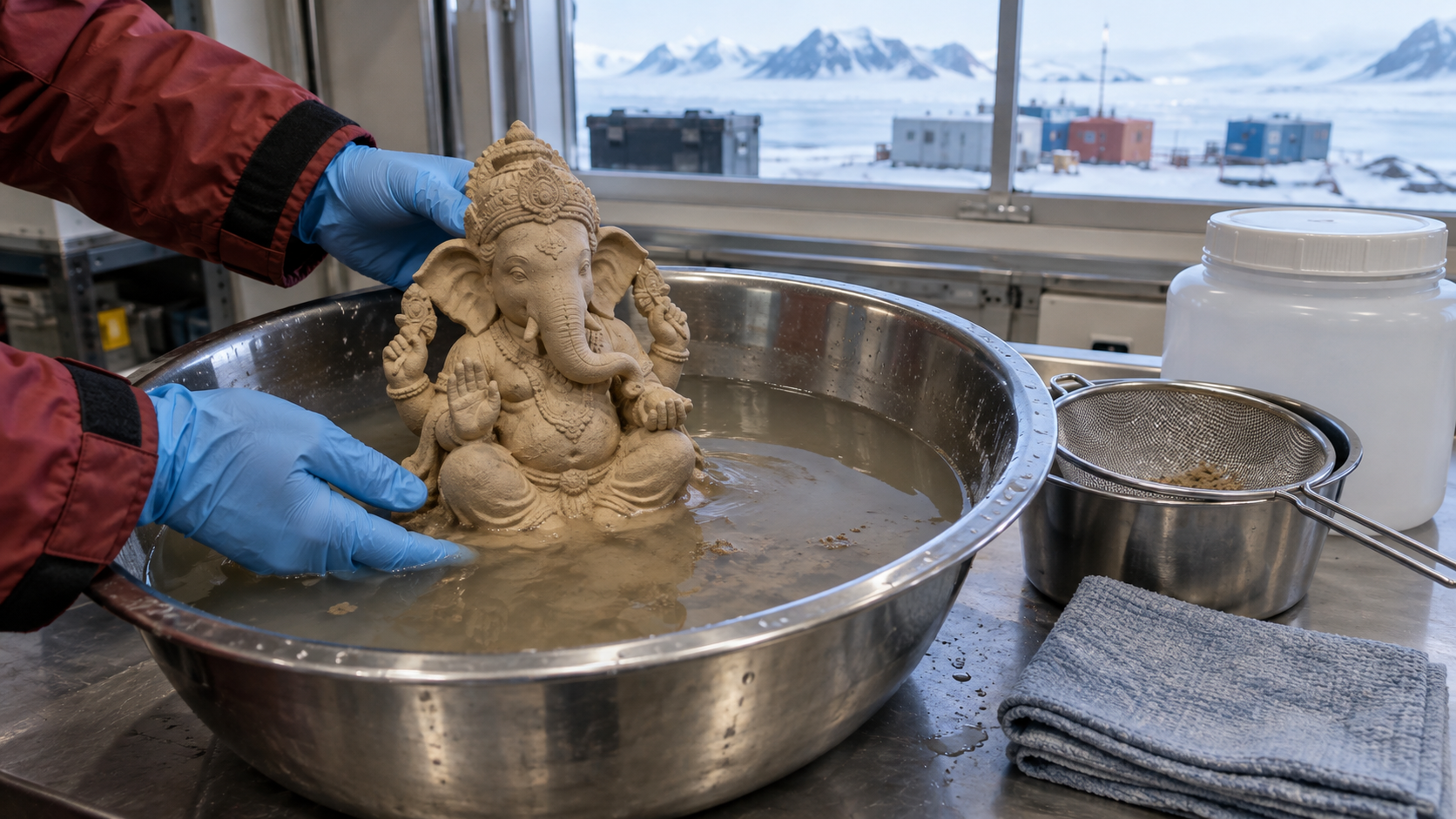
The snow-made Bappa offered a striking answer to a practical question: what should a murti be made from when the celebration takes place in Antarctica? The festivities were presented as an unusually direct form of eco-friendly immersion. Snow connected the murti to the immediate setting instead of requiring a conventional idol to be transported from India.
Yet “made from snow” should not become a careless claim that every part of a celebration has no environmental consequence. The murti also carried a garland and flowers. Responsible visarjan means accounting for decorations, offerings, packaging and every other added object, not merely choosing a biodegradable-looking central material.
If you are organising a festival at a research facility, workplace, university, park or other regulated location, plan the conclusion before constructing the murti:
- Ask the responsible site authority which materials may be brought in, used and removed.
- Attach decorations so that every nonlocal item can be separated from the murti before visarjan.
- Keep food and ritual offerings within approved areas unless you have explicit permission to take them outside.
- Arrange collection and disposal before the ceremony begins; do not improvise after participants have dispersed.
- Use a symbolic immersion when local environmental or operational rules make physical immersion inappropriate.
This is where the Maitri adaptation deserves attention. Eco-conscious ritual is not achieved by abandoning tradition. It is achieved by distinguishing the purpose of a rite from a material that may be unsuitable in a particular place, then finding a form that respects both.
A practical pattern for celebrating far from home

If your family, student group, military unit, ship’s crew or overseas workplace wants to observe a Hindu festival in an unfamiliar environment, do not begin by asking how to reproduce everything done at home. Begin by identifying what makes the observance recognisable within your own parampara.
- Name the indispensable elements. At Maitri, the visible pattern included a murti, puja, communal chanting, visarjan and modaks. Your family or sampradaya may set different requirements, so settle those before choosing decorations.
- Map the real constraints. Check available indoor space, permitted materials, food-preparation facilities and waste rules. A restriction discovered early can guide a thoughtful adaptation; one discovered during the ritual becomes a disruption.
- Adapt the material, not the reverence. The Maitri group used snow because it belonged to the setting. In another location, the suitable material may be different. Choose it for ritual fitness, local permission and a clear end-of-use plan.
- Protect the sequence even when the scale is modest. A small gathering feels complete when participants know how the observance begins, what happens during worship and how it concludes. Scale cannot substitute for coherence.
- Keep the shared food achievable. Handmade modaks gave the Maitri celebration a familiar festive conclusion. Select prasad that your facilities can safely prepare and distribute instead of planning an elaborate menu that the location cannot support.
- Describe the event without exaggeration. Record who celebrated, where it happened and what they did. Avoid unsupported claims such as “first ever,” “everyone participated” or “completely impact-free.” Precision strengthens cultural memory.
This pattern reveals something important about dharmic continuity. A living tradition does not survive by mechanically freezing every outward detail. It survives when people understand which elements carry meaning, which forms can change, and which responsibilities the new setting imposes.
Key takeaways
- The Maitri celebration retained a complete ritual arc despite extreme distance and limited materials.
- The scientists’ worship expressed dharmic identity; it was neither a scientific experiment nor a rejection of scientific reason.
- A natural murti material is only one part of environmental responsibility; decorations, offerings and cleanup must also be planned.
- Remote communities should preserve the purpose and sequence of a festival while adapting its scale and physical form.
- Accurate captions and restrained claims protect the event from being reduced to misinformation or a slogan.
If your next Ganesh Chaturthi must be observed far from home, write down your essential ritual elements first. Then secure the necessary permission, choose a material suited to the place, and decide how every item will be removed before inviting participants. That preparation turns a distant celebration into disciplined dharmic practice rather than a nostalgic imitation.
References

Leave a Reply
You must be logged in to post a comment.