

If you survived an accident, endured an assault, or woke from danger with Hanuman’s name already on your lips, the question can stay with you long after the immediate crisis has passed: did Hanuman intervene, or am I giving sacred meaning to a fortunate turn of events?
You do not have to choose between devotion and intellectual honesty. You may receive an experience as grace without claiming that you can prove its unseen cause. The more important question is what you do with it now: whether it deepens humility, courage, truthfulness, and seva, or becomes a reason for exaggeration, superiority, or carelessness.
Begin by separating the event, the experience, and the interpretation

A powerful experience often arrives as one indivisible memory. For careful discernment, separate it into three layers:
- The event: What can be observed or corroborated? There was a collision, an injury, a narrow escape, an unexpected warning, or help from another person.
- The experience: What did you perceive inwardly? You saw a form, heard a name, felt yourself moved, remembered the Hanuman Chalisa, or experienced unusual steadiness.
- The interpretation: What meaning do you give it? You believe Hanuman protected you, strengthened you, directed help toward you, or made his presence known.
The first layer may be checked by other people. The second belongs to your testimony. The third is an act of spiritual understanding. Keeping them distinct does not drain the event of sanctity. It protects both shraddha and satya: reverence does not have to purchase certainty by overstating what you know.
A survivor of a night-bus collision later described Hanuman appearing in a dreamlike moment and pulling him away from the window just before another bus struck near his seat. The collision and injuries belong to the outward event. The appearance of Hanuman belongs to the survivor’s experience. His conviction that Hanuman saved him belongs to his interpretation. An outsider’s inability to verify the inward moment does not prove that the survivor was dishonest; the survivor’s certainty, in turn, does not oblige every outsider to accept a publicly demonstrated miracle.
Captain Smit Machchar’s survival and continued action after an alleged cockpit attack carried similar force for devotees because he invoked Hanuman while human courage, teamwork, and assistance also remained part of the event. There is no need to erase those human causes in order to speak of grace. A bhakta may see the people who helped, the capacity to remain conscious, and the timely opening of a door as the very means through which grace operated.
This protective relationship with Hanuman is older than any viral story. The Dvaita scholar and Vijayanagara spiritual adviser Vyasa Tirtha, who lived from 1447 to 1539, is credited with overseeing the installation of 732 Hanuman images in protective, heroic forms across the Deccan and South India. That history does not prove the supernatural cause of a particular escape. It does show that turning toward Hanuman in times of danger belongs to a long and durable devotional memory.
Judge the experience by the Hanuman it forms in you
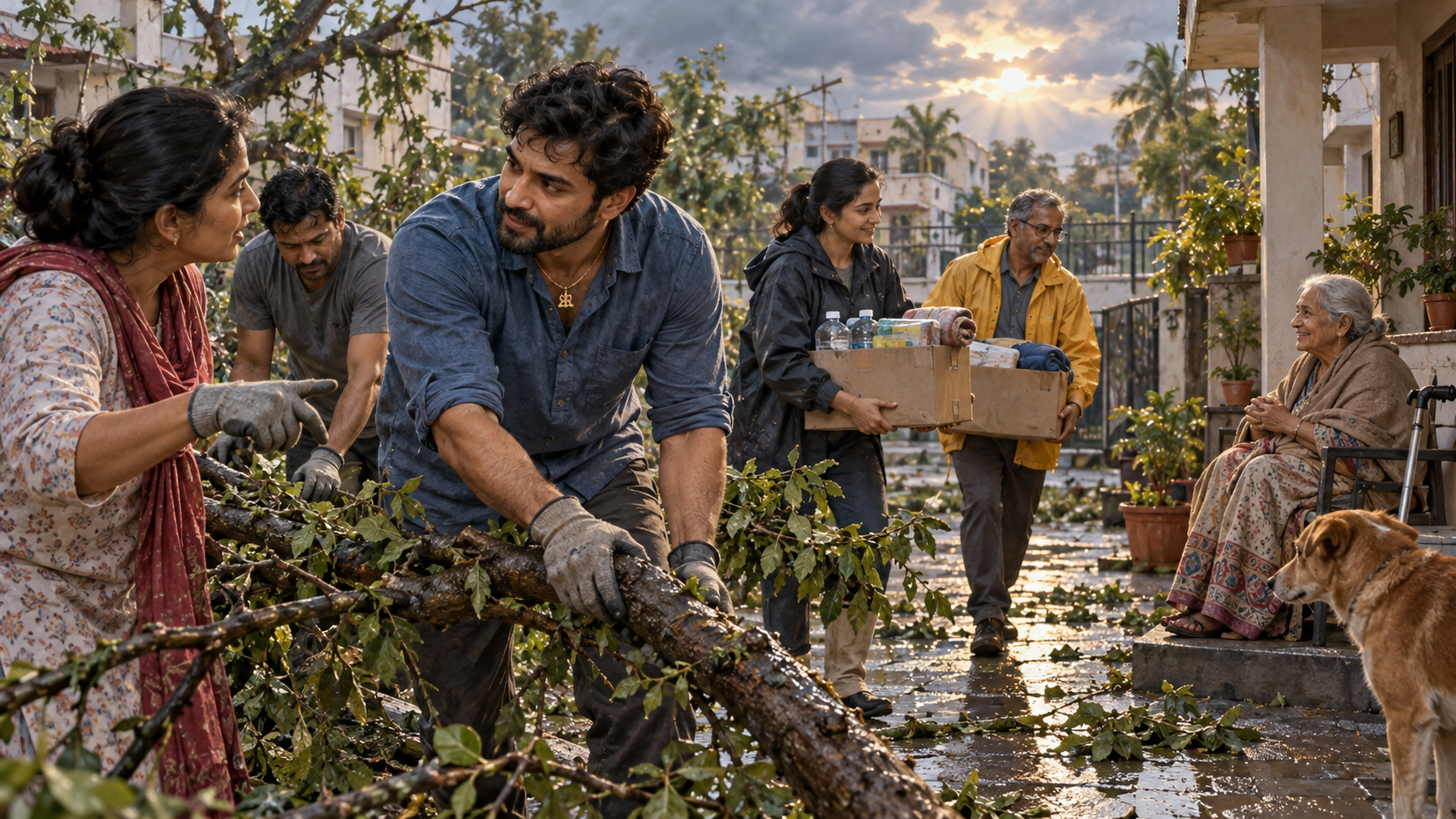
A perceived intervention can never be evaluated only by how dramatic it felt. Intensity is not the same as spiritual depth. A more useful test is its fruit: what sort of person are you becoming because you believe you received Hanuman’s help?
- Humility: You think, “I have been given another opportunity to serve,” rather than, “I must be more important than others.”
- Courage with discipline: You face a necessary duty without confusing courage with recklessness.
- Truthfulness: You preserve the difference between what happened, what you perceived, and what you believe it meant.
- Gratitude: Your prayer becomes steadier after the emergency instead of disappearing when the fear passes.
- Seva: Protection received becomes protection offered to someone else.
- Reduced ego: You become less interested in being known as a person who experienced a miracle and more interested in living by the qualities Hanuman embodies.
Hanuman’s immense strength is inseparable from service to Rama. That is the corrective built into Hanuman bhakti itself. Power is not displayed for personal importance; it is placed at the feet of dharma. If your experience makes you more demanding, grandiose, contemptuous, or hungry for attention, do not automatically treat those impulses as sacred merely because they followed a sacred moment.
There are also practical warning signs. Do not test Hanuman by taking avoidable risks. Do not refuse medical examination after an injury because you feel protected. Do not ignore aviation, road, workplace, or household safety rules as though caution revealed weak faith. Do not embellish uncertain details to make your testimony more impressive. Hanuman bhakti should make you more capable of carrying responsibility, not less willing to do so.
Turn gratitude into a disciplined response

If you believe Hanuman helped you, respond in a way that joins devotion to duty. The following sequence works whether the incident was dramatic or known only to you.
- Finish the human response first. Get medical care, contact emergency services, secure the dangerous location, preserve relevant evidence, and give an accurate account to the responsible authorities. Prayer can accompany these duties; it cannot replace them.
- Record the memory without polishing it. As soon as you are able, write four separate notes: what you directly observed, what other people later told you, what you inwardly perceived, and what you believe it means. Memory naturally absorbs later information. This separation helps you remain truthful when you tell the story months or years afterward.
- Offer simple, sustainable gratitude. Recite the Hanuman Chalisa if it belongs to your practice, visit a Hanuman mandir, perform your usual puja, or sit quietly with Hanuman’s name. Choose an observance you can continue without neglecting family, health, or work. A costly or punishing vow is not required to make gratitude sincere.
- Convert thanks into one concrete act of seva. If you survived a road emergency, learn or support safer conduct. If strangers helped you, help someone who cannot repay you. If family carried you through recovery, relieve part of their burden. The act need not imitate the event exactly; it should answer received help with responsible help.
- Tell the story with calibrated language. Say, “I experienced Hanuman’s presence,” or, “I believe Hanuman protected me.” Do not quietly change those statements into, “This proves what everyone else must believe.” Personal conviction can be strong without becoming coercive.
- Revisit the fruit after the emotion settles. Ask whether your speech is more truthful, your daily practice steadier, and your conduct more useful. If nothing changes except the frequency with which you repeat the extraordinary details, you may be preserving excitement rather than deepening bhakti.
A sudden dream, image, or sense of presence during danger is not by itself a reason to panic. If such experiences become persistent, disrupt sleep or ordinary functioning, or seem to command you to harm yourself or someone else, seek qualified medical or mental-health help promptly. You may also speak with a trustworthy spiritual teacher, but spiritual counsel should accompany appropriate care rather than displace it.
Do not turn grace into a verdict on somebody else’s suffering

The hardest question usually follows the declaration of rescue: if Hanuman protected one person, why did another person suffer or die? Bhakti does not give you permission to answer by declaring that the survivor had superior faith or that the victim possessed inferior karma. You cannot audit another person’s spiritual worth from the outcome of an accident.
You may call your own survival grace. You may not use that grace as evidence that someone else was abandoned, impure, or undeserving. Such claims add moral injury to grief and turn an intimate relationship with the divine into a ranking system. They also forget that devoted people encounter pain, loss, and unanswered prayer.
Divine help need not always mean physical rescue. A bhakta may perceive help in the strength to act, the arrival of another person, the clarity to accept a painful reality, or the capacity to continue serving after loss. That is not a formula explaining every tragedy. It is a way of remaining open to grace without pretending to possess a complete map of causation and karma.
Exercise the same restraint when a devotional story goes viral. Repetition can carry Hanuman’s name across languages and communities, but it can also make uncertain details sound settled. Preserve words such as “alleged” where they belong. Credit the passengers, crew members, emergency workers, clinicians, or relatives whose actions mattered. Refuse sensational additions you cannot verify. Bhakti does not become stronger when truth becomes weaker.
A sincere skeptic need not be treated as an enemy, either. If someone accepts the physical chain of events but not your spiritual interpretation, disagreement does not erase your anubhava. Let the quality of your life carry what argument cannot. Courage without aggression, devotion without vanity, and service without demand are harder to dismiss than an inflated claim.
Key takeaways
- You may receive a narrow escape as Hanuman’s grace without claiming that its unseen cause has been publicly proved.
- Keep the observable event, your inward experience, and your spiritual interpretation distinct when recording or sharing what happened.
- Test the experience by its fruit: humility, courage, truthfulness, steady sadhana, and seva.
- Prayer never cancels medical care, emergency action, accurate reporting, or ordinary safety measures.
- Never use your perceived rescue to judge the faith, karma, or worth of a person who was not rescued.
- The most credible testimony is a life made more dharmic, not a story made more dramatic.
If an experience of Hanuman’s protection is still alive in you, write three lines today: what happened, what you received, and what duty now follows. Then perform that duty. The strongest way to honour perceived grace is to let it become disciplined service.
References

Leave a Reply
You must be logged in to post a comment.