
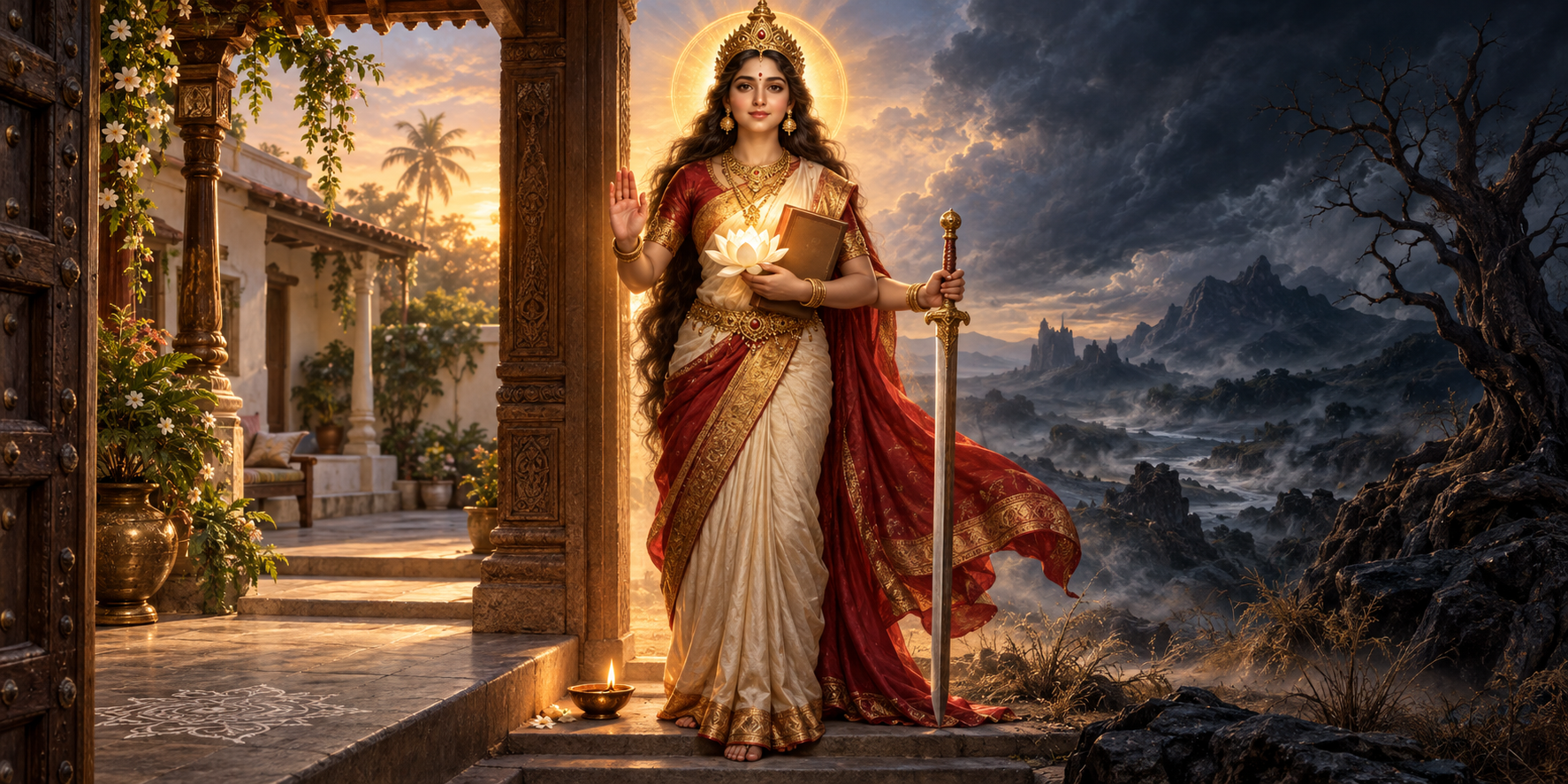
When you turn to Devi in a difficult season, what should you ask for: clarity, safety, or the strength to fight? The question can feel as though it requires choosing among different Mothers. In practice, the three powers belong together.
Knowledge shows you what is true. Protection preserves what is worthy. Warrior strength confronts what threatens it. If you reverse that order, fear can masquerade as devotion and anger can masquerade as courage. If you keep the order, worship becomes a discipline for making better decisions.
Three forms, one movement of dharma
The Mother of knowledge, the protective Kula Devi, and the fierce war goddess are not interchangeable images. Each has its own devotional setting, inherited customs, and emotional force. Yet you can approach them through one practical sequence: see clearly, identify what must be guarded, and then act with proportionate strength.
This sequence matters because each power corrects a possible distortion in the others. Knowledge without protection can remain detached from suffering. Protection without knowledge can preserve a harmful habit merely because it is familiar. Warrior energy without either can become aggression in sacred language.
Key takeaways
- Seek knowledge before certainty. Separate what you know from what you fear, assume, or desire.
- Define what protection means. Name the person, principle, relationship, or duty that genuinely needs to be guarded.
- Test warrior energy by its purpose. Courage protects dharma; rage tries to satisfy the wounded ego.
- Make devotion concrete. Pair prayer with one truthful, protective, or courageous action that is actually within your power.
You do not need to invoke every form in every situation. You do need to recognize which power the moment is asking you to cultivate, and which power must restrain it.
Knowledge is Devi’s presence, not merely Her possession

The name Jnanavigraha in the Sri Lalita Sahasranama makes an exact distinction. Devi is not described merely as someone who has knowledge. Her very form is knowledge. This moves the devotee beyond the idea of approaching a powerful being only to obtain information, success, or a desired answer.
For you, the immediate implication is demanding: do not ask the Mother of knowledge to bless a conclusion you have already decided to believe. Ask Her to expose confusion, including confusion that protects your pride. A prayer for knowledge must leave room for your first interpretation to be wrong.
Before an important decision, write three short statements:
- What I know: facts you could state without guessing another person’s motive.
- What I am adding: fears, hopes, inherited assumptions, and predictions.
- What I still need to learn: the unanswered question that would materially change your decision.
Then ask a harder question: What would the truthful action be if the outcome were not under my control? This turns jnana from accumulated information into viveka, practical discernment. You may still need advice, study, or time. Devotion does not eliminate those needs; it disciplines the mind that uses them.
This is also why intelligence alone is not the same as wisdom. A clever mind can construct reasons for almost anything. Knowledge as Devi’s presence asks whether your thought serves truth and dharma, especially when truth costs you convenience, status, or the pleasure of feeling unquestionably right.
The Protector is encountered through relationship and continuity
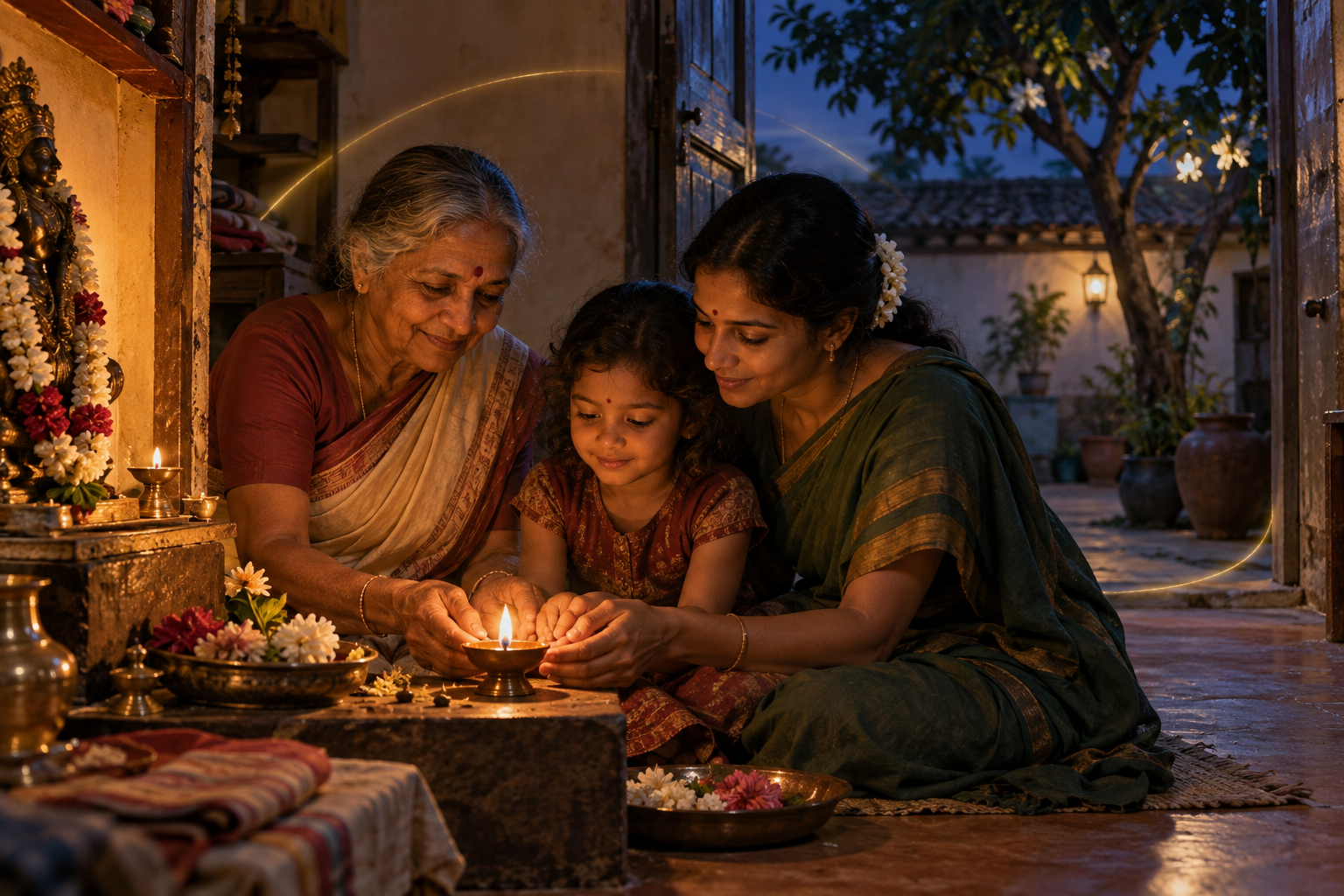
A Kula Devata is not an abstract symbol selected for a temporary preference. The relationship is carried through family memory, a particular name and place, inherited observance, and repeated return. For one Angalamman devotee, the experience of protection stretches from childhood hardship to yearly family visits to the Kula Devata temple in Erode’s Keerakara Veedhi. The significance lies not only in an extraordinary claim, but also in the durable pattern of belonging around it.
A personal testimony can tell you how a devotee understands events and sustains faith. It cannot prove that every hardship will be removed for every worshipper. Do not measure your devotion by whether pain disappears on your preferred schedule. Protection may also take the form of discernment, restraint, timely assistance, a boundary you finally keep, or the strength to endure without becoming cruel.
If your family has a Kula Devata tradition but you know little about it, begin with recovery rather than invention:
- Ask elders for the deity’s exact name, the associated temple or place, and the customs they personally remember.
- Separate remembered family practice from additions collected online. When the two conflict, ask a responsible family elder or someone entrusted with the temple tradition.
- Choose a sustainable rhythm of remembrance. A modest observance you can maintain is more honest than an elaborate promise you will abandon.
- Connect prayer with responsible protection in ordinary life: keep a necessary boundary, seek qualified help, fulfil a neglected duty, or support the person whose safety concerns you.
If the lineage is unknown, do not fabricate one merely to feel complete. You can approach Devi through a form and practice already meaningful to you while continuing to ask careful questions about family history. Reverence grows through truthfulness, not through pretending certainty.
The Warrior protects a boundary; She does not flatter rage

The fierce Mother cannot be reduced to a metaphor for confidence. Tamil memory preserves Kotravai as a goddess of war, later identified with Durga and Kali within the wider Shakta world. It also remembers Navakandam and Arikandam as voluntary acts of self-sacrifice before Kotravai in ancient and medieval Tamil tradition.
That history should be faced without sanitizing it and without turning it into a devotional spectacle. It belongs to a past warrior culture; it is not an instruction for contemporary worship. Nothing about reverence for Kotravai, Durga, or Kali justifies injuring yourself or another person. Do not reenact, romanticize, or spiritually rationalize bodily harm. If ritual imagery is drawing you toward immediate harm, move away from any means of injury and contact emergency help or a trusted person who can remain with you.
For present practice, the sacrifice must be ethical and nonviolent. Offer the vanity that refuses correction, the cowardice that abandons another person, the attachment to applause, or the comfort purchased by silence in the face of a clear wrong. These are difficult offerings because they change how you live after the prayer ends.
Before calling your response righteous anger, test it with four questions:
- What exactly is being threatened? Name the person, duty, truth, or boundary. Do not answer with a vague sense of insult.
- Am I protecting the vulnerable or defending my image? Both can feel urgent, but they do not carry the same moral claim.
- Is my response proportionate? The smallest firm action that stops harm is often stronger than uncontrolled retaliation.
- Will I accept accountability afterward? Courage can explain its conduct when the heat has passed; rage usually asks for exemption.
The warrior aspect is therefore inseparable from restraint. Fierceness is not permission to dehumanize an opponent, humiliate someone weaker, or convert every disagreement into a battle between dharma and adharma. The Mother who destroys confusion within you cannot honestly be invoked to protect that same confusion when it becomes anger.
Use a three-question practice when the next step is unclear

You can bring the three forms into a single decision without collapsing their differences. Take one live problem and move through the questions in order.
| Power of Devi | Question to ask | Concrete response | Distortion to avoid |
|---|---|---|---|
| Knowledge | What is actually true, and what remains uncertain? | Verify the decisive fact, correct a false assumption, or postpone certainty until you know enough. | Using intelligence to defend the answer you already want. |
| Protector | What worthy thing must not be surrendered? | Name the boundary, duty, person, or practice and take one step that preserves it. | Calling every preference sacred simply because it is familiar. |
| Warrior | What firm action does protection now require? | Choose a proportionate act you can defend calmly afterward. | Confusing punishment, spectacle, or wounded pride with courage. |
End with one sentence for each power: Mother, let me see without self-deception. Let me guard what serves dharma. Give me courage to do the next right thing without hatred. Then write down that next thing. It should be small enough to begin and definite enough that you will know whether you did it.
Sometimes the correct result will be more study. Sometimes it will be a boundary. Sometimes it will be a confrontation you would rather avoid. Let the need determine the form, but keep the sequence intact: first see, then protect, then act.
The next time you approach Devi with a problem, do not ask only for the outcome you prefer. Ask which of Her powers the moment requires from you, and make your prayer visible in one action before the day ends.
References
- Hindu Pad – Miracles of my Kula Devata Ma Angalamman in my Life
- Hindu Blog – Jnanavigraha: Why Sri Lalita Sahasranama Reveals the Divine Mother as Knowledge Itself
- Hindu Blog – Navakandam and Arikandam: When Tamil Warriors Offered Their Own Heads to the Goddess of War

Leave a Reply
You must be logged in to post a comment.