
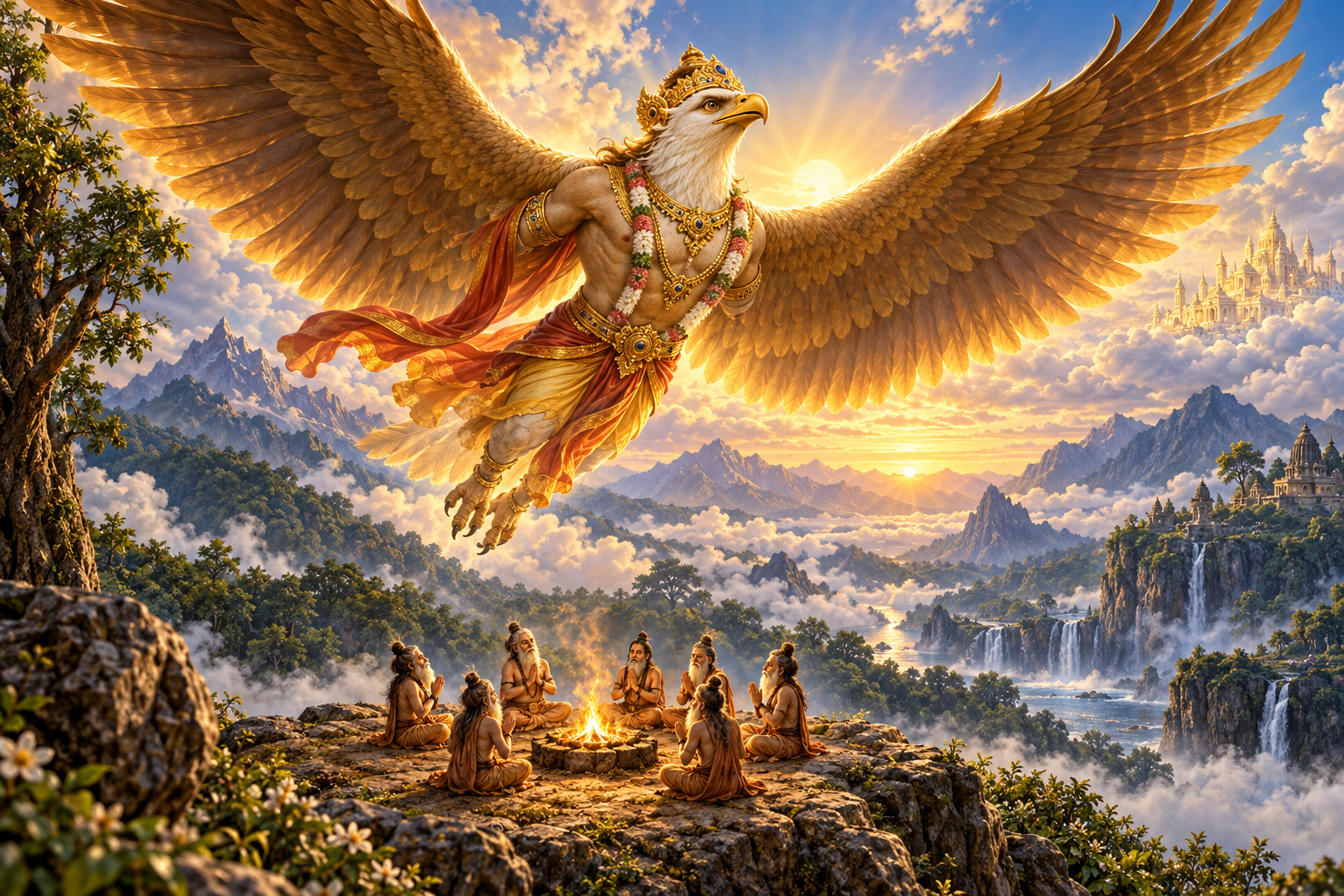
If you have wondered why the story of Garuda’s birth pauses over a multitude of sages no taller than a thumb, you have found the key to the episode. The Valakhilyas are not decorative figures in Garuda’s background. Their encounter with Indra sets the decisive chain of events in motion.
Read the sequence carefully and Garuda’s birth becomes more than the arrival of a mighty divine bird. It becomes a lesson about deceptive appearances, the consequences of arrogance, the efficacy of tapas, and the Dharmic redirection of power.
How the Valakhilyas are connected to Garuda’s birth

The Valakhilyas are described as sixty thousand sages, each only the size of a thumb. Garuda Purana, Chapter V, identifies them as the sons of Sage Kratu and Sumati. Their minute bodies are paired with extraordinary inner attainment: they have mastered their passions and possess a radiance compared with the burning sun.
That contrast must remain in view. Physically, the sages appear insignificant. Spiritually, they are formidable. The story works because Indra notices only the first fact and fails to perceive the second.
The Astika Parva of the Mahabharata connects their ascetic power with the circumstances surrounding Garuda’s birth. Indra encounters the tiny sages while preparations are being made for Kashyapa’s sacrificial undertaking. Their contribution looks negligible beside his own strength, and he mocks them. The insult is not harmless amusement. It reveals that the ruler of the devas has confused visible capacity with true worth.
The offended Valakhilyas direct their discipline toward bringing forth another Indra, one greater than the existing ruler. Kashyapa then intervenes. The force of their undertaking is not treated as imaginary, nor can their resolve simply be dismissed. Its fruit is redirected toward the birth of a sovereign among winged beings. Garuda, born to Vinata and Kashyapa, becomes that magnificent being.
This is what it means when a retelling says that the Valakhilyas “gave birth” to Garuda. They are not his biological parents. Vinata is his mother and Kashyapa his father. The sages are causal participants whose tapas helps determine the exceptional power and station of the child who will be born.
Indra’s mistake is a failure of spiritual perception
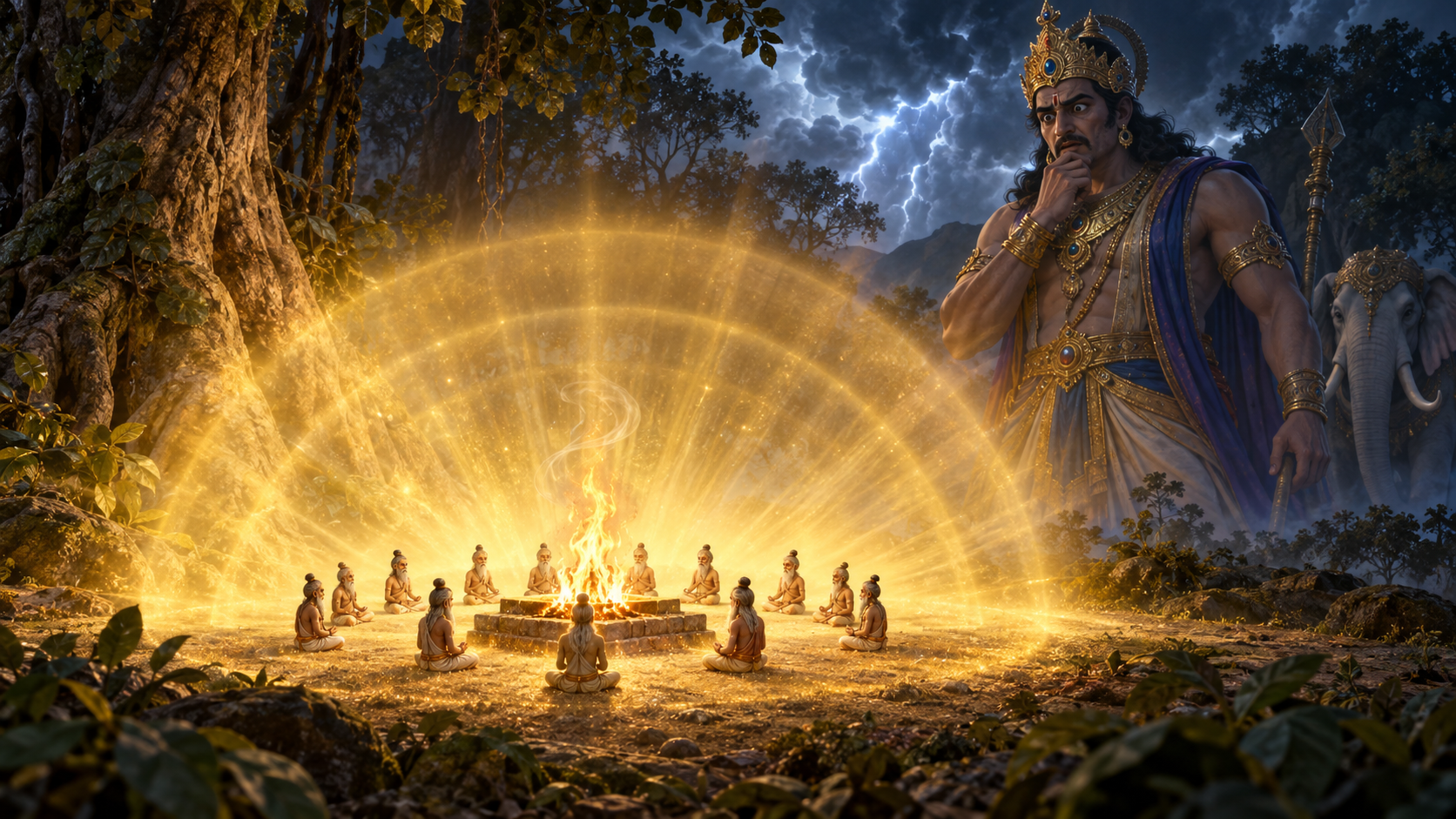
It is easy to reduce the incident to the familiar instruction that you should not mock someone who looks weak. That is true, but it does not reach the deepest point. Indra possesses immense strength, yet his judgement is governed by scale. He sees small bodies and assumes small power.
The Valakhilyas overturn that assumption. Their bodies occupy little space, but their self-mastery gives their intention consequence. They show you that tapas is not measured in height, wealth, social visibility, physical force, or the amount a person can carry. The disciplined consciousness behind an offering matters more than its outward size.
This also explains why the tradition emphasizes both their smallness and their brilliance. If you remember only that they are tiny, they become curiosities. If you remember that they shine with ascetic energy and govern their passions, their size becomes a deliberate test of perception. Will you judge as Indra initially judges, or will you learn to recognize an inward achievement that has no need to advertise itself?
The warning is especially relevant when you hold authority. The greater your status, the easier it becomes to treat another person’s modest contribution as beneath notice. The episode asks you to examine that reflex before it hardens into contempt. A small act performed with discipline may carry more moral weight than a grand act accompanied by pride.
Why Kashyapa redirects the vow instead of denying it
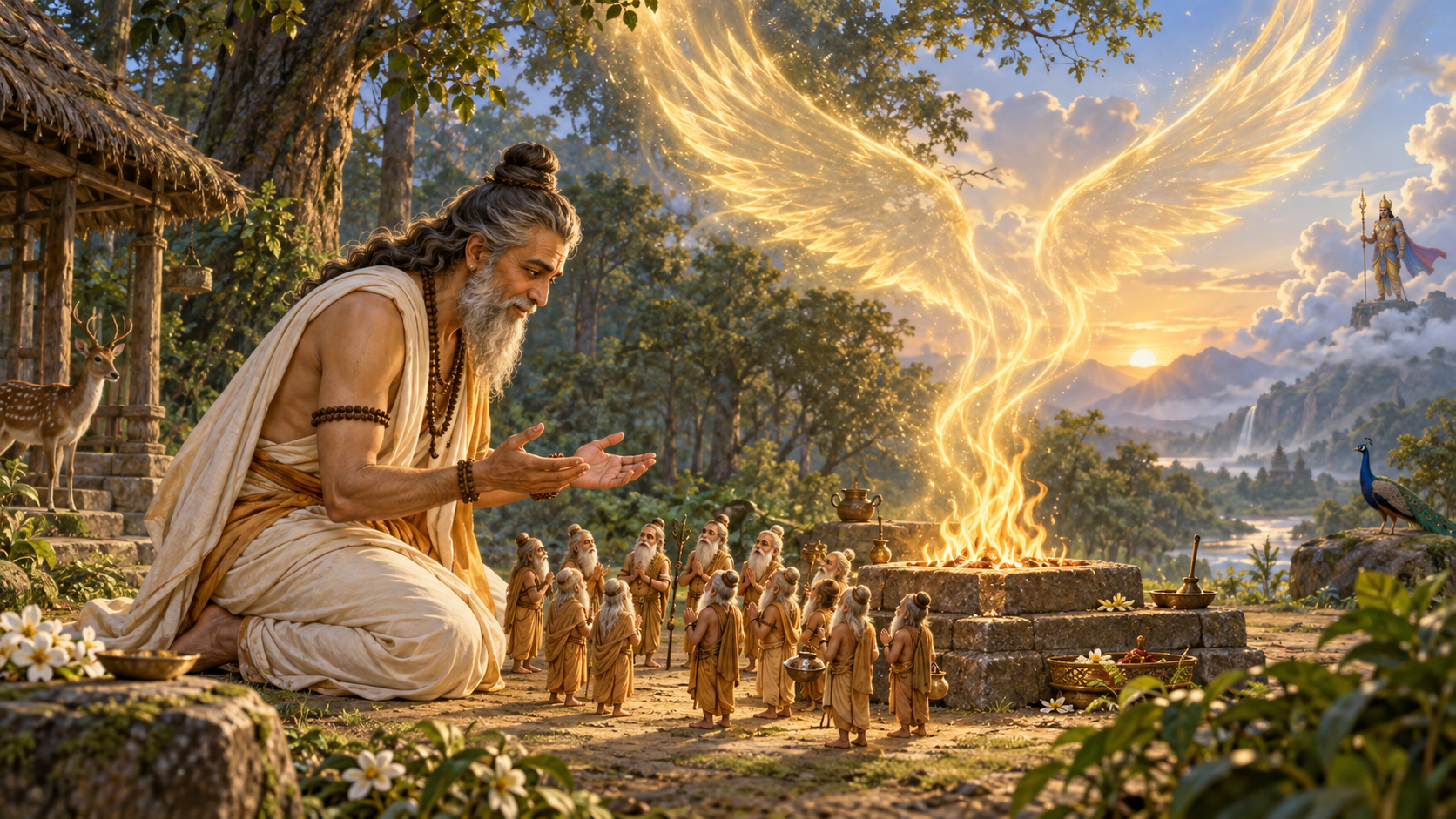
Kashyapa’s role is essential. Two realities must be honored at once: the Valakhilyas’ tapas has efficacy, and the cosmic position already assigned to Indra cannot be treated casually. The resolution therefore does not declare one side unreal. It gives the sages’ intention a different and fitting field of fulfilment.
The promised greatness is expressed through Garuda as the pre-eminent being among birds. The sages’ resolve is not wasted, yet its fulfilment does not require the established Indra to be replaced. This is a recognizably Dharmic mode of mediation. A powerful intention is neither suppressed nor allowed to tear apart the larger order; it is transformed into a result that preserves truth on both sides.
You can use this part of the episode as a practical test when facing conflict. Do not ask only which party must lose. First identify what is valid in each claim. Then look for a resolution that preserves the legitimate principle without preserving the original collision. Redirection is not the same as surrender when the underlying purpose still reaches fulfilment.
The outcome also changes how Garuda’s might should be understood. His greatness does not emerge as brute force detached from Dharma. It appears within a moral sequence: arrogance produces danger, ascetic power makes that danger real, wise mediation redirects it, and a new form of sovereignty enters the world.
How to read and teach the episode without flattening it
If you are explaining this story to a child, a study group, or someone encountering Garuda for the first time, keep its causal order intact. Otherwise the Valakhilyas become an odd footnote and the birth of Garuda seems disconnected from the lesson that gives it meaning.
- Begin with the contrast. The Valakhilyas are physically minute but spiritually radiant and self-controlled. Do not use “small” as a synonym for “powerless.”
- Name Indra’s error precisely. His fault is not strength itself. It is the pride that makes visible strength his standard for judging everyone else.
- Explain tapas as agency. The sages do not answer mockery with physical retaliation. Their disciplined intention has consequences because their austerity has given it force.
- Keep biological and causal parentage distinct. Vinata and Kashyapa are Garuda’s parents. The Valakhilyas help create the spiritual and ritual conditions associated with his extraordinary birth.
- Do not omit the mediation. Kashyapa’s intervention shows how a potent vow can be fulfilled through redirection rather than simple cancellation or destructive rivalry.
This method prevents two common misreadings. The first turns the Valakhilyas into magical miniature characters without moral agency. The second treats the narrative as a simple revenge tale. Neither accounts for the sages’ self-mastery, Kashyapa’s intervention, or the ordered form in which their power finally bears fruit.
Key takeaways
- The Valakhilyas are sixty thousand thumb-sized sages whose outward smallness conceals immense ascetic attainment.
- Indra’s mockery exposes the danger of measuring spiritual worth by visible power or social importance.
- The sages do not replace Vinata and Kashyapa as Garuda’s parents; their tapas is a causal force behind the circumstances of his birth.
- Kashyapa redirects their intention toward a sovereign among birds, allowing its power to bear fruit without overturning the existing cosmic order.
- When you read the episode, watch the entire movement from misjudgement to consequence, mediation, and transformation.
The next time you see Garuda beside Vishnu or hear his power praised, remember the tiny sages behind that greatness. Then carry the story into conduct: measure people less by the space they occupy and more by the discipline, sincerity, and Dharma present in what they do.
References

Leave a Reply
You must be logged in to post a comment.