
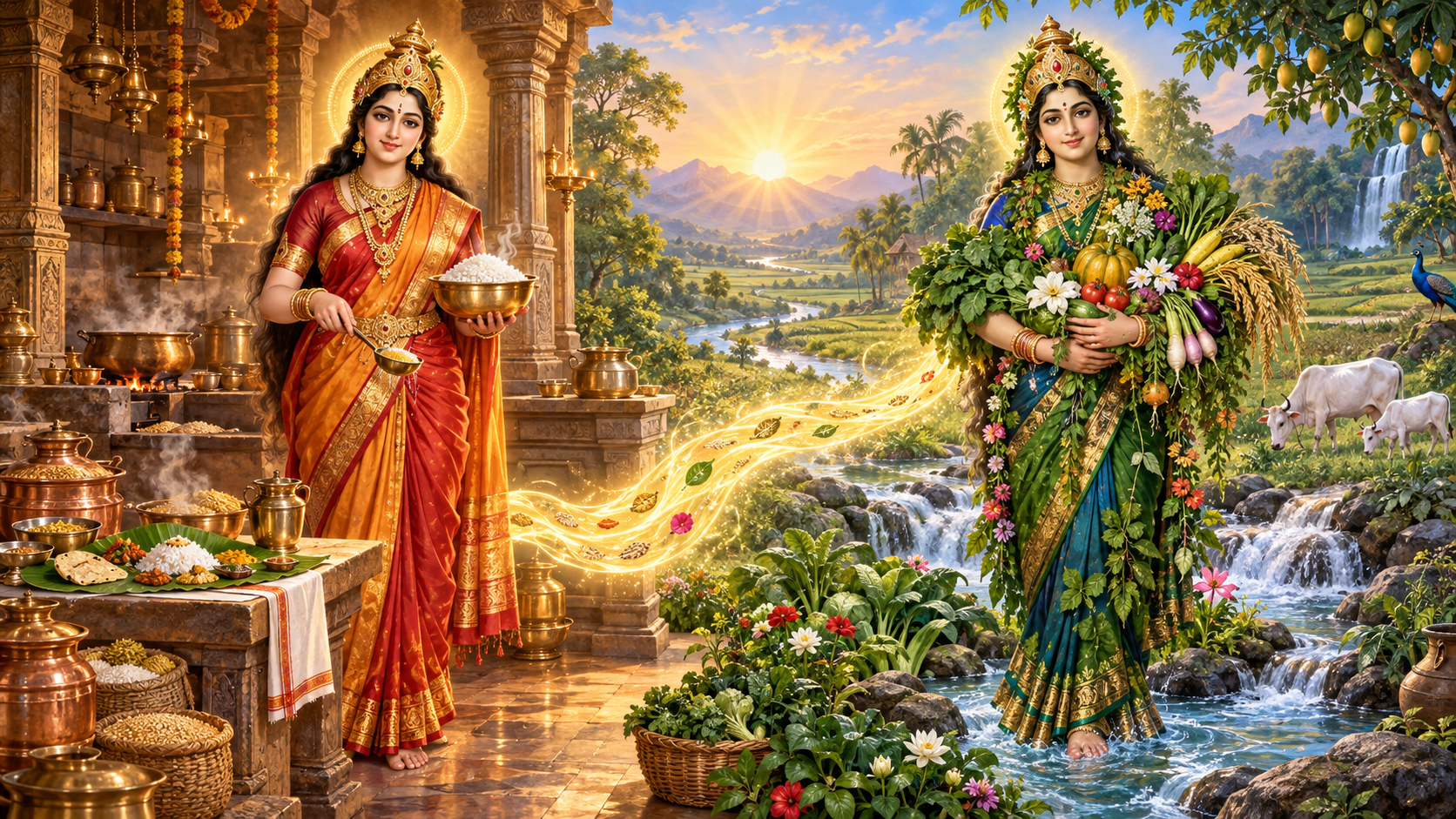
If you are trying to understand why Hindu tradition approaches nourishment through both Annapurna and Shakambhari, begin with your next meal rather than a catalogue of divine names. Annapurna brings your attention to food placed within reach. Shakambhari makes you notice the living conditions that allowed it to arrive.
This distinction gives you a practical way to worship the Divine Mother. Receive food without entitlement, share it without condescension, and protect the water, soil and living abundance from which food comes. The two forms belong to one movement of grace: life is sustained, and what sustains life must circulate.
Two forms reveal the full journey of nourishment
A helpful contemplative map begins before the kitchen and ends beyond the plate. It is not a rigid doctrinal boundary between the two Devis. It is a way to notice what each form places before your conscience.
Annapurna is the goddess of food and nourishment, commonly depicted with a pot of food and a ladle. Her image presents nourishment at the moment it becomes available to another being. The pot holds what can sustain life; the ladle carries it from the vessel to the person who needs it. Contemplated together, the symbols make abundance relational. Food is fulfilled not by being possessed but by being served.
Shakambhari brings nourishment, mercy and ecological balance into one maternal form. Her scriptural setting is associated with the Devi Mahatmya, also known as the Durga Saptashati, within the Markandeya Purana. The imagery of her thousand eyes and life-giving tears expands compassion beyond a private emotion. The Mother sees suffering, responds to it and restores the conditions in which life can be nourished.
A meal therefore has two sacred horizons. At the near horizon are the cooked food, the vessel and the serving hand: Annapurna’s domain. At the wider horizon are water, fertility, cultivation and ecological balance: Shakambhari’s domain. If you attend only to the plate, you can forget the world that produced it. If you speak only about nature, you can overlook the hungry person waiting to be fed. The two forms hold those responsibilities together.
Annapurna turns eating from entitlement into reception
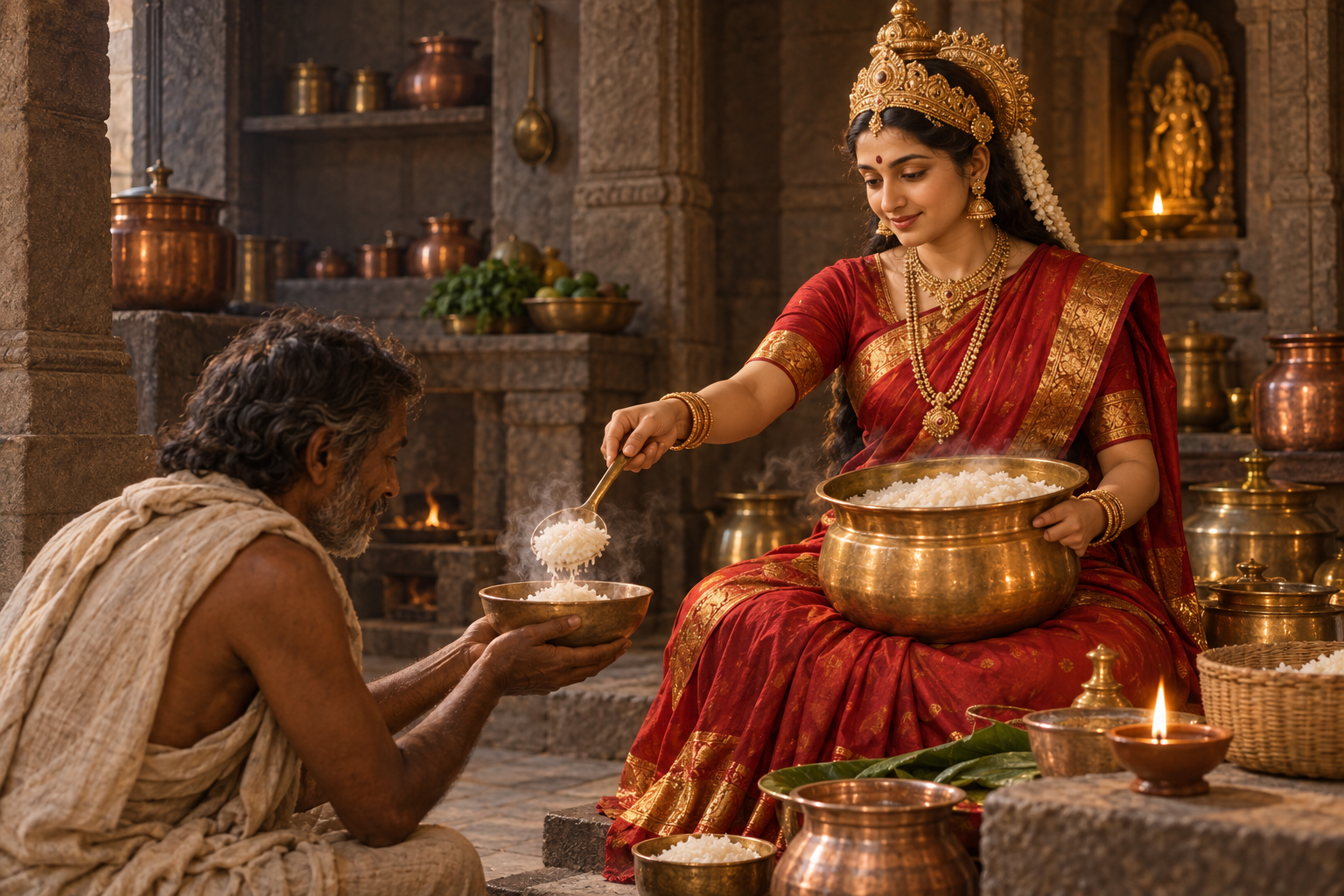
Most meals disappear into habit. We eat while distracted, complain before tasting, or take more than we will finish. Annapurna interrupts that automatic relationship with food. She asks you to see a meal as something received rather than something the world simply owes you.
The practical correction is not elaborate. It has three movements: notice, offer and share.
- Notice what is actually present. Before eating, look at the food rather than immediately reaching for it. Remember that ingredients had to grow, be gathered or prepared, transported, cooked and served. Gratitude becomes clearer when it has an object.
- Offer before consuming. If your household follows a formal naivedya practice, use the procedure handed down in your family or sampradaya. If it does not, a quiet pause is enough to change the inner posture. Receive the meal as grace rather than as an entitlement.
- Share while food can still nourish. Do not wait until excess has become unwanted or unusable. Plan portions before cooking, identify edible surplus promptly, and make giving part of the meal rather than an afterthought.
The distinction between offering and disposal matters. Giving someone food you regard as beneath you reproduces hierarchy; serving food you would receive yourself expresses reverence. The ladle in Annapurna’s hand is not merely a sign that food exists. It is a sign that nourishment crosses the distance between the full vessel and the empty hand.
This vision also prevents a serious spiritual mistake: romanticising scarcity. A modest meal can be received with gratitude, but involuntary hunger is not made noble by religious language. Annapurna does not ask you to call deprivation holy. She makes the act of feeding sacred. When someone is hungry, the first appropriate response is food, not a lesson about detachment.
You can apply this immediately at home. Serve a manageable amount first and take more if needed. Keep wholesome leftovers in view rather than letting them vanish at the back of storage. When you host, treat the person serving and the person eating with equal dignity. These small choices make Annapurna’s symbolism visible in conduct.
Shakambhari widens compassion beyond the dining table
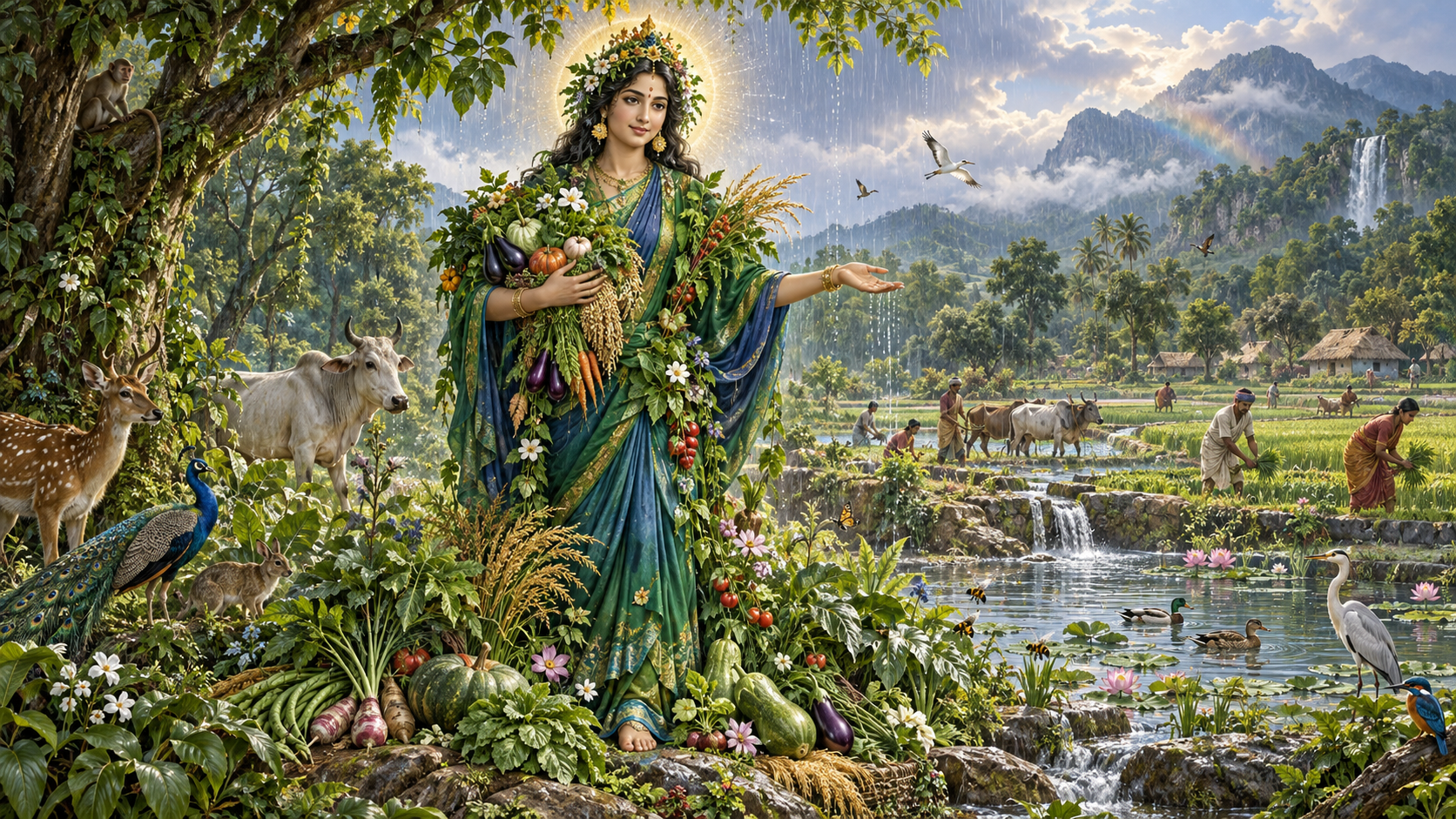
Shakambhari changes the scale of attention. Food does not begin in a shop or kitchen. It depends on a living world capable of producing and renewing nourishment. Her ecological dimension asks you to recognise that care for food and care for the conditions of food are the same responsibility viewed at different distances.
Her thousand eyes can be contemplated as disciplined awareness. Compassion is easy when need is directly in front of you; it is harder when harm is scattered across habits, supply chains and landscapes. The eyes of the Mother do not permit selective sight. They direct attention toward what convenience encourages us to ignore.
The tears associated with Shakambhari carry a second insight. Mercy must become materially useful. Feeling sorrow for hunger is not yet nourishment. Compassion must move outward until it becomes water protected, food preserved, waste reduced or a person fed. Emotion has Dharmic weight when it supports life.
Use four questions when you buy, prepare or serve food:
- What is being wasted? Look first at your own purchasing, portions and leftovers. A visible, repeatable correction is more useful than vague guilt about the whole world.
- What living conditions made this meal possible? Name the water, soil, plant life, cultivation and human effort involved. You protect more carefully what you have learned to notice.
- Who remains unseen? Consider the person who grew, moved, cooked or served the food, as well as the person nearby who cannot reliably obtain it. Gratitude that excludes people is incomplete.
- What can be repaired at your scale? Choose an action you can sustain: waste less in your kitchen, support dependable food sharing, care for water, or participate in a community effort that joins nourishment with dignity.
This is ecological dharma without abstraction. You are not required to solve every system before eating a conscientious meal. You are required to stop treating the causes of nourishment as invisible. Shakambhari’s vision begins when attention becomes honest and continues when that attention changes a habit.
A repeatable practice can unite the two forms
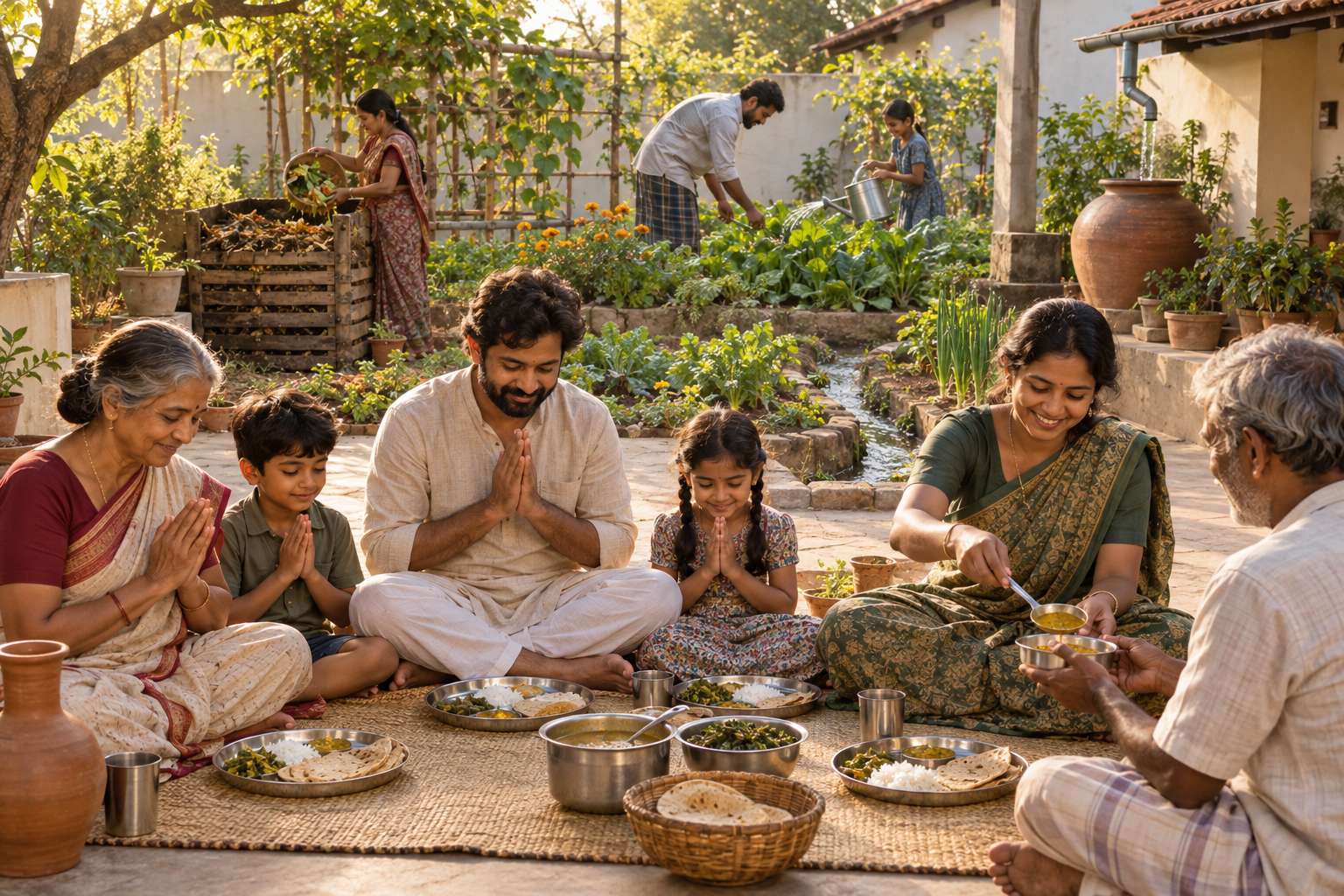
You do not need to invent a new ritual or replace the worship taught by your family, temple or guru. The following practice is a simple ethical contemplation that can accompany an ordinary meal. Its purpose is to align bhava, the inner disposition, with conduct.
- Prepare without display. Choose food appropriate to the people who will eat it. Devotion does not require extravagance, and extravagance that becomes waste defeats the purpose.
- Decide how the food will circulate. Before serving, know how much is needed, what can be shared and how remaining food will be used. Planning is more compassionate than trying to rescue neglected excess later.
- Remember both horizons. See Annapurna in the food ready to be served. Remember Shakambhari in the living world that made the meal possible.
- Offer according to your practice. Make a formal offering if that belongs to your tradition. Otherwise, pause in gratitude. Do not create a symbolic portion that will simply be discarded; reverence should protect food from needless waste.
- Eat attentively and without contempt. Do not demean simple food or shame another person’s needs. Sacredness is not measured by price, rarity or presentation.
- Complete an outward act. Share food, support a trustworthy feeding effort, reduce a recurring source of waste, or care for a resource on which nourishment depends. Choose something definite enough to be completed rather than admired as an intention.
The same test applies at different scales. In a household, ask whether everyone is served with dignity and whether usable food is routinely lost. In a temple, ask what happens to offerings after worship and whether distribution is clean, respectful and accessible. In a community, prefer dependable nourishment over an impressive event that disappears as soon as attention moves elsewhere.
Ritual and service need not compete. Ritual trains perception; service proves that perception has reached the hands. Annapurna without sharing can be reduced to an image of private abundance. Shakambhari without ecological responsibility can be reduced to a pleasing story about nature. Worship becomes whole when the vessel opens and the thousand eyes remain attentive.
Key takeaways
- Annapurna reveals prepared food as a gift to receive gratefully and distribute with dignity.
- Shakambhari extends nourishment to mercy, ecological balance and the life-supporting conditions behind every meal.
- The two forms are best contemplated as complementary lenses, not as interchangeable names or competing goddesses.
- Reverence for food must not romanticise hunger; an actual need for nourishment calls first for a material response.
- A useful practice joins inward offering with outward conduct: plan portions, prevent waste, share food and care for the living world that produces it.
At your next meal, choose a concrete act that lets nourishment continue through you. Pause before receiving, serve without hierarchy, and make sure gratitude changes what happens after the plate is cleared. That is where Annapurna’s ladle and Shakambhari’s compassionate gaze meet.
References
- Hindu Pad – Annapurna Mahatmyam
- Hindu Blog – Shakambhari Devi’s Thousand Eyes: Symbolism and Significance

Leave a Reply
You must be logged in to post a comment.