

You may be chanting, serving, and hearing Hari-katha, yet the mention of one devotee still tightens your mind. Perhaps you were dismissed, embarrassed, excluded, misrepresented, or harmed. You know resentment is affecting your bhakti, but telling yourself to be humble has not removed it.
You do not have to call wrong conduct right. You do have to stop the grievance from ruling your inner life. Ill feelings toward Vaishnavas can become a serious obstacle when they harden into contempt, fault-finding, or a continuing desire to punish. The remedy is an honest sequence: identify the wound, respond proportionately, seek repair where possible, and release the inner prosecution.
Name the wound without feeding the grievance
Resentment becomes difficult to work with when an event, your interpretation of it, and your judgment of the person have fused into one story. Separate them before you decide what to do.
- State the observable event. Write one sentence describing what happened without guessing the other person’s motive. A useful test is whether a neutral witness could have observed it.
- Name the effect. Did the conduct damage trust, disrupt service, expose private information, or simply wound your pride? Different effects require different responses.
- Identify your interpretation. Distinguish this person ignored my message from this person considers me worthless. The first may be a fact; the second is a conclusion that still needs testing.
- Decide what remains unfinished. You may need clarification, an apology, restitution, a boundary, mediation, or no further contact. Vague anger often persists because no concrete decision has been made.
Watch especially for words such as always, never, false devotee, or hopeless. They turn one action into a final judgment on the whole person. Correcting that language does not excuse the action. It prevents your mind from claiming knowledge it does not possess.
Do not force yourself into premature self-blame. You may genuinely have been wronged. Humility means being willing to see your own contribution; it does not mean automatically assigning yourself all the fault.
Separate forgiveness, reconciliation, trust, and access

These are not four names for the same decision. Confusing them can keep you trapped between bitterness and unsafe compliance.
- Forgiveness means relinquishing the wish to keep punishing someone in your thoughts. It concerns what you carry.
- Reconciliation is the restoration of a relationship. It requires participation from both sides.
- Trust is confidence grounded in conduct. It may return gradually, or it may not return.
- Access is the degree of influence or proximity you permit. You can limit it even after forgiving.
This distinction lets you adopt a clean position: you will not cultivate hatred, and you will not knowingly place yourself back in a harmful arrangement. Forgiving a Vaishnava does not require giving that person responsibility over your service, money, private information, family, or spiritual decisions.
If the problem is a misunderstanding, clarification may be enough. If it is recurring disrespect, reduce unnecessary contact and make expectations explicit. If it involves coercion, threats, abuse, financial wrongdoing, or danger, do not treat silence as a spiritual duty. Preserve relevant information and seek help from responsible community leadership and the appropriate professional or civil authorities. Concern about Vaishnava-aparadha must never be used to prevent someone from reporting serious misconduct.
A boundary should protect dharma without becoming revenge. Avoid humiliating the person, recruiting a faction, or spreading details to people who cannot help. Share what is necessary with those who can assess the matter, protect others, mediate, or make a responsible decision.
Turn the recurring reaction into a practice

Ill feeling is rarely removed by one grand resolution. It returns when you see the person, hear the name, or remember the incident. Prepare a response for that moment rather than arguing with the same memory again.
- Acknowledge one truth that resentment hides. If you can sincerely remember a good quality in the person, do so. If you cannot, begin with the smaller truth that no soul is reducible to the worst action you associate with them.
- Pray for truth before comfort. Ask that both of you see clearly, act rightly, and become free from malice. Do not disguise a demand for the other person’s punishment as prayer.
- Refuse recreational retelling. Before repeating the story, ask whether the listener can help resolve, assess, or contain the problem. If not, the retelling is likely feeding the identity of the injured party.
- Interrupt the imaginary courtroom. When the mind starts rehearsing accusations and perfect replies, tell yourself: This matter needs either action or release; rehearsal is neither. Then take the next legitimate action or return attention to your present duty.
- Serve without staging contact. Continue constructive seva for Bhagavan and the community, but do not manufacture closeness with the person merely to prove that you are forgiving.
The immediate aim is not warm affection. Manufactured affection usually collapses at the next provocation. Aim first for non-malice: the ability to remember the person without wishing degradation, to discuss necessary conduct without attacking spiritual identity, and to continue your own sadhana without making the conflict its centre.
You may also discover that resentment is protecting something else: shame, envy, disappointment in a leader, loss of belonging, or fear that justice will never come. Address that actual pain. Otherwise the mind will keep using anger as a guard long after anger has stopped helping.
Speak directly when a repair conversation is wise
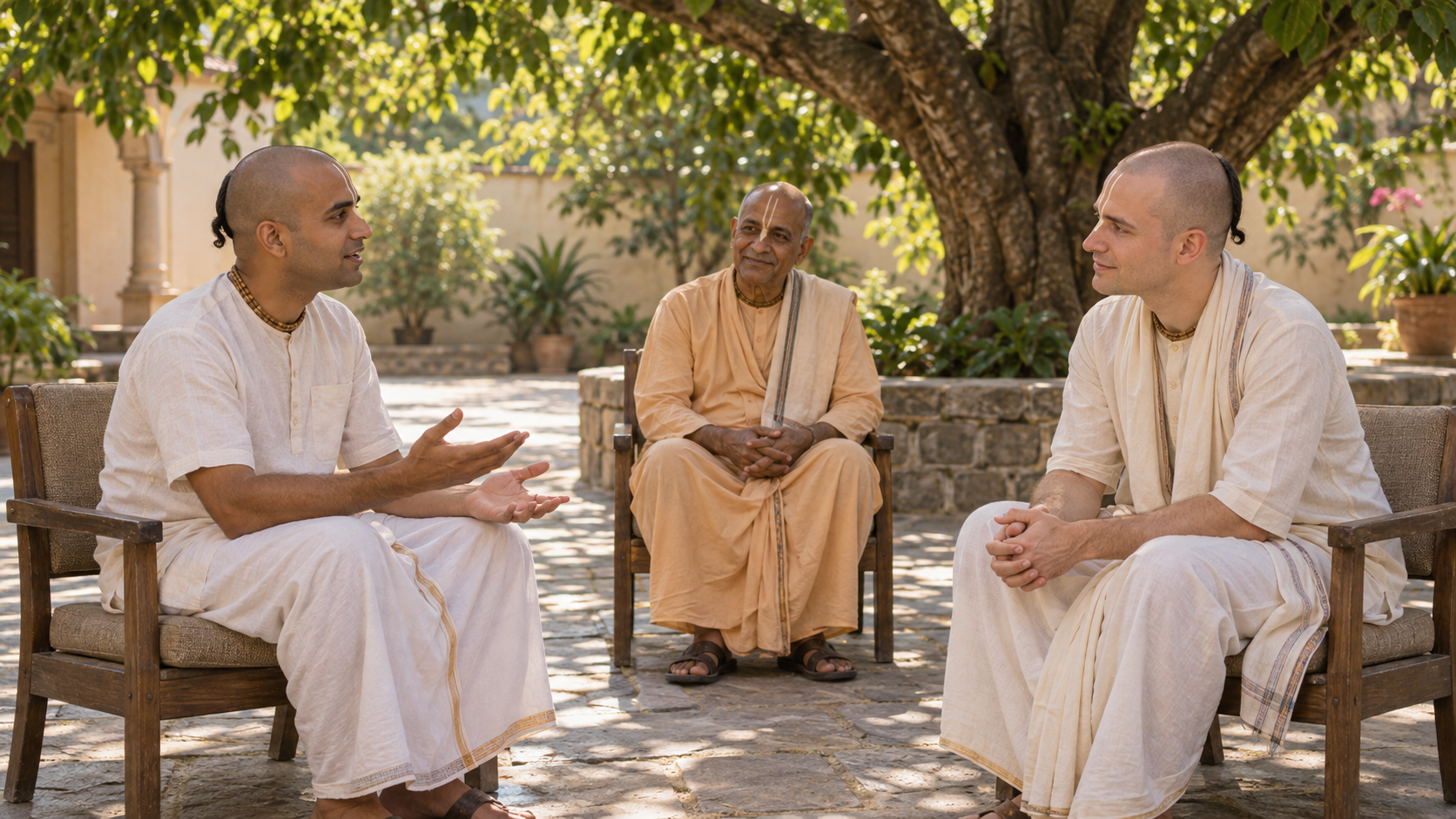
A conversation is useful when you can describe the conduct clearly, request a practical change, and listen without demanding a predetermined confession. If there is a strong power imbalance, a history of intimidation, or a risk of retaliation, use a trustworthy mediator instead of meeting alone.
A disciplined opening can follow this form: When this happened, I understood it in this way, and it affected me in this way. I may be missing some context. How did you see it? Going forward, I am asking for this specific change.
That form does several things at once. It states the issue without condemning the person’s character. It leaves room for missing information. It also makes the desired repair visible. Compare it with opening through a spiritual accusation such as A real Vaishnava would never do this. That accusation invites a debate about identity and qualification when the actual issue is conduct.
- Discuss the event that needs resolution rather than presenting an inventory of every irritation you have stored.
- Describe impact without exaggerating motive.
- Ask for a concrete change instead of demanding that the other person feel exactly what you feel.
- If you contributed to the conflict, admit the precise conduct without adding an excuse.
- If new facts correct your interpretation, revise it openly. Protecting an accusation after it has been disproved is not firmness.
- If the person will not engage honestly, end the exchange without insult and move to an appropriate boundary.
A clean apology is equally concrete: name what you did, acknowledge that it was wrong, recognise its effect, and state what you will change. Avoid the phrase if you were hurt; it turns your apology into an assessment of the other person’s sensitivity.
Repair may still fail. You control whether you speak truthfully, listen fairly, correct your part, and refrain from retaliation. You do not control whether the other person admits fault. Releasing that outcome is part of releasing resentment.
Key takeaways
- Describe the conduct before judging the person’s motive or spiritual standing.
- Forgiveness can coexist with accountability, limited contact, and the refusal to restore trust prematurely.
- Seek counsel to resolve or contain a problem, not to assemble an audience against another devotee.
- Use direct, behaviour-specific language when repair is possible; use a mediator when direct contact is unsafe or distorted by power.
- Aim first for non-malice, not instant affection or a performance of reconciliation.
- When the mind rehearses the grievance, choose a legitimate action or consciously return to your present seva.
Choose the one Vaishnava whose name most disturbs your mind. Before your next encounter, write the observable event, the unresolved need, and the boundary or conversation that dharma actually requires. Then stop adding private punishment to the necessary response. That is a modest beginning, but it turns resentment from an identity into a matter you can address.
References

Leave a Reply
You must be logged in to post a comment.