
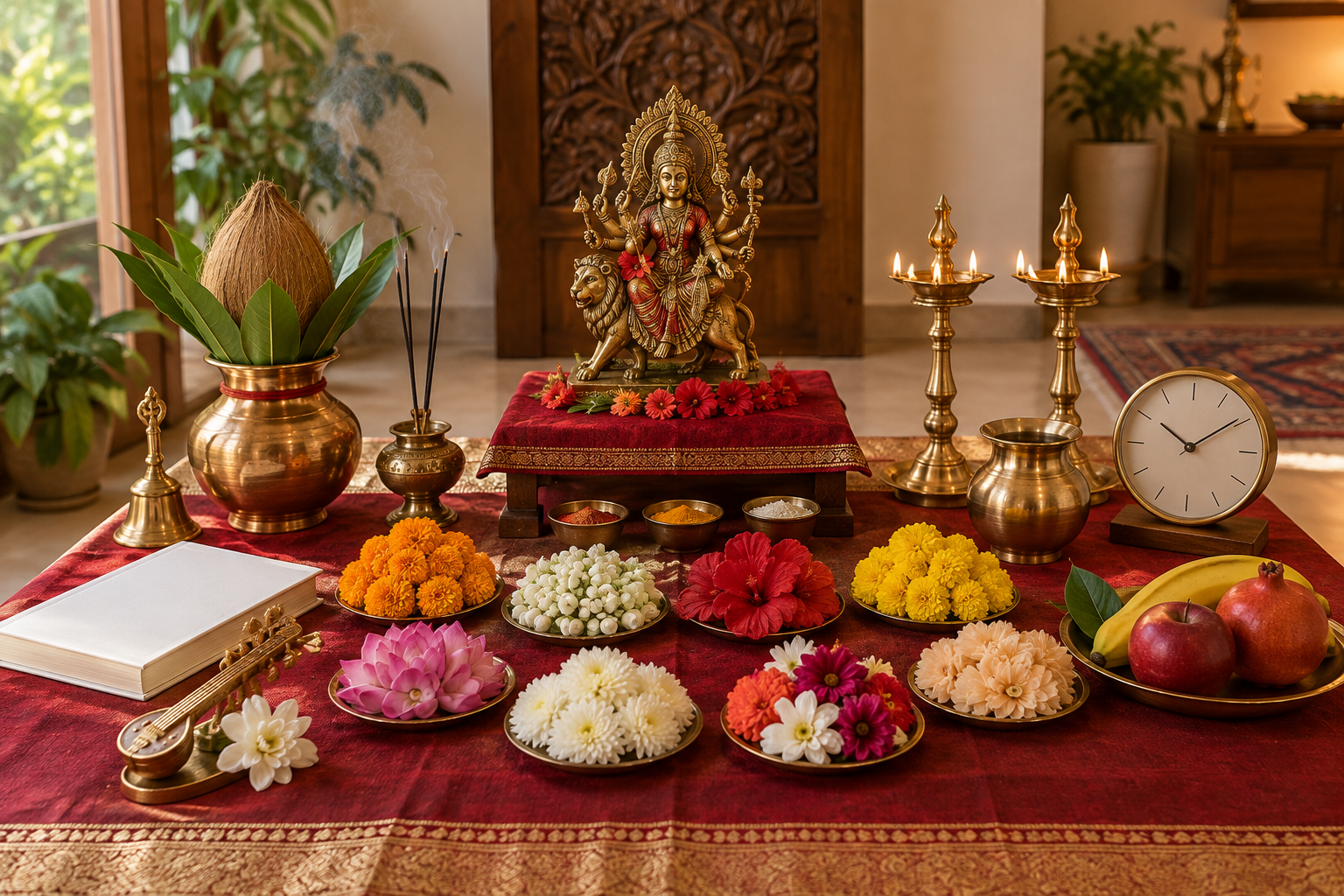
You have nine forms of Devi on one calendar, Saraswati worship on another, and a precisely timed Sandhi Puja at the meeting of Ashtami and Navami. If you try to force these into a single sequence, Navratri can feel more confusing than devotional.
The observances are easier to coordinate once you see them as overlapping layers. Keep one steady daily puja, add Saraswati Avahan at its proper Nakshatra, and reserve the Sandhi window before the festival begins. You do not need to collapse distinct traditions or reproduce an elaborate temple ceremony at home.
Navadurga, Saraswati and Sandhi form three ritual layers
The Navadurga method gives each day a particular form of the Goddess. Shailaputri is worshipped on the first day, establishing the daily rhythm. Brahmacharini follows on the second day. You then continue through the remaining forms according to the sequence preserved by your family, temple or sampradaya.
A second arrangement honours the Goddess through Parvati, Lakshmi and Saraswati. Within that pattern, the final three days are especially dedicated to Saraswati. This does not cancel the Navadurga form assigned to any of those days. It gives that day’s worship an additional emphasis on knowledge, disciplined study, music, speech and the arts.
Sandhi Puja is different again. It is not another whole day or another deity to fit into the daily list. It marks the junction at which Ashtami ends and Mahanavami begins. Its importance comes from that threshold, so correct timing matters more than extending the ceremony.
| Ritual layer | When it applies | What you should plan |
|---|---|---|
| Navadurga | Across the nine days | Worship the form assigned to each day, beginning with Shailaputri and Brahmacharini on the first two days. |
| Saraswati emphasis | During the final three days | Add prayers and offerings directed toward learning, wisdom, music or your own field of disciplined practice. |
| Saraswati Avahan | Primarily during Moola Nakshatra | Record the locally applicable Nakshatra interval before the day arrives. |
| Sandhi Puja | The 48-minute junction of Ashtami and Mahanavami | Prepare everything in advance and begin according to the local tithi boundary. |
This layered view resolves the apparent conflict. Your daily Navadurga worship remains the foundation. Saraswati Avahan is an added observance within the later part of Navratri. Sandhi Puja is a concentrated rite at one exact transition.
Build one repeatable home puja before adding special rites
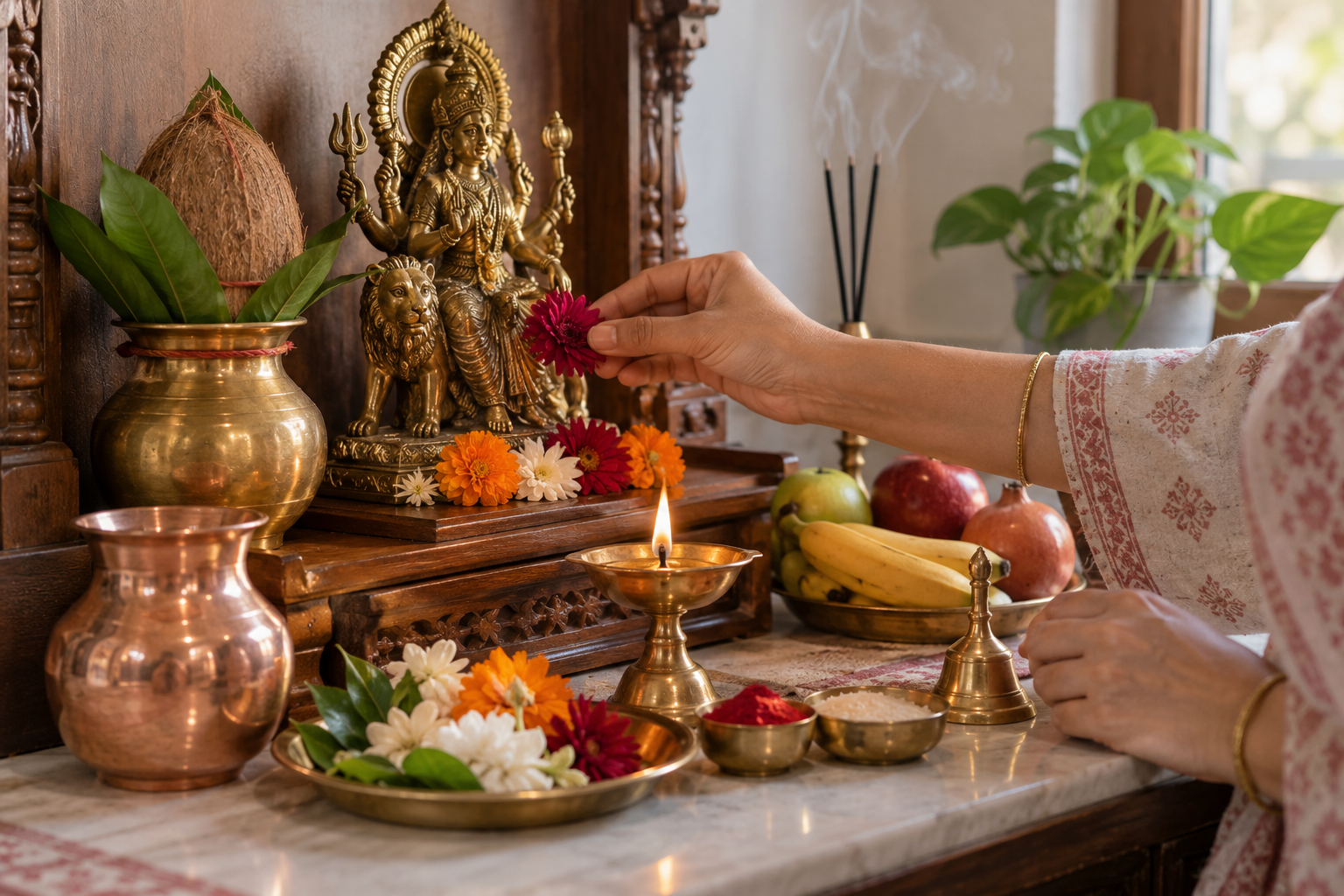
A home observance becomes sustainable when its basic form stays consistent. Changing every object, prayer and sequence each day can make the external arrangement overshadow the devotion. Establish a simple daily order first; alter only the name, image or particular emphasis associated with that day’s form of Devi.
Traditional lists for the first two Navadurga pujas include familiar materials such as turmeric, kumkum, camphor, rice, a kalash and water. Treat such a list as preparation for reverent worship, not as a test in which one missing item invalidates sincere puja. Your family tradition may use more, fewer or different offerings.
A workable daily sequence
- Confirm the day’s observance. Write down the relevant tithi, the Navadurga form followed in your tradition and any special rite that overlaps it. Do this before arranging the altar.
- Prepare a clean worship space. Place the image or murti steadily, fill the water vessel or kalash if you use one, and arrange every offering within reach.
- Set your sankalpa. State whom you are worshipping and the purpose of the observance. Keep it truthful and specific: devotion to Devi, purification of conduct, steadiness in sadhana or gratitude are sufficient.
- Invoke Devi. Use the dhyana, mantra or prayer received through your family, temple or teacher. If you have not learned a specialised procedure, do not imitate one from fragments; offer a familiar Devi prayer with attention.
- Make the offerings in an orderly way. Water, rice, turmeric, kumkum, flowers, incense where used, and naivedya can follow the customary order of your household.
- Recite and sit quietly. A stotra, a set of names, japa or a period of silent remembrance can form the centre of the puja. Consistency matters more than collecting several texts that you cannot follow attentively.
- Perform aarti and conclude. Offer the flame safely, bow, distribute prasad and leave the worship area orderly for the next day.
On the second day, for example, keep this same structure while directing it toward Brahmacharini. The distinctive quality of a daily form should deepen your attention; it need not require rebuilding the entire ritual. If your inherited vidhi specifies mantras, nyasa, abhishekam or other formal acts, that vidhi takes precedence over a general home outline.
Prepare lamps and camphor so that sleeves, curtains, children and pets cannot reach the flame. Extinguish every flame before leaving the room. This practical care is part of maintaining a composed worship space.
Let Saraswati Avahan change how you approach knowledge
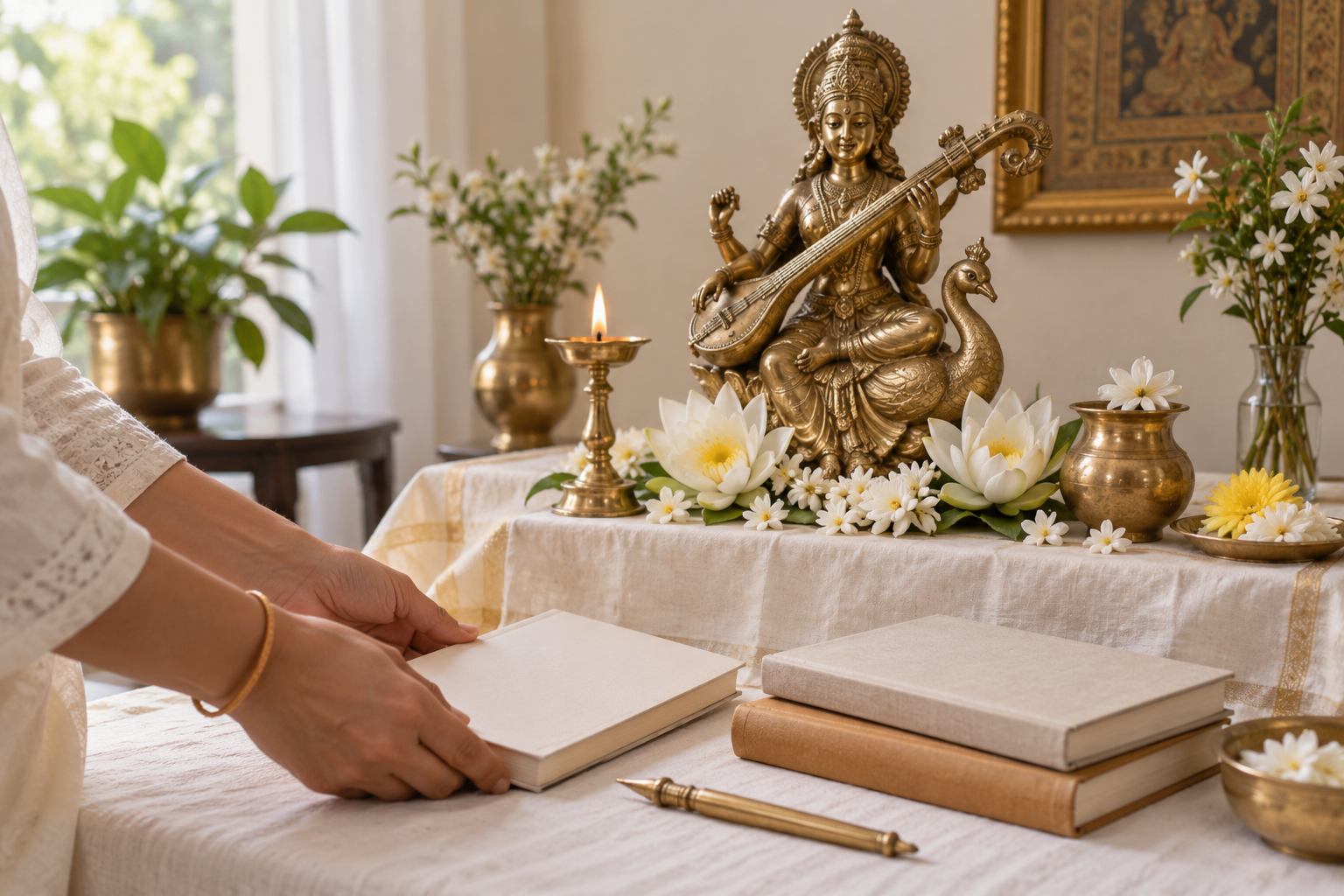
Saraswati Avahan is the ceremonial invitation or installation of Saraswati during Navratri. Its placement within the closing portion of the festival turns the worshipper’s attention toward knowledge and the disciplines through which knowledge is cultivated.
The principal timing cue is not merely the numbered day. Saraswati Avahan is mainly performed during Moola Nakshatra. Because Nakshatra intervals are location-sensitive and do not necessarily match a full civil day, use a panchang calculated for your city. Record the applicable interval rather than relying on a date graphic circulated for another place.
In 2026, Saraswati Avahan is dated Friday, 16 October. Use that date as your planning point, then confirm the Moola Nakshatra timing in the panchang followed by your household or temple. If two calendars differ, do not combine the beginning from one with the ending from another. Select one recognised local calendar and follow it consistently.
A simple home observance
- Choose one clean object that represents the knowledge you actually cultivate: a scripture, study book, notebook, pen or musical instrument.
- Place it respectfully near the altar before the puja. The purpose is concentrated remembrance, not a display of every book or device you own.
- Perform the established daily Devi puja, then invoke Saraswati using the prayer followed in your tradition.
- Offer flowers, kumkum where customary, naivedya and aarti. Keep delicate books and instruments clear of oil, water and flame.
- End with a concrete vrata of attention: resume a neglected text, practise your instrument regularly, improve the care of your speech or teach something worthwhile without vanity.
The last step prevents Saraswati worship from becoming only decorative. A book on the altar points beyond itself. The offering becomes meaningful when you return to learning with humility, protect truth in your speech and use knowledge without arrogance.
Reserve the Sandhi window before Ashtami begins
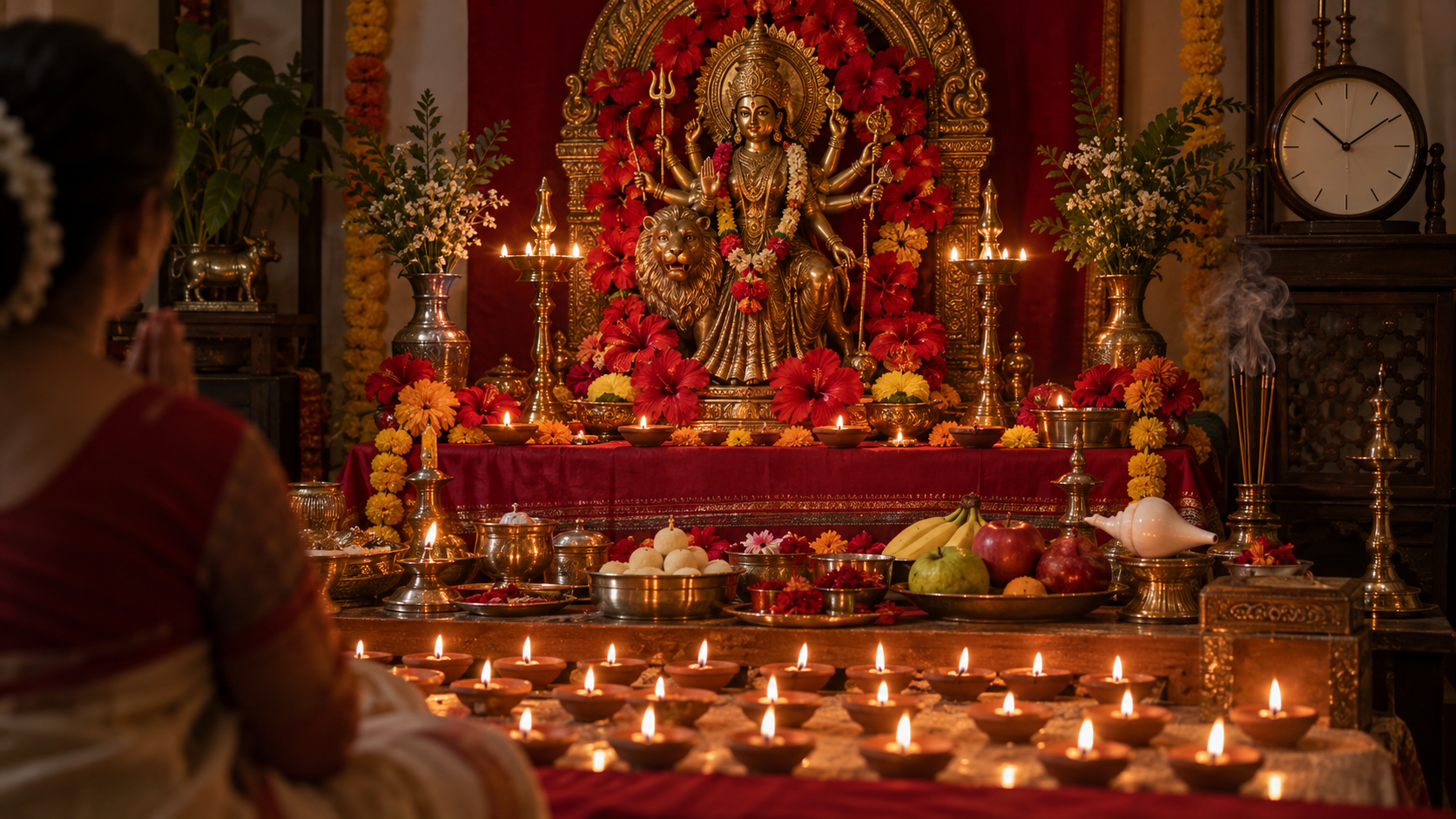
Sandhi Kala is the 48-minute interval during the ending of Durga Ashtami and the beginning of Mahanavami tithi. It is therefore a junction, not simply an evening observance that can be moved to a convenient hour. A civil date tells you which day to watch; the tithi boundary tells you when to worship.
This is the one part of the plan most likely to fail through late preparation. If you begin looking for wicks, flowers or the relevant prayer after the interval starts, much of the Sandhi period can pass before worship settles. Put the exact start and end times beside your altar and prepare the space beforehand.
- Find the local Ashtami-Navami junction. Use the same panchang tradition and location you used for the rest of Navratri.
- Write down both boundaries. A reminder that says only “Sandhi Puja tonight” is not precise enough; keep the beginning and ending times visible.
- Complete ordinary preparation early. Bathe, clean the altar, arrange offerings, prepare the lamp and open the prayer text before the window begins.
- Enter the interval without administrative distractions. Silence the phone, tell other household members the timing and avoid interrupting the rite to search for materials.
- Follow your inherited Sandhi vidhi where one exists. Temple and regional forms can be more elaborate than a domestic observance. Do not add specialised acts merely because you have seen them performed publicly.
- For a simple home observance, keep the focus on Devi. Offer light, flowers, prayer, japa or stotra and aarti as taught in your household, remaining attentive through the junction.
- Conclude cleanly. Bow, distribute prasad when appropriate and secure every flame rather than letting the intensity of the moment produce hurried handling.
If your household cannot perform an elaborate Sandhi Puja, mark the threshold sincerely within your competence. Simplicity is not the same as carelessness. Correct timing, prepared materials, a stable flame and undistracted prayer give a modest home rite a clear form.
Make a one-page plan you can follow during Navratri
Before the first day, make a small schedule with five columns: civil date, tithi or Nakshatra, daily Navadurga form, puja time, and additional observance. The additional-observance column is where Saraswati Avahan and Sandhi Puja belong. This prevents an important distinction from disappearing inside a generic list of nine dates.
- Choose one locally applicable panchang and use it throughout the festival.
- Mark Shailaputri on the first day and Brahmacharini on the second, then fill in the remaining daily forms according to your lineage or household calendar.
- Mark the final three days for Saraswati-focused worship without removing the corresponding Navadurga observances.
- Record the Moola Nakshatra interval used for Saraswati Avahan.
- Record both the beginning and ending of the 48-minute Sandhi period.
- List any special materials beside the relevant entry, not on a separate sheet that may be forgotten.
- Set out ordinary puja supplies together so the daily observance remains repeatable.
Key takeaways
- Navadurga worship is the daily sequence; Saraswati worship is an added emphasis during the final three days; Sandhi Puja belongs to one exact tithi junction.
- Shailaputri and Brahmacharini establish the first two days of the Navadurga order.
- Time Saraswati Avahan by the locally applicable Moola Nakshatra interval, not by the civil date alone.
- In 2026, plan around Friday, 16 October for Saraswati Avahan, subject to the panchang used in your location.
- Sandhi Puja occupies the 48-minute transition from the end of Ashtami into the beginning of Mahanavami.
- A consistent daily puja with prepared materials is better than an elaborate plan you cannot perform attentively.
Make the calendar now, place the special timings where you will see them, and rehearse your basic puja order before Navratri begins. When the later observances arrive, you will be able to meet them as distinct moments of worship rather than as last-minute additions.
References
- Hindu Pad – Saraswati Avahan 2026 | Navratri Saraswati Avahanam
- Hindu Pad – Sandhi Puja 2026 Timing | Auspicious Muhurat in Durga Puja 2026
- Hindu Pad – Brahmacharini Puja Vidhi | Maa Brahmacharini Pooja Procedure
- Hindu Pad – Shailaputri Puja Vidhi | Shailputri Maa Pooja Procedure

Leave a Reply
You must be logged in to post a comment.