
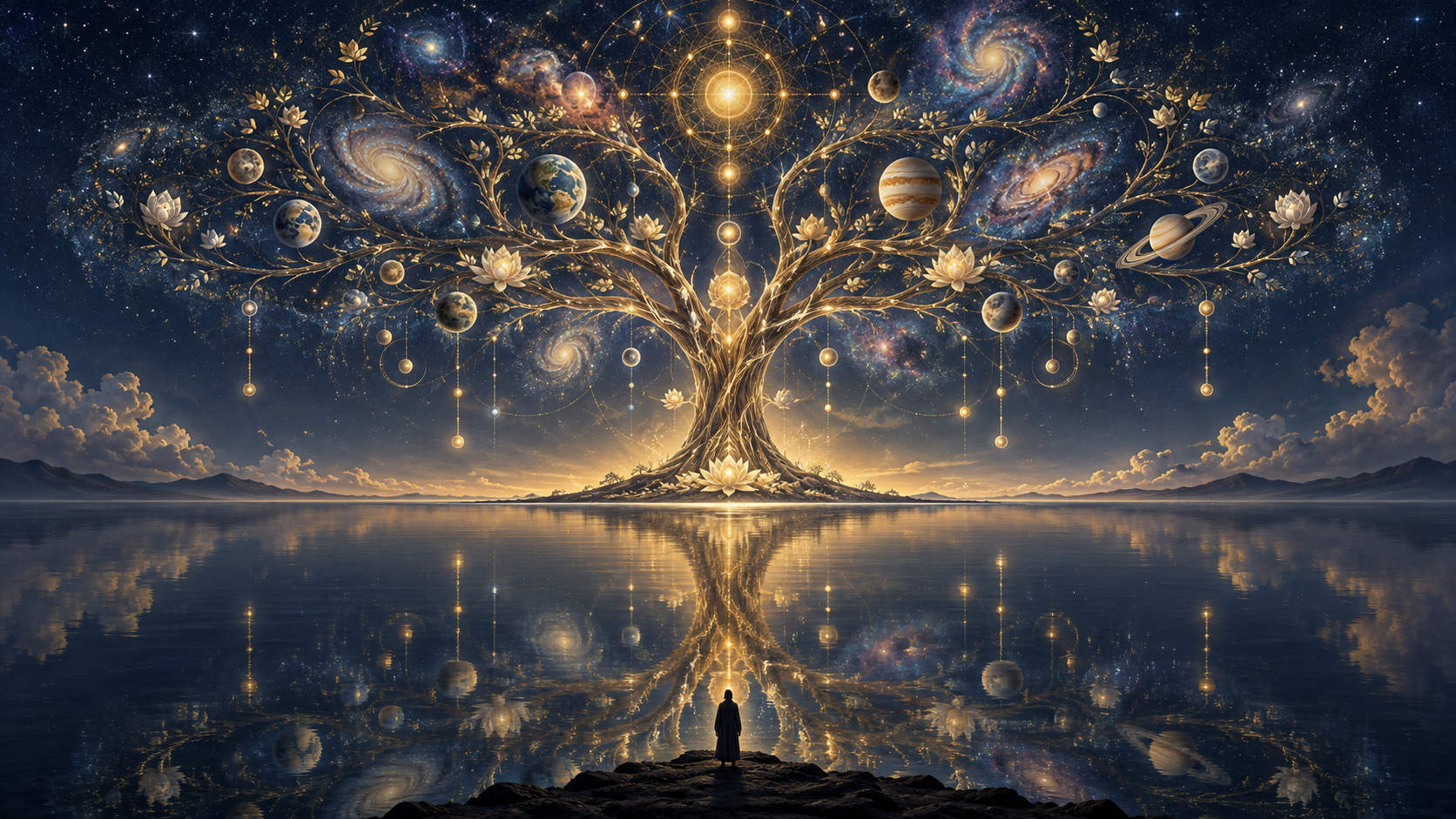
You may be wondering whether Srimad-Bhagavatam 3.9.16 gives you a serious argument for intelligent design or only a devotional image. The honest answer is that it offers something precise but different from a laboratory proof: a Vaishnava account of what kind of cause the universe ultimately requires.
Read it that way and the verse becomes harder to dismiss – and harder to misuse. You can defend its claim without pretending that a cosmic tree is a modern astronomical diagram or that one Sanskrit verse settles every scientific dispute.
Key takeaways
- SB 3.9.16 presents the universe as an ordered, dependent system whose ultimate root is Bhagavan.
- Brahma, Vishnu and Shiva represent differentiated functions of creation, maintenance and dissolution; they are not three unrelated ultimate causes.
- Material mechanisms can be real and accurately described without being the complete explanation of the system in which they operate.
- The verse supports a metaphysical case for intelligent causation. It does not, by itself, provide a scientific calculation disproving a particular biological or astronomical theory.
- A disciplined discussion separates three questions: how a process operates, what ultimately grounds cosmic order, and how scripture identifies that ground.
SB 3.9.16 maps causes, not astronomical measurements
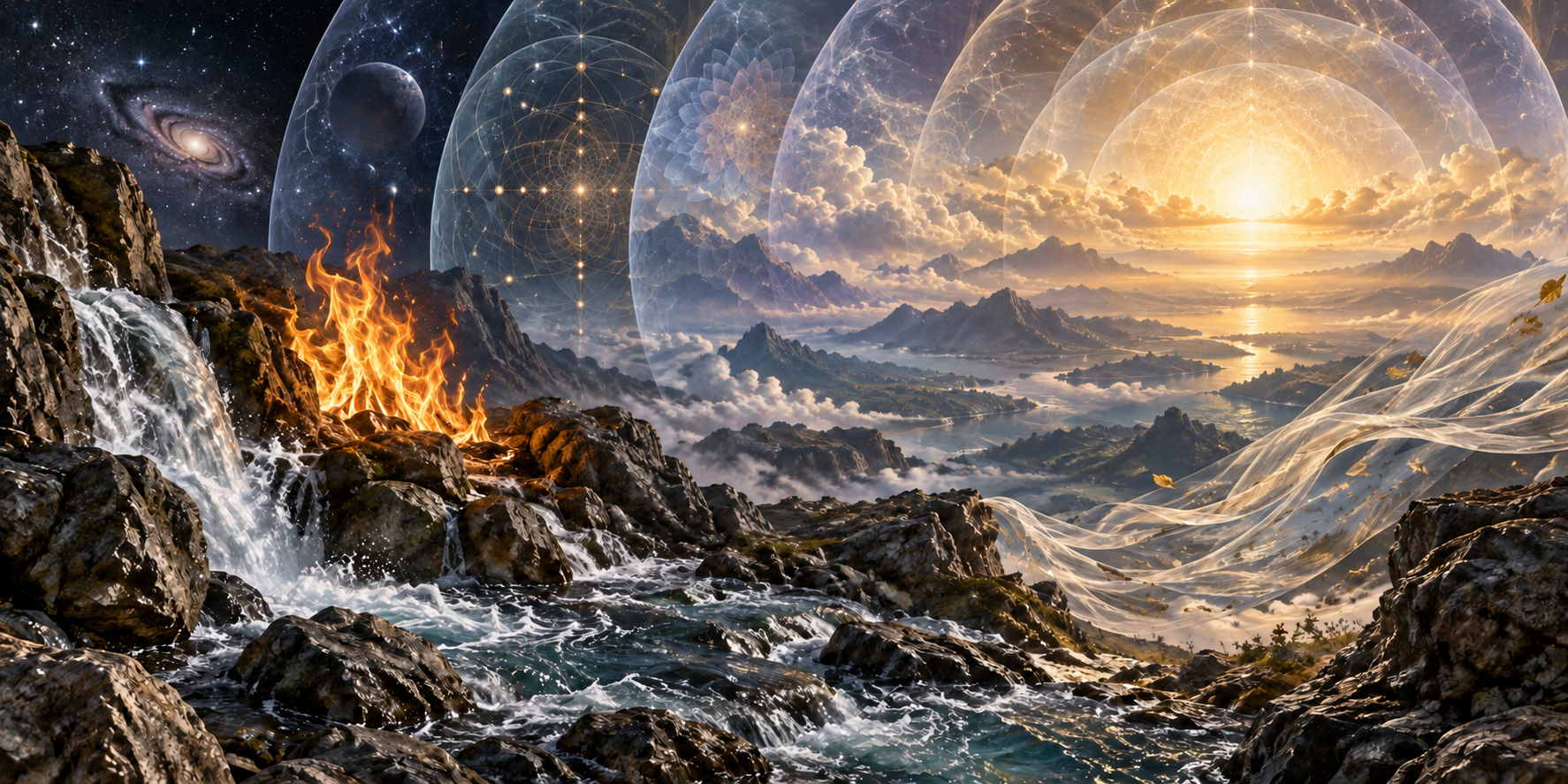
Brahma speaks as a participant in creation who is trying to understand the source of his own power. He describes Bhagavan as the prime root of a tree of planetary systems. From that root emerge three principal trunks and then many branches.
The root is described as self-rooted. That is the decisive feature. An ordinary branch depends on a trunk, and the trunk depends on a root, but the ultimate root cannot be another item inside the same chain. Otherwise the explanation has merely moved backward by one step. In this Vaishnava cosmology, Bhagavan is not one more object in the universe. Bhagavan is the cause on which the universe and its subordinate causes depend.
The three trunks distinguish three cosmic functions: Brahma creates, Vishnu maintains, and Shiva dissolves. The many branches represent the further differentiation of cosmic administration and manifested existence. The associated purport extends the image across the upper, middle and lower worlds and the fourteen planetary systems. Its main concern, however, is causal order: material nature is the Lord’s agency rather than an independent ultimate cause.
This gives you a practical rule for reading the verse. If your question concerns the measured mass of a planet, an orbital period or the chemical stages of a reaction, SB 3.9.16 supplies no calculation. If your question is whether the network of measurable causes is self-explanatory, the verse answers directly: no. The branches operate, but their operation depends on the root.
That distinction also tells you what intelligent design can responsibly mean here. The verse supports the thesis that intelligible cosmic order is grounded in intelligence and personhood. It does not automatically endorse every empirical claim made under the modern label of intelligent design.
Use the tree and reflection analogies without forcing them

The tree image becomes richer when read beside the inverted tree of the Bhagavad-gita. Its root is above, while its branches and sensory objects extend into conditioned existence. Downward-growing roots represent the fruitive actions that bind living beings more deeply to the material system. Cosmic manifestation therefore has both an ultimate cause and participating secondary causes: Bhagavan is its source, while the desires and karma of embodied beings help determine their places within it.
A reflection in water supplies the second image. You need an original tree, a reflecting medium and an observer who sees the reflection. In the interpretation developed around SB 3.9.16, these elements correspond to the following:
- The original tree represents Bhagavan and spiritual reality, which supply the pattern and causal ground.
- The reflected tree represents temporary material manifestation.
- The reflecting medium represents material energy and, in another application, desire through which the reflection becomes relevant to the conditioned being.
- The observer represents the living being whose senses are connected to material forms.
- The disturbance and calming of the water illustrate manifestation and dissolution: the reflection can disappear while its original remains.
The analogy is about dependence, not optics. It does not say that planets are literally made of reflected light or that the universe occupies a pond. Nor does reflection mean absolute nonexistence. A reflection is experienced and can affect the observer’s choices, but it lacks independent substance and permanence. Material existence is real as dependent experience, temporary as manifestation, and distorted when mistaken for the complete reality.
Some applications of the tree image move from causal symbolism to physical cosmography, placing the rootward direction near the pole star and relating it to Dhruvaloka and Brahmaloka. That is a further scriptural claim, not something proved merely because the tree metaphor works at the causal level. Keep the two arguments separate. A convincing account of dependence does not automatically verify every proposed spatial correspondence.
Before you use the analogy, finish this sentence plainly: the root represents this, and the branches represent that. If you cannot identify the intended correspondence, the image is doing rhetorical work rather than explanatory work.
The strongest design argument concerns explanatory depth

A hammer striking a nail offers a useful model. You can describe the impact in terms of mass, motion and force. That description may be entirely correct. Yet it does not tell you why the hammer was swung, who built the tool, or what purpose the work serves. The mechanical explanation is not false; it is limited to one level of causation.
The same separation helps with cosmology. Three levels of explanation should not be collapsed:
- Mechanism asks how parts interact and what regular patterns those interactions follow.
- Systemic causation asks why those parts, powers and regularities form a coherent order rather than an unintelligible collection.
- Agency and purpose ask whether the system ultimately depends on consciousness, intention and ends.
SB 3.9.16 addresses the second and third levels. A.C. Bhaktivedanta Swami Prabhupada’s Gaudiya Vaishnava reading treats material nature as a genuine operative energy while denying that it is metaphysically independent. The universe can therefore display stable mechanisms without those mechanisms becoming their own ultimate cause.
This is stronger than a God-of-the-gaps argument. If divine causation is invoked only wherever science has not yet found a mechanism, every new discovery seems to reduce God’s role. The Bhagavatam’s root-and-branches model says something else: even a fully described branch still depends on the root. Better knowledge of the branch does not make the root less necessary within the theology.
The model also rejects deism, the idea that a creator starts the cosmic machine and then withdraws. Divine governance is presented as continuous: the Lord is present at the most subtle level, devas exercise delegated functions, and the material order responds to the karma and devotional actions of living beings. Regularity is not evidence of divine absence in this view. Regularity is one form taken by governance.
That does not require you to hunt for violations of physical law. The claim is not that God’s presence is visible only when an equation fails. It is that equations, entities and causal powers operate within an order they do not ultimately ground by themselves.
Three overclaims that weaken the Dharmic case
Chance is not the same as lawlessness
A Dharmic argument loses precision when it says that science teaches pure chaos. Scientific descriptions search for regularity, including in processes that contain probabilistic elements. Chance may describe an unpredictable event, a probability distribution or variation within a law-governed process. It does not necessarily mean that nothing has structure or that anything can happen without constraint.
Do not argue that evolution is simply disorder. Variation and selection are proposed mechanisms operating within a structured natural system. The more exact Bhagavatam-based question is whether descriptions of such mechanisms amount to an ultimate explanation of the system, its causal powers and the existence of living agency. That is a philosophical challenge worth discussing. Calling every stochastic process chaos only gives a scientifically informed reader an easy reason to stop listening.
Complexity raises a question; it does not calculate its own answer
Living organisms contain functional, coordinated structures, and their origin naturally raises questions about causal adequacy. But complexity alone is not a completed proof. SB 3.9.16 supplies no probability threshold, comparison class or experimental procedure for showing that a particular organism could not arise through proposed natural mechanisms.
It is also important to distinguish the origin of the first replicating life from the diversification of life after replication exists. Treating those as one problem obscures rather than strengthens the argument. You can reasonably ask whether material interactions are a complete explanation of organized life without claiming that the verse has mathematically disproved every evolutionary mechanism.
Observed order does not identify Krishna without an additional premise
Suppose someone agrees that cosmic order points beyond blind, self-sufficient matter. That agreement does not yet establish the full Vaishnava conclusion. Moving from order to intelligence is one inference. Identifying the intelligent ground as Bhagavan, describing Brahma, Vishnu and Shiva as differentiated cosmic agents, and affirming a devotional relationship with the Supreme are theological conclusions received through scripture and spiritual realization.
The Bhagavatam itself dramatizes this limit. Brahma tries to trace the lotus stem toward its source but cannot reach the ultimate cause by material searching. Vishnu must disclose that source. The narrative does not despise investigation; it marks the point at which investigation of effects is insufficient to reveal the transcendent person behind them.
Own that transition when you make the argument. Say where observation ends, where philosophical inference begins, and where scriptural testimony supplies a specific identity. This honesty does not weaken Dharma. It prevents an opponent from rejecting the entire case because one stage was presented as though it proved all the others.
How to discuss Bhagavatam cosmology without a category error

If you want to use SB 3.9.16 in a class, satsanga or conversation with a skeptic, proceed in five moves:
- State the verse’s claim modestly. Bhagavan is the self-sufficient root; material nature and cosmic agents are dependent causes.
- Ask what kind of question is being debated. Is it a measurable mechanism, the metaphysical ground of natural order, or the scriptural identity of the ultimate cause?
- Grant what a successful mechanical explanation actually establishes. Describing an interaction accurately does not injure the Bhagavatam’s root-and-branches model.
- Test claims of completeness. Ask whether a chain of material interactions explains only how the system changes or also why there is a law-governed, intelligible system with causal powers at all.
- Mark the theological step openly. The identification of the root with Bhagavan and the hierarchy of cosmic governance come from a specific Vaishnava reading of revelation.
A clean formulation is this: physical science can describe regularities within nature, while SB 3.9.16 asks whether nature and its regularities are self-grounding. It answers that they are not. Their root is personal, intelligent and continuously active, even when the branches appear to operate automatically.
This conclusion belongs to a Gaudiya Vaishnava theological framework. Other Dharmic traditions need not accept the same hierarchy or the same account of ultimate personhood. You can present the view confidently without disguising a sampradaya-specific interpretation as a conclusion every Hindu, Buddhist or Jain school must share.
Next time the topic arises, do not begin by attacking science. Begin with the cosmic tree and ask a sharper question: is a complete description of interactions the same thing as a complete account of why an ordered system exists? That is where SB 3.9.16 makes its most durable contribution.
References
- Dandavats – SB 3.9.16 – Chaos or Cosmos; Thoughts on Intelligent Design (Alachua 9/1/95)
- Richard L. Thompson Archives – Chaos vs Cosmos (SB 3.9.16)

Leave a Reply
You must be logged in to post a comment.