
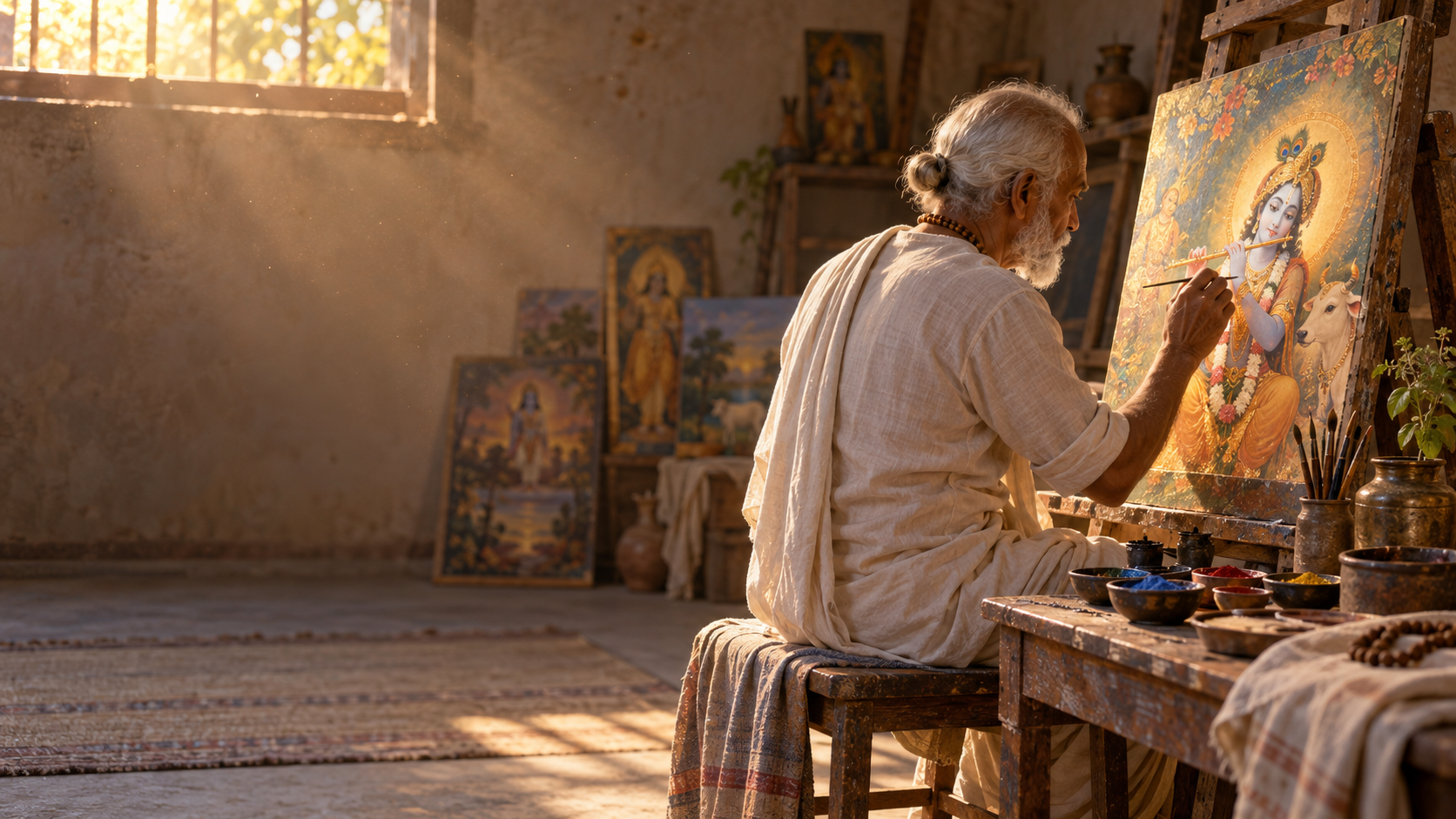
When a devotional artist leaves this world, the easiest tribute is to praise the pictures. The harder and more useful task is to understand the discipline behind them. If you came looking for why Ananta Shakti Prabhu mattered, his life offers a clear answer: he trained the eye, submitted talent to sadhana, and treated beauty as service.
Ananta Shakti Prabhu left his body on a Dwadasi evening in England, surrounded by devotees. He had served through art for more than four decades and was remembered for kindness, sensitivity, humility, dedication to the mission, and love for devotees. His legacy therefore includes more than the images he made. It offers a way to think about talent itself: not as private possession or self-display, but as something that can be refined and offered.
His search for the perfect form began before formal bhakti
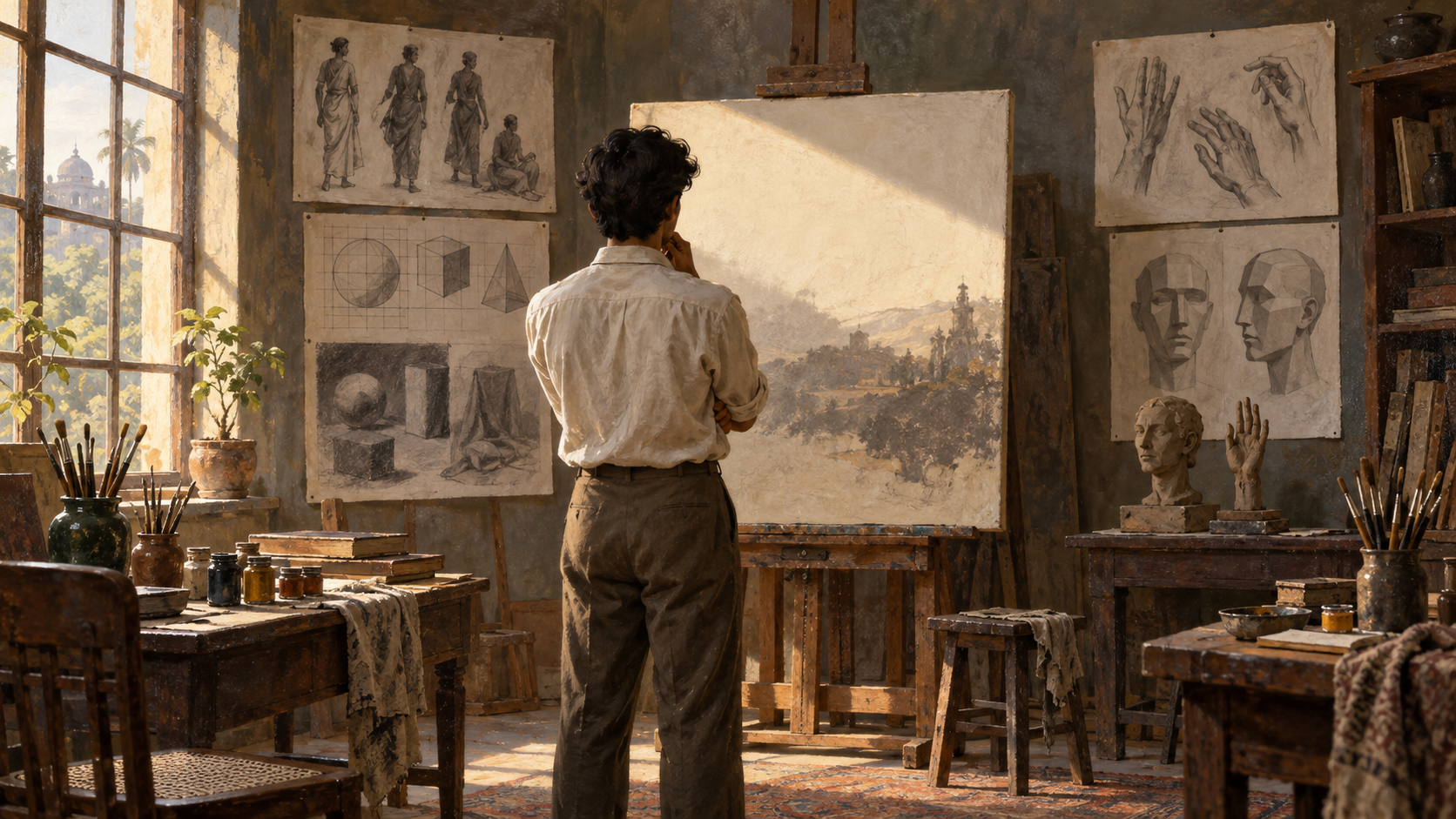
During his school years in the 1960s, Ananta Shakti became dissatisfied with an education system he felt prepared people to become products of an exploitative society. At fourteen, he decided to become an artist and naturalist. He spent time in the local library and in natural settings along riverbanks, shorelines, and wooded areas. Art books introduced him to the work of Picasso, Leonardo da Vinci, Gauguin, Raphael, and the Pre-Raphaelites; the changing seasons and diversity of living creatures supplied another kind of visual education.
That early training matters. His later devotional commitment did not replace technique with religious enthusiasm. It gave technique a purpose. Color, tone, composition, observation, and imaginative expression were already part of his vocabulary. Bhakti would eventually determine what he wanted that vocabulary to say.
He briefly returned to formal study through art college. Fine art instruction did not satisfy him, while graphic design appeared practical but too closely tied to selling products and advancing consumerism. He wanted art to address the questions beneath a career: Who am I? Where am I going? What is life for? His friend Ron Holbeche, a Christian mystic and painter, gave that search a direct spiritual orientation by insisting that human life was meant for service to God.
Before encountering the form at the center of his mature devotion, Ananta Shakti tried to imagine a perfect person. He thought such a being would unite forceful reason with gentle intuition, and he represented that reconciliation through a symbolic half-male, half-female form comparable to Siva-Sakti imagery. This was not yet the Krishna-centered vision that later defined his service. It does, however, reveal his characteristic method: when an idea mattered, he tried to make it visible.
If you are an artist, the useful distinction is between craft and purpose. Learn the craft rigorously. Study how line, color, gesture, scale, and composition affect the viewer. But do not expect technique to answer the question of what your work should serve. Ananta Shakti’s path changed when that second question received a devotional answer.
Rama, the maha-mantra and darshana redirected his art
While living in a forest commune, Ananta Shakti supported himself as a portrait artist and also made fringed, beaded moccasins. The decisive visual encounter came through rice-paper rubbings brought back from Bangkok by an art-college friend. They had been taken from bas-reliefs at the temple of the reclining Buddha and depicted pastimes of Lord Ramachandra, although he did not initially know the identity of the figure.
He first responded as an artist. Rama appeared to combine delicate beauty with irresistible divine power: poised on a chariot, bow drawn, ready to confront evil. Ananta Shakti began making detailed color studies of the forms. A friend who had visited Vrindavan then identified the figure as Ramachandra and explained His relationship to Krishna. The same friend gave him Spiritual Sky incense and suggested that he offer a stick each day to the image of Krishna on the packet.
That daily offering is a small but revealing detail. A sacred image was no longer merely material to be studied or adapted. It had become a focus of repeated devotional attention. The transition did not happen by abandoning the eye of the artist; it happened by changing the relationship between the observer and the form observed.
Another turning point came when Carol, a visitor from the Hare Krishna temple in Toronto, taught him the Hare Krishna maha-mantra. As he repeated it with intense attention, he later described an inward vision of a beautiful bluish person, a being of bliss and independent power whose form seemed like liquid sapphire. Such an experience belongs to personal testimony; it is not a test that another practitioner must reproduce. Its biographical importance is clear: through chanting, the divine person he had been seeking in visual form became experientially real to him.
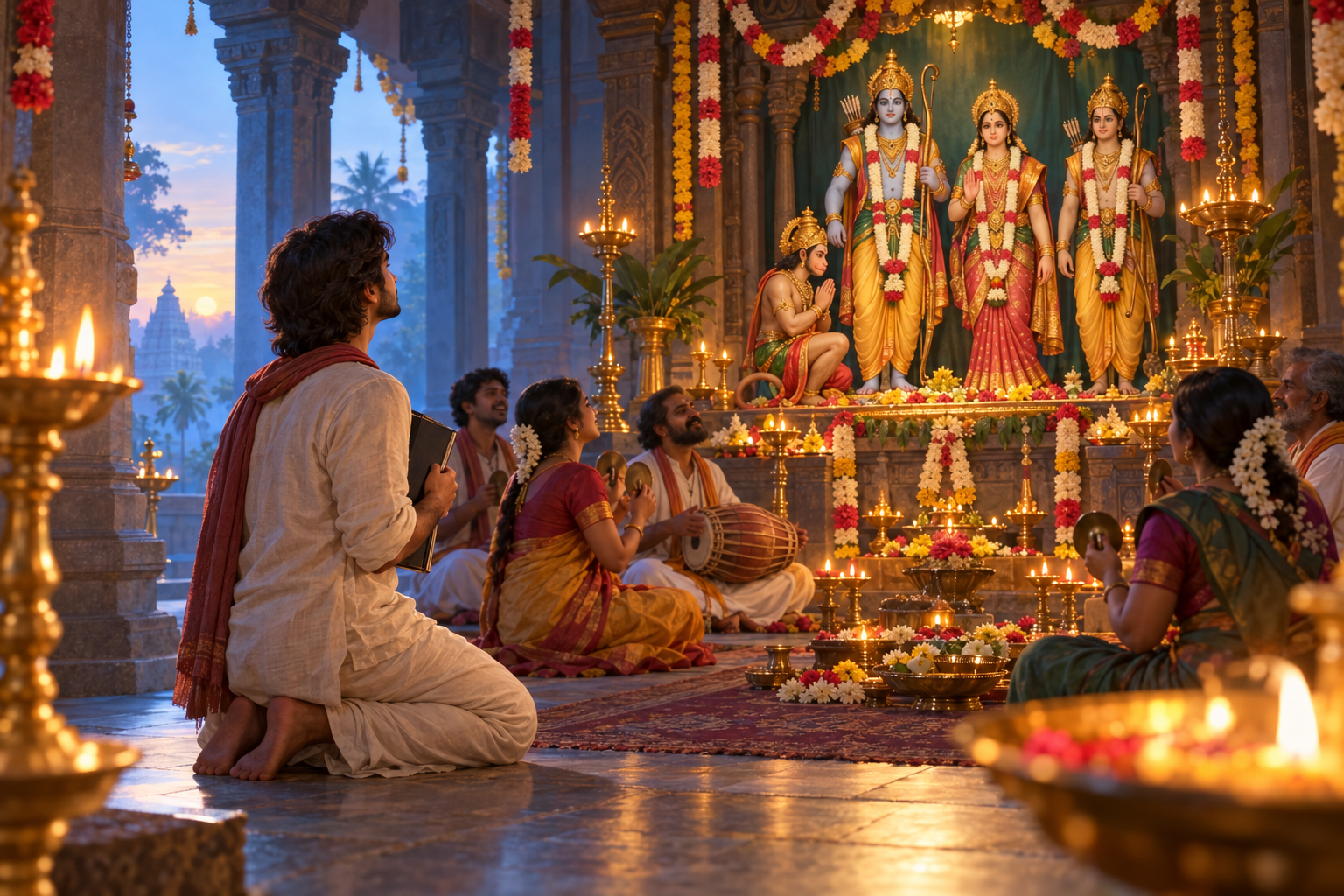
Soon afterward, he visited the Hare Krishna temple at Watford, outside London, and had darshana of Sri Sri Radha Gokulananda. He experienced a powerful sense of recognition. The devotees explained it in terms of an eternal loving relationship with God that is awakened through glorification of the holy names. He joined the temple, received formal initiations, and went on to study and glorify divine forms and make portraits of A. C. Bhaktivedanta Swami Prabhupada.
This shift is central to understanding his work. Earlier, he had tried to invent an ideal form capable of holding his philosophical intuitions. In bhakti, he approached sacred form as something received through mantra, temple worship, spiritual teaching, and relationship. When you look at devotional art shaped by that approach, do not stop at asking whether it is realistic or attractive. Notice where the gaze is directed, how delicacy and power are balanced, and what relationship the image invites you to form with the person depicted.
Four decades of seva define the measure of his legacy
Ananta Shakti’s service continued for more than four decades. The devotees mourning him did not chiefly describe public status, commercial success, or artistic celebrity. They remembered a sensitive person whose art touched hearts, a servant dedicated to the mission, and a humble devotee who loved other devotees deeply. That community memory tells you how his work was received: art and character were not treated as separate achievements.
Two reductions would distort that legacy. The first is to tell his life only as a sudden mystical awakening; that erases the years of looking, drawing, studying, experimenting, and learning how visual form works. The second is to discuss only his aesthetic skill; that removes the mantra, darshana, offering, temple life, and service that gave the skill its direction. The trained hand and the devotional purpose belong together.
Key takeaways
- Ananta Shakti’s devotional art grew from serious visual training; bhakti redirected his abilities rather than replacing them.
- His encounters with imagery of Rama, the Hare Krishna maha-mantra, and Sri Sri Radha Gokulananda changed sacred form from an artistic idea into a focus of personal service.
- His legacy rests on continuity: more than four decades of using art to glorify divine forms and serve a devotional community.
- A faithful memorial must preserve both sides of his vocation: the works themselves and the spiritual context in which they were made.
This also means that humility should not become anonymity. Devotional communities sometimes preserve an image while losing its maker, date, setting, intended use, or chain of custody. Accurate attribution is not a distraction from seva. It protects the truth of the service and allows future devotees to understand how sacred visual culture was actually sustained.
How you can honour the legacy without reducing it to nostalgia
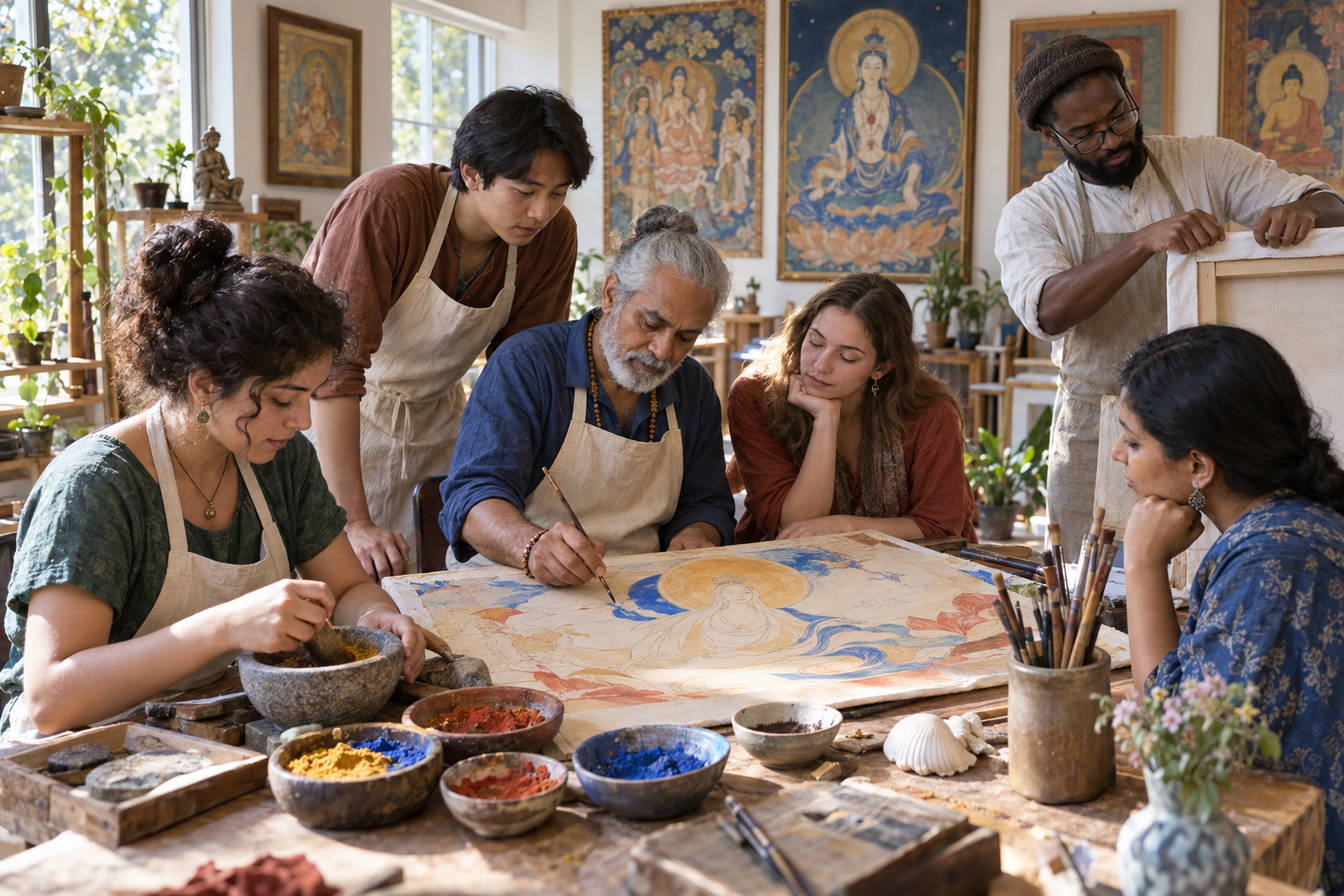
A tribute becomes durable when it produces a concrete act of attention. If you possess one of Ananta Shakti’s works, remember seeing one in a temple, know someone who worked with him, or simply want to approach his art more carefully, use the following sequence.
- Verify attribution before circulating an image. Check for a signature, inscription, original publication, temple record, commission record, or named first-hand testimony. If the attribution rests only on memory, preserve the memory but label the identification as unconfirmed.
- Create a basic record for each verified work. Record the title or subject as originally given, medium, dimensions when known, documented date, original purpose, former and present locations, source of the reproduction, and the person or institution holding reproduction rights. Leave an unknown field blank instead of completing it by guesswork.
- Record memories while witnesses can supply context. Ask concrete questions: Which image did you see? Where was it displayed? Who requested or received it? Did Ananta Shakti discuss a choice of color, expression, gesture, or composition? Separate what the person witnessed from what they later heard, and attach the speaker’s name and the date of the recollection.
- Preserve the devotional setting. Identify Rama, Krishna, Radha-Krishna, Prabhupada, or another subject only when the identification is secure. Note whether a work served temple worship, publication, teaching, remembrance, or private devotion. Removing that context and calling everything generic Indian art conceals the relationship the image was made to serve.
- Share responsibly. Credit the artist, retain the available provenance, and obtain permission before public reproduction. A compressed social-media copy with no attribution may spread widely while destroying the information that makes it historically and devotionally useful.
You do not need to be an archivist to enter the practice behind the work. Choose a reliably attributed image and stay with it long enough to notice a deliberate choice in color, posture, gaze, or composition. Ask what quality of the divine person that choice helps you perceive. Then chant, pray, or offer respect according to your practice. This turns viewing from rapid consumption into devotional attention without pretending that you must duplicate another person’s spiritual experience.
The mantra at the turning point of Ananta Shakti’s life was Hare Krishna, Hare Krishna, Krishna Krishna, Hare Hare / Hare Rama, Hare Rama, Rama Rama, Hare Hare. For a reader who knows him only as a painter, chanting it attentively may reveal more about the intention behind his service than looking quickly through a large collection of images.
Begin with one durable act: correctly credit an image, preserve a dated memory from someone who knew him, or spend unhurried time before a sacred form and chant. Ananta Shakti Prabhu’s legacy remains alive when attention becomes devotion and devotion is passed forward with care.
References

Leave a Reply
You must be logged in to post a comment.