
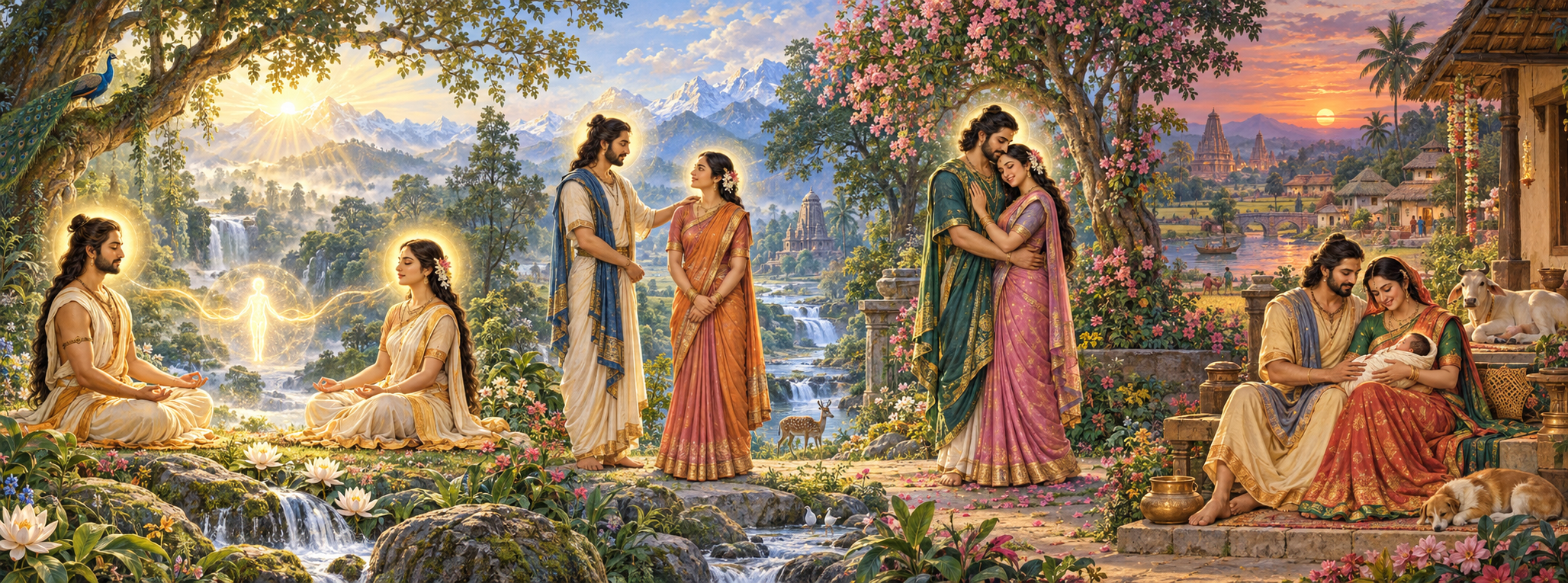
If you are trying to understand how creation could occur differently in different Yugas, begin by narrowing the question. This teaching is not describing four separate creations of the universe. It is describing a change in how embodied beings generate offspring as dharma and consciousness decline through the cycle of the ages.
That distinction makes the sequence intelligible. Thought, touch and bodily union are not three disconnected marvels. They mark a progressive dependence on outward means: what consciousness once accomplished directly comes to require contact and, finally, physical generation.
Creation here means the generation of embodied life

Hindu thought uses creation at several scales. It can refer to cosmic manifestation, the appearance of worlds, the emergence of beings or the birth of an individual. The Yuga sequence considered here concerns the last two levels. Its question is not, “Who recreates the cosmos in every age?” but, “How does embodied life continue when the capacities of beings change?”
This prevents a common category error. If you read thought-creation as an alternative account of the origin of the universe, the passage seems to conflict with other cosmological accounts. If you recognise it as a teaching about progeny and embodied generation, its internal movement becomes much clearer.
The ages are Krita, also called Satya, followed by Treta, Dvapara and Kali. They form a descending cycle in which dharma, purity and the effective power of consciousness gradually weaken. The change in procreation gives that descent a concrete form.
The four ages move from inward power to outward means
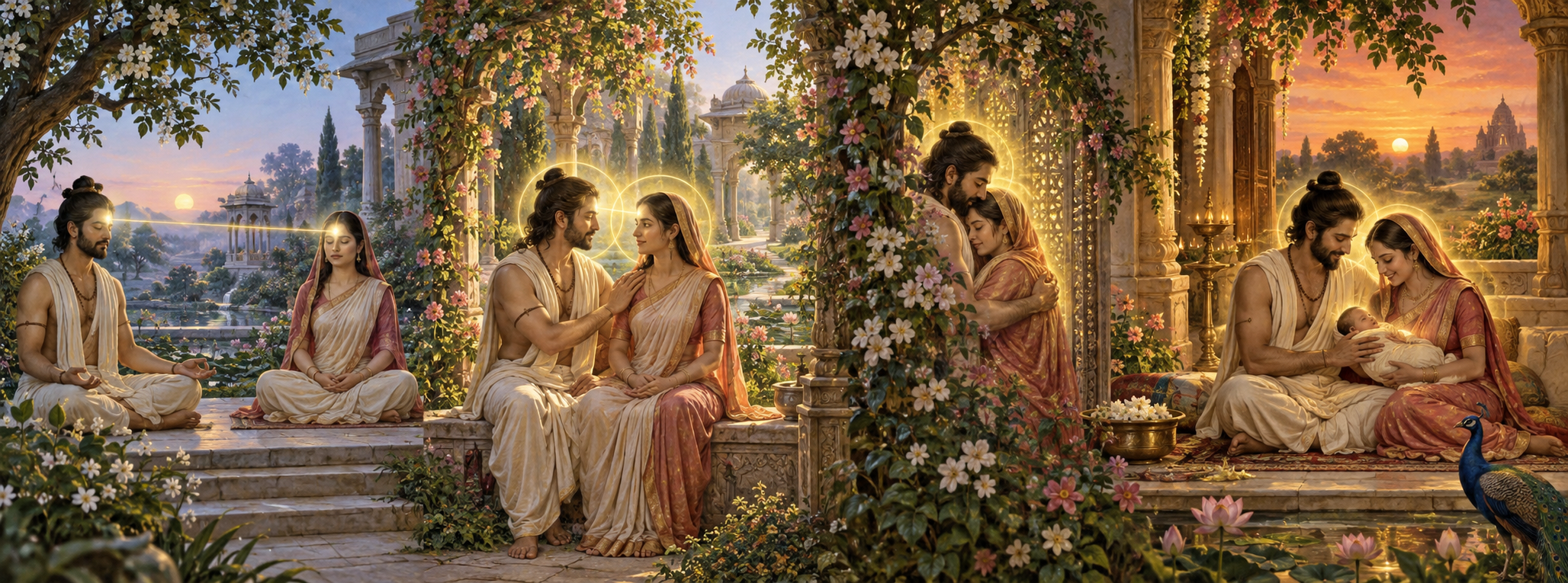
| Yuga | Characteristic mode of generation | What changes |
|---|---|---|
| Krita or Satya | Thought or intention | Consciousness itself possesses creative efficacy. |
| Treta | Touch | Intention now requires contact with another embodied being. |
| Dvapara | Bodily union | Generation becomes dependent on physical conjunction. |
| Kali | Bodily union continues | The physical mode remains while the surrounding condition of dharma becomes more difficult. |
In Krita Yuga, generation is associated with thought or resolve. This is the starting point because Krita represents the condition of greatest purity. Intention is not merely a private wish; it has effective creative force.
In Treta Yuga, touch enters the process. Consciousness has not become powerless, but it no longer operates without an outward medium. Contact bridges intention and manifestation.
By Dvapara Yuga, bodily union becomes the decisive means of generation. Kali Yuga retains that embodied mode while carrying the cyclical descent further into moral struggle. The essential progression is therefore from thought, to touch, to union across the four Yugas. There are four ages but only three principal modes because the final transition concerns the condition in which embodied generation occurs, not the introduction of another reproductive mechanism.
Read the entries as characteristic modes, not as permission to invent a complete biology for each age. The sequence gives a theological pattern. It does not supply every physiological detail a modern reader might ask for.
The deeper change is dependence, not the worth of the body
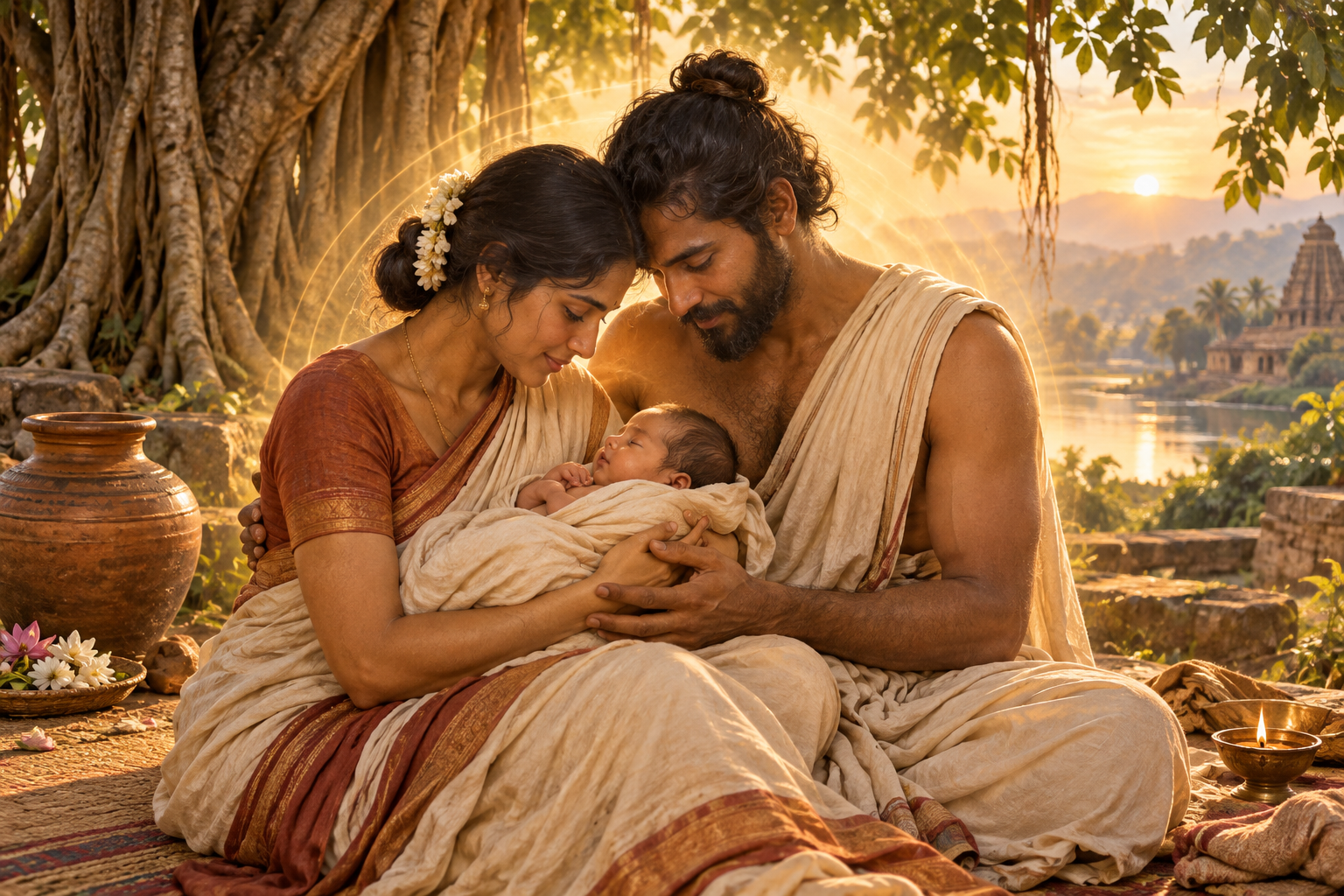
The easiest way to remember the pattern is to ask how much mediation creation requires. In Krita, consciousness acts directly. In Treta, it works through touch. In Dvapara and Kali, generation depends on full bodily participation. Each step adds an external condition.
This is a map of diminishing spiritual capacity, not a declaration that bodies, marriage or ordinary parenthood are impure. The body is where dharma must be lived in the later ages. Turning the sequence into contempt for embodied life would add a conclusion that the sequence itself does not require.
Nor should you convert the teaching into contempt for people born in Kali Yuga. A difficult age describes the conditions under which action takes place; it does not settle the moral worth of every person living within it. The practical question is not whether you possess the effortless powers associated with Krita. It is whether you govern the capacities available to you through dharma.
The pattern also reverses a familiar modern assumption. Material complexity is often treated as proof of human advancement. The Yuga framework asks you to examine another measure: how dependent has action become on external instruments, and how reliably can intention remain aligned with dharma? Greater control over matter need not mean greater mastery of the self.
Read the sequence as sacred history and moral diagnosis
You do not have to force a choice between a traditional and a symbolic reading. A traditional reader may receive the modes of generation as features of sacred time. A philosophical reader may also see an image of consciousness becoming progressively entangled with material conditions. The two readings answer different questions and can coexist.
What should be avoided is careless flattening. Treating the account only as modern reproductive science strips it of its cosmological purpose. Treating it only as a metaphor dismisses the sacred history that many Hindus receive seriously. A disciplined reading first allows the teaching to speak in its own categories and then considers what those categories disclose about human life.
Four questions will keep your interpretation grounded:
- Which kind of creation is being discussed? Distinguish cosmic manifestation from the generation of offspring.
- What changes between the ages? Follow the movement from direct intention to increasingly physical mediation.
- Is the account describing or commanding? A description of earlier capacities is not an instruction to imitate them or to condemn present family life.
- Where does dharma enter? The point of identifying Kali’s constraints is to practise rightly within them, not to use the age as an excuse for adharma.
This method is useful beyond this single teaching. Whenever you encounter an extraordinary claim about a Yuga, identify its scale, its role in the cycle of dharma and the ethical distinction it is making before trying to translate it into modern categories.
Key takeaways for study and practice
- The sequence concerns embodied generation rather than four independent origins of the cosmos.
- Krita or Satya is associated with creation through thought; Treta introduces touch; Dvapara and Kali depend on bodily union.
- The underlying movement is from direct conscious efficacy toward dependence on external and physical means.
- Kali differs not because the body becomes worthless, but because embodied life unfolds amid a deeper struggle to sustain dharma.
- The account can be received as sacred history, read for its philosophical meaning, or approached at both levels without forcing one to erase the other.
The next time this Yuga teaching appears in study or conversation, do not stop at the striking claim that thought once created life. Trace the full movement. Then bring the question back to the age in which you actually live: when intention no longer guarantees a righteous result, what discipline must govern your speech, relationships and embodied actions? That is where the cosmology becomes practice.
References

Leave a Reply
You must be logged in to post a comment.