
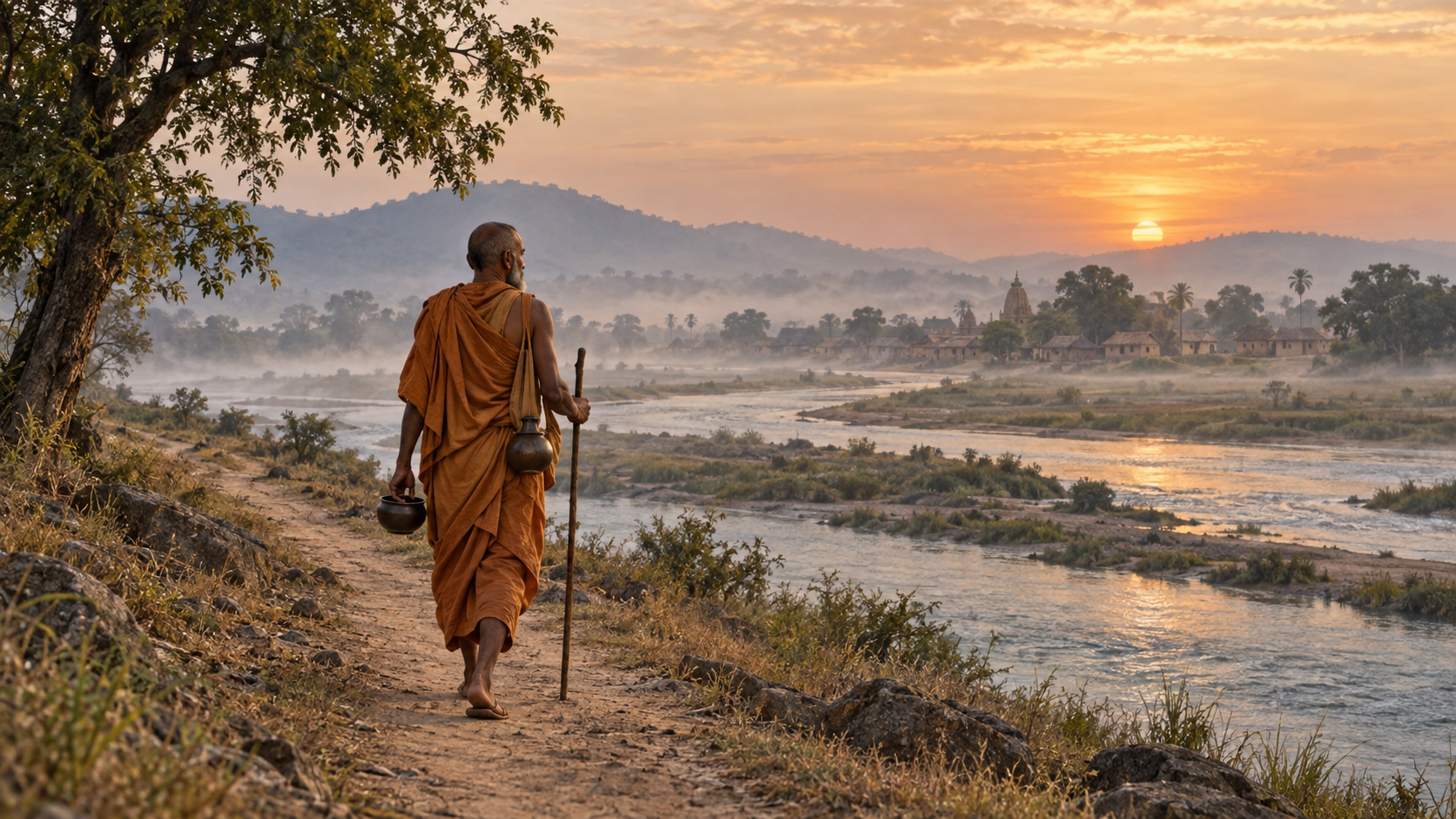
You may have met the word Bahudaka while reading about sannyasa, listening to a discourse, or trying to understand the many kinds of Hindu renunciants. The quickest mistake is to translate it into a modern image of someone who simply travels without a permanent address.
A Bahudaka is better understood through purpose. Wandering is the visible form of the life, but liberation is its governing aim. Once you hold those two elements together, the category becomes spiritually intelligible rather than merely picturesque.
What the name Bahudaka identifies
Bahudaka identifies a recognised class of wandering Hindu renunciant dedicated to moksha. It is not a loose label for every sadhu, pilgrim, mendicant, or person living outside settled society.
This distinction matters because Hindu traditions do not treat spiritual maturity as a single outward pattern. The pursuit of liberation can assume different forms suited to different dispositions and stages of development. A householder may practise detachment while fulfilling family duties. A pilgrim may leave home temporarily and then return. A renunciant makes relinquishment the organising principle of life. The Bahudaka belongs to that last field.
When you encounter the term, therefore, read it as a classification of disciplined religious life. Do not reduce it to clothing, appearance, poverty, or distance travelled. Those are external conditions. The decisive question is what the wandering is meant to accomplish within the renunciant.
Why wandering can become a spiritual discipline
A fixed home does more than provide shelter. It gathers possessions, routines, status, relationships, memories, and expectations around a person. None of these is automatically wrong. For a renunciant, however, they can become supports for the very identity that must be examined and relinquished.
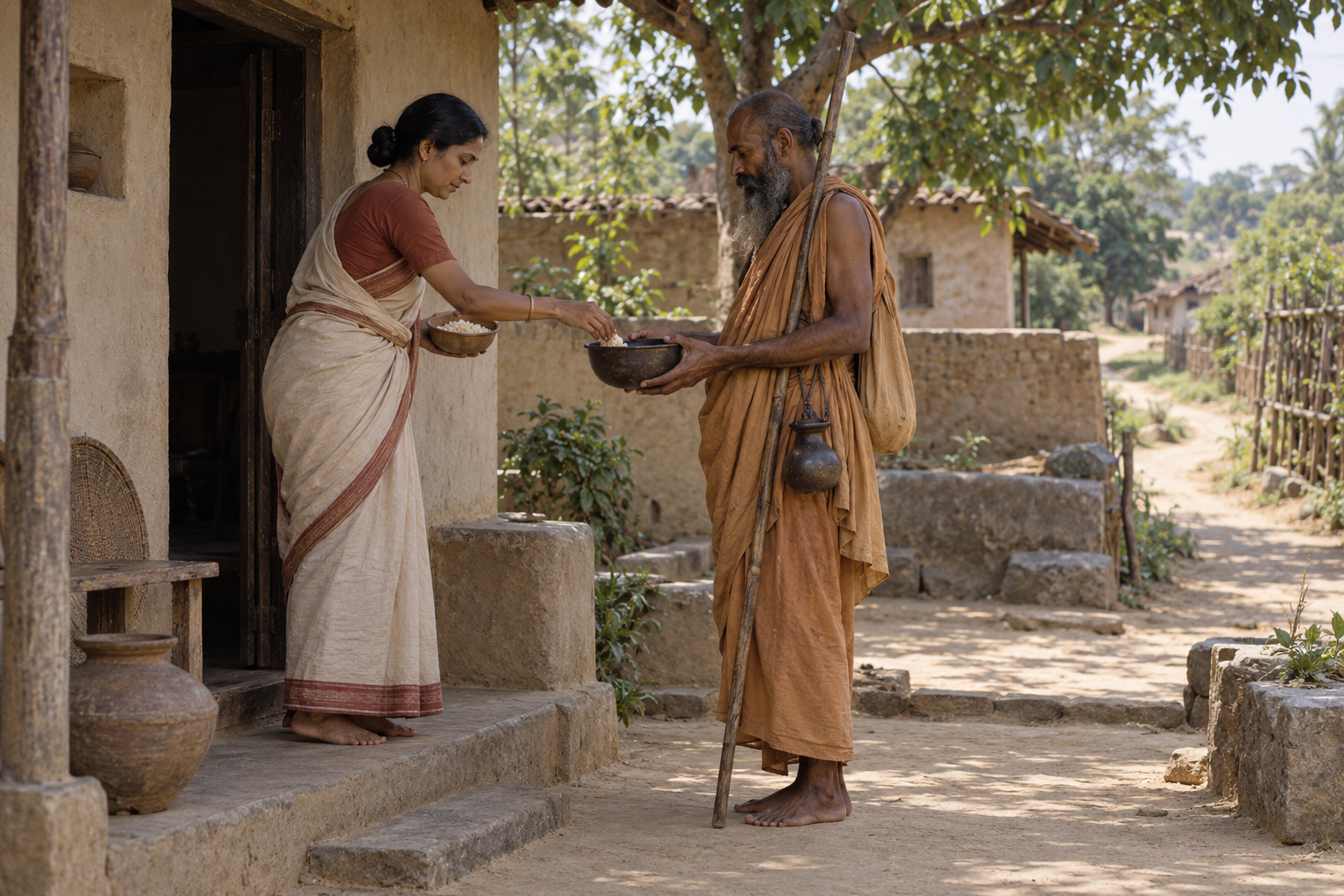
Wandering interrupts that accumulation. A person who cannot continually rebuild comfort around a familiar place must confront attachment more directly. Uncertainty exposes the difference between genuine inner steadiness and the security supplied by surroundings. Dependence on the hospitality or alms of others also limits the illusion of complete self-sufficiency.
This does not make movement holy by itself. Restlessness can travel just as easily as wisdom. Someone may change places continually while carrying every craving, resentment, and ambition along. The Bahudaka ideal only makes sense when outward movement supports inward release.
Use that distinction whenever you see a wandering ascetic described. Ask whether movement is serving restraint, non-attachment, contemplation, and the pursuit of moksha. If the journey is treated as an achievement in its own right, the spiritual centre of the category has been missed.
Four questions that prevent common misreadings
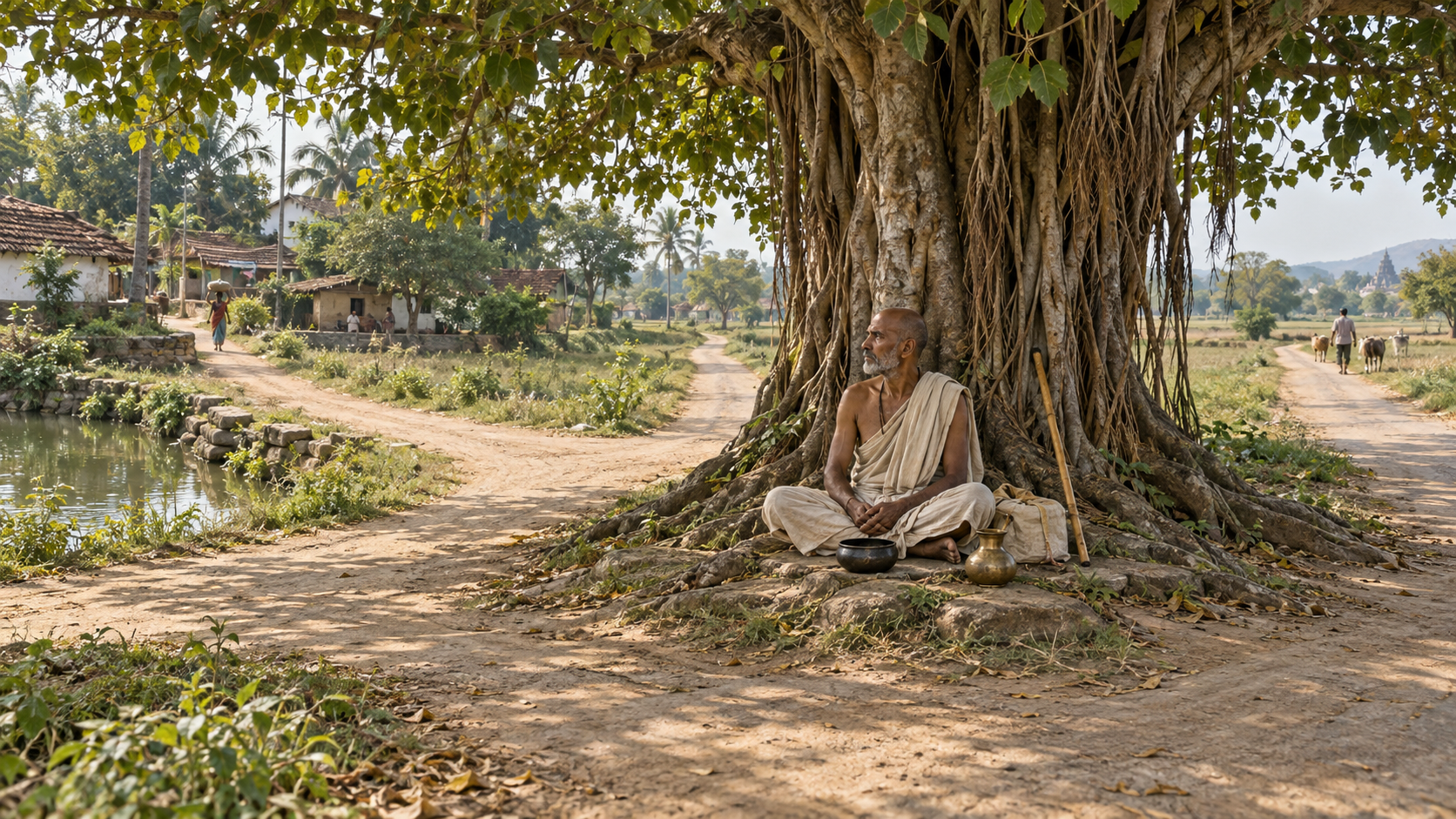
You do not need to romanticise homelessness or reconstruct every customary detail to understand the Bahudaka. Four questions will usually give you a sound reading.
- What has been renounced? Look beyond property. Fixed social identity, habitual comfort, prestige, and control may be more difficult to relinquish than objects.
- What is the renunciation for? The aim is moksha, not novelty, social rebellion, or escape from ordinary frustration. Without a liberating aim, travel alone does not define Bahudaka life.
- What disciplines remain? Renunciation is not the absence of order. The meaningful question is whether simplicity and movement are governed by spiritual discipline rather than impulse.
- What relationship with society continues? A wandering renunciant may leave household life without becoming unrelated to householders. Material dependence and spiritual instruction can create a reciprocal relationship between the ascetic and the community.
These questions also help you avoid three false equations. A Bahudaka is not simply a tourist with fewer belongings. Not every itinerant holy person must belong to this particular class. And renunciation should not automatically be interpreted as contempt for family or society. The point is release from binding identification, not hatred of the world.
Keep some humility when applying historical categories. Hindu ascetic traditions are diverse, and names can carry different emphases across lineages and contexts. If a particular teacher or text uses Bahudaka in a more technical way, let that context govern the interpretation rather than forcing every renunciant into one uniform model.
What the Bahudaka ideal asks of you today

Most readers are not deciding whether to become wandering renunciants. Your useful question is narrower: what does this form of life reveal about attachment?
Begin by identifying one external support that has quietly become part of your identity. It may be a title, a possession, a familiar routine, a social role, or the need to control your surroundings. Then ask what happens internally when that support is unavailable. Irritation, fear, defensiveness, or self-importance can reveal the attachment more clearly than abstract reflection.
You can test this insight without imitating a renunciant’s entire life:
- Spend a defined period using less of one nonessential comfort, and observe the mind rather than congratulating yourself for the sacrifice.
- Travel or undertake pilgrimage with fewer possessions, but treat inconvenience as material for self-examination rather than as proof of spiritual superiority.
- Perform one necessary duty without drawing attention to your role, status, or sacrifice.
- Notice whether simplicity makes you gentler and less possessive. If it makes you proud, the attachment has changed its clothing rather than disappeared.
These are exercises in discernment, not informal initiation into sannyasa. Formal renunciation affects duties, relationships, and one’s place within a living tradition. Do not abandon dependants, financial obligations, or essential care in an attempt to copy the external form. If formal sannyasa is genuinely under consideration, seek guidance within a qualified lineage that can distinguish a sustained vocation from exhaustion, conflict, or a temporary desire to escape.
The Bahudaka stands as a demanding question: how much of your apparent stability belongs to the Self, and how much depends on familiar surroundings? You do not have to leave home to begin answering. Choose one attachment, loosen it deliberately, and watch what the mind tries to protect.
Key takeaways
- Bahudaka names a particular kind of Hindu wandering renunciant, not every pilgrim or itinerant sadhu.
- Wandering is a means of weakening attachment; it is not the final spiritual objective.
- Moksha gives the life its direction, while discipline distinguishes renunciation from aimless movement.
- External simplicity is meaningful only when it produces less possessiveness, less dependence on status, and greater inner steadiness.
- A householder can learn from the ideal without abandoning legitimate duties or pretending to have taken formal sannyasa.
References

Leave a Reply
You must be logged in to post a comment.