

If your family observes ancestral rites, the immediate question is practical: which date should you reserve, and what must be settled before the observance begins? For October 2026, Amavasya falls on 10 October.
This Amavasya is observed as Mahalaya Amavasya or Sarva Pitru Amavasya. That makes it an important occasion for remembering the pitrs, but it does not make every regional calendar, sankalpa, or household procedure identical. Use the date as your starting point, then confirm the local timing and the method followed by your family or sampradaya.
Key takeaways
- Keep 10 October 2026 available for the October Amavasya observance.
- The same occasion is called Ashwin Amavasya in North Indian calendars and Bhadrapada Amavasya in Telugu, Kannada, Marathi, and Gujarati calendars.
- Mahalaya Amavasya and Sarva Pitru Amavasya are names associated with this date; the different labels do not necessarily indicate different observances.
- Confirm the tithi window for the place where you will actually perform the rite. Do not copy timings calculated for another city or time zone.
- Tharpana procedure, eligibility, materials, and sankalpa wording can differ by family tradition. Obtain instructions from a person who knows your lineage before the day begins.
One date can carry several calendar names
The October observance is known as Ashwin Amavasya in North Indian calendars and Bhadrapada Amavasya in several western and southern calendars. You may therefore see different month names on temple notices, regional panchangas, and family calendars even when they point to the same civil date.
This difference arises because Hindu calendars do not all label lunar months in the same way. It is not, by itself, evidence that one calendar is wrong. Before rejecting a notice because its month name looks unfamiliar, check its region and calendrical convention.
The civil date is only the planning anchor. Amavasya is a tithi, not a midnight-to-midnight date. Its local beginning and ending can cross parts of two civil days, and the rule used to select the ritual period may depend on the observance and tradition. If you live outside Bharat, are travelling, or will perform the rite somewhere other than your usual home, consult a panchanga calculated for the place of performance.
Ask for a direct answer to a direct question: “For our family’s Amavasya Tharpana, at what local time should the rite be performed on 10 October 2026?” Save the answer with the city, time zone, and name of the tradition used. A screenshot containing only a time, with no location or ritual context, is not enough.
What to confirm before performing Tharpana
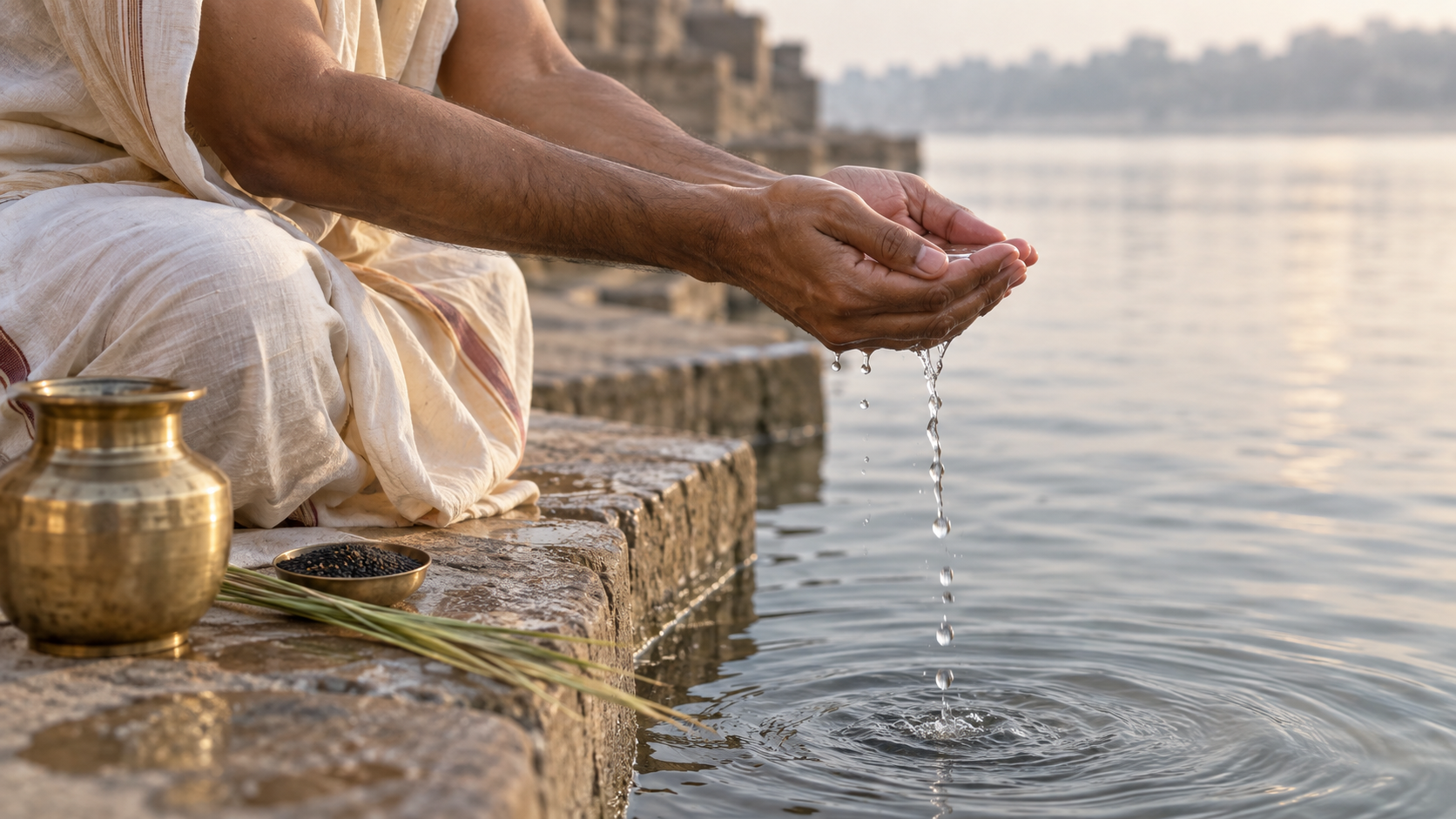
Tharpana is a formal offering, principally through water, made in accordance with inherited ritual rules. It should not be treated as a free-form remembrance ceremony. Shraddha and Tharpana are also not automatically interchangeable terms: a household may perform Tharpana as part of its Amavasya discipline while treating a fuller ancestral rite as a distinct observance.
Sarva Pitru Amavasya provides a collective occasion for honouring the ancestral line, including in circumstances where every individual ancestral tithi is not being observed separately. Even so, it should not be assumed to cancel or replace a family’s other duties. That decision belongs within the family’s customary practice.
Settle these five questions in advance
- Which observance are you undertaking? Establish whether your family expects Amavasya Tharpana alone, a broader Mahalaya observance, a temple service, or another form of ancestral rite.
- Who performs it in your tradition? Rules about the karta and eligibility are not uniform across all Hindu communities. Avoid categorical internet claims that ignore sampradaya and family practice.
- Which ancestral details are required? Prepare the names, relationships, gotra, and other lineage information your procedure calls for. If some information is unknown, ask how your tradition handles that absence rather than inventing it during the sankalpa.
- Which materials and physical arrangements are prescribed? Water is central, but additional materials, direction, posture, hand usage, sacred-thread position, and the number or order of offerings may differ. Obtain one complete list from the same authority who gives you the procedure.
- Which sankalpa should you use? A sankalpa contains calendrical and place-dependent elements as well as the ritual intention. Use a version prepared or verified for this observance, your location, and your tradition.
The date has a specifically associated Amavasya Tharpana sankalpa for October 2026, but a line of Sanskrit found online is not automatically complete for your circumstances. Replacing the date in an old formula can leave other calendar or location details incorrect. If you cannot explain which parts of the sankalpa must change, have the entire wording checked.
Pronunciation matters, but fidelity is not limited to pronunciation. The correct sequence, intention, names, and substitutions for unavailable information also matter. Keep a transliterated copy if that is what you can read accurately, and have any doubtful words marked before the observance rather than stopping midway to search for them.
Organise the day without inventing a universal ritual
A responsible preparation plan separates logistics from ritual authority. You can organise the space and information yourself; the formal procedure should come from the tradition you are following.
- Before 10 October: confirm the local tithi-based timing, the person performing the rite, the exact procedure, and the complete materials list.
- The previous day: place the verified instructions, required vessels and materials, and written ancestral details together. Check that every Sanskrit passage is legible.
- At the advised local time: complete the customary personal and spatial preparation. Arrange the materials in the order in which they will be used.
- At the sankalpa: read the version verified for October 2026 and your place of performance. Do not silently substitute a city, month name, or ritual purpose unless you were instructed to do so.
- During the offerings: follow one coherent method from beginning to end. Preserve its prescribed sequence rather than combining gestures or mantras collected from unrelated videos and websites.
- At the close: complete the concluding acts required by the same procedure. If your custom includes further prayer, feeding, dana, or another act, treat it as part of that custom rather than as a universal requirement imposed on every family.
Mixing instructions is the most avoidable error. Two procedures may both be valid within their own lineages while being incompatible when assembled piecemeal. If your family manual and a public webpage differ, pause and consult someone competent in the family’s tradition. Popularity is not a substitute for ritual continuity.
Travel deserves special attention. Use the location where the rite will be performed when checking the tithi and any place-dependent language in the sankalpa. A schedule prepared for relatives in another country should not be transferred unchanged merely because the Gregorian date is the same.
If you do not have an inherited procedure
Not every Hindu household has preserved a written Tharpana method, and many people now live far from the elders or purohita who previously maintained it. If that is your situation, do not reconstruct a formal rite from fragments and present it as lineage practice.
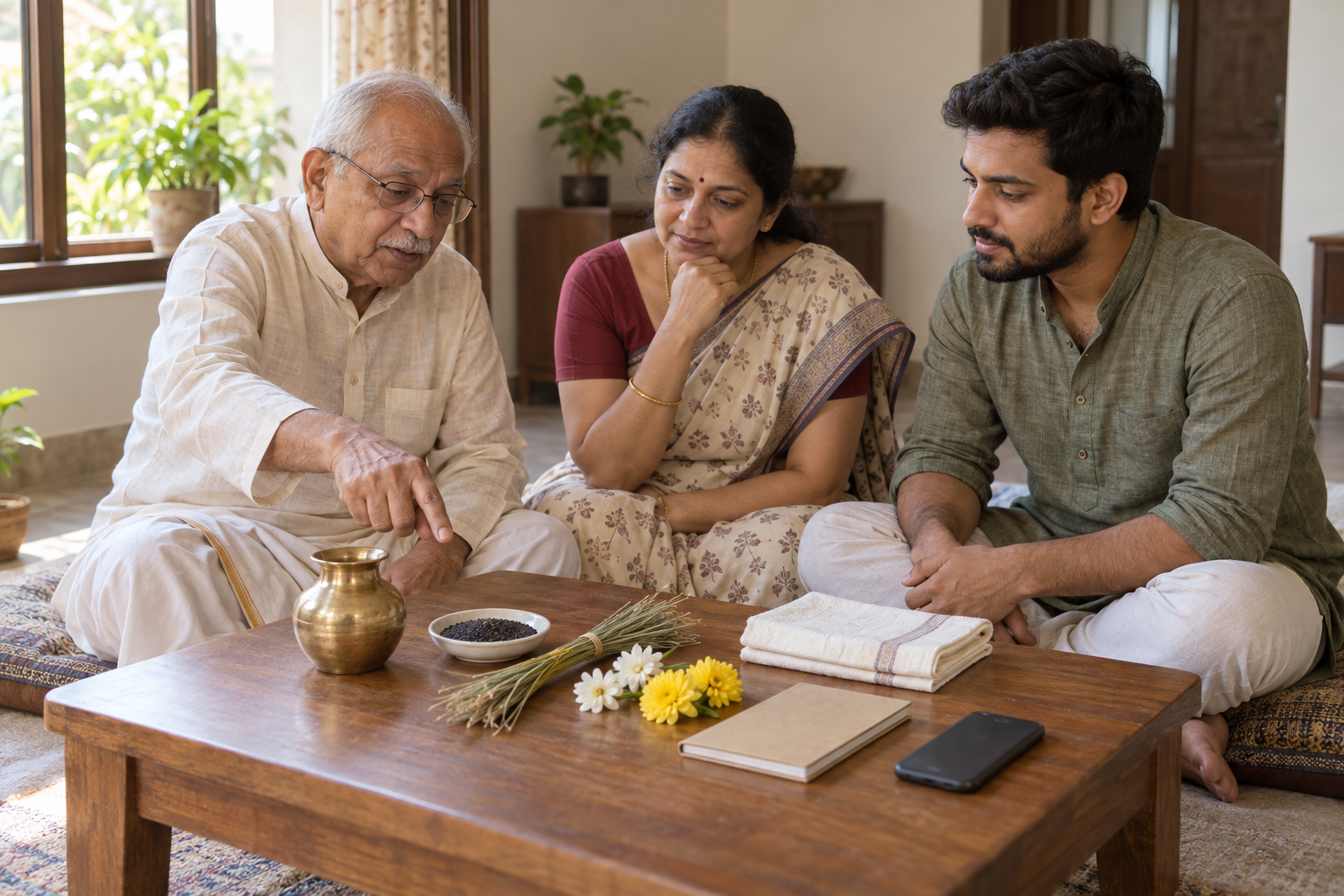
Contact a temple or tradition-competent purohita before 10 October. Tell them your family background, the tradition if known, the place where you will observe, and whether you need personal guidance or a temple-conducted service. Ask whether advance registration is required and what ancestral information you should bring.
If a formal Tharpana cannot be arranged, you can still spend the day in respectful remembrance through prayer and whatever non-formal acts of gratitude your family regards as appropriate. You may preserve ancestors’ names, share their stories with younger relatives, or support a worthy act in their memory. These can be meaningful expressions of smriti and gratitude, but do not claim that they are ritually identical to Tharpana unless your tradition teaches that they are.
Your most useful action now is simple: reserve 10 October, identify the local authority you trust, and prepare a single written sheet containing the timing, procedure, materials, and ancestral details. Once those questions are settled, the observance can remain centred on reverence rather than last-minute uncertainty.
References
- Hindu Pad – Amavasya October 2026 date, Time
- Hindu Pad – Amavasya Tharpana Sankalpa Mantras October 2026

Leave a Reply
You must be logged in to post a comment.