
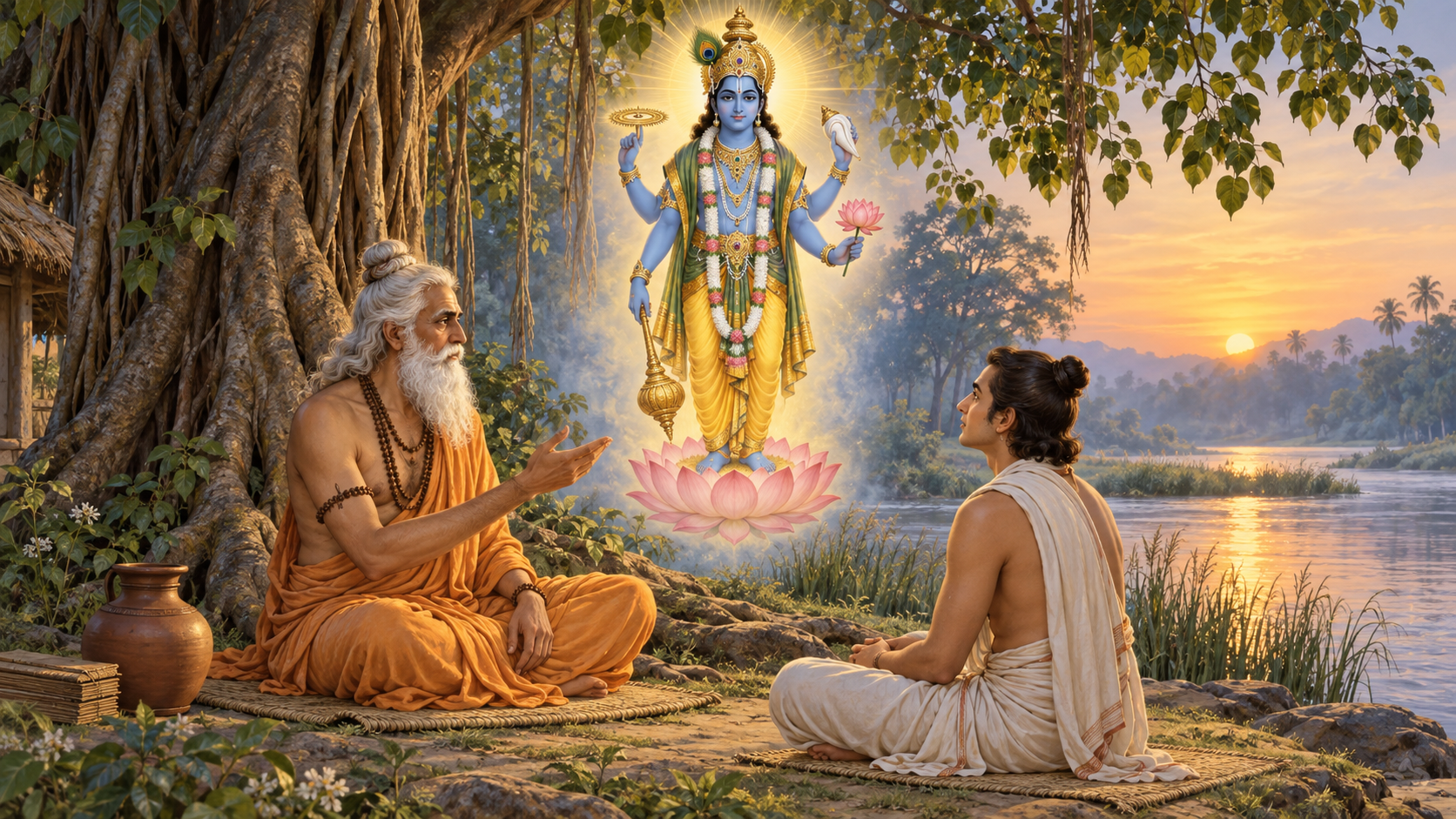
You sit down intending to remember the Lord, but within moments the mind is replaying a conversation, planning tomorrow, or negotiating with an uncomfortable body. Kapila’s answer is not to force the mind into vacancy. He gives it a sacred form, an order in which to contemplate that form, and a devotional reason to remain there.
If you have been moving between mantra, breath, visualization, and abstract silence without knowing what should lead, Kapila’s method supplies the missing structure. Prepare the attention, contemplate the Lord one feature at a time, let remembrance mature into devotion, and carry that devotion into service. The test is not how vividly you can manufacture an image. It is whether possessiveness weakens and remembrance begins to govern ordinary conduct.
Give the mind a person, not merely an absence
In the Bhagavata’s dialogue between Kapila and Devahuti, meditation is inseparable from bhakti. The Lord is not a temporary symbol invented to occupy the mind, and the practitioner is not trying to disappear into an impersonal mental state. Meditation is an act of attention directed toward Bhagavan.
This distinction changes what you do when the mind wanders. You are not defending a blank space from unwanted thoughts. You are returning to someone. That return can contain reverence, dependence, gratitude, and the wish to serve. Even before concentration becomes steady, the act of returning is already devotional.
Choose the form of the Lord that you have received through scripture, worship, and your sampradaya. Keep a murti or sacred image nearby if it helps you remember the form accurately. Avoid changing the object of meditation whenever novelty fades. A stable relationship is formed through repeated attention; constantly replacing the form trains the mind to seek stimulation instead.
Do not turn visualization into a private exercise in invention. Study the recognized form carefully: its posture, ornaments, expression, and the attributes held in its hands. The image helps recollection, but the goal is not a perfect internal picture. The goal is attentive remembrance of the Lord represented by that form.
Move from the lotus feet upward without rushing
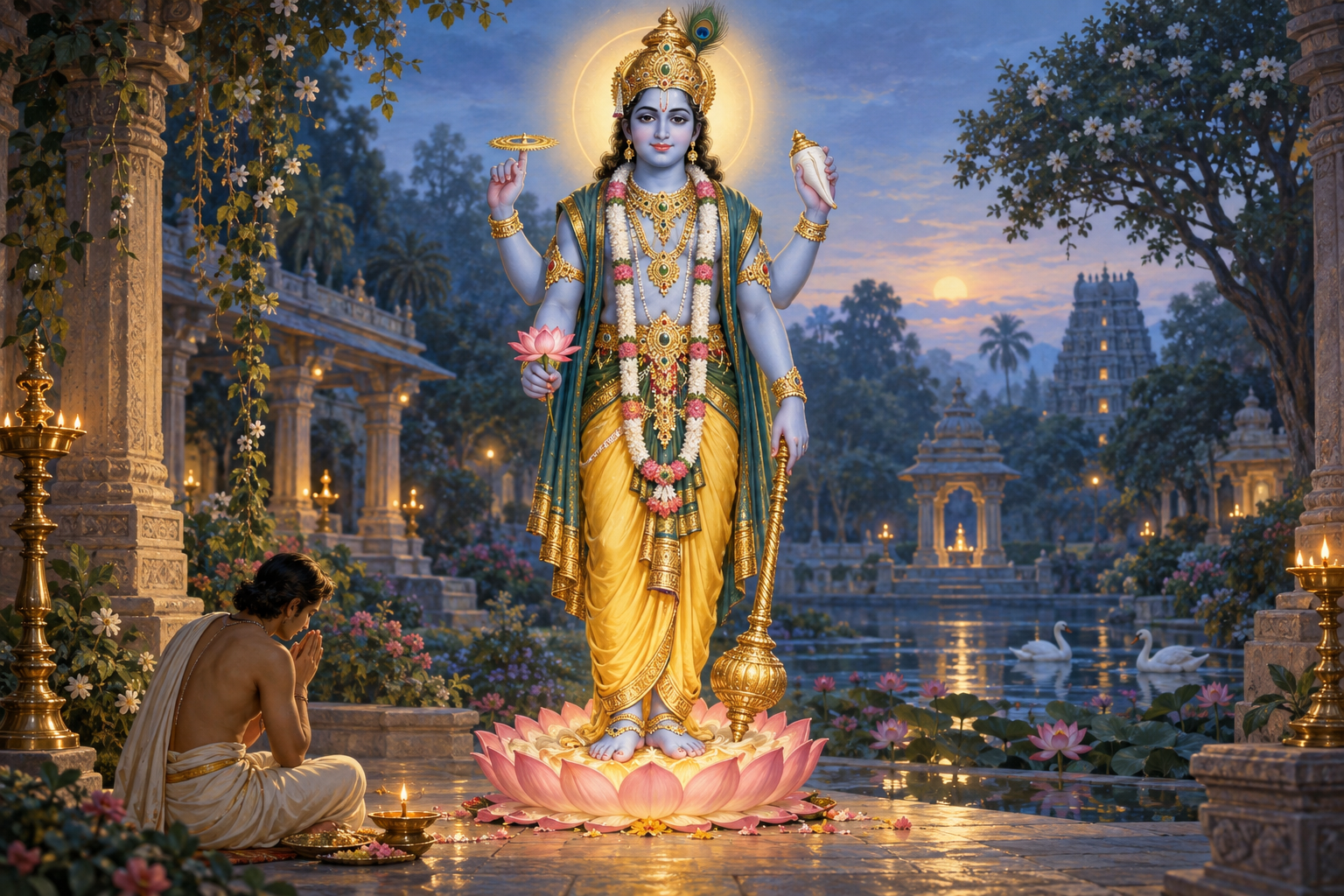
Kapila gives the restless mind a sequence. Contemplation begins at the Lord’s lotus feet and proceeds through the divine form, feature by feature, toward the face and gracious expression. Instead of trying to hold the whole form at once, you give undivided attention to one place and then move onward.
Beginning at the feet also establishes the inner posture of the practice. You approach from surrender, not mastery. The mind may want to seize the complete vision immediately, but bhakti begins by accepting shelter. When attention scatters, the feet remain a natural place to return.
A workable sitting can follow this order:
- Choose before you sit. Settle on the form, mantra, and place of practice in advance. Do not spend the sitting deciding among techniques.
- Become physically steady. Sit in a position that is alert and sustainable. Take enough time for hurried breathing and obvious muscular tension to settle, but do not make bodily calm the final object.
- Look carefully. If you use a murti or image, study the lotus feet before closing your eyes. Recall that one feature rather than demanding an immediate vision of the whole form.
- Join attention to relationship. Do not merely catalogue shape and ornament. Approach the feet as shelter and as the place where service begins. A simple inward prayer is more useful than elaborate commentary.
- Move upward deliberately. Follow the form as it has been described and received in your tradition. Move to the next feature when attention has become reasonably settled; if the sequence dissolves, return to the last feature you can remember clearly.
- Rest at the face. Let the Lord’s glance and expression draw out affection. Do not hurry past this point simply to complete a mental checklist.
- End in service. Offer your prayer, bow, or continue with the form of seva appropriate to your daily life. This prevents meditation from becoming a sealed-off private experience.
If you use the divine Name, let Name and form support each other. The mantra can gather the wandering mind while the remembered form gives personal direction to the sound. If you have received a specific method from a qualified guru, follow that instruction rather than assembling competing practices during the same sitting.
It is better to contemplate a smaller part of the sequence attentively than to race through the entire form. Completion is not the achievement. Repeated, reverent attention is.
The culmination is freedom from false ownership
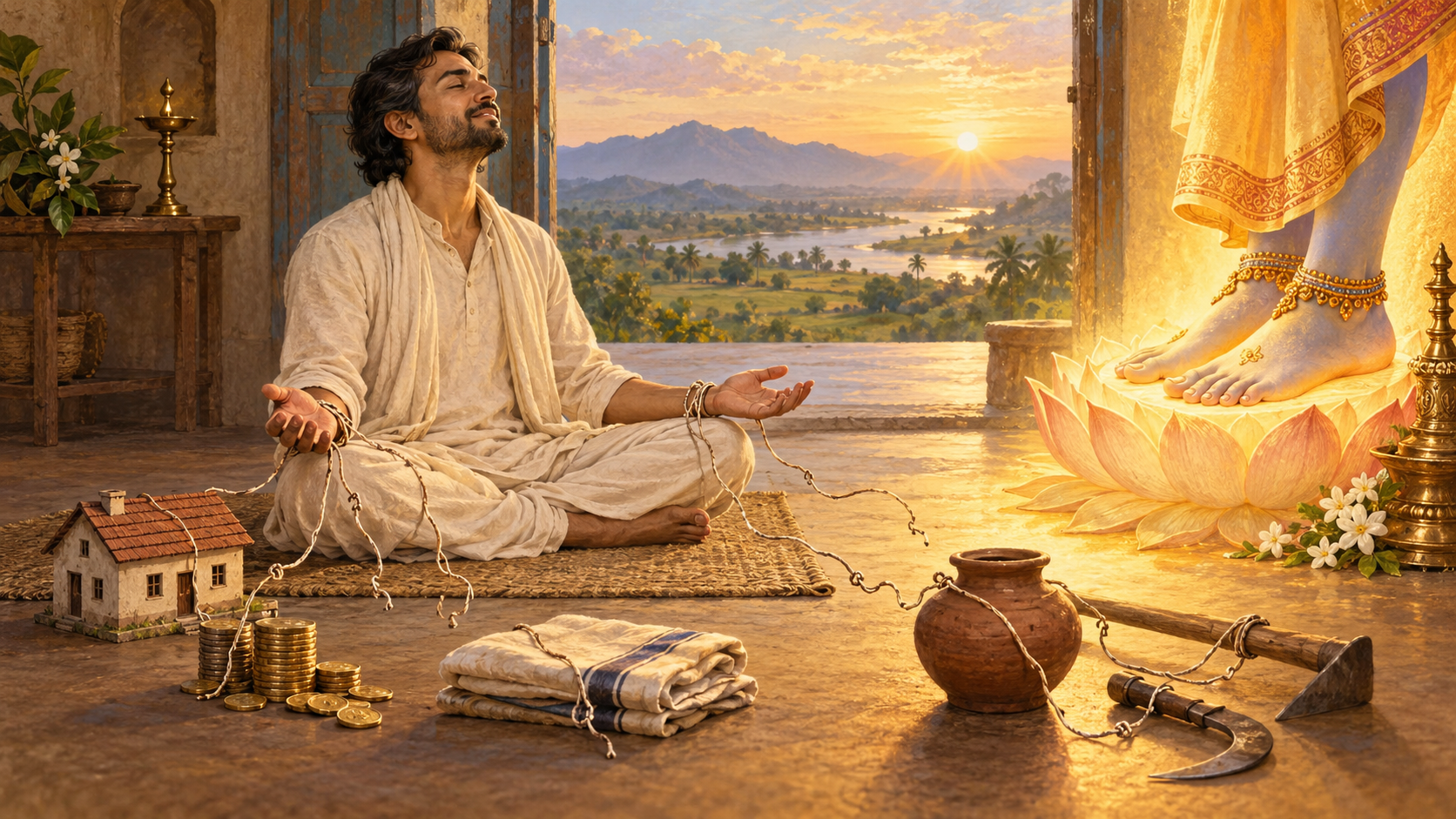
Kapila’s instruction does not end with an impressive visualization. Its culmination concerns identity. In Srimad Bhagavatam 3.28.37-38, the realized yogi has attained awareness of the true self and no longer treats the body’s movements as the centre of identity. The body and senses continue their destined course under the Lord’s arrangement, but the awakened person no longer claims the bodily condition as the self, just as someone who has awakened no longer claims a dream body.
These verses describe mature realization, not a posture that a beginner should imitate. Saying, “I am not the body,” while neglecting health, livelihood, family, or promised duties is not detachment. It is bodily irresponsibility wearing spiritual language. Kapila’s teaching removes false proprietorship; it does not remove dharma.
The practical shift is from ownership to stewardship:
- Instead of treating the body as your complete identity, care for it as an instrument entrusted for service.
- Instead of making every sensation a command, notice it and decide what dharma actually requires.
- Instead of using work to enlarge the ego, perform the work carefully and offer its result.
- Instead of measuring spiritual life by unusual experiences, notice whether the demand to control people and outcomes is weakening.
This is why meditation upon the Lord and knowledge of the self belong together. Attention fixed on Bhagavan exposes the false claim that everything revolves around the body-mind. The body continues to sit, stand, work, rest, age, and change. The self learns to stand in relation to the Lord rather than trying to be the independent owner of those changes.
Detachment should therefore make you more lucid and responsible, not less. Attend to genuine bodily needs without worshipping them. Fulfil obligations without turning them into a personal throne. If meditation leaves you frightened, unable to function, or indifferent to your safety or another person’s welfare, pause the intensive practice and seek guidance from a qualified spiritual teacher and an appropriate health professional. That condition is not a reason to push harder in the name of renunciation.
Correct the practice where it actually breaks down
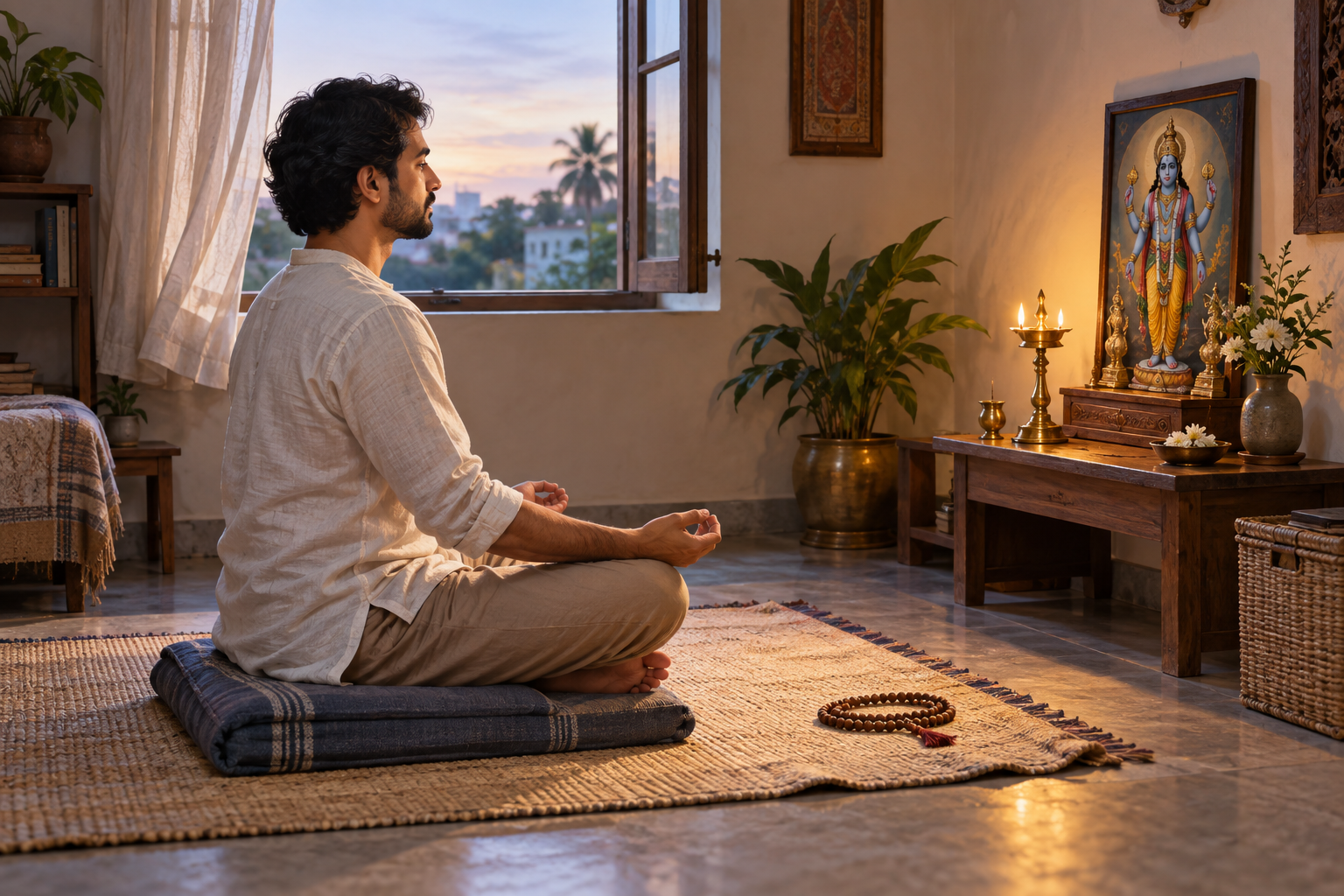
Most difficulties become manageable once you identify whether the problem lies in recollection, relationship, bodily preparation, or expectation.
- The form will not remain clear. Open your eyes and study one feature again. Close them and recall only that feature. Repeat without straining. Clarity grows through familiarity; forcing an elaborate image usually adds frustration.
- The sequence feels mechanical. Connect each feature with your relationship to the Lord. At the feet, seek shelter. At the hands, remember divine protection and service. At the face, receive the Lord’s gracious regard. The exact contemplation should remain faithful to the form and teaching you have received.
- Mantra and visualization compete. Decide which is primary in your instructed practice. Let the other remain a quiet support instead of rapidly alternating between two demanding tasks.
- Physical discomfort consumes the sitting. Adjust the posture before pain becomes the entire object of attention. Steadiness is useful; avoid making unnecessary pain into proof of devotion.
- You keep waiting for an extraordinary state. Examine the hours after meditation. Are speech and conduct less harsh? Is duty performed with less resentment? Do you remember the Lord before acting on impulse? These fruits are more revealing than mental spectacle.
- Detachment is turning into contempt. Return to service. Freedom from bodily identification should loosen egoistic division, not justify coldness toward embodied beings who are also connected to the Lord.
You can review a sitting with a few concrete questions. Did you return when the mind wandered, or spend the time resenting the distraction? Did you contemplate the Lord, or merely inspect a mental picture? Did the practice lead into prayer and service? Did it make the body a better instrument of dharma during the rest of the day? These questions keep technique subordinate to transformation.
Key takeaways
- Kapila’s meditation is personal and devotional: you repeatedly return your attention to Bhagavan rather than trying merely to suppress thought.
- Begin at the Lord’s lotus feet and proceed through the form in an ordered way. Stable attention to one feature is better than a hurried survey of the whole form.
- Use a recognized sacred form and the instruction of your sampradaya. Consistency matters more than novelty or visual intensity.
- The mature fruit is awareness of your true identity and freedom from false ownership of the body, not neglect of the body or abandonment of duty.
- Measure progress in remembrance, humility, responsible conduct, and service rather than visions or unusual sensations.
At your next sitting, make the practice smaller and more definite. Place the chosen form before you, begin at the lotus feet, and let the divine Name bring wandering attention back. Then carry that remembrance into one duty performed as service. Kapila’s method becomes lived wisdom when seeing the Lord changes both what you believe yourself to be and how you use everything entrusted to you.
References

Leave a Reply
You must be logged in to post a comment.