
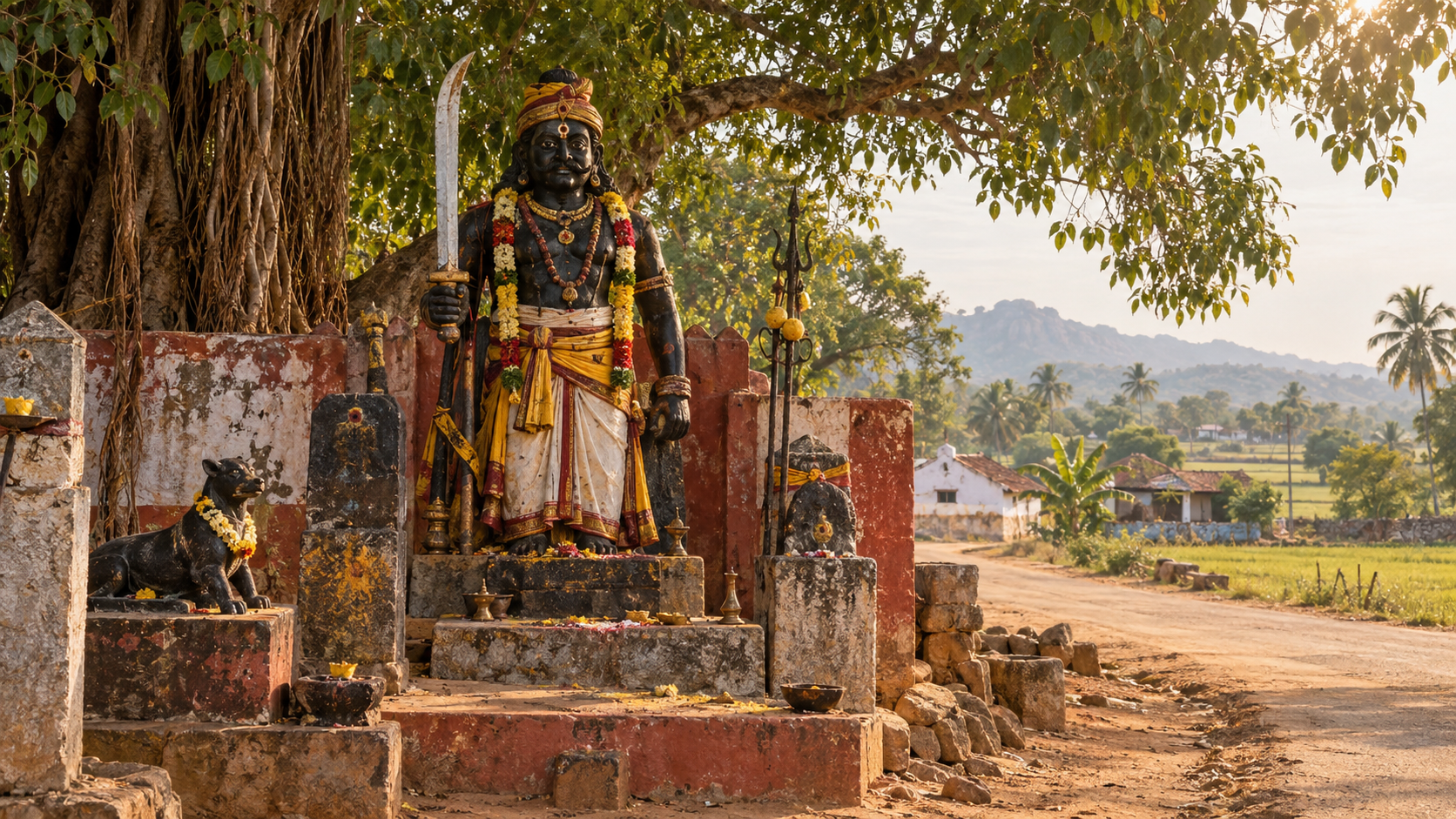
You may have encountered Karuppu Muniyandi beside a Tamil village road, heard the name in a family conversation, or seen a sword-bearing guardian identified as Karuppu Muni, Muniyappan or Muniswaran. The immediate questions are practical: Are these names interchangeable? Why does a guardian stand at the boundary? How should you approach the shrine without misunderstanding it?
The clearest answer begins with function rather than a forced universal biography. Karuppu Muniyandi belongs to a living Tamil tradition in which protection, justice and sacred land are joined. If you can read those three ideas together, the name, location and sword stop looking like disconnected pieces.
Read the name before you classify the deity
Karuppu Muni is revered across Tamil Nadu and among Tamil communities abroad under related names such as Karuppu Muniyandi, Karuppu Muniyappan and Karuppu Muniswaran. These names place him within the wider devotional family known as Muneeswaran or Muniyandi.
The Tamil word karuppu means black or dark and refers here to the guardian’s complexion. Muni means a sage. That combination matters because it prevents two common mistakes. Darkness should not be imported into an English-language moral scheme in which black automatically means evil, and the guardian should not be reduced to a frightening warrior image while the word muni is ignored.
The several names indicate a religious family resemblance, but they don’t give an outsider permission to flatten every local identity into one standardized figure. A community may favor one name, pronunciation or understanding. Use the name spoken at that shrine. If you are documenting the tradition, record variants as variants instead of silently replacing them with the term most familiar to you.
This gives you a reliable first rule: begin with the local name, then ask about the local role. A dictionary meaning is useful, but it cannot substitute for the relationship between a guardian, a place and the people who worship there.
Boundary, sword and justice form one religious grammar
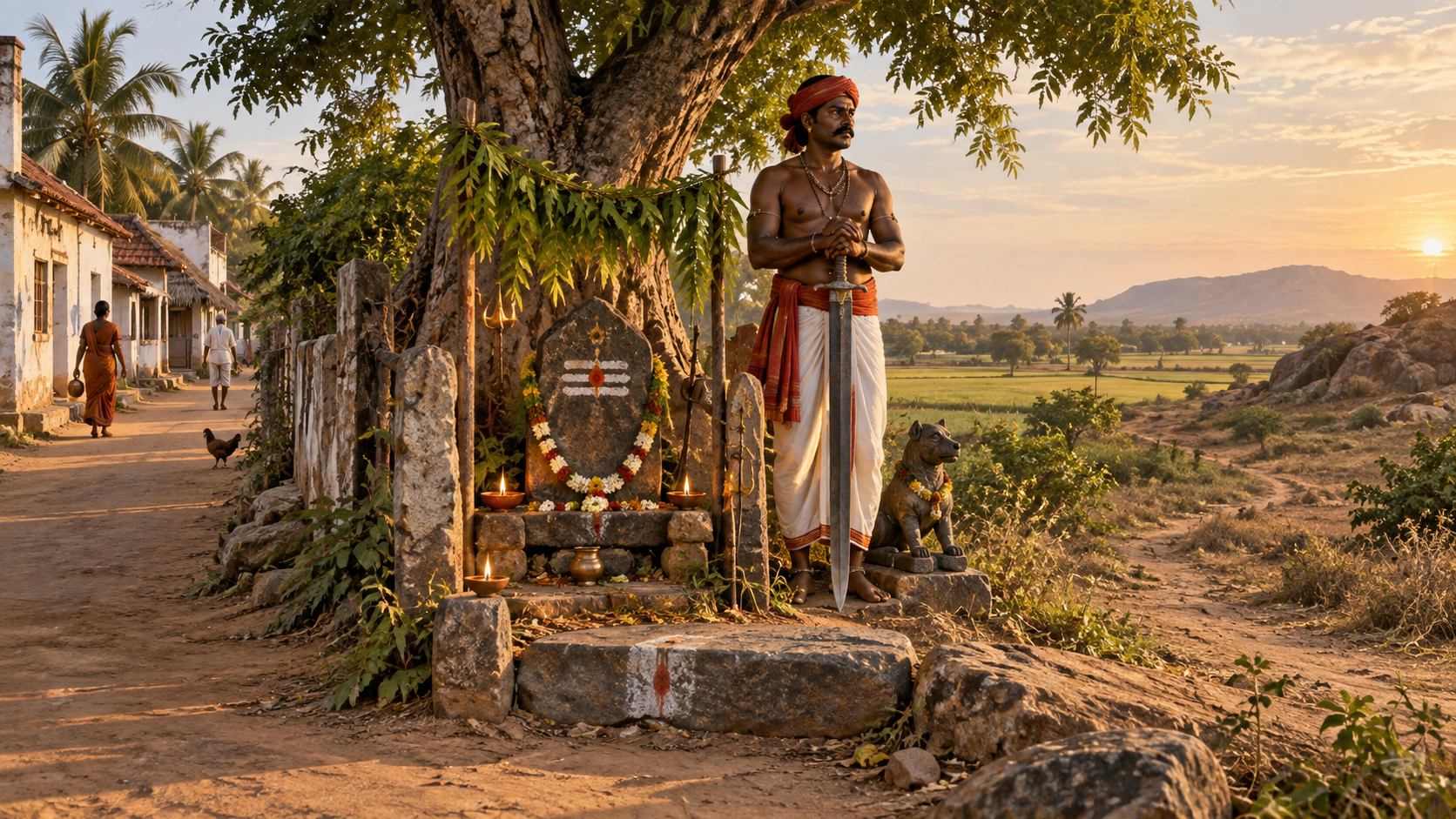
A guardian at the edge of a settlement can be misread as a deity of lesser rank because the shrine is not at the geographical center. That reading misses the importance of a boundary. The edge is where the protected space meets what lies beyond it. A presence stationed there is not being pushed aside; it is being entrusted with the point at which order is most exposed.
The sacred land in this tradition is more than an area on a map. It is a lived field of belonging, responsibility and protection. The guardian’s relationship to that land makes religion concrete. Protection concerns a real community and a real place, while justice concerns the order that allows both to endure.
The sword holds those meanings together. It signals the capacity to confront harm, but it is not merely an emblem of aggression. Beside a guardian associated with justice, the weapon points to protection backed by authority. Separating the sword from justice produces a caricature of violence; separating justice from the sword turns guardianship into an abstraction with no power to defend anything.
When you encounter the imagery, read it through three questions. What land or community is being protected? What kind of disorder does guardianship answer? What obligation does the language of justice place on the worshipper as well as on the divine protector? The third question is crucial. It keeps devotion from becoming a demand that the deity punish other people while leaving the devotee’s own conduct unexamined.
This is also why labels such as village deity or folk deity must be used carefully. They can describe a setting, but they should not imply that the worship is spiritually shallow, frozen in the past or outside the Hindu world. A tradition can be intensely local and still express recognizably Dharmic concerns: the sanctity of place, the restraint of disorder, reciprocal duty and justice lived through community.
Local variation is part of the tradition, not a defect
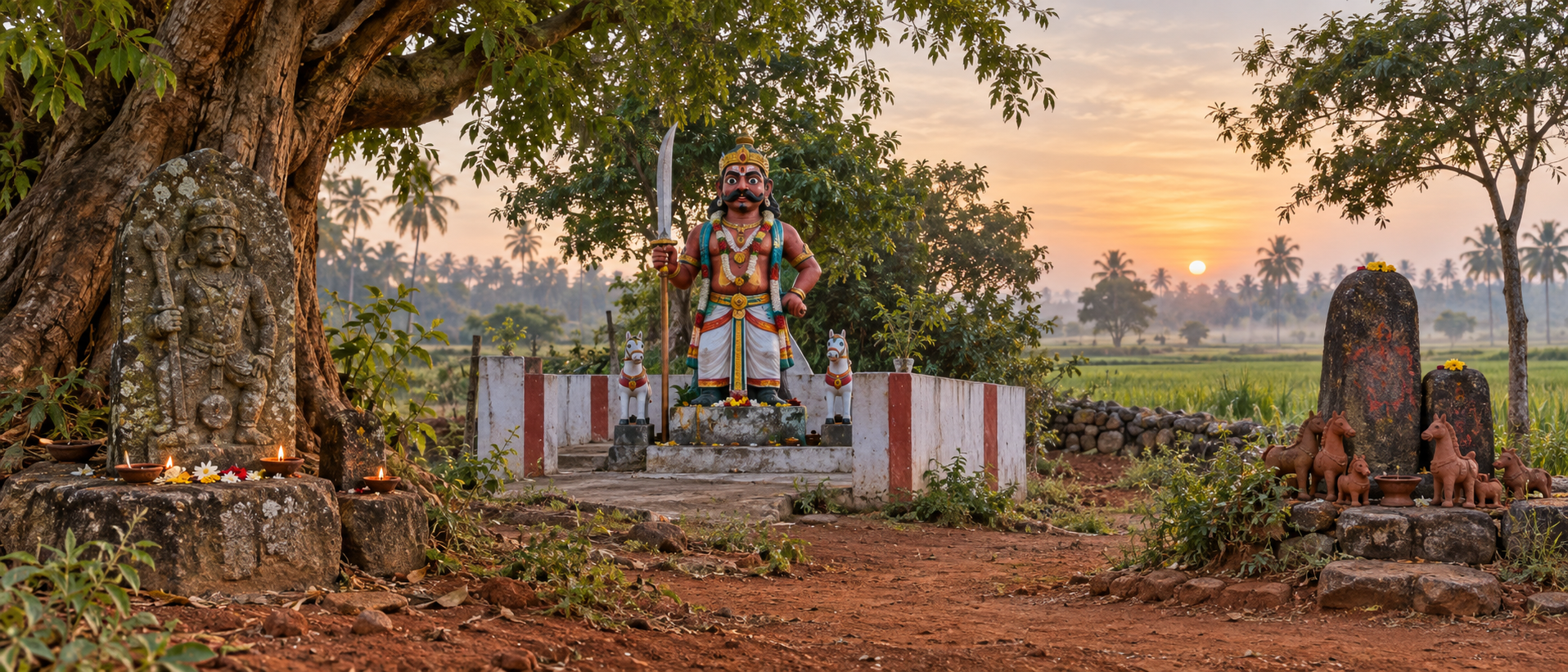
People accustomed to standardized manuals often look for one definitive account of Karuppu Muniyandi: one origin story, one iconographic checklist and one universally correct ritual sequence. A place-based guardian tradition does not need to conform to that expectation. Its local character is not incomplete theology awaiting correction.
The practical consequence is simple: don’t turn a custom observed at one shrine into a rule for every shrine bearing a related name. Names may overlap while histories, responsibilities and practices retain local distinctions. If two devotees give you different explanations, first ask whether they belong to different places or communities. Variation may explain the difference more accurately than declaring one person wrong.
The Tamil diaspora adds another layer. A guardian worshipped beyond Tamil Nadu can remain connected to Tamil sacred memory without reproducing every feature of a village setting. When a tradition travels, continuity and adaptation can coexist. Ask what the community has preserved, what it has adapted and which local instructions now govern the shrine. Do not assume that distance from the ancestral landscape makes the devotion less authentic.
If you are researching or writing about Karuppu Muniyandi, keep three kinds of information separate in your notes: the exact name used at the site, the explanation given by people attached to that site, and your own broader interpretation. This small discipline prevents a local statement from being presented as a universal doctrine. It also makes your account more useful to the next reader, who can see where observation ends and interpretation begins.
Textual pedigree should not be used as the only test of religious legitimacy. Local continuity, customary authority and a community’s sustained relationship with a guardian are forms of religious knowledge too. You can study them seriously without romanticizing every custom or forcing the deity into a genealogy the worshippers themselves do not use.
How to approach a Karuppu Muniyandi shrine respectfully
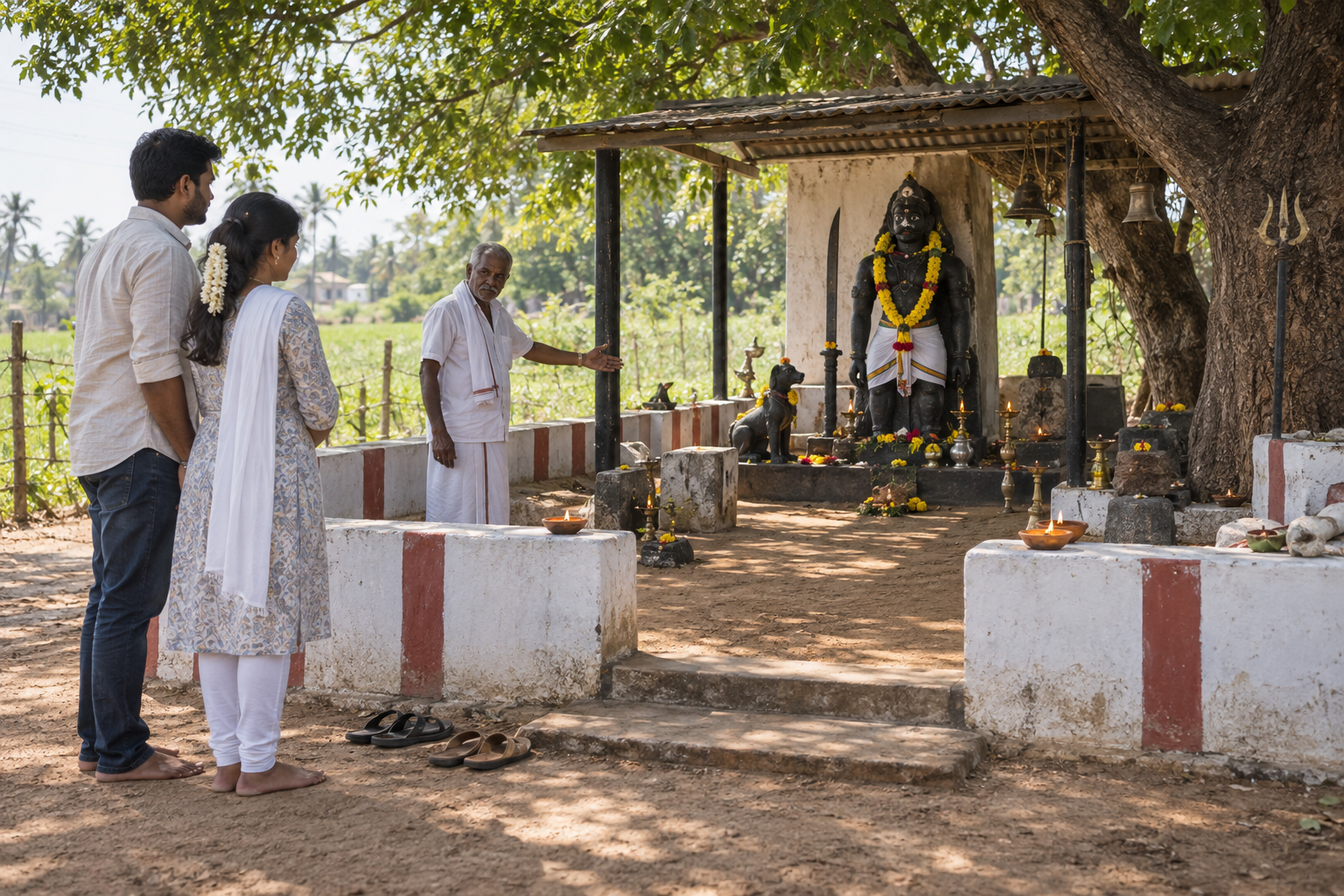
You do not need to pretend that you already understand the shrine. Respectful uncertainty is better than confident improvisation. Use this sequence when visiting a shrine or attending worship with a Tamil community:
- Pause before entering. Notice where other people stand, whether footwear is removed and whether any part of the site is treated as restricted. A boundary shrine can have meaningful boundaries of its own.
- Ask for the local name. Do not begin by announcing what you think the deity must be. Ask which name the community uses and repeat it accurately.
- Ask about conduct before objects. The most useful first question is how a visitor should pray or pay respect, not how old, rare or photogenic the shrine may be.
- Request permission before photographing or touching anything. A sword, image, ritual object or offering is not public scenery merely because it is visible from a road.
- Do not invent an offering or promise. If you are invited to participate, ask what the act means and follow the instructions given there. If no knowledgeable person is available, quiet observation is safer than copying a rite from another shrine.
- Describe only what you can support. If you later publish photographs or commentary, identify the place and locally used name. Do not present one community’s explanation as the single doctrine governing all Muniyandi or Muneeswaran worship.
Four questions usually open a better conversation than a demand for a complete mythology: What name is used here? What does the guardian protect? Is there a customary way for a visitor to show respect? Is photography permitted? Each question gives local practitioners room to define their own shrine.
Avoid describing the worship as primitive, superstitious or merely fear-based. Those labels announce the observer’s hierarchy rather than explain the devotion. At the same time, respectful study does not require you to manufacture agreement or claim initiation you do not possess. State what you saw, credit the local explanation and mark your interpretation honestly.
Key takeaways
- Karuppu Muniyandi is a dark-complexioned Tamil guardian associated with the broader Muneeswaran or Muniyandi family; muni also carries the meaning of sage.
- Karuppu Muniyandi, Karuppu Muniyappan, Karuppu Muni and Karuppu Muniswaran are related names, but local usage should determine how you identify a particular shrine.
- The boundary is a position of responsibility: it marks the point where sacred land and communal order require protection.
- The sword should be read together with justice. It represents protective authority, not violence detached from moral purpose.
- When visiting, ask about the local name and customary conduct, seek permission before taking photographs, and never convert one shrine’s practice into a universal rule.
The next time you encounter Karuppu Muniyandi, carry four words with you: name, place, protection and practice. Learn the name people actually use, notice the place the guardian holds, ask what is protected, and follow the practice taught there. That approach will take you further than a hurried search for one standardized story.
Most importantly, let the boundary correct your point of view. What appears peripheral on a map may be central to a community’s understanding of safety, justice and sacred belonging.
References

Leave a Reply
You must be logged in to post a comment.