

You may have seen Murugan holding a flower and wondered whether the image softens his martial character. It does something more demanding: it shows what strength is for.
The flower does not ask you to choose between courage and devotion. It places them in the same hand. Murugan remains the warrior, but his power does not become an object of self-worship. If you are carrying responsibility, entering a conflict, or enjoying a hard-won success, the image asks a practical question: can you use your strength fully without making yourself its ultimate beneficiary?
Why the flower belongs in a warrior’s hand
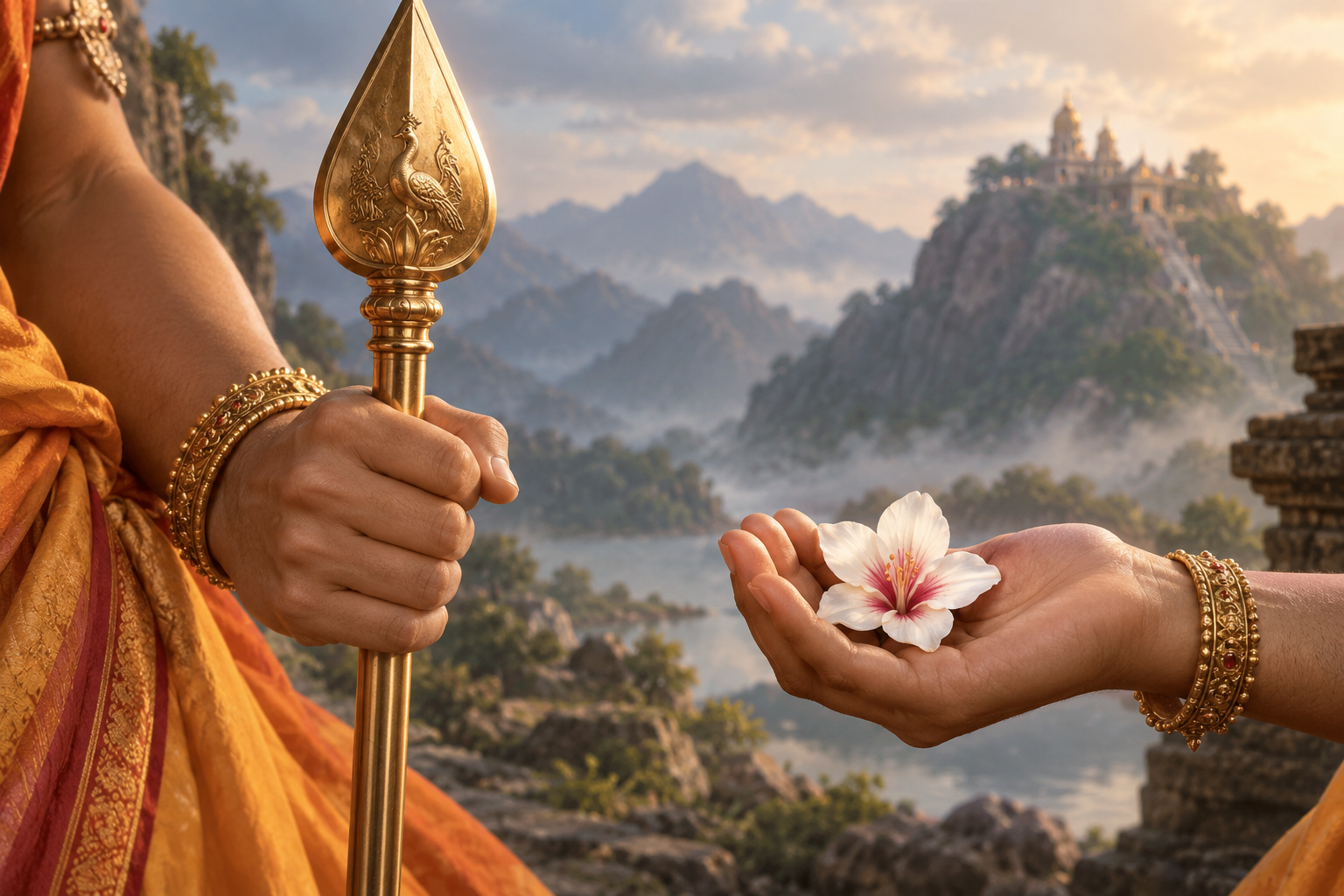
Whether you know him as Murugan, Skanda, Subrahmanya, Kartikeya, Kumara, or Shanmukha, the contrast is deliberate. Murugan is revered as the commander of the celestial armies and the destroyer of Surapadman. A flower in his hand must therefore be read beside his warrior identity, not in place of it.
A weapon can compel. A flower cannot. A weapon marks the capacity to confront what must be confronted; a flower, read as an offering, expresses reverence and surrender. Their relationship gives the image its spiritual force. Murugan possesses power, governs it, and refuses to treat its fruits as personal trophies.
That sequence matters. Strength without restraint becomes domination. Restraint without strength can become avoidance. Strength and restraint without surrender can still leave the ego enthroned. The flower completes the warrior because it reveals the inner direction of his power.
This is divine humility: not the absence of greatness, but greatness that does not turn inward and demand worship. Murugan does not become less capable when he assumes the disposition of a devotee. His capability becomes rightly ordered.
What divine humility does and does not require
It does not require you to belittle your abilities
False humility says, “I have no strength,” even when strength is plainly present. Divine humility says, “This strength is not self-justifying, and it must serve something higher than my image.” The first statement hides capacity. The second places capacity under discipline.
If you lead well, know your subject, endure difficulty, or can speak decisively, you do not honour Murugan by pretending otherwise. Name the ability honestly. Then ask what dharmic responsibility comes with it. Competence becomes dangerous when you use it to establish superiority rather than fulfil duty.
It does not require withdrawal from conflict
The flower does not cancel the warrior. You may still need to oppose wrongdoing, enforce a boundary, correct an error, or deliver an unwelcome decision. Humility changes the motive, manner, and aftermath of that action; it does not automatically make inaction virtuous.
Before a confrontation, ask: “Am I protecting what is right, or am I protecting my need to appear right?” Both motives can produce forceful language, but only one remains answerable to dharma. If correction is necessary, make the correction. Remove the unnecessary insult, the public spectacle, and the desire to prolong another person’s defeat.
It is not a performance of modesty
Performative humility keeps the self at the centre. It announces sacrifice, fishes for reassurance, or turns every act of service into evidence of personal goodness. The flower points in the opposite direction: an offering is directed away from the one who holds it.
You can test your humility by looking at what happens after success. Do you assign credit accurately? Can you receive praise without becoming dependent on it? Can you complete an unnoticed duty without manufacturing an audience? These are more reliable measures than modest language.
A practical way to contemplate Murugan’s flower

You do not need to turn the image into an abstract puzzle. Bring one real decision to it. The following exercise can be used before a Murugan image in a temple or at home, or simply as a moment of reflection before you act.
- Look at the whole form. Notice the flower without mentally removing Murugan’s warrior identity. Hold both aspects together: the one who can confront also offers.
- Name one actual capacity. Choose something concrete: authority over a decision, command of a subject, physical courage, persuasive speech, endurance, or the ability to protect another person. Do not exaggerate it, and do not deny it.
- Identify the duty attached to that capacity. Ask what the situation genuinely requires from you. Separate that duty from your wish to win admiration, punish an opponent, avoid embarrassment, or control every outcome.
- Find the flower in the decision. Choose one act that keeps strength under devotion: credit a collaborator, apologise without adding an excuse, say no without contempt, correct someone privately, accept a necessary loss of status, or complete useful work without seeking recognition.
- Act within a definite time. Do not let contemplation become delay. If the matter is ready for action, choose the next observable step and do it within the day.
- Release the result. You might close with a simple intention: “Let this ability serve dharma. Let its fruit not enlarge my ego.” This is not a demand that events unfold as you prefer; it is a discipline for how you will meet the outcome.
The same practice works at different moments. Before conflict, it purifies your motive. After victory, it prevents success from hardening into vanity. After failure, it keeps humility from collapsing into shame: acknowledge the error, make the repair, and return to duty.
How to read the symbol without inventing certainty
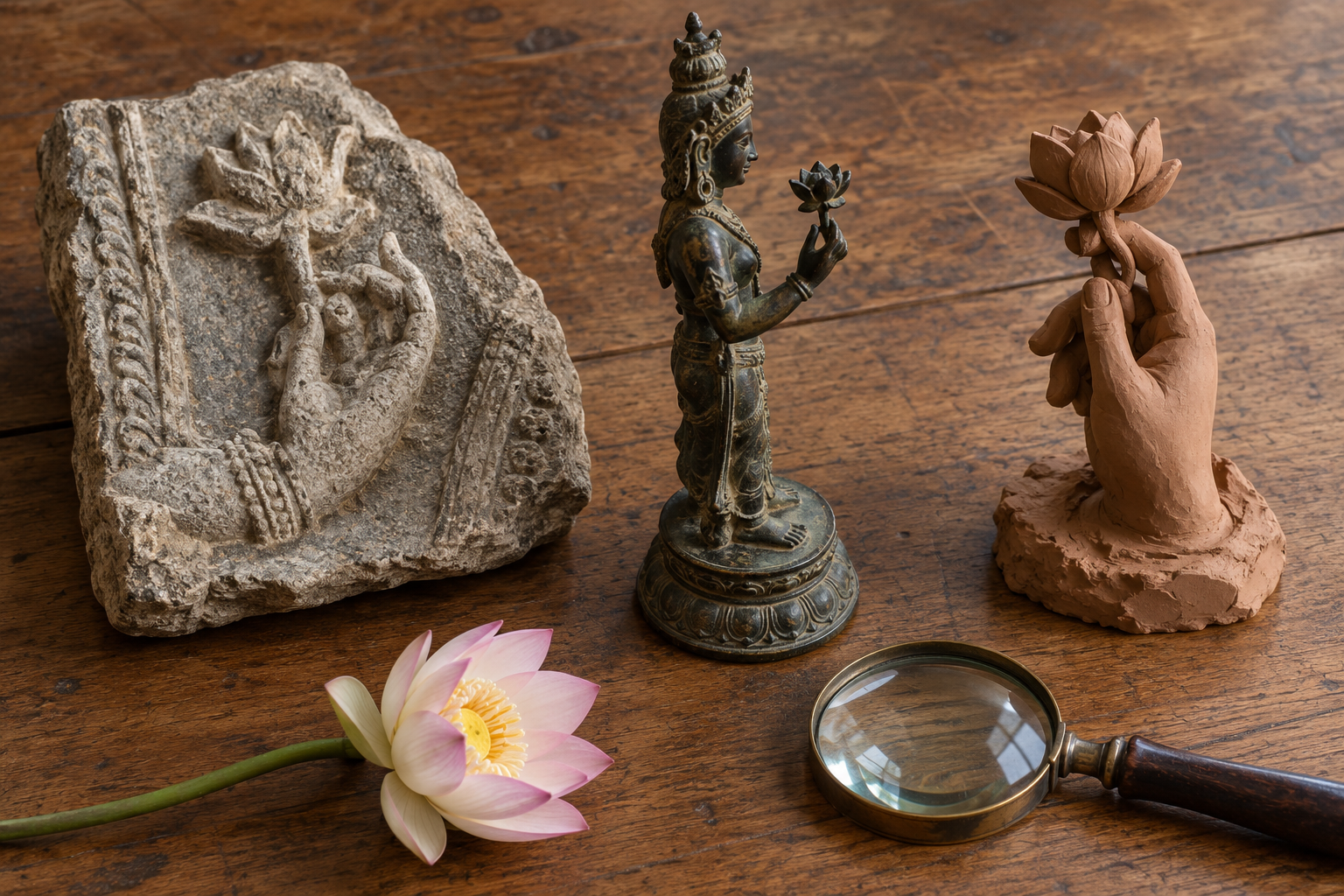
Sacred iconography deserves attentiveness, but attentiveness is not the same as claiming more than an image tells you. Begin with what is visibly present. Then consider the relationship among the elements. Only after that should you move to spiritual interpretation.
For Murugan’s flower, the careful formulation is that the flower can be read as a sign of devotion, offering, and humility in relation to his warrior nature. That is stronger than a vague claim that flowers merely represent goodness, and more responsible than asserting that every flower in every Murugan image carries one fixed meaning.
Do not assign a botanical species when the image or its temple tradition does not identify one. Do not detach the flower from the rest of the form. Do not turn one symbolic reading into a universal rule for every regional, artistic, or sampradaya context. If a temple preserves a specific explanation, give that local tradition priority when discussing that particular murti.
Most importantly, reject interpretations that make humility synonymous with humiliation. Murugan’s example does not tell you to tolerate adharma, conceal competence, or surrender a necessary boundary. The flower disciplines power; it does not hand power over to those who would misuse it.
Key takeaways
- Murugan’s flower completes his warrior form rather than contradicting it.
- Divine humility means placing real capability in the service of dharma, not pretending to be incapable.
- The symbol is especially useful before confrontation and after success, when ego can easily imitate righteous purpose.
- A sincere response should produce an observable act: cleaner speech, accurate credit, a necessary apology, a firm boundary without contempt, or service without display.
- Interpret the flower in relation to the whole form, and do not invent a species or universal iconographic rule without support from the relevant tradition.
The next time you stand before Murugan, do not ask only for enough power to overcome the obstacle. Ask for the harder grace: to remain an offering-bearer when power arrives, when the conflict ends, and when victory gives you a reason to think everything was yours.
References

Leave a Reply
You must be logged in to post a comment.