
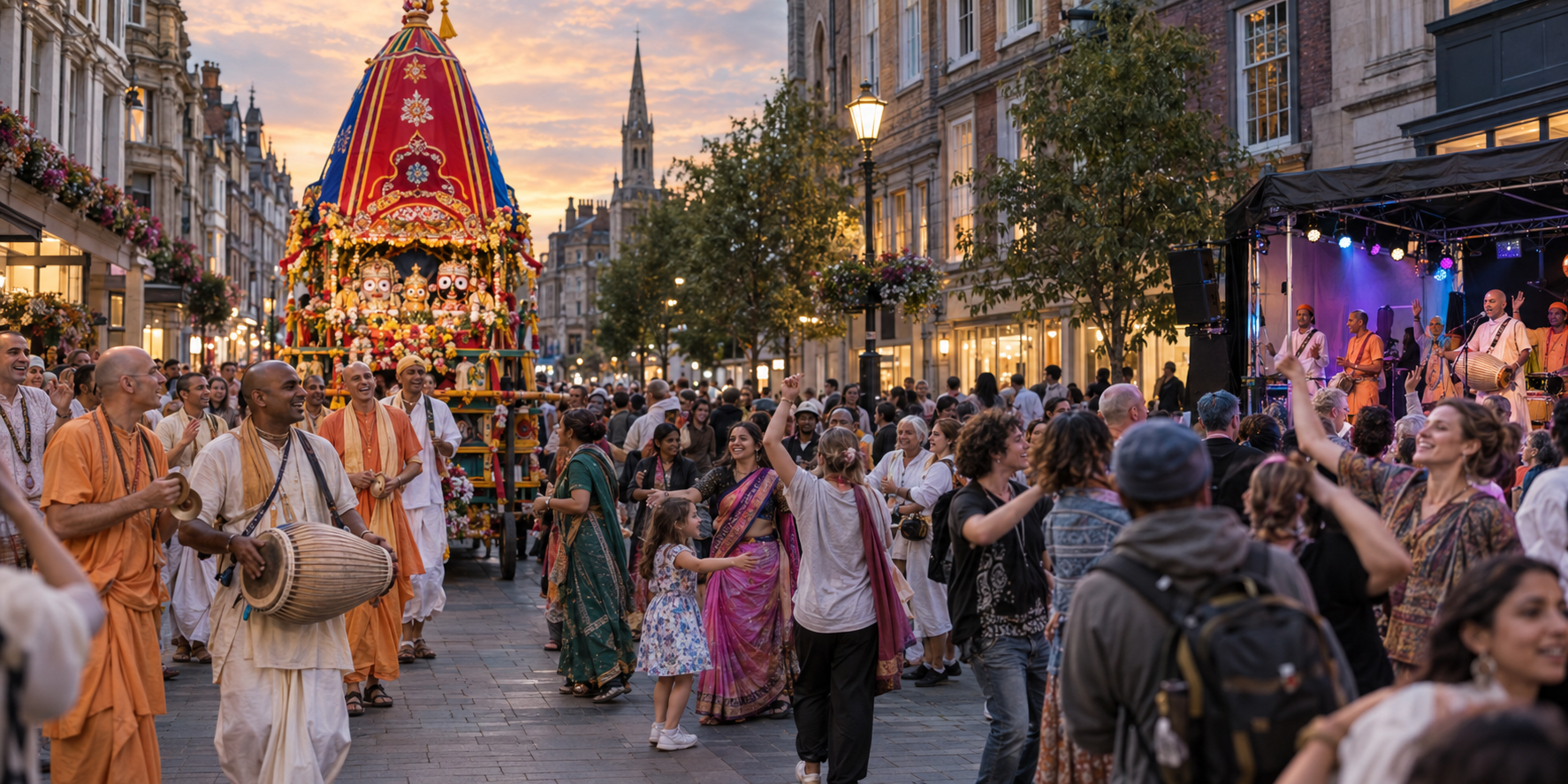
You hear the maha-mantra and hand cymbals on an English high street, encounter a chariot procession in a city centre, or see a Hare Krishna event promoted with the language of contemporary music. Should you treat it as worship, cultural celebration, entertainment, or an invitation to spiritual practice?
The useful question is not whether the presentation looks old or new. Ask whether it makes Krishna-bhakti intelligible, lets you participate without pressure, and offers a clear path from a striking public encounter to sustained spiritual practice.
One devotional purpose can take very different public forms
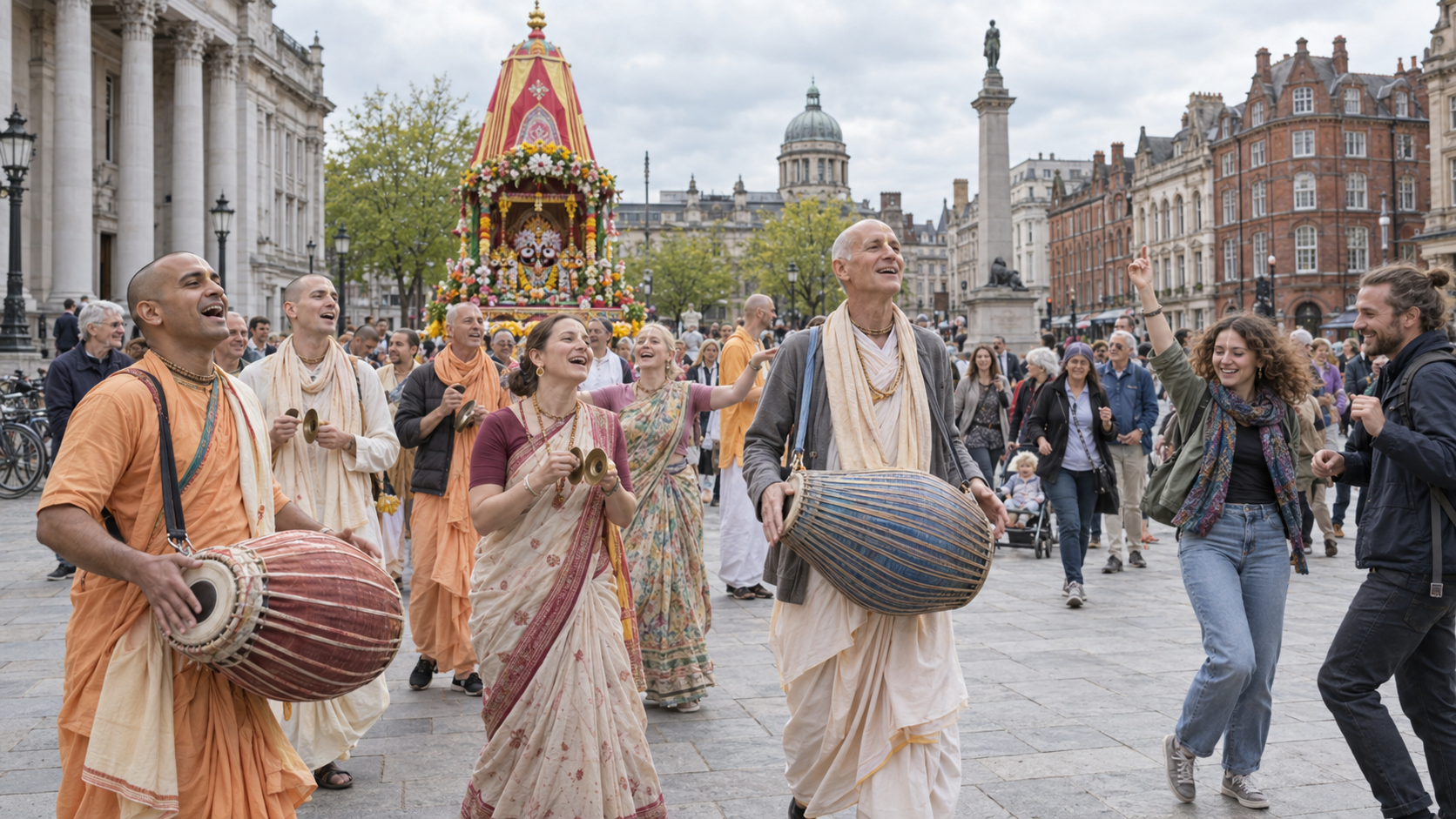
England recently offered two contrasting examples. Sheffield welcomed Ratha Yatra again after a gap described as roughly 10–15 years. In London, an outreach event on 3 October 2026 was presented as Hare Krishna Goes RAVE.
These formats should not be collapsed into the same thing. Ratha Yatra is a sacred chariot festival that brings darshan, chanting and collective service into public space. A rave-style presentation borrows a contemporary musical frame that may feel more familiar to people who would not ordinarily enter a temple. The former begins with a recognisable devotional tradition; the latter begins with a cultural doorway.
Neither tradition nor novelty guarantees good outreach. A chariot can pass through a city without helping an onlooker understand what is happening. A contemporary music event can attract attention while leaving Krishna almost invisible. The format succeeds only when it carries the devotional purpose rather than replacing it.
This is where sankirtana differs from ordinary promotion. Public chanting is not merely an advertisement for a spiritual activity located somewhere else. Chanting the divine names is itself the practice. A passer-by may listen, repeat the mantra, dance, ask a question or simply receive a respectful first impression. Outreach therefore begins during the encounter, but it should not end there.
- At the centre: Can you identify the maha-mantra, Krishna and the devotional purpose, or only the spectacle?
- At the threshold: Can a newcomer watch and ask questions without being embarrassed, cornered or pressured?
- Beyond the event: Is there an understandable next step, such as a beginner-friendly kirtan, temple visit, Bhagavad-gita discussion or community gathering?
A large crowd shows that an event was visible. It does not tell you whether people understood it, trusted the hosts or found a way to continue. Reach and spiritual depth are different outcomes, and serious outreach plans for both.
How to assess and join an event without guesswork
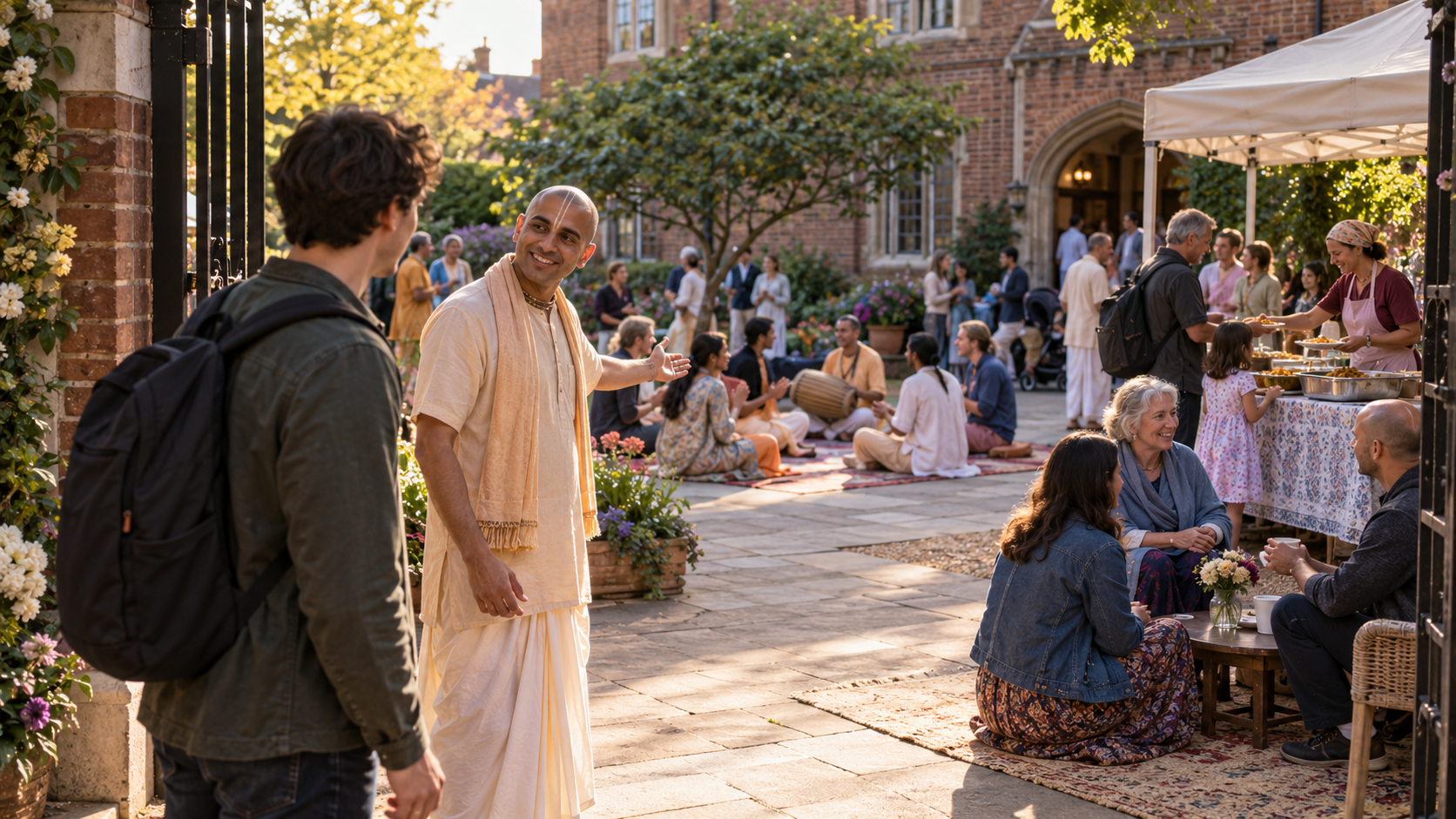
If you are curious but unfamiliar with Hare Krishna practice, you do not need to decide immediately whether you accept its theology. Begin by observing how the community handles four things: meaning, invitation, conduct and continuity.
- Meaning: Look for the mantra in readable form and for a plain explanation of why it is being chanted. Sacred sound need not be reduced to a slogan, but newcomers should not be expected to decode an unexplained scene.
- Invitation: Healthy participation is voluntary. You should be free to listen, chant, dance or step away. Warmth is appropriate; emotional or social pressure is not.
- Conduct: Notice whether hosts treat passers-by, neighbours, venue staff and people who decline with equal courtesy. Public devotion should make discipline visible as well as enthusiasm.
- Continuity: Ask which community is hosting, where its regular practice takes place and what gathering is suitable for a first visit. A clear answer is more useful than a handful of vague invitations.
At a Ratha Yatra, let the procession’s stewards guide you. Keep clear of moving equipment, do not touch the chariot or ritual objects unless invited, and ask before entering an area whose purpose is unclear. You can usually participate most naturally by listening to the kirtan, repeating the mantra when comfortable and speaking with a designated host rather than interrupting someone engaged in worship or service.
At a music-led indoor event, do not infer the programme from the word “rave” alone. Ask what the evening contains: congregational kirtan, a DJ presentation, teaching, meditation, prasadam or some combination. The answer will tell you whether the contemporary language describes the musical energy, the venue, the intended audience or the entire character of the gathering.
If food is offered as prasadam and you have an allergy or strict dietary requirement, ask about the ingredients rather than treating the devotional designation as an ingredient list. If you want photographs, remember that a public setting does not remove the need for courtesy, especially around children, close-up portraits and moments of worship.
Before leaving, choose a next step small enough that you will actually take it. Save the location of a regular gathering, learn the maha-mantra accurately, obtain an introductory text you intend to read, or arrange to attend with someone you trust. Otherwise, even a powerful evening can remain only an unusual memory.
Organisers should build a bridge, not a single spectacle
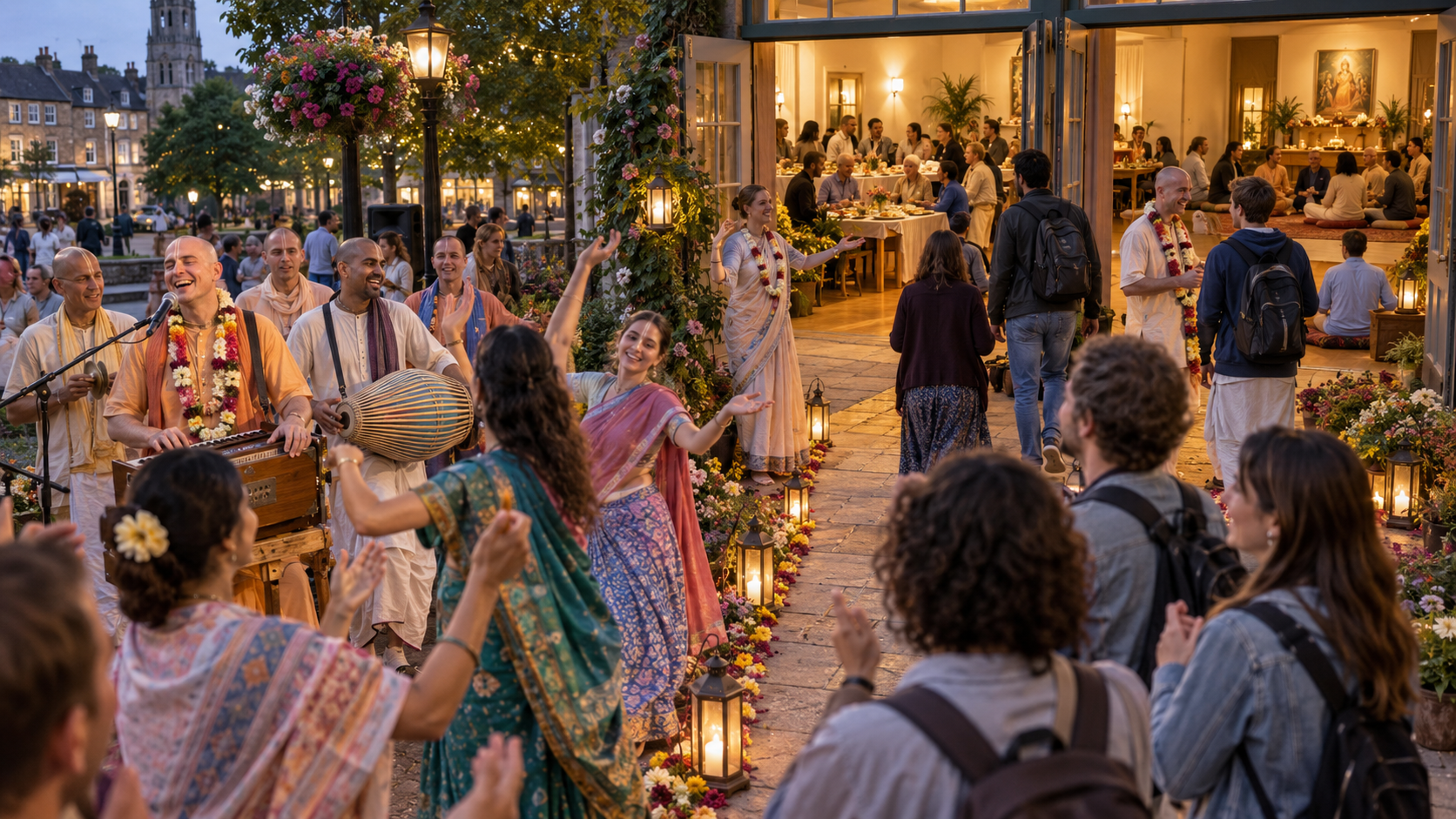
If you are helping to organise Hare Krishna outreach in England, begin with the change you hope to make in the newcomer’s understanding. “Create a lively event” is too vague. A more useful aim is that someone who arrives knowing nothing can recognise the maha-mantra, understand that the gathering is an expression of Krishna-bhakti, participate freely and know where to continue.
- State the devotional centre in plain language. Write the explanation that a host should be able to give without insider vocabulary. If the team cannot say what the gathering is for, the public will read it through appearance alone.
- Separate the non-negotiable core from the adaptable wrapper. The mantra, devotional integrity and respectful conduct belong to the core. Music production, visual design, venue choice, programme length and explanatory language can be adapted to the audience.
- Design the newcomer’s arrival. Use visible hosts, readable information and an obvious place for questions. Do not make an interested passer-by push through an established social circle to discover what is happening.
- Assign hospitality and operational responsibility. The person leading kirtan cannot simultaneously answer every question, watch every boundary and solve every practical problem. Give named volunteers clear roles before the public arrives.
- Confirm current local requirements before promotion. A procession, public-space gathering and indoor music event present different operational questions. Check the relevant council, landowner or venue requirements, access arrangements and safety conditions for the particular event rather than relying on memories from a previous year.
- Arrange the next gathering before advertising the main one. Public interest decays when the reply to “What happens next?” is “Follow us and wait.” A date, place and beginner-appropriate invitation turn curiosity into a real path.
- Preserve institutional memory. Record contacts, responsibilities, decisions, equipment needs, problems and improvements while they remain fresh. Sheffield’s return after a long interval is a reminder that revival is possible, but continuity becomes much easier when practical knowledge survives changes in the volunteer team.
Contemporary presentation requires a particularly clear test: does it translate Krishna consciousness or conceal it? Someone may first approach because of rhythm, production or atmosphere. They should not leave believing that Hare Krishna is merely a musical brand. Put the maha-mantra, the devotional identity of the gathering and the route to further practice in plain sight.
The opposite error is to attract people through music and then treat their unfamiliarity as a defect. A newcomer does not need a dense lecture before being allowed to participate. Offer a concise explanation at the threshold and make greater depth available without forcing it into every moment of the programme.
England is not a single outreach environment. A city-centre procession, neighbourhood festival, university gathering and nightlife-oriented venue place people in different frames of mind. Keep the spiritual identity consistent, but adapt the first explanation, volunteer deployment and next-step invitation to the setting in front of you.
Afterward, evaluate more than attendance or online visibility. Ask whether first-time visitors could explain what they encountered, whether questions received clear answers, whether interested people accepted a concrete follow-up, whether neighbours and venue staff were treated well, and whether the team could repeat the programme sustainably. A useful final test is simple: would the gathering still serve its devotional purpose if no photographs or social-media clips were produced?
Key takeaways
- Judge Hare Krishna outreach by the clarity of its devotional centre, not by whether its presentation is traditional or fashionable.
- Ratha Yatra and rave-style outreach can open different doors, but each needs an intelligible connection to Krishna-bhakti.
- As an attendee, look for voluntary participation, respectful conduct, understandable teaching and a concrete route to continued practice.
- As an organiser, plan the follow-up gathering before launching publicity for the main event.
- Measure understanding, trust, return participation and repeatability alongside public reach.
If you encounter Hare Krishna outreach in England, stay long enough to ask where the practice continues after the procession or music ends. If you are organising it, establish that continuing destination first and build the public event as a clear, hospitable bridge toward it.
References
- Dandavats — Weekly Feed Archive, October 4, 2026
- Dandavats — Hare Krishna Goes RAVE in London, 3.10.26

Leave a Reply
You must be logged in to post a comment.