

You may be planning a Devi pilgrimage, choosing a form for home worship, or trying to understand why families address the Divine Mother by so many names. The difficulty is not a shortage of names. It is knowing how to approach one form without reducing every Devi to a label, a wish, or a stop on an itinerary.
A sound beginning requires four things: the Devi’s name, the divine work her form reveals, the place or community in which she is worshipped, and the conduct her worship asks you to carry into ordinary life. That map will take you further than an indiscriminate catalogue of temples.
Read each form as a relationship, not an entry in a list
Devi means “goddess” in Sanskrit, while her many forms express different aspects of Shakti, the divine feminine power. This gives you a useful starting point, but it does not make the forms interchangeable. A particular name gathers a particular katha, mode of worship, sacred setting, and relationship with devotees.
You therefore do not need to rank the forms or force them into a single neat chart. Ask what each form teaches you to notice. Annapurna directs attention toward nourishment. Kaila Devi carries the devotional identity of a particular temple and community. The name is not decorative; it tells you how the relationship is being approached.
When you encounter an unfamiliar form of Devi, use these four questions:
- What does the name reveal about the way devotees approach her?
- Which katha gives the form its meaning, and what human duty does that katha illuminate?
- Is the form rooted in a particular temple, region, family, or inherited tradition?
- What conduct would make the devotion visible after the prayer ends?
If your family already has an inherited Devi tradition, begin there. Ask elders not only for the name, but also for the associated katha, customary offerings, important occasions, and remembered obligations. A living tradition is transmitted through reasons and practices, not merely through a photograph on an altar.
Annapurna turns reverence for Devi toward nourishment
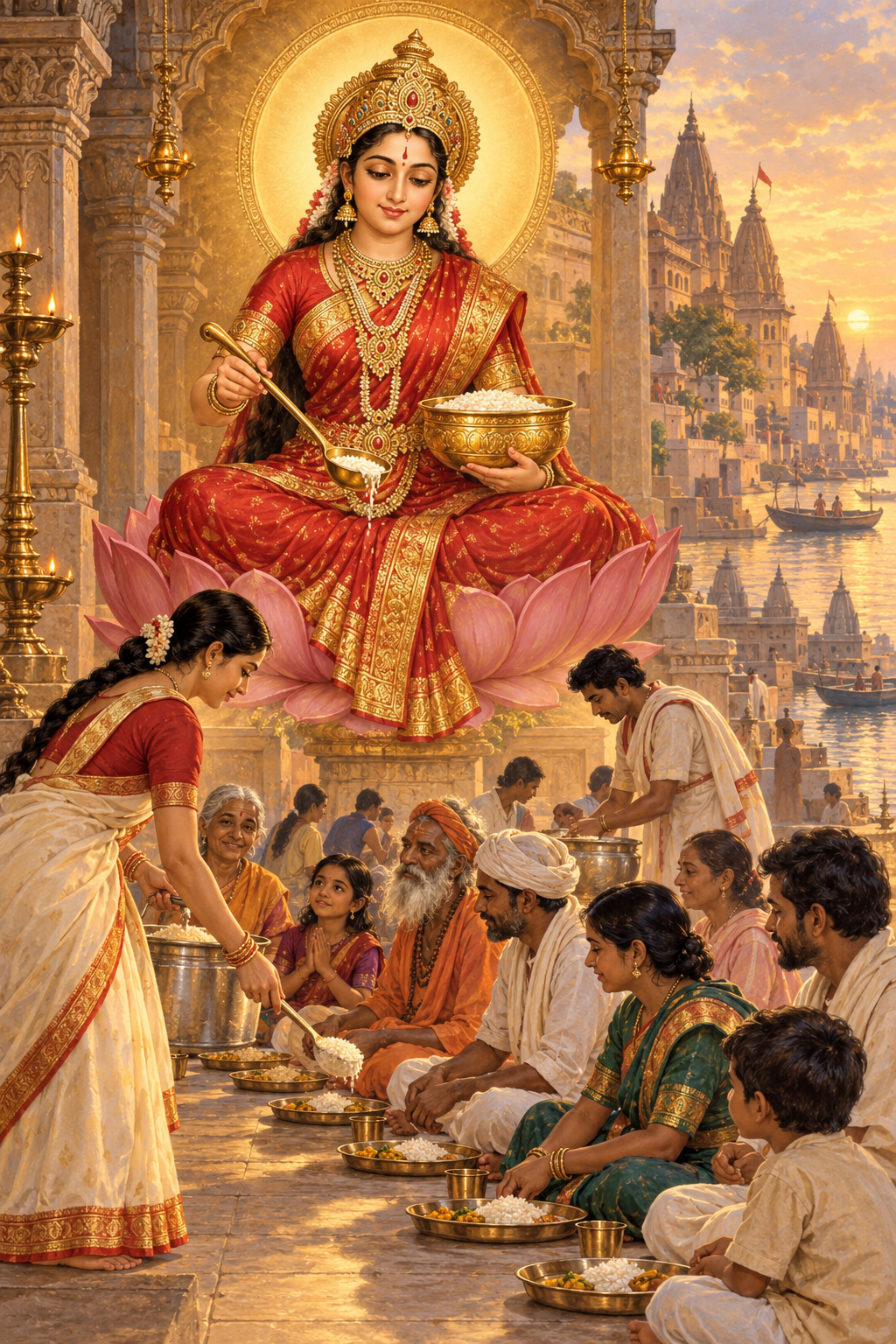
Annapurna is revered as the provider of food and nourishment to living beings, and her katha is situated in Kashi, or Varanasi, in connection with Shiva and Parvati. Her form directs the devotee toward something so constant that it is easily taken for granted: every embodied life depends upon nourishment.
That insight changes the meaning of worship. Food is no longer only a private possession or a product bought for consumption. It becomes a gift sustained by land, labour, water, skill, and grace. Gratitude that never affects the way you handle food remains incomplete.
You can begin living the teaching without inventing an elaborate ritual:
- Read or retell the Annapurna katha before choosing prayers or offerings. Let the relationship come before the ritual accessories.
- Pause before a meal and acknowledge the human and natural chain that brought it to you.
- Reduce avoidable waste in your own kitchen. Reverence for nourishment and careless disposal of edible food pull in opposite directions.
- Feed another person, contribute usable food, or support a meal with attention to dignity rather than recognition.
These actions are not presented as a replacement for a prescribed family or temple rite. They are ways to prevent devotion from becoming detached from its meaning. If Annapurna draws you toward Kashi, learn the katha before planning the journey so that the place becomes more than a destination.
Kaila Devi shows why sacred geography cannot be ignored
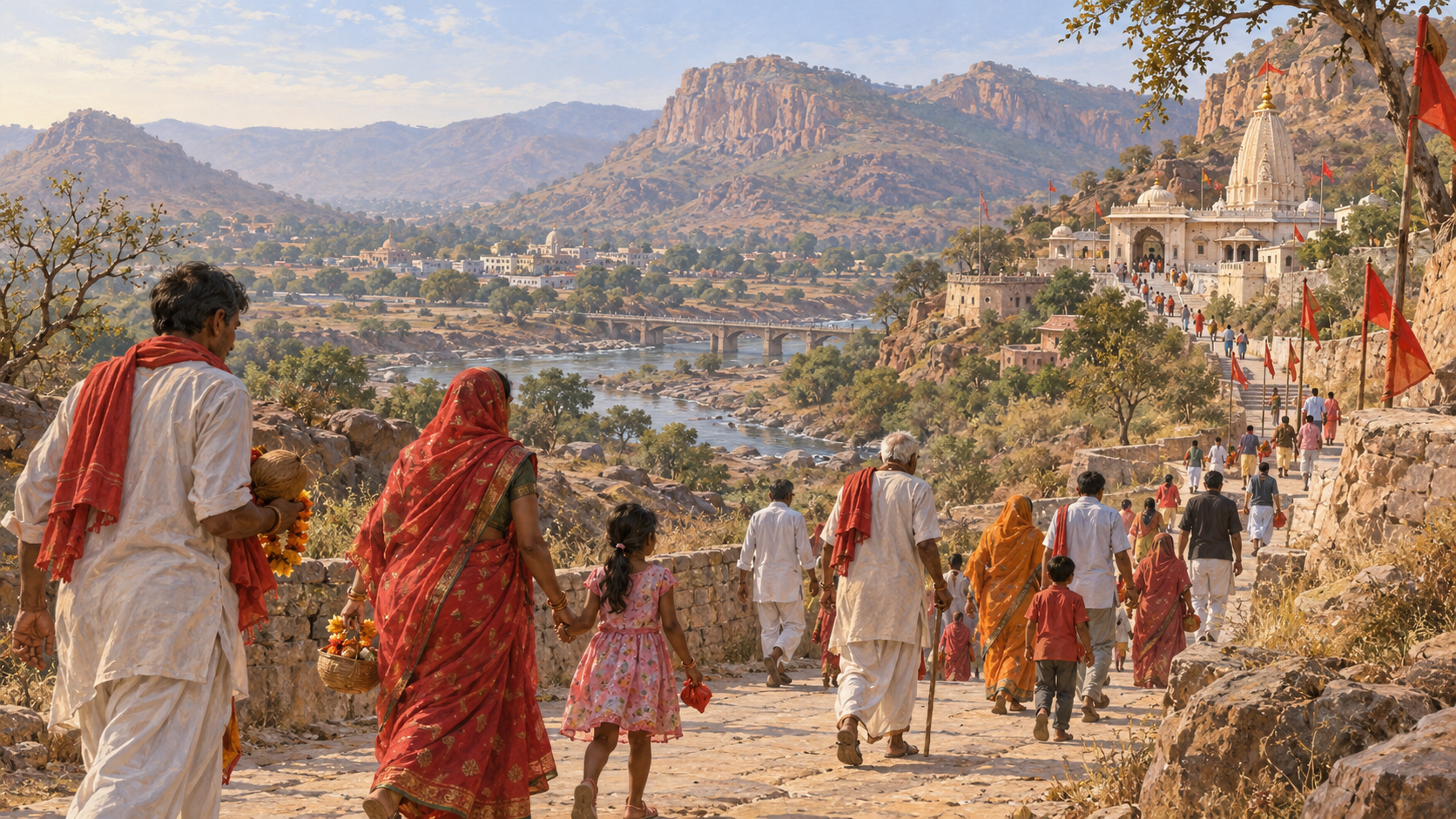
Kaila Devi Temple stands in Kailadevi village in Rajasthan, where Kaila Mata is revered as a form of Parvati. The local name, place, and devotional memory belong together. Calling her only “another form of Parvati” may be broadly intelligible, but it leaves out the relationship through which the community knows her.
Devotees approach Kaila Devi seeking release from the influence described as Kali Purusha, while purification from sin, health, and prosperity are among the hopes associated with her grace. These are devotional claims, not mechanical guarantees. A pilgrimage should deepen responsibility and moral clarity, not become a transaction in which an offering is expected to purchase a result.
Before visiting a temple associated with a regional form of Devi, find out:
- the exact name by which the Devi is addressed there;
- the local katha and the qualities devotees especially remember;
- the customary order of darshan and any rules governing offerings;
- current opening times, access arrangements, and restrictions, confirmed through the temple or reliable local guidance;
- whether your family’s practice requires preparation that a general visitor would not know.
Do not assume that an offering or procedure seen at one Devi temple belongs at another. Local discipline is not an obstacle to personal devotion. It is part of receiving the sacred place on its own terms.
Use a five-step method to choose your next devotional step
If you feel pulled toward many forms and places at once, narrow the decision deliberately:
- Write your intention in one sentence. “I want to understand nourishment as sacred” is clearer than “I want Devi’s blessings.”
- Give inherited relationships first consideration. A family Devi, a trusted teacher’s direction, or a nearby temple where you can practise consistently may be more formative than a distant place chosen for novelty.
- Learn one katha well. Identify the problem it presents, the divine quality it reveals, and the duty it leaves with the devotee.
- Prepare for the actual place. Confirm practical information and local customs instead of relying on assumptions formed at another temple.
- Choose one discipline to continue afterward. For Annapurna, that might be careful treatment and sharing of food. For a temple pilgrimage, it might be preserving the prayer, restraint, or responsibility that brought you there.
This method keeps breadth from turning into superficiality. You do not have to visit every Devi shrine or collect every form before your worship becomes serious. Depth begins when one relationship changes how you live.
It also protects you from two common errors. The first is treating all forms as identical names with no local or theological character. The second is treating each form as a separate provider of a narrowly defined benefit. The more useful question is not, “Which Devi will give me what I want?” It is, “Which quality of the Divine Mother am I being asked to recognise and embody?”
Key takeaways
- Devi’s forms express aspects of Shakti, but each name must be understood through its own katha, place, and devotional relationship.
- Annapurna makes nourishment the centre of attention, so reverence should affect how you receive, use, and share food.
- Kaila Devi demonstrates that a sacred place carries local memory and discipline that should not be flattened into a generic temple experience.
- Health, prosperity, purification, and protection are devotional hopes, not guaranteed exchanges for offerings.
- A pilgrimage becomes durable when you carry one fitting practice back into daily life.
Choose one concrete beginning this week. If Annapurna speaks to your present need, learn her katha and connect the next meal you share with deliberate gratitude. If your family points you toward Kaila Devi or another regional form, record the name and remembered katha, then confirm the temple’s own customs before travelling. One name understood deeply is a better beginning than many names hurried past.
References
- Hindu Pad — Annapurna Katha | Story of Mata Annapurneshwari
- Hindu Pad — 6 Famous Stories of Devi
- Hindu Pad — Story of Kaila Devi Temple, Karauli, Rajasthan

Leave a Reply
You must be logged in to post a comment.