
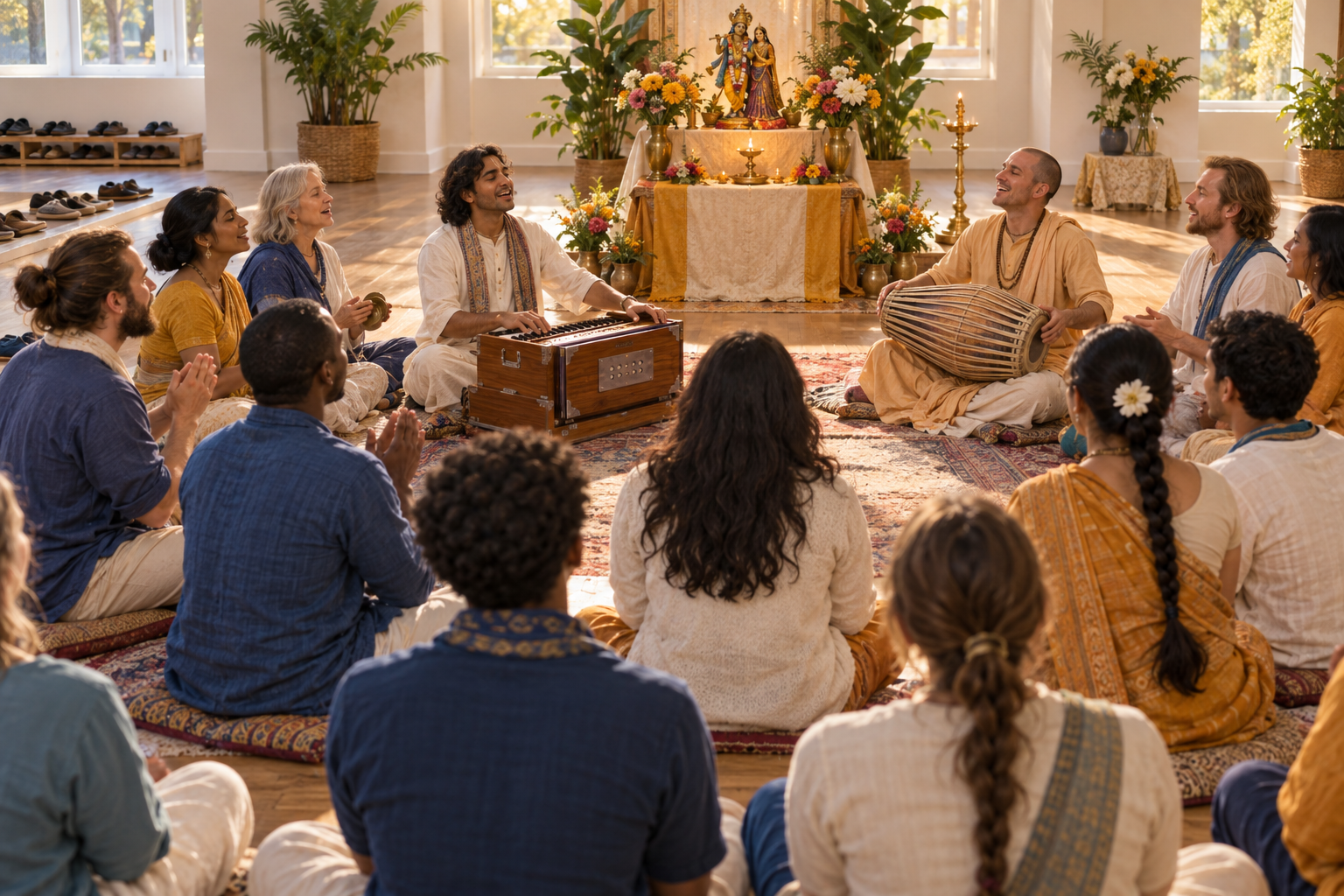
You have been asked to bring kirtan into a yoga gathering, cultural programme, campus event, or open community space. The practical question is not whether devotion may be public. It is how to keep a public setting from turning devotion into a performance, a decorative theme, or material for someone else’s social-media feed.
The answer begins with two disciplines. Kirtan makes devotion audible and participatory. Rūpa—the sacred form or visible focus recognised by the hosting tradition—gives that devotion direction. When sound, form, etiquette, and service reinforce one another, newcomers can enter without the tradition being diluted.
Kirtan opens the circle; rūpa gives it a centre
Kirtan is collective remembrance through sacred names, mantras, or verses. In its familiar call-and-response form, a leader offers a phrase and the gathering answers. That structure matters: the leader is not meant to monopolise the sacred sound but to make participation possible.
Rūpa means form. In a devotional setting, it can refer to the visible form toward which reverence is directed: a murti or vigraha, an image, an altar arrangement, or another focus recognised by that community. The term must not be flattened into a universal formula. Dharmic traditions—and different sampradayas within Hindu dharma—do not understand or employ sacred form in identical ways.
Sound travels across the room; form gathers attention at its centre. Kirtan can invite a hesitant visitor to answer one line without pretending to possess knowledge they do not have. A properly tended sacred form reminds musicians and participants that the gathering is oriented toward the Divine, not toward the charisma of the person holding the microphone.
This relationship becomes especially important outside a temple. A live kirtan at the World Yoga Festival in Henley-on-Thames places sacred sound in a setting where many people may encounter it as yoga culture, music, or a first doorway into bhakti. A third day of Rupotsava devoted to an outpouring of devotion reflects a different setting: an extended observance whose participants may already understand its devotional vocabulary. The same external format should not simply be copied from one setting into the other.
Before planning anything, ask one clarifying question: what is this gathering helping people remember? If the honest answer is a performer, a brand, or an impressive spectacle, the centre has shifted. If the answer is the Divine, the sacred name, the teaching, or the devotional relationship honoured by the tradition, the public expression has a sound foundation.
Prepare the public space before the first note

A sincere intention cannot compensate for a careless room. Most avoidable problems arise before the kirtan starts: no one has decided how the sacred form will be treated, who may record, how a newcomer will learn the response, or who is responsible for the close. Use this sequence before opening the doors.
- Write a one-sentence purpose. For example: “This is a participatory Vaishnava kirtan centred on the sacred names.” That sentence should guide the introduction, room arrangement, photography rules, and choice of music.
- Name the tradition plainly. Hospitality does not require disguising a devotional practice as generic wellness. Tell people what they are entering, while making clear that respectful listening is welcome and participation is voluntary.
- Confirm the venue boundaries. Settle sound limits, entry and exit routes, footwear expectations, accessibility, photography, livestreaming, and the placement of food or commercial stalls before the sacred area is arranged.
- Assign two kinds of responsibility. One person leads the devotional sequence; another watches the room. The room steward helps newcomers, protects access routes, manages cameras, and handles practical disruptions without forcing the kirtan leader to abandon the chant.
- Arrange sound for the congregation. Microphones should support the shared voice. Test from the participants’ position, not only from the stage. If people nearest the leader cannot hear the responses around them, amplification has begun to replace participation.
- Place sacred form according to the host tradition. Confirm the appropriate support, height, orientation, offerings, handling, and closing procedure with someone authorised by that community. If no one can explain the protocol, simplify the visual arrangement instead of improvising a ritual.
- Plan the final five actions. Decide who brings the chant to rest, whether silence or prayer follows, how offerings are concluded, how sacred items leave the space, and who cleans the area. An abrupt switch from mantra to announcements or sales weakens the devotional frame.
Keep commercial displays, rubbish points, tangled cables, and casual storage outside the sacred visual field. This is not about creating an expensive stage. A simple, clean arrangement with clear purpose is more coherent than elaborate decoration whose objects no one knows how to honour.
Lead kirtan so newcomers can actually participate
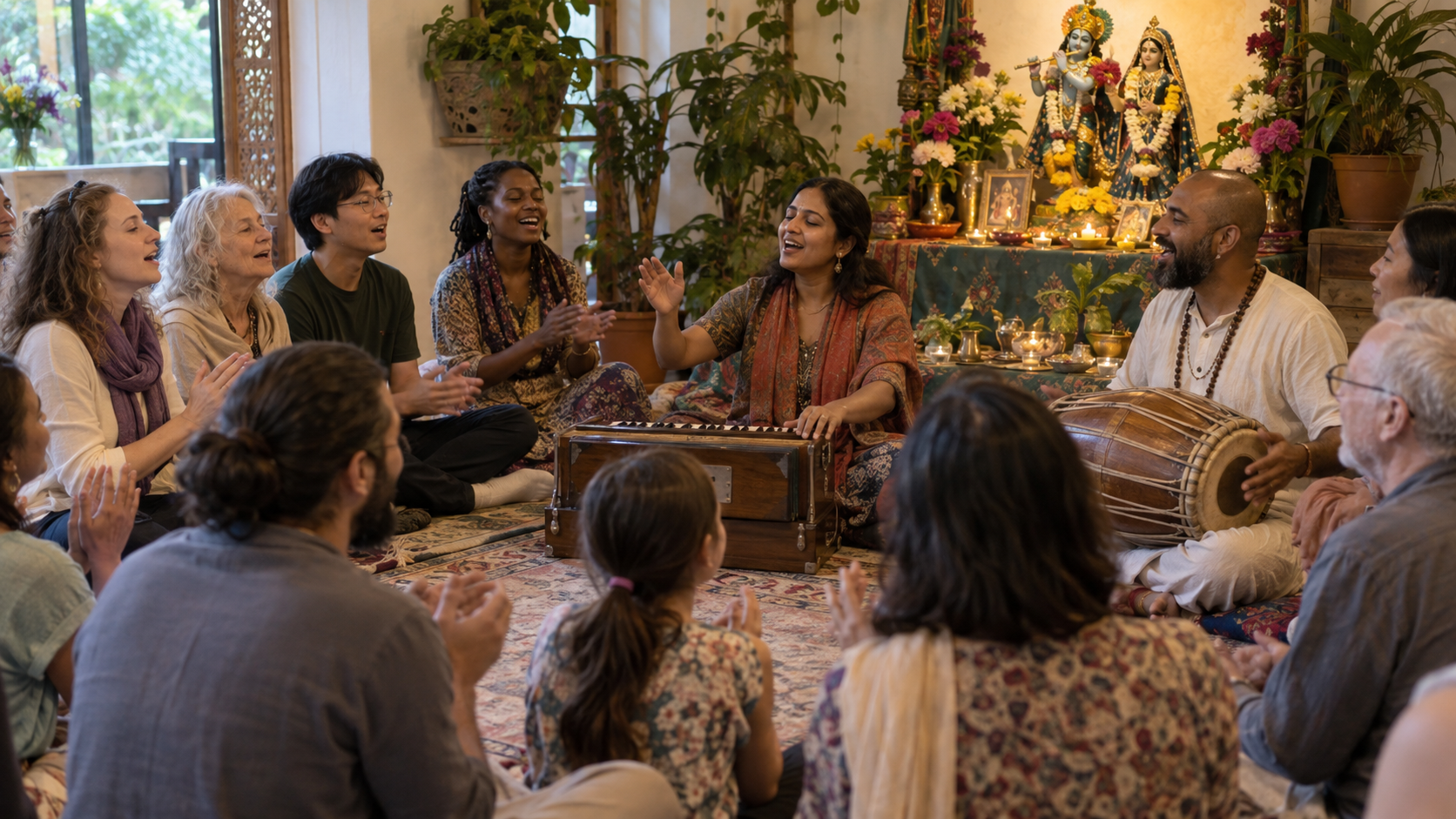
The musical skill needed to impress an audience is not identical to the devotional skill needed to carry a congregation. A public kirtan leader has to listen in both directions: toward the sacred name being sung and toward the people trying to answer.
- Teach the response by singing it. Begin with the simplest refrain and repeat it consistently. A short spoken introduction can name the mantra and explain the call-and-response pattern; a lecture before the first note is rarely necessary.
- Let the group complete its answer. Do not sing over the response or change the melody just as people learn it. Musical variation should deepen attention, not continually reset the congregation’s confidence.
- Keep instruments beneath the shared voice. Percussion and accompaniment should carry the chant without making the words unintelligible. Listen from the middle and back of the room during the sound check.
- Offer participation without demanding display. A person may sing, listen, sit quietly, stand, or refrain from unfamiliar gestures. Do not pressure newcomers to reproduce an emotional intensity or bodily expression they do not yet understand.
- Explain unfamiliar etiquette at the point of need. If a boundary concerns touching sacred objects, approaching an altar, footwear, food, or photography, state it briefly before the relevant moment. Public correction in the middle of worship usually produces embarrassment rather than understanding.
- Notice when the room becomes an audience. If most people have stopped responding and are watching the leader, return to a familiar phrase, reduce musical complexity, and leave more space for the answer.
A newcomer should not need insider knowledge to identify their part. The invitation can be precise: “We will sing one line, and you may repeat it.” That is more useful than asking everyone to “feel the energy,” because it gives the person a real devotional action rather than prescribing an emotion.
The leader’s visibility also requires discipline. Avoid turning every pause into personal commentary. Introduce only what helps people chant with understanding: the name or mantra, its place in the tradition, the response pattern, and any essential etiquette. The sacred sound should remain the gathering’s centre of gravity.
Keep sacred form from becoming stage décor
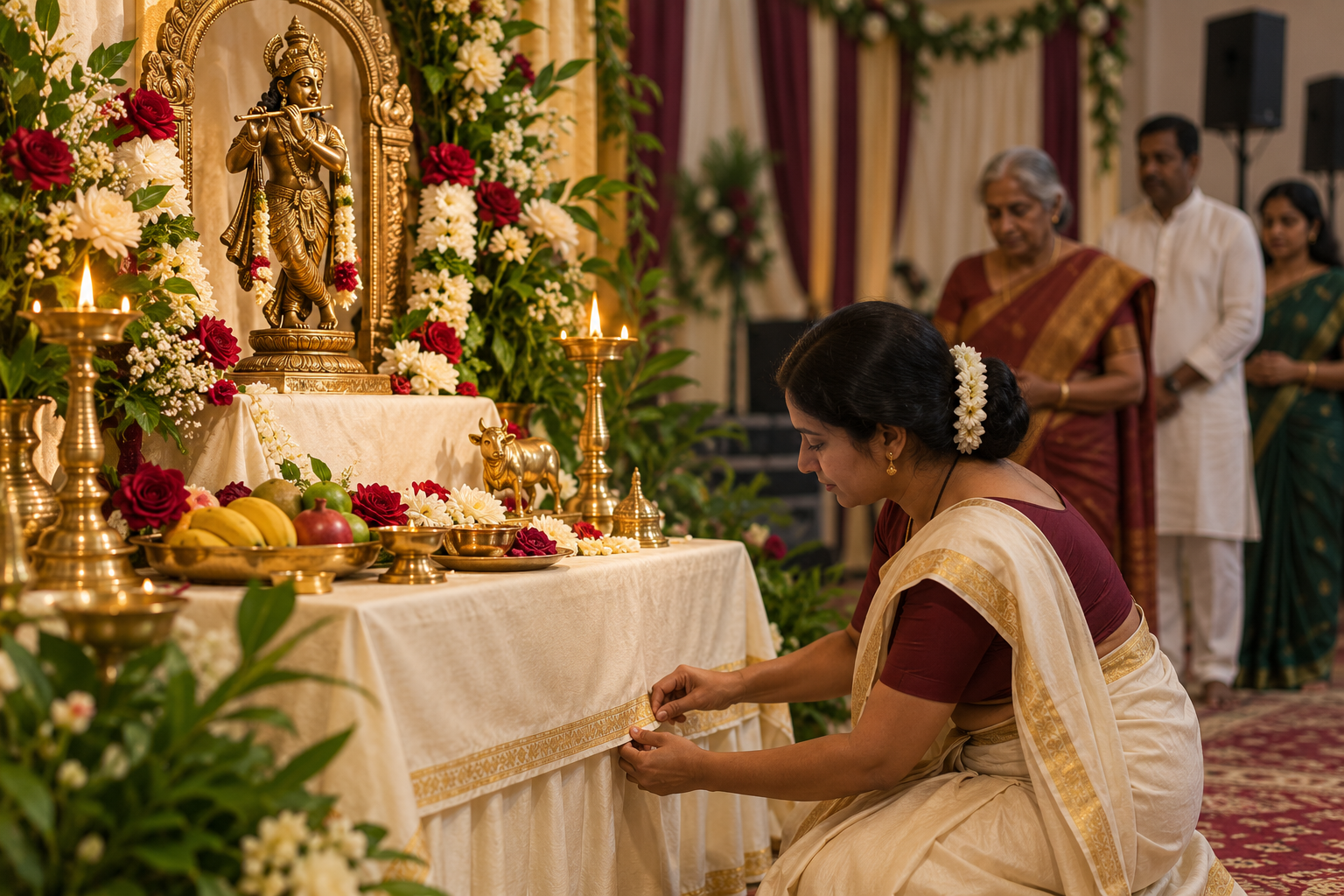
A sacred form is not a visual shortcut for making an event look “spiritual.” Some communities approach a consecrated form as divine presence; others use images according to different theological rules or avoid them. The responsible question is therefore not “What will look good behind the musicians?” but “What form does this community recognise, and what duties follow from placing it here?”
Use five checks before including rūpa in a public gathering.
- Meaning: someone responsible can explain what or whom the form represents without inventing a vague universal story.
- Authorisation: the hosting community accepts its use in this setting, including any offerings, decorations, processions, or acts of reverence planned around it.
- Care: a named steward remains responsible for placement, cleanliness, protection, and removal. Sacred objects should not be left unattended with general stage equipment.
- Visual priority: screens, speakers, sponsor logos, camera tripods, and performers do not obscure or visually consume the devotional focus.
- Completion: the form and any offerings are treated appropriately after the public programme. Reverence does not end when the audience leaves.
Photography deserves a separate decision. Permission from a venue does not automatically settle devotional consent. State whether recording is allowed, whether particular rites or sacred forms should not be photographed, and where cameras may stand. A camera operator should never block a participant’s view, cross the sacred area for a better angle, or prompt worshippers to repeat a gesture for footage.
You can also diagnose misplaced emphasis by looking at the images the event produces. If every photograph centres the performer while the sacred focus survives only as background decoration, reconsider the layout and camera brief. If branding surrounds the altar or sacred form, move it. If volunteers know how to assemble the display but not how to close it respectfully, the plan is incomplete.
Respect need not become hostility. A room steward can redirect a visitor quietly, explain why a boundary exists, and offer an acceptable alternative. The aim is to protect the practice while helping a person learn, not to test whether a newcomer already behaves like an initiate.
Key takeaways
- Kirtan remains devotional when the leader makes the sacred response easier to join than the performance is to watch.
- Rūpa should be included only when the hosting community can identify its meaning and accept responsibility for its care.
- A public venue changes logistics, not the origin of the practice. Name the tradition clearly instead of presenting bhakti as anonymous wellness.
- Photography, amplification, branding, and stage design are not neutral once they redirect attention away from the devotional centre.
- Newcomers need a clear invitation, voluntary participation, and discreet guidance—not pressure to display an emotion or imitate unfamiliar conduct.
- The close is part of the worship. Plan how the chant settles, how offerings conclude, how sacred items are removed, and how the space is restored.
Before your next public gathering, write the purpose sentence, appoint the devotional lead and room steward, agree on the recording boundary, and rehearse the simplest response with the actual sound system. Those four actions will reveal most weaknesses while there is still time to correct them—and leave the gathering free to do what it came to do: turn public attention toward devotion.
References
- Dandavats — Hare Krishna — Radhika Das — LIVE Kirtan at World Yoga Festival’26, Henley-on-Thames, U.K
- Dandavats — HG Prasanta Devi Dasi | Rupotsava Day 3 | Outpourings of Devotion

Leave a Reply
You must be logged in to post a comment.