
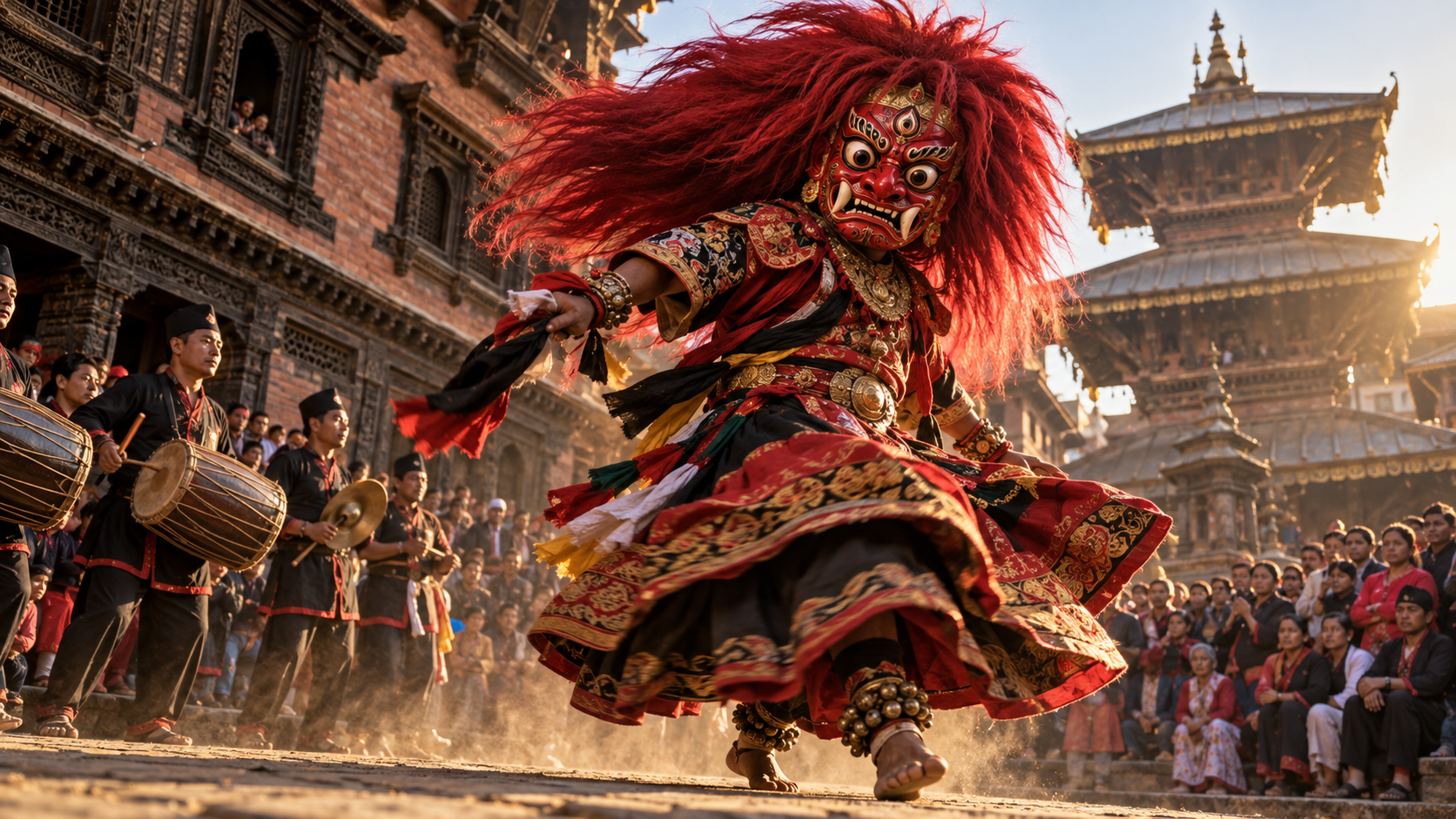
If you have seen Majipa Lakhey’s frightening mask and wild red hair, your first question may be the obvious one: why would Kathmandu celebrate a demon? The useful answer begins by refusing to turn him into either a simple villain or a harmless mascot.
Majipa Lakhey matters because the tradition holds danger and protection together. His fearsome power is not forgotten when he becomes a guardian. It is the reason his guardianship carries weight.
Keep both halves of his identity in view
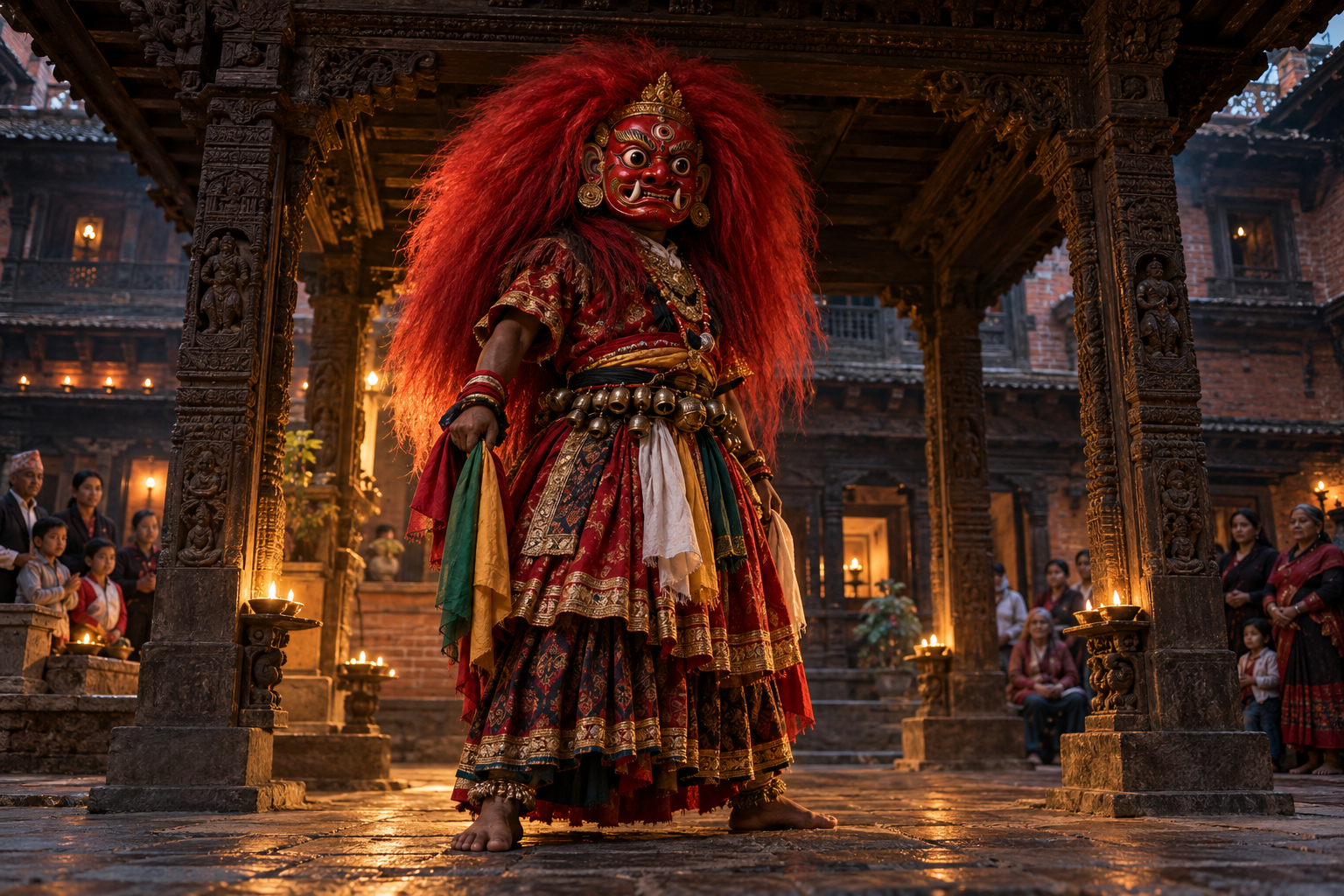
The fastest way to misunderstand Majipa Lakhey is to let the English word “demon” settle the question. In ordinary English, a demon is often assumed to be wholly evil. A being placed in that category can only be opposed, expelled or destroyed. Majipa Lakhey does not fit that narrow moral box: he is remembered as a demon who became a guardian.
That does not mean “demon” should simply be replaced with “good spirit.” Doing so removes the very tension that makes the figure intelligible. Lakhey remains fearsome. The mask, hair and forceful dance do not pretend that his dangerous character has vanished.
A careful description therefore preserves both claims: Majipa Lakhey is a formidable Lakhey figure, and his power has been drawn into the protection of a community. If you retain the English label, treat it as shorthand for a dangerous being, not as a complete verdict on his moral nature.
This distinction also prevents an easy cultural mistake. You do not need to force Lakhey into a good-versus-evil framework imported from elsewhere before you can understand him. Begin with the form in which Kathmandu remembers him: terror has not been denied, but it has been given a protective place.
Read the dance, not just the mask
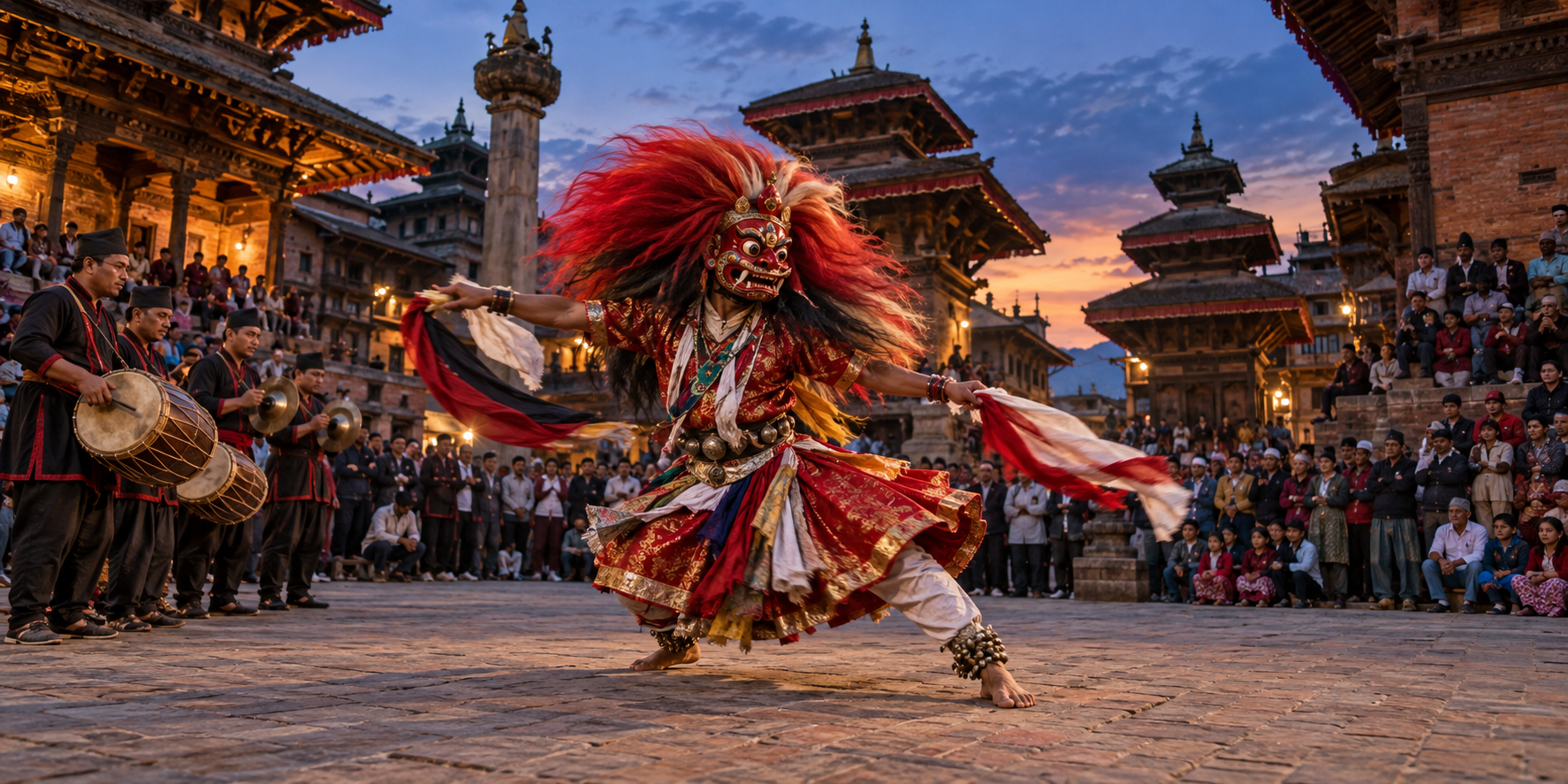
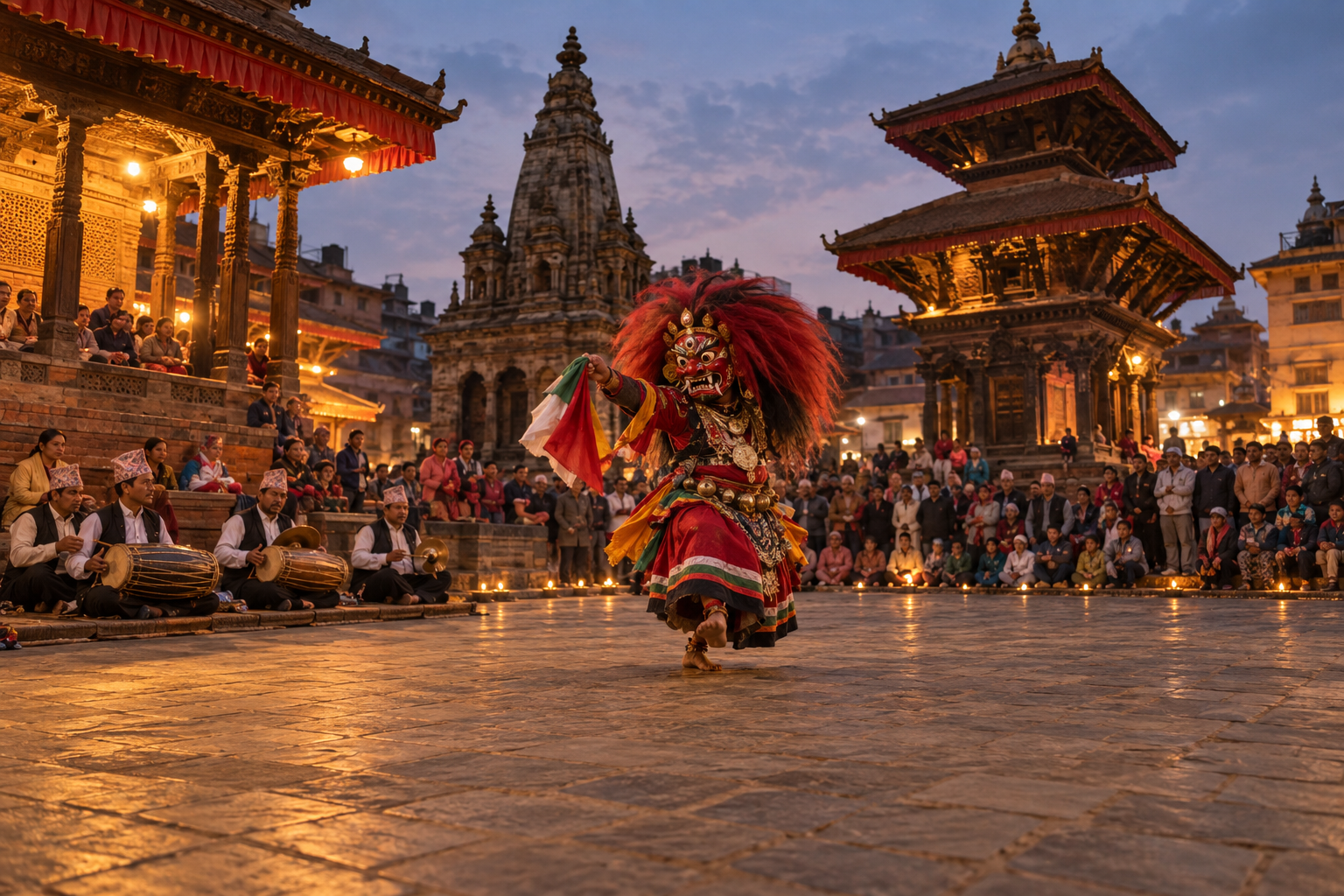
A still photograph gives you the most dramatic feature and removes nearly everything needed to interpret it. Majipa Lakhey belongs to a sensory festival setting. During Indra Jatra, also identified with Yanyaa Punhi, he appears amid drums, incense and a fierce stomping dance.
When you watch the performance, notice how its elements work together:
- The frightening mask makes danger visible. Its purpose is not to make Lakhey pleasant or decorative.
- The wild red hair enlarges the figure and resists any impression of controlled, courtly calm.
- The stomping dance gives force a body. Lakhey is encountered as movement and impact, not merely as a character in a narrated tale.
- The drums and incense place that force within a communal and sacred occasion. They tell you that you are seeing more than theatrical horror.
This gives you a practical rule: never interpret Majipa Lakhey from facial appearance alone. Ask where the figure appears, when the community brings him forth, what sounds accompany him and what role the tradition assigns him. Context does not soften the fearsome image; it tells you what that image is doing.
Calling the mask a “costume” can be technically convenient, but it is interpretively incomplete. A costume may be judged as an isolated object. Majipa Lakhey has to be read through mask, dancer, sound, motion, incense, festival and communal memory together.
The journey from forest to festival is the key
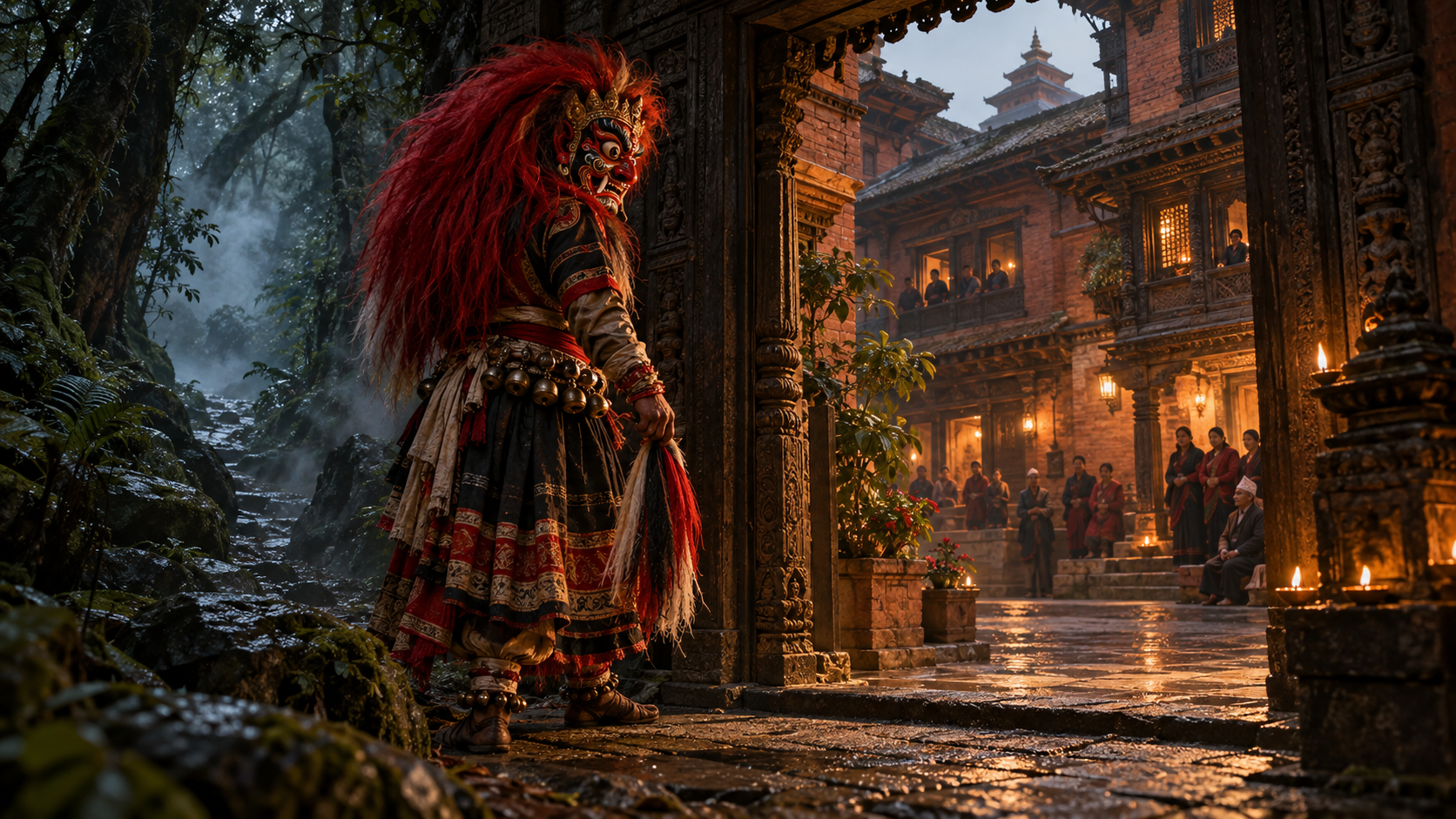
The sacred story moves Majipa Lakhey from the forest into the festival. Even before you add further details of the legend, that movement gives you a reliable way to understand the transformation.
The forest marks a power beyond the settled community. The festival is a shared, recurring space in which the community presents its order, relationships and sacred memory. Moving from one to the other does not require Lakhey to lose his wildness. It means that wildness is no longer merely outside.
This is why “taming” can be a misleading word if it makes you imagine that Lakhey becomes weak, cute or inconsequential. The visible figure says otherwise. His hair remains wild, his face remains terrifying and his dance remains forceful. What changes is not the existence of power but its relationship to the people around it.
Guardianhood, in this sense, is incorporation without erasure. The community does not protect itself by pretending fierce power is unreal. It remembers that such power can be turned toward a protective role. That interpretation accounts for both sides of the tradition without forcing one to cancel the other.
It also explains why annual performance matters. A guardian confined to an old tale would remain an idea. Majipa Lakhey’s return during the festival makes the transformed relationship publicly visible again. Story becomes movement; memory becomes presence.
How to encounter Majipa Lakhey respectfully
Whether you meet Majipa Lakhey in Kathmandu, in a recording or through an image shared online, a few disciplined habits will keep the encounter from becoming cultural spectacle.
- Name the figure and setting precisely. Use “Majipa Lakhey,” “Kathmandu Valley” and “Indra Jatra/Yanyaa Punhi” rather than reducing the event to a generic demon dance.
- Watch beyond the most frightening frame. Pay attention to the stomping, drums, incense and festival setting. Those elements carry meaning that a cropped image cannot.
- State the central tension before offering an interpretation. He is fearsome and he is a guardian. If an explanation cannot preserve both facts, it is probably flattening the tradition.
- Keep the legend distinct from your symbolism. The movement from forest to festival supports a reading of dangerous power entering a protective relationship with the community. Broader claims about anger, psychology or every Dharmic tradition are interpretations, not details you should quietly insert into the story.
- If you attend the festival, follow local directions about movement, access and photography. A living sacred celebration is not arranged as a private photo set, and respect begins with the community’s conduct rather than a visitor’s desire for the closest image.
If you need one accurate sentence to explain what you saw, use this: Majipa Lakhey is Kathmandu’s fearsome Lakhey figure whose transformation from a dangerous presence into a guardian is renewed through festival performance.
Then return to the dance. Notice that the tradition has not made the guardian convincing by hiding his ferocity. It has made his ferocity answer to a protective role. That is the detail worth carrying forward when you next see the red hair, the mask and the stamping feet.
Key takeaways
- Majipa Lakhey cannot be understood as only a monster or only a benign mascot; his identity depends on the tension between danger and guardianship.
- The English word “demon” is a starting label, not a complete moral explanation.
- The mask must be read with the dance, drums, incense and Indra Jatra/Yanyaa Punhi setting.
- The movement from forest to festival shows fierce power entering a communal, protective relationship without losing its wild appearance.
- The most respectful interpretation names the local figure precisely and separates documented tradition from personal symbolism.
References

Leave a Reply
You must be logged in to post a comment.