
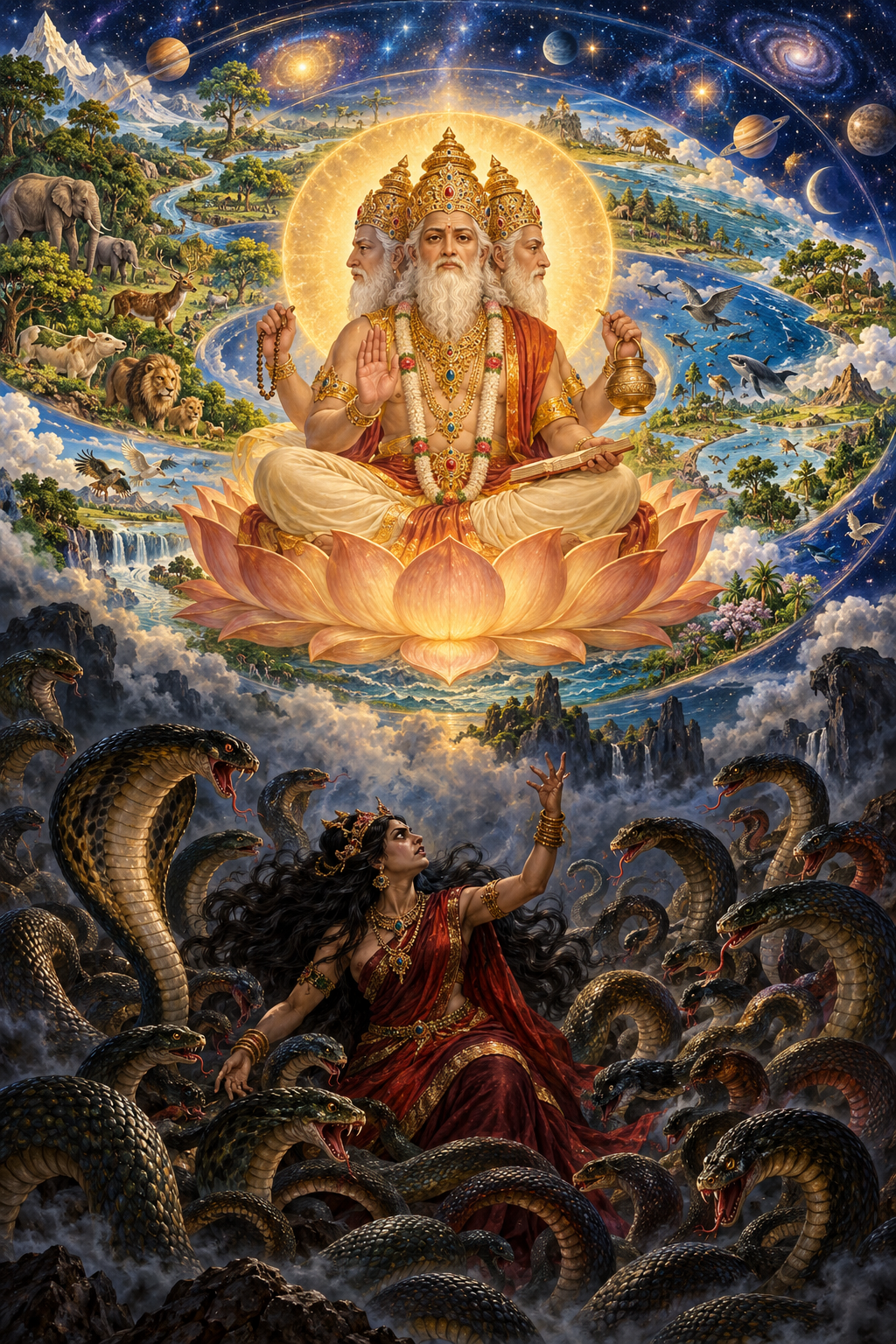
If Brahma protects creation, why would he permit Kadru to curse her own sons with death in a future snake sacrifice? If that troubles you, begin with the discomfort. The Mahabharata is not asking you to treat a mother’s anger as righteous merely because her words acquire cosmic force.
The episode makes a harder distinction. Kadru remains responsible for deceit, coercion and wrath. Brahma considers a separate question: whether the consequence she unleashed can restrain beings whose conduct has become dangerous to the rest of creation. His acceptance concerns cosmic balance, not the innocence of Kadru’s motive.
Start with the wager, because Kadru’s motive matters

Kadru and Vinata are sisters and wives of Sage Kashyapa. Their dispute concerns Ucchaihshrava, the extraordinary horse that emerged during the churning of the ocean. Vinata says its tail is white; Kadru says it is black. They agree that whoever loses will become the other’s servant.
Kadru does not trust truth to decide the wager. She orders her serpent sons to cling to the horse’s white tail and make it appear black. When some refuse to participate in the deception, she curses them to perish in King Janamejaya’s future serpent sacrifice. The obedient sons disguise the tail, Vinata loses, and Kadru gains mastery through a manufactured appearance. This chain of events – a wager, an attempted fraud, a refusal and a curse – must remain intact if you want to understand Brahma’s response.
The refusing sons are not condemned because dishonesty suddenly becomes filial duty. Their refusal exposes the moral disorder already present in Kadru’s demand. She wants obedience even when obedience requires falsehood, and she turns maternal authority into a weapon when conscience resists her.
That gives you the first interpretive guardrail: never read Brahma’s later acceptance backward as approval of Kadru’s wager, lie or rage. A consequence can be incorporated into cosmic order without making the person who initiated it morally pure.
Brahma judges the danger to creation, not Kadru’s temper

Brahma sees the episode from the standpoint of creation as a whole. In the Mahabharata’s account, the serpent beings have multiplied, possess deadly venom and have become a source of indiscriminate harm. Preserving creation therefore cannot mean preserving every life in every circumstance while ignoring what that life does to others. Protection also requires limits on destructive excess.
This is the cosmic rationale behind allowing the curse to stand. The future sacrifice will become an instrument through which dangerous excess is checked. Brahma does not invent Kadru’s fraud, command her anger or announce that every serpent deserves destruction. He recognises that the curse can operate within a larger correction required by the condition of the world.
Three levels of responsibility are working at once:
- Kadru’s intention: she wants victory, servitude and obedience. Her curse arises from anger when some sons will not help her deceive Vinata.
- The sons’ moral choice: refusing a wrongful command is not made wrongful merely because the command comes from a parent.
- Brahma’s cosmic judgement: he evaluates the accumulated danger posed to other beings and allows the curse to become part of a corrective process.
Keeping these levels separate prevents two common mistakes. The first is to conclude that Brahma endorses whatever Kadru does. The second is to conclude that any good emerging from the curse erases her responsibility. Neither conclusion follows. Dharmic causality is large enough to turn a wrongful impulse toward a necessary limit, yet precise enough to leave the original wrongdoing attached to its doer.
This is not a simple claim that the end justifies the means. Kadru does not possess Brahma’s vision, and her purpose is not the welfare of creation. The cosmic use of her curse belongs to Brahma’s judgement; the deceitful use of her freedom belongs to her.
The sacrifice is limited, so correction does not become annihilation

The wider Astika narrative supplies an essential boundary. Janamejaya’s serpent sacrifice does not continue until every naga is gone. Astika intervenes, the king stops the rite, and the serpent lineage survives. The epic therefore does not resolve dangerous excess through limitless extermination.
That ending clarifies what cosmic balance means here. The world is not asked to tolerate indiscriminate killing by powerful beings. It is also not purified by erasing an entire order of life. Harm is restrained, the destructive process is stopped, and continued existence remains possible.
You should also resist turning the story into a crude statement about ordinary snakes. The nagas of the epic are a lineage of serpent beings within a sacred narrative. The episode is concerned with power, venom, conduct, consequence and cosmic order. It is not practical permission to destroy wildlife, and it certainly cannot be transferred to human communities as a defence of collective punishment.
The stopping point matters because a response may begin as protection and end as vengeance. Once Janamejaya’s rite threatens to become all-consuming, Astika’s intervention restores a boundary. Dharma appears not only in the power to impose a consequence but also in the wisdom to say, “Enough.”
Use five questions before calling a punishment dharmic
You are not being invited to imitate Brahma’s cosmic authority. Human beings act with partial knowledge, mixed motives and limited foresight. The useful lesson lies closer to home: test a proposed punishment before anger dresses itself in the language of justice.
- Am I defending truth or manufacturing an appearance? Kadru’s demand begins with making a white tail look black. If your desired outcome depends on concealing facts, pressuring witnesses or changing the appearance of events, stop there. The process is already adharma.
- Am I responding to real harm or merely to disobedience? Kadru treats refusal as an offence because her sons will not serve her will. Before imposing a consequence, name the actual harm. “They did not obey me” is not the same as “they endangered someone.”
- Does the consequence fit the act? A curse of death for refusing deceit is radically disproportionate at the family level. Do not borrow Brahma’s later cosmic rationale to excuse Kadru’s immediate excess. Judge your own response by the knowledge and authority you actually possess.
- Who will suffer besides the wrongdoer? Kadru’s deception enslaves Vinata, while the curse reaches into a future generation and a future king’s ritual. Trace the secondary effects before you act. If innocent or uninvolved people will bear the cost, redesign the response.
- What will stop the correction? Astika’s intervention shows why a limiting condition is indispensable. Decide in advance what restitution, changed conduct or fulfilled condition will end the penalty. A punishment with no route back easily becomes revenge.
This test is especially useful wherever authority can be mistaken for moral infallibility: within a family, a religious institution, a community or a government. Respect for a legitimate role does not require cooperation with falsehood. At the same time, resistance to a wrongful command does not free anyone to answer one excess with another.
Brahma’s position should make us humbler, not more eager to punish. Cosmic governance may draw order from tangled causes because it comprehends connections that individuals cannot see. Our duty is narrower and more demanding: tell the truth, examine our motive, protect those at risk, keep consequences proportionate and preserve a stopping point.
Key takeaways
- Brahma’s acceptance of Kadru’s curse does not validate her attempted fraud or her anger toward sons who refused to assist it.
- The cosmic rationale concerns protection of creation from destructive excess, not the absolute authority of a mother over conscience.
- The later intervention of Astika prevents correction from becoming total annihilation.
- The episode distinguishes personal motive from the wider consequence that cosmic order may draw from an action.
- For human decision-making, the safe lesson is to test truth, actual harm, proportionality, effects on others and the point at which punishment must end.
When someone invokes duty, loyalty or a greater good to demand your cooperation, look first for Kadru’s hidden tail: are you being asked to uphold truth, or merely to make a preferred claim appear true? That distinction is where your practical reading of this episode should begin.
References

Leave a Reply
You must be logged in to post a comment.